Category: Business

  • Ethereum Foundation Stakes More ETH, Boosting Total to $50 Million

    Ethereum Foundation Stakes More ETH, Boosting Total to $50 Million

    In brief

    • The Ethereum Foundation staked more than $46 million worth of ETH on Monday.
    • The move is the organization’s second staking action, with nearly $50 million staked in total.
    • The initiative is part of its new treasury plan designed to “enhance financial sustainability.”

    The Ethereum Foundation staked another 22,517 ETH, or $46.2 million worth, as part of its previously announced staking initiative, according to on-chain data curated by blockchain analytics firm Arkham Intelligence. 

    The latest batch was staked in 11 distinct transactions, with 2,047 ETH or around $4.2 million worth staked each time. In total, the firm has now staked 24,623 ETH, valued around $50 million, since it began proactively implementing staking as part of a revamped treasury strategy unveiled last June

    As part of that newly established strategy, the organization promised to more frequently utilize staking and DeFi protocols to “enhance financial sustainability and to support a key application category that is delivering on the promise of permissionless secure access to base civilizational infrastructure.” 

    Staking refers to the act of locking up tokens to help validate Ethereum’s proof-of-stake network, and provides back ETH token rewards in the form of yield to those who do so. Approximately $78 billion worth of ETH is currently staked in the network.

    The Ethereum Foundation intends to ultimately stake around 70,000 ETH, or $142 million worth of the second largest crypto asset, with all the rewards flowing back to the Foundation. Based on data from Arkham, the Foundation holds around 147,000 ETH at present time, with a portfolio valued at more than $364 million in total. 

    The organization’s on-chain activity comes amid its funding of the Ethereum Economic Zone (EEZ), a new framework designed to better align infrastructure and stakeholders within the Ethereum ecosystem. 

    Proposed by Gnosis and Zisk, the “economic zone” aims to address barriers and limitations currently present for Ethereum’s layer-2 scaling networks. For example, under the EEZ framework, layer-2s can operate in shared environments, avoiding duplicative work while removing some of the isolation that layer-2 networks may have from Ethereum mainnet. 

    The EEZ’s introduction comes shortly after Ethereum co-founder Vitalik Buterin pressed the importance of a “new path” for the layer-2 network roadmap, asking for scaling networks to act less like “extensions” of Ethereum mainnet. 

    Buterin has not yet publicly commented on the Ethereum Economic Zone, but he did re-post the introductory announcement from the EEZ on X—a potential sign of endorsement. 

    A representative for the Ethereum Foundation did not immediately respond to Decrypt’s request for comment.

    Daily Debrief Newsletter

    Start every day with the top news stories right now, plus original features, a podcast, videos and more.


  • Galaxy Digital Analyst Alex Thorn: “There’s a Hidden Reason Why Banks Are Stopping Bitcoin and Cryptocurrencies”

    Galaxy Digital Analyst Alex Thorn: “There’s a Hidden Reason Why Banks Are Stopping Bitcoin and Cryptocurrencies”

    The cryptocurrency world is discussing not so much Bitcoin’s price movements, but rather the intriguing paradox between institutional adoption and regulatory pressures.

    Appearing on The Wolf Of All Streets, Alex Thorn stated that global banks are facing the “Innovator’s Dilemma,” suggesting they are conducting a strategic “delay” operation.

    According to Thorn, giant institutions like JPMorgan and Morgan Stanley are simultaneously establishing their own crypto custody services and blockchain-based payment systems, while also creating legal obstacles to stifle the industry through their lobbyists in Washington.

    Thorn summarizes the situation with these words: “Banks are currently both building things and obstructing the process through their lobbyists. This is actually a clever strategy: They are slowing down innovation and buying time to integrate their own products before advanced technologies displace them.”

    Related News BREAKING: Fed Chair Jerome Powell Is Making Hot Statements

    Thorn notes that despite Bitcoin being in the $70,000 range, there is a “bear market feeling” in the market, attributing this to the complacency that comes with success.

    Thorn says that individual investors are disappointed, while institutions are quietly and steadily continuing to enter the market, noting that the gap between these two groups has widened more than ever before.

    Thorn predicts that the biggest future surge may come not from politicians, but from “Autonomous Agents.” Citing research, Thorn notes that autonomous AI tools tend to prefer stablecoins for payments and Bitcoin for savings and value preservation.

    Thorn argues that AI could become one of the biggest players in the Bitcoin economy, saying, “It’s very easy to explain to a rational machine why it should prefer a currency that cannot be seized and that has no sovereignty.”

    *This is not investment advice.

  • Bitcoin Exchange Upbit Announces New Listing and Update! Here Are the Details

    South Korea-based cryptocurrency exchange Upbit has announced the addition of two new digital assets to its platform and a partial change to its listing schedule.

    According to the announcement, Sky Protocol ($SKY) and USDS will be made available to users with KRW and USDT trading pairs.

    The exchange announced an update to the planned trading start time, particularly for USDS. Previously announced for March 31, 2026 at 12:00 PM, the opening time has been postponed to 1:00 PM. For $SKY, the planned start time for trading is 12:00 PM on the same day.

    It was emphasized that both assets operate on the Ethereum network, and users were reminded to select the correct network when making deposits and withdrawals. It was also stated that transaction start times may be delayed if sufficient liquidity is not available.

    Upbit also announced that some trading restrictions will be implemented initially for newly listed assets. Accordingly, measures such as short-term buy restrictions after trading opens, limitations on low-priced sell orders, and the acceptance of only limit orders for a certain period will be put into effect.

    Sky Protocol stands out as a decentralized lending platform where users can generate USDS by providing collateral, while USDS is designed as a stablecoin pegged to the US dollar. The project reportedly uses various algorithmic mechanisms to ensure price stability.

    This development shows that new project listings continue unabated in the Asian market.

    *This is not investment advice.

  • Strategy’s Latest SEC Filing Shows No Bitcoin Purchases or Share Sales During Quiet Week

    Strategy’s Latest SEC Filing Shows No Bitcoin Purchases or Share Sales During Quiet Week

    Strategy reported no bitcoin purchases or equity sales in its latest SEC filing, reinforcing disciplined capital management while maintaining a massive crypto position and spotlighting high-yield, low- volatility instruments within its treasury strategy.

    Strategy Bitcoin Holdings and SEC Filing Activity Pause

    Strategy Inc. filed Form 8-K with the U.S. Securities and Exchange Commission (SEC) on March 30, 2026, reporting no bitcoin purchases and no equity sales last week. The disclosure confirms no activity under its at-the-market program while continuing its regular reporting on treasury movements.

    The filing presents the update as part of ongoing transparency rather than a shift in capital allocation. Strategy stated:

    “On March 30, 2026, Strategy Inc. announced that, during the period between March 23, 2026 and March 29, 2026, Strategy did not sell any shares under its at-the-market offering program and did not purchase any bitcoin.”

    The update reflects the company’s established practice of providing consistent visibility into both equity issuance and digital asset activity.

    Saylor Highlights STRC Performance as Strategy’s Bitcoin Reserves Remain Central to Balance Sheet

    Over the weekend, Executive Chairman Michael Saylor posted on social media platform X, sharing volatility data for STRC rather than the bitcoin-related chart he has previously used in connection with purchase updates. He wrote that STRC recorded lower volatility than all major asset classes and S&P 500 constituents over a 30-day period while delivering an 11.5% dividend yield, with the dataset placing STRC at about 2% volatility compared with bitcoin at 50% and higher levels across equities, commodities, and bond-linked exchange-traded funds.

    Balance sheet figures reinforce the magnitude of the company’s digital asset holdings and cost basis. Strategy noted in its SEC filing:

    “As of March 29, 2026, Strategy holds approximately 762,099 bitcoin that were acquired at an aggregate purchase price of $57.69 billion and an average purchase price of approximately $75,694 per bitcoin, inclusive of fees and expenses.”

    The data illustrates continued reliance on bitcoin as a core treasury asset while maintaining transparency through regular filings.

    FAQ 🧭

    • What did Strategy disclose in its latest SEC Form 8-K filing?
      Strategy reported no bitcoin purchases or equity sales for the specified week.
    • Does the lack of activity signal a change in Strategy’s bitcoin strategy?
      The company indicated the update reflects routine transparency, not a strategic shift.
    • How does STRC compare to bitcoin in terms of volatility and yield?
      STRC shows significantly lower volatility while offering an 11.5% dividend yield.
    • Why does Strategy’s bitcoin position remain important for investors?
      The firm’s large bitcoin holdings continue to anchor its treasury model and market valuation.
  • $SUI, $EDGE, $BEAT Ready to Witness Key Token Unlocks This Week

    $SUI, $EDGE, $BEAT Ready to Witness Key Token Unlocks This Week

    The next week is set to be full of key token unlocks in the crypto market. In this respect, Sui ($SUI), Definitive ($EDGE), and Audiera ($BEAT) are leading the list of the top seven unlocks of the week. As per the data from CryptoRank, the other names on the list take into account Falcon Finance ($FF), Opinion ($OPN), Ethena ($ENA), and EigenCloud 9$EIGEN). These unlocks include both the smaller and large market-cap tokens with likely effects on tokenomics.

    🔓 Top 7 Token Unlocks of the Upcoming Week

    The following tokens with the largest unlock amount will be unlocked next week:$SUI – $47.19M$EDGE – $11.82M$BEAT – $10.53M$FF – $9.66M$OPN – $8.29M$ENA – $8.63M$EIGEN – $6.38M pic.twitter.com/uCdQt0Yo6H

    — CryptoRank.io (@CryptoRank_io) March 30, 2026

    Sui ($SUI) Leads Next Week’s Token Unlocks with $47.19M

    Sui ($SUI) is the 1st among the next week’s crypto token unlocks. Specifically, Sui ($SUI) is poised to unlock a notable 53.40M tokens on the 1st of April. This equals a staggering $47.19M in terms of value. This amount also occupies 1.37% of the project’s market capitalization and 39.0% of its token supply. In addition to this, Definitive ($EDGE) is going to unlock 103.75M tokens on April 2, signifying a total $11.82M worth and 1.37% of its market cap. Additionally, this figure shows 25.5% of the total supply of the project.

    Apart from that, Audiera ($BEAT) has also scheduled an unlock of 21.24M tokens on April 1, occupying an overall $10.53M amount that equals 15.3% of market capitalization. At the same time, the unlocked amount is 22.5% of Audiera’s total token supply. Next name on the list is Falcon Finance ($FF), which is unlocking 136.66M on April 1. The amount totals $9.66M and equals 5.84% of the project’s market cap. Along with that, the respective figure is equivalent to 25.5% of the cumulative token supply.

    CryptoRank’s list of the leading token unlocks to occur next week includes Opinion ($OPN) in the 5th position. The project has scheduled the unlock of a total of 40.42M tokens for April 2, totaling $8.29M. Additionally, these tokens constitute 20.4% of the market capitalization of the project and 19.9% of its supply.

    EigenCloud ($EIGEN) Bottoms List with $6.38M

    Following that, with $8.63M to be unlocked on April 2, Ethena ($ENA) is unveiling 94.18M tokens. So, the project is unlocking 1.11% of market capitalization and 56.8% of total supply. Concluding the list of the next week’s token unlocks is EigenCloud ($EIGEN), which is bringing forth 36.82M tokens on April 1, equaling $6.38M. The respective amounts equal its market cap’s 5.35% and total supply’s 27.1%.

  • Dogecoin at a crossroads: Will DOGE breakout to $0.1 or see another pullback?

    Dogecoin at a crossroads: Will DOGE breakout to $0.1 or see another pullback?

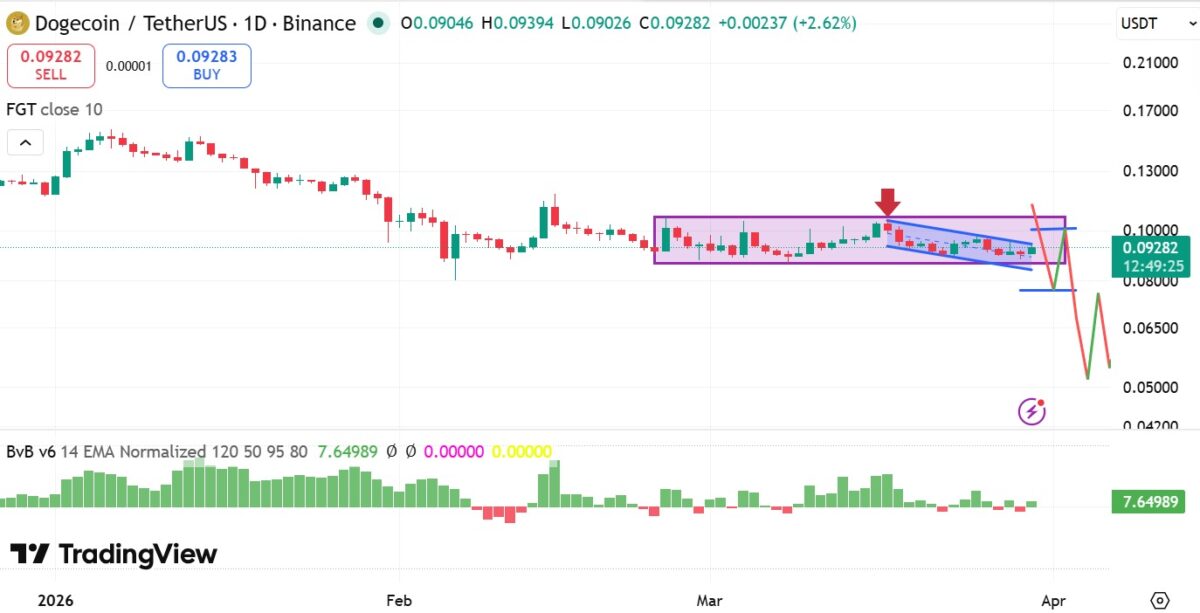
    Amid extended market weakness, memecoin signaled market recovery, making slight gains across the board. With memecoins showing slight upside momentum, Dogecoin [$DOGE] successfully defended $0.09 and then jumped to $0.093 before retracing slightly.

    At press time, $DOGE traded at $0.092, after slightly rising by 1.86% on the daily charts. This price uptick was backed by a 7% increase in trading volume, which exceeded $1 billion, reflecting market momentum.

    Dogecoin: Spot buyers defend key levels

    Dogecoin bulls have attempted to defend and flip $0.09 support over the past few days, with no success. As the market signaled a recovery, bulls jumped in with strength and successfully achieved their goal.

    Source: TradingView

    In fact, the Bulls vs. Bears indicator turned positive again, rising to 6.8 after falling into the negative zone. A rebound here suggested that buyers stepped in and displaced bears.

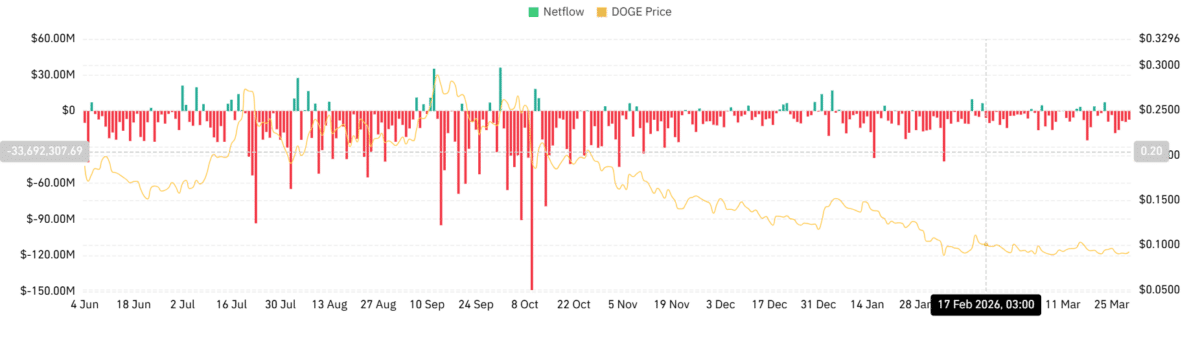
    According to CoinGlass data, $DOGE recorded $82.79 million in Spot outflows compared to $68.64 million in inflows. As a result, the memecoin’s Spot Netflow dropped 148% to -$14.25 million.

    Source: CoinGlass

    Notably, when outflows outpace inflows, it suggests that exchanges recorded more withdrawal orders than deposit orders.

    Such a setup on exchanges reduces the supply available for immediate sale, effectively increasing scarcity and creating perfect conditions to accelerate upside momentum.

    Futures remain overly bearish

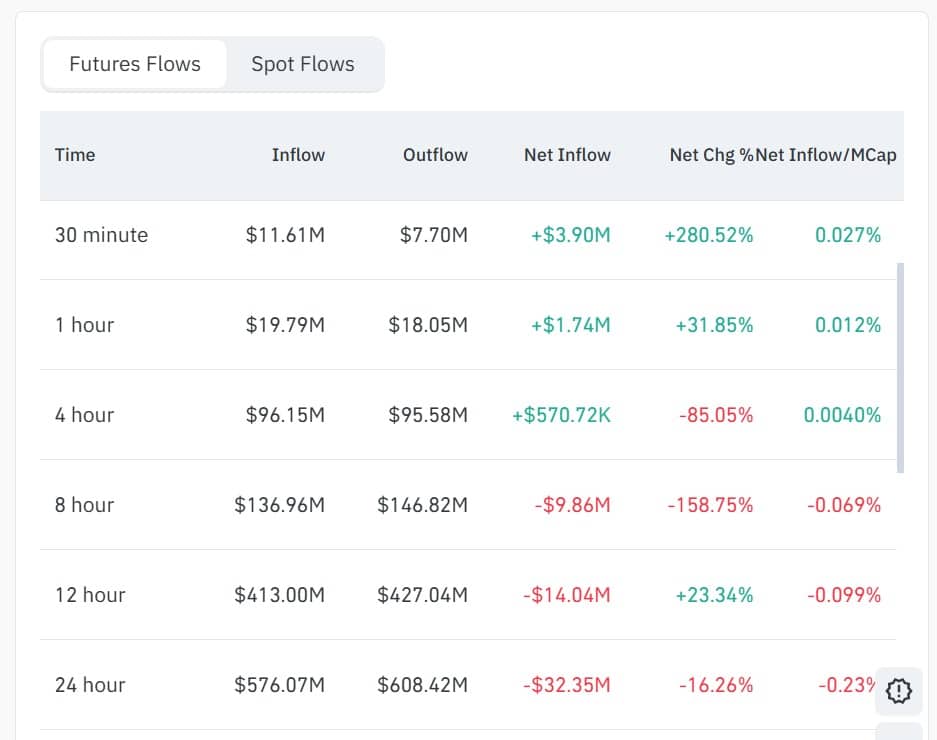
    Although significant capital has flowed into the Spot market, derivatives market participants have continued to reduce their exposure.

    While $DOGE showed slight upside momentum, traders have avoided piling in, especially on the long side. This is due to increased long-position liquidations.

    According to CoinGlass data, over $2.8 million in longs were liquidated. This liquidation rate amplified investors’ fear of taking more long positions.

    Source: CoinGlass

    As such, massive capital flowed into the Futures market, with over $608.4 million in outflows. This suggests that most participants closed their positions, indicating reduced risk appetite.

    Such market conditions have left the Dogecoin market weakened and exposed to potentially more losses on its price charts.

    What’s next for $DOGE?

    Dogecoin is currently at a crossroads, with the Spot market showing greater determination to pull the market out of a slump, while Futures remain bearish. These two conflicting forces expose $DOGE to the fate of whichever side manages to overwhelm the other.

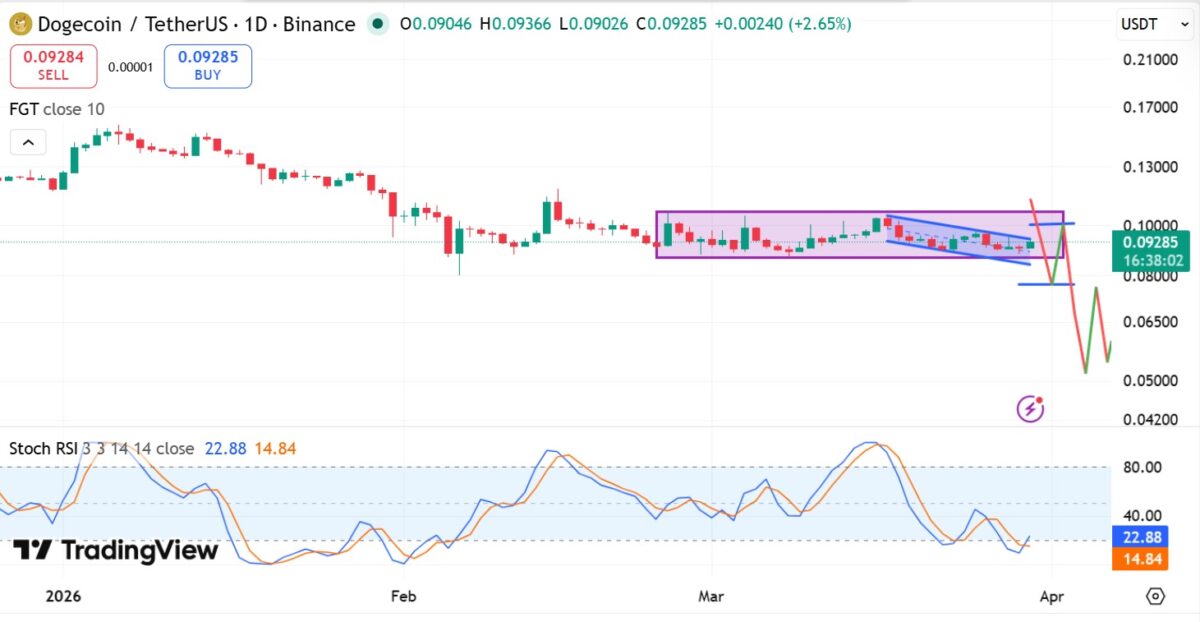
    Looking at the Stochastic RSI, the momentum made a bullish crossover, rising from 7 to 23, reflecting increased buying pressure. Despite this crossover, the momentum index remains firmly stuck in oversold territory, signaling the presence of sellers.

    Source: TradingView

    Even more worrying for memecoin prospects, the future Grand Trend suggested another slip. Based on the future model, $DOGE could drop below $0.09 again, falling to $0.086, with $0.080 as critical support.

    However, if Spot demand outweighs Futures selling, Dogecoin could hold above $0.09 and target $0.106 resistance.


    Final Summary

    • $DOGE rose slightly, flipping $0.09, touching a high of $0.093, before retracing to $0.092.
    • Dogecoin saw fresh capital inflows into the Spot market, but Futures remained bearish, posing a risk of pullback.
  • Bluesky Users Revolt Against AI Tool Attie, Blocking It More Than ICE and White House Accounts

    Bluesky Users Revolt Against AI Tool Attie, Blocking It More Than ICE and White House Accounts

    In brief

    • Bluesky’s new AI feed-building app, Attie, has already been blocked more than 125,000 times since launch.
    • The total places the account ahead of ICE and the White House, second only to Vice President JD Vance in total user blocks.
    • Users responding to the announcement raised concerns about automation, AI training, and the platform’s direction.

    A new AI tool launched on Bluesky over the weekend has quickly become one of the most-blocked accounts on the platform, representing a strong anti-AI vibe on the rising social network rival to Elon Musk’s X.

    The account for Attie, an experimental feed-building app, has been blocked 125,000 times since it was publicly announced on Saturday, according to data from analytics website ClearSky.

    That total places the account second only to U.S. Vice President JD Vance among the platform’s most-blocked profiles. Attie has been blocked by users more than the accounts for the White House and Immigration and Customs Enforcement (ICE), both of which have been blocked by more than 100,000 users.

    Attie was created by The Atmosphere, a development team led by former CEO Jay Graber, and built using Bluesky’s AT Protocol, the decentralized infrastructure that powers the network and lets developers build interoperable social apps.

    At its core, Attie lets users type in a simple description of the type of posts or topics they want in their personalized feed. Using AI, the tool automatically searches for relevant posts across Bluesky and assembles a custom feed that matches the user’s request.

    While the launch was framed as a way to make the Bluesky experience better, it drew nearly immediate pushback from some users.

    “It would be kinda neat if Attie became the most-blocked account,” wrote author Dani Finn.

    “Attie is almost as unpopular as ICE and JD Vance—and it’s only been about 27 hours,” writer and artist Dan Lansdowne wrote late Sunday.

    Other users framed the feature as a shift away from what originally attracted them to the platform.

    “You guys do realize that most of your user base came here because they wanted to get away from Twitter’s AI right?” illustrator Marco Alfaro commented. “So basically, you guys are turning the only advantage Bluesky had over X, and why most people migrated here. This definitely won’t backfire.”

    Others criticized the company’s priorities as the platform grows.

    “This always happens when companies start to get bigger, they start to shift more into what they think the market wants rather than fixing issues that still exist on the main platform,” tech YouTuber Sam Thibault wrote.

    Unlike Bluesky, X does not make its analytics publicly available, making it unclear how many times an account has been blocked by users.

    The surge in blocks reflects Bluesky’s culture, where users often rely on blocking and shared blocklists to filter accounts they don’t want to see. The practice has become a common form of user-driven moderation on the platform. When U.S. Vice President JD Vance joined Bluesky last summer, his account quickly became the most-blocked on the site, still holding that record at 180,684 according to ClearSky.

    “We understand that some of our users have genuine concerns about how LLMs work and the impact they are having on our society,” Graber, now Bluesky’s chief innovation officer, told Decrypt in a statement. “We take those concerns seriously.”

    Editor’s note: This story was updated to include comment from Bluesky.

    Daily Debrief Newsletter

    Start every day with the top news stories right now, plus original features, a podcast, videos and more.

  • Coinbase, Robinhood and Figure Stocks Are 60% Off Their Peaks—Bernstein Says Buy the Dip

    Coinbase, Robinhood and Figure Stocks Are 60% Off Their Peaks—Bernstein Says Buy the Dip

    In brief

    • Bernstein lowered its price targets on Coinbase to $330, Robinhood to $130, and Figure to $67, while keeping Outperform ratings on all three.
    • Coinbase spot volumes are tracking roughly 30% below Q4 2025 levels, with Bernstein cutting its 2026 EPS estimate by 44%.
    • Robinhood’s prediction markets revenue is projected to surge 286% in 2026, partly offsetting weakness in crypto trading.

    Bernstein analysts cut price targets Monday on Coinbase, Robinhood, and blockchain lending firm Figure Technology Solutions, citing geopolitical headwinds and weak crypto sentiment.

    But the analysts maintained “Outperform” ratings on all three companies, despite the reductions.

    “In our view, these businesses offer exposure to trillion dollar markets with years of growth ahead—prediction markets, stablecoins, tokenized real world assets, crypto derivatives, and further beta on crypto recovery from the bottom,” they wrote. “We believe, we will see a bottom in crypto stocks into weak Q1 earnings.”

    The stocks are trading roughly 60% below their 2025 peaks, according to the note, written by analyst Gautam Chhugani. Bernstein lowered its price target on Coinbase (COIN) to $330 from $440, on Robinhood (HOOD) to $130 from $160, and on Figure (FIGR) to $67 from $72.

    Coinbase, currently trading around $160, faces the most direct crypto exposure of the three. Spot volumes are tracking roughly 30% below Q4 2025 levels, and Bernstein cut its 2026 earnings per share estimate by 44% to $5.97. Still, the firm projects a 26% revenue compound annual growth rate through 2027, citing the firm’s stablecoin revenue.

    The San Francisco-based exchange receives roughly half of Circle’s USDC income, and has been rapidly scaling its derivatives business following its acquisition of Deribit.

    Robinhood and Figure will have an easier time rebounding because of their more limited exposure to crypto prices, Bernstein analysts argued.

    “We see stronger resilience particularly in HOOD and FIGR given revenues unlinked to crypto recovery—Figure is a pure blockchain tokenization business. Crypto is mere ~20% of HOOD revenues,” they wrote.

    The analysts expect prediction markets to emerge as a meaningful revenue driver for Robinhood in 2026, projecting roughly $586 million in contributions—a 286% jump year-over-year—supported by its Kalshi distribution deal and proprietary exchange Rothera, a joint venture with Susquehanna.

    Figure, a pure-play blockchain tokenization platform, crossed $1 billion in monthly loan origination volume in March, Bernstein noted, and is expanding beyond its core home equity line of credit business into auto loans, small business lending, and tokenized equities. The company went public in September at a $5.3 billion valuation.

    Robinhood (HOOD) recently traded around $64, down about 3% on the day, while FIGR is down less than 1% to under $31 per share.

    Daily Debrief Newsletter

    Start every day with the top news stories right now, plus original features, a podcast, videos and more.

  • SEC decisions scrutinized as senator seeks records on crypto enforcement rollbacks

    SEC decisions scrutinized as senator seeks records on crypto enforcement rollbacks

    U.S. securities regulators have been under more strain than ever from critics this time around on rollbacks of cryptocurrency regulation, and a key senator asks whether they have internal information on any new stock trading or SEC policy decisions.

    Senator Richard Blumenthal, the top Democrat on the Senate investigations subcommittee, has written to SEC Chairman Paul Atkins to share records and exchanges related to the government’s high-profile digital asset cases, including the dismissal of its claims against Tron founder Justin Sun.

    Blumenthal’s request comes weeks after the SEC’s interim head of enforcement, Judge Margaret Ryan, departed. Ryan commenced the job near the end of 2025 and left in March of this year.

    According to reports, Ryan was seeking to delve more deeply into pursuing fraud charges involving those in President Donald Trump’s inner circle. However, people familiar with the matter say he faced a setback because Atkins and other top Republicans on the commission opposed it.

    “Ms. Ryan’s abrupt departure from the agency raises questions in light of her short tenure and reports that senior leadership intervened to prohibit the Division of Enforcement from pursuing cases against certain cryptocurrency companies,” Blumenthal said in the letter.

    SEC drops high-profile crypto cases amid allegations of political influence

    According to reports, tensions have risen over Sun’s case. During the Biden administration, the SEC charged Sun and his three affiliated companies with conducting unregistered sales of $TRX and BTT tokens. Charges that stood against him also included manipulating $TRX prices through wash trading and paying celebrities, including actress Lindsay Lohan and influencer Jake Paul, to promote the tokens without proper disclosure.

    Under the Trump administration, the SEC dropped several high-profile cases against major crypto firms, including Coinbase and Kraken, which had been accused of failing to register correctly. In May, the agency also dismissed charges against Binance after alleging the platform had misrepresented its trading controls.

    Just this month, the watchdog has thrown out charges against Sun, the Tron Foundation, and BitTorrent (now Rainberry) and ordered the latter to pay a $10 million civil penalty to the agency. Sun has been a vocal supporter of Trump and has made huge investments in Trump-family-backed crypto ventures, including World Liberty Financial and Trump’s memecoin $TRUMP.

    “This is a clear example of how President Trump’s blatant crypto corruption creates back doors for his family’s business partners, creating a pay-to-play enforcement regime that turns a blind eye to grave threats to national security and consumer protection,” Blumenthal said in the letter.

    Moreover, according to Blumenthal’s letter, Ryan’s short tenure raises concerns that political actors (in particular, the White House) influenced the decision not to approve or decline certain cryptocurrency cases.

    The senator is also looking for communications between senior SEC officials and industry leadership partners, including the developers who run World Liberty Financial, now a cryptocurrency company supported in part by President Trump supporters, said Blumenthal.

    Critics say the SEC’s recent enforcement approach, which was so aggressive earlier, has brought dozens of crypto‑related enforcement decisions in a single year and has since transitioned to a more lenient or selective approach. Under former SEC Chair Gary Gensler, there were 46 crypto‑related enforcement efforts in 2023 alone, the best year on record for the agency.

    Legal experts note the pivot has been noticeable: after a series of disputes with the biggest platforms, the SEC in 2025 dismissed or paused litigation against several crypto firms, particularly exchanges and trading platforms, amid a major regulatory focus.

    Blumenthal probes SEC shift as lawmakers scrutinize crypto oversight

    The tone has shifted sharply throughout Washington. Supporters of the newly adopted SEC structure say that explaining the rules could bring innovation and clarity, and that enforcement will be lower at firms that comply with disclosure and registration requirements. Opponents argue that weakening enforcement could put investors’ interests at risk and grant bad actors impunity.

    Blumenthal’s inquiry probes into the reasons behind this shift. In his letter, he specifically asked for SEC communications regarding potential enforcement against crypto companies, including interactions with political appointees or outside actors.

    He expressed deep concern and discomfort with the abrupt leadership change and enforcement decisions that impose strict limits on the agency’s ability to prosecute corporate crimes in the fast‑paced digital asset space.

    Industry reactions are mixed. Crypto advocates are betting that we are taking a step forward rather than moving from legal war to a firm rule-making scheme, and that, through various initiatives, they will see how different tokens and business models apply to rules in U.S. securities law.

    For now, Blumenthal asked Atkins to provide records and communications between the SEC’s enforcement division and its leadership by April 13th. He has also requested records between his office and any member of the Trump family.

    And so lawmakers and regulators alike will be closely watching as this record request goes out, to see how the SEC will balance innovation with its basic function of protecting customers.