Category: Business

  • Solana Price Prediction: Split Paths Toward $1,000

    Solana Price Prediction: Split Paths Toward $1,000

    Two analysts shared different Solana chart views, but both pointed to a larger upside case over time. One chart suggested Solana may be repeating an old recovery pattern, while the other showed room for a deeper correction before any move toward much higher targets.

    Solana Chart Signals Repeat Pattern as Trader Points to Another Long Term Breakout

    A weekly Solana chart shared by X user TheoTrader showed a familiar pattern that, in his view, could lead to another strong move higher. The chart, posted under the $SOL/$USDT pair on Binance, showed Solana trading near $82.70 after a long decline from earlier highs. TheoTrader wrote that the same setup “always plays out the same,” suggesting he expects Solana to recover again despite the current weakness.
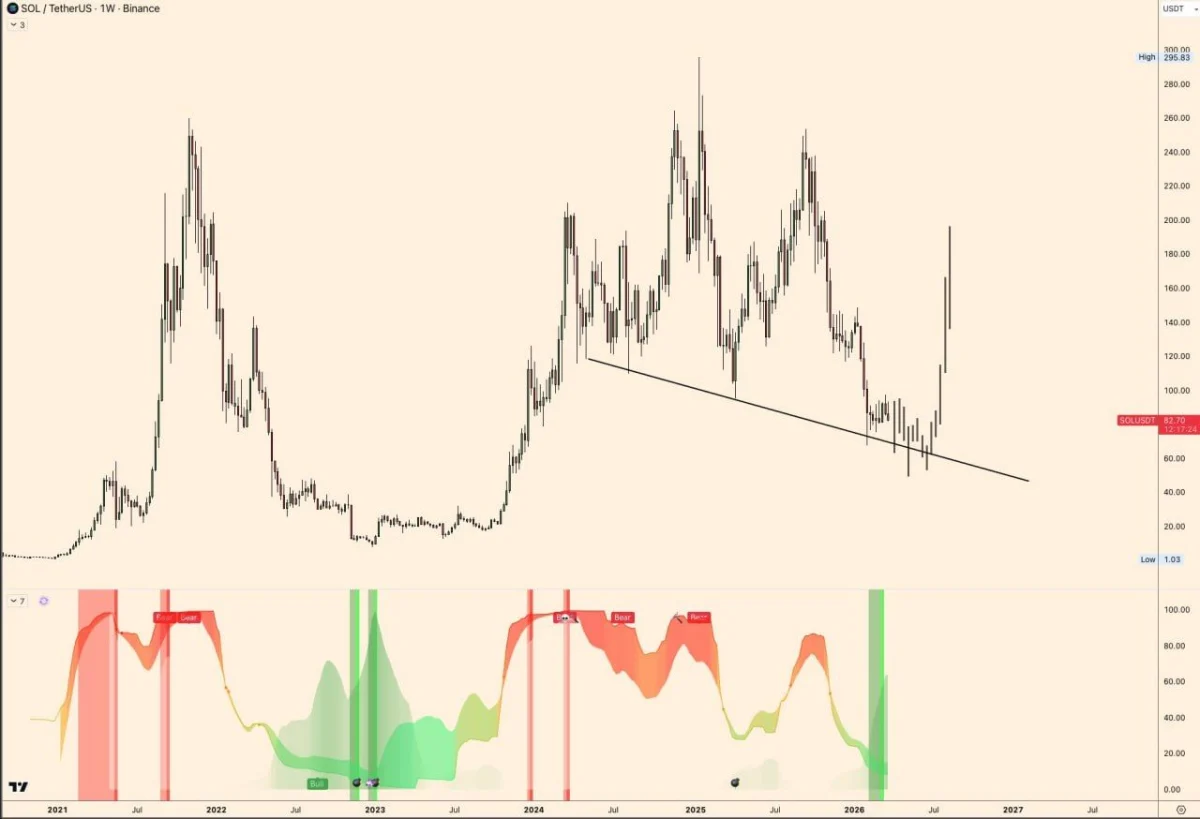
    $SOL/$USDT 1W Chart: Source: TheoTrader on X

    The chart tracked Solana price action from 2021 into 2027 on a weekly timeframe. It showed earlier boom and bust cycles, including a sharp rise above $250 in 2021, a deep drop through 2022, and another major rally that pushed price close to the $300 level. On the right side of the chart, Solana sat below a descending trendline that connected lower highs across the recent downtrend.

    At the same time, the chart also showed a fresh rebound from the lower range. Several recent candles pushed upward after Solana spent weeks near the trendline support area. A projected path on the chart suggested that price could first move toward the $110 zone, then continue much higher toward roughly $170 and even near $200 if momentum builds.

    Below the main price chart, a momentum indicator appeared to shift from red bearish zones into green territory. Earlier cycles on the same indicator showed similar green turns near past market bottoms. Because of that, the trader appeared to argue that Solana may be entering another recovery phase rather than starting a new breakdown.

    Still, the chart did not confirm a breakout yet. Solana remained below its long running descending resistance line, which means the next move would need to hold above recent gains and clear that trend barrier. Until then, the setup remains a forward looking chart view rather than a confirmed trend reversal.

    Even so, the post framed the current weakness as part of a repeated market cycle. In that reading, short term fear does not change the longer pattern. Instead, the chart suggests Solana could be setting up for another strong upside phase if the historical structure continues to repeat.

    Solana Chart Maps Correction Zone Before Possible Push Toward $1,000

    A monthly Solana chart shared by X user Crypto Patel outlined a deeper correction phase before any possible move toward much higher long term targets. The chart framed the current structure as a pullback within a broader cycle and marked the $70 to $50 area as the main support and accumulation zone. Crypto Patel argued that the path to $1,000 would likely include another shakeout before a stronger expansion phase begins.
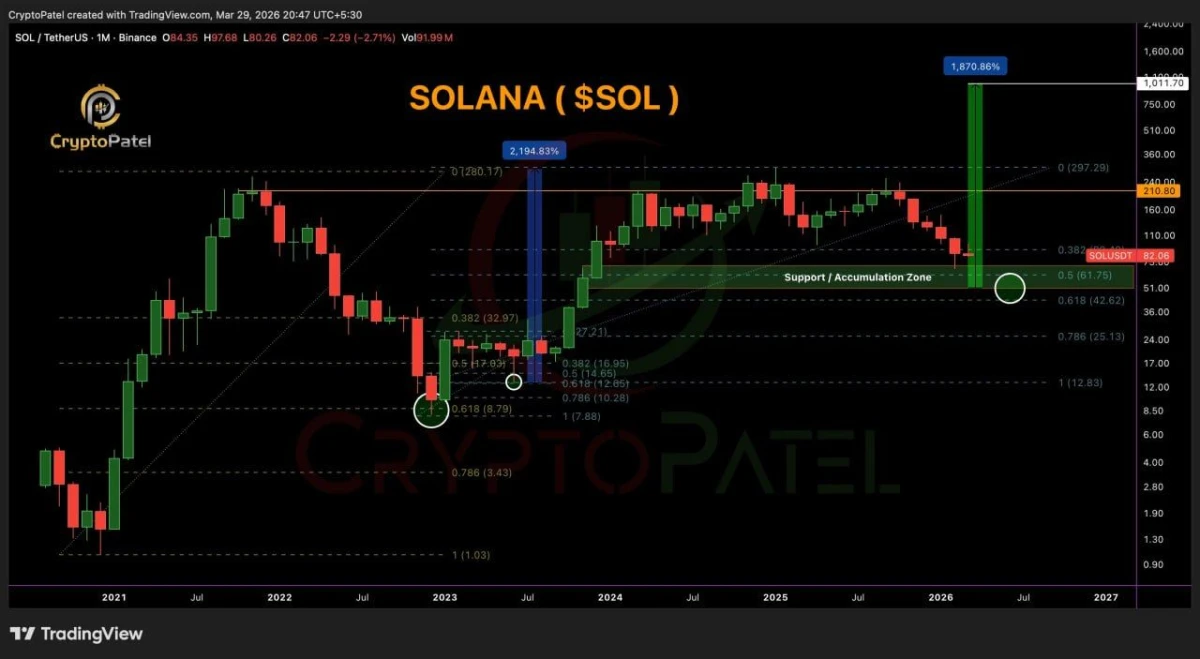
    $SOL/$USDT 1M Chart: Source: Crypto Patel on X

    The chart showed Solana moving through a distribution phase after a strong uptrend. It marked liquidity below the $60 level and suggested that a break under $70 could open the way for a drop toward the lower end of the support band. In that setup, the correction is not presented as a trend failure but as part of a broader cycle that could reset the market before the next leg higher.

    Crypto Patel also highlighted how deep pullbacks have appeared in earlier parts of Solana’s market structure. The chart included previous rebound zones and measured rallies that followed them. Based on that pattern, the analyst suggested that another washout into the marked accumulation area could clear weaker holders before a stronger recovery begins.

    At the same time, the chart kept its long term outlook bullish. It showed projected upside targets at $500 and then $1,000 after the correction phase ends. Those targets depend on Solana holding the broader cycle structure and eventually turning the support zone into a base for the next rally.

    Still, the setup remains conditional. A move below the upper support band would strengthen the bearish case in the short term and increase the chance of a sweep through lower liquidity levels. Until the chart confirms a reversal from that zone, the outlook remains focused on a correction first and a larger breakout only later.

  • Kingdom of Bhutan signals dumping more Bitcoin

    Kingdom of Bhutan signals dumping more Bitcoin

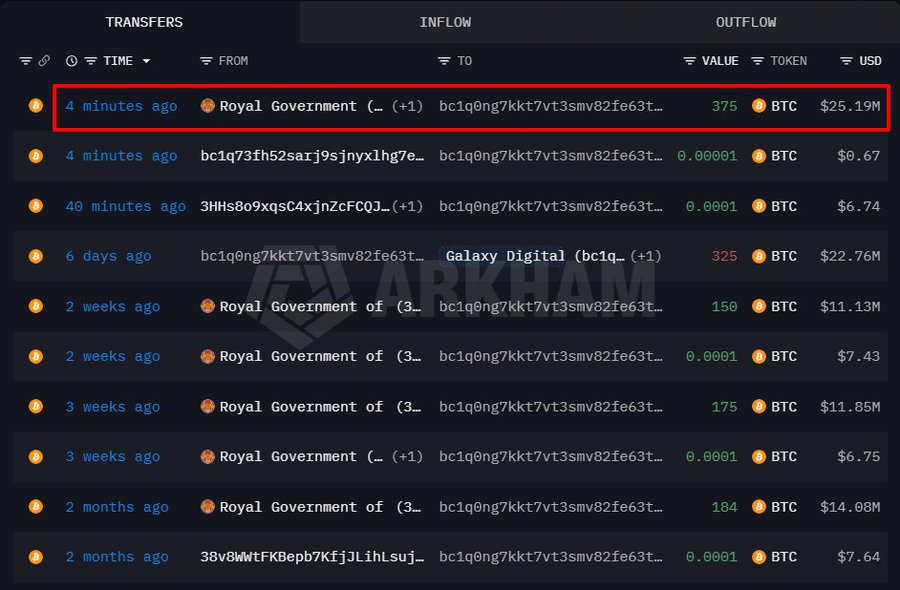
    The Royal Government of Bhutan has transferred another batch of Bitcoin ($BTC), signaling possible selling as the asset continues to witness capital outflows.

    On-chain analytics show the move involved roughly 375 Bitcoin, valued at approximately $25.19 million at the time of the transfer. The amount was moved to an intermediary wallet previously linked to outflows toward Galaxy Digital, according to on-chain data retrieved from Arkham on March 31.

    Bhutan Kingdom Bitcoin transactions. Source: Arkham

    This latest activity adds to a wave of large transfers throughout March. Earlier, the government moved 973 Bitcoin worth about $72 million over two days, followed by 519.7 Bitcoin valued at $36.75 million to external wallets, including those linked to trading firms.

    Another 123.7 Bitcoin transfer worth $8.5 million on March 27 underscores the accelerated pace.

    Overall, these transactions have pushed total 2026 outflows above $152 million, with net sales estimated at around $120 million after accounting for some inflows.

    Bhutan Bitcoin holdings

    As of press time, the kingdom’s Bitcoin holdings stood at approximately $714.08 million, equivalent to 10,769 $BTC, representing about 0.051% of the total supply of Bitcoin.

    The valuation reflects a 25% decline over the past three months, highlighting the impact of recent market movements on the kingdom’s digital asset reserves.

    Bhutan began mining Bitcoin in 2019 using surplus hydropower, turning excess clean energy into a strategic reserve managed by Druk Holding and Investments that, at one point, contributed nearly 40% of GDP.

    By late 2025, it had built one of the world’s largest sovereign Bitcoin holdings, viewed as a long-term store of value.

    However, after pledging up to 10,000 $BTC for the Gelephu Mindfulness City project, 2026 has marked a shift toward steady, measured sales, typically $5 to $10 million per batch, to limit market impact.

    Many of these transfers have been routed through established trading counterparties, including Singapore-based QCP Capital, in what analysts describe as orderly over-the-counter arrangements.

    The proceeds are understood to support national infrastructure projects, civil servant salaries, and broader development goals tied to Gelephu Mindfulness City.

  • Bitcoin Flashes ‘Warning Sign’ With Nearly Half of BTC Supply Sitting at a Loss: Report

    Bitcoin Flashes ‘Warning Sign’ With Nearly Half of BTC Supply Sitting at a Loss: Report

    In brief

    • About 47% of Bitcoin is sitting at a loss, according to data gathered from CEX.io Research.
    • The mark includes more than 30% of the Bitcoin held by long-term holders, the highest mark since 2023.
    • Bitcoin is roughly even on the day, but has fallen more than 47% from its all-time high.

    Holders of around 9.4 million Bitcoin, or approximately 47% of the total circulating supply, are sitting on unrealized or paper losses, according to a new report from CEX.io Research

    That includes more than 30% of the Bitcoin held by long-term holders, or $304 billion worth of the largest crypto asset, which is now underwater—the highest share since 2023, according to the report. 

    “Long-term holders are now selling at their deepest losses in three years, and the speed of the reversal indicates a sharp deterioration in confidence,” the report reads.

    “The broader context makes this more concerning,” analysts added. “Bitcoin’s price has been drifting slightly higher over recent weeks, but the share of long-term holders sitting in profit has been quietly shrinking at the same time.” 

    Bitcoin is roughly flat in the last 24 hours, recently changing hands around $66,567, but it has fallen around 6% in the last week of trading as the potential for escalation in the conflict in Iran has grown. 

    The shift in conditions has led Bitcoin to a shaky place, according to CEX.io. The firm’s Bitcoin Impact Index, which measures Bitcoin holders and their stress levels as it relates to selling, has flashed to “high impact.” In other words, there is significant stress across Bitcoin holders and institutional capital. 

    “This kind of divergence between price action and on-chain conviction has historically been a warning sign,” the report says. “For instance, similar moves occurred in mid-2018 and mid-2022 before price drops by over 25%.”

    Another 25% drop would push Bitcoin below $50,000 for the first time since February 2024. As of this writing, Bitcoin is currently about 47% off its all-time high of $126,080 set in October.

    The CEX.io research suggests that the new setup resembles the period of late January, which preceded the steep drop in Bitcoin prices from the mid-$90,000s to low $60,000s in early February. 

    “The difference this time is that holders are not yet rushing Bitcoin to exchanges to sell. That kept February’s worst moments from becoming even worse, and it is doing the same now,” it said, adding that if it continues to hold, prices could stabilize rather than fall further. 

    The cautious analysis is similar to that recently shared by VanEck, which indicated an “unusually strong demand” for downside protection on Bitcoin. Earlier this year, CryptoQuant suggested that BTC’s real bear market bottom price would be closer to $55,000, while Standard Chartered said it would hit $50,000 before rebounding towards $100,000.

    Daily Debrief Newsletter

    Start every day with the top news stories right now, plus original features, a podcast, videos and more.

  • US Midterm Elections Approaching: A New Breakthrough from the Popular Altcoin Partnered with the US Department of Commerce!

    US Midterm Elections Approaching: A New Breakthrough from the Popular Altcoin Partnered with the US Department of Commerce!

    Donald Trump won the US presidential election in November 2024, ushering in a new era for the United States.

    However, with the midterm elections just seven months away, campaigning has already begun. Accordingly, large cryptocurrency companies are expanding their influence on politics through political fundraising groups.

    According to recent news, Chainlink Labs and Anchorage Digital have joined the founding members of a political action committee (PAC) called the “Blockchain Leadership Fund” in the US.

    Chainlink Labs, the developer of the blockchain oracle Chainlink (LINK), and institutional digital asset custody company Anchorage Digital have joined a US lobbying group called the Blockchain Leadership Fund (BLF) to promote more positive cryptocurrency and blockchain policies.

    The group will operate as a “hybrid PAC,” allowing for both direct contributions to candidates and independent election spending (such as advertising). Neither company disclosed the amount of their contributions.

    The formation of the Political Action Committee (PAC) comes ahead of the November 3rd midterm elections, and the election results are of great importance.

    The results will determine which party will gain a majority in the US House of Representatives and the Senate, and are expected to directly influence the direction of legislation related to cryptocurrencies. This is because they closely follow the progress of important bills, including the stablecoin law “GENIUS” and the market structure law “CLARITY”.

    At this point, Chainlink Labs stated that the industry needs organized support for candidates who support the CLARITY Act.

    Anchorage co-founder and CEO Nathan McCauley said, “2026 will be a crucial year for cryptocurrency regulation. The choices we make now will shape the industry and American financial leadership for decades to come. That outcome will depend on who invests in the process and who steps up at key moments.”

    As you may recall, in the 2024 US presidential and general elections, approximately 270 pro-crypto candidates won seats in Congress, and the political action committee called “Fairshake,” supported by Ripple and Coinbase, spent hundreds of millions of dollars to exert significant influence on the election races.

    *This is not investment advice.

  • Quantum risk resurfaces at the worst time for bitcoin, but 1 token is loving it

    Quantum risk resurfaces at the worst time for bitcoin, but 1 token is loving it

    By Omkar Godbole (All times ET unless indicated otherwise)

    If macro worries tied to the Iran conflict weren’t enough, new research has revived what might be seen as an existential threat to bitcoin , quantum computing.

    A paper from Google suggests breaking the Bitcoin blockchain’s cryptography with quantum computers could require fewer than 500,000 qubits, a fraction of previous estimates. A separate paper by Caltech and quantum startup Oratomic suggests a system with around 26,000 qubits could break the encryption standard that secures the Bitcoin and Ethereum blockchains, in about 10 days. (“Qubits” are considered the processing power units of quantum computers.)

    A quantum hack would compromise the core tenets of crypto, namely “trust the code” and the “hard money” value proposition, according to Charles Edwards, founder of Capriole Investments. About 25%-30% of the total bitcoin supply is already vulnerable to future quantum computing attacks.

    While these attacks remain theoretical, according to Dragonfly Managing Partner Haseeb, they put a deadline in place: The network may need to upgrade to quantum-safe technology by around 2029.

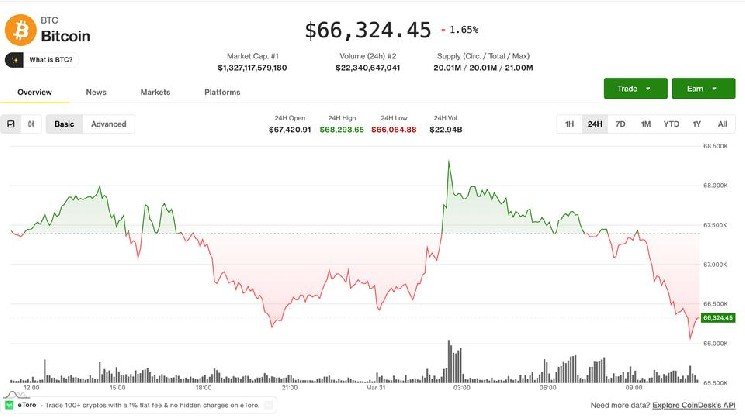
    The leading cryptocurrency by market value has already pulled back to $66,250 from the high of over $68,000 reached during Asian trading hours. This comes as demand-side conditions appear weak and real or inflation-adjusted returns on bonds rise, disincentivizing investment in risky and emerging technologies such as bitcoin.

    While the broader market followed bitcoin lower, one token stood out. QRL, the native cryptocurrency of the Quantum Resistant Ledger, has surged 40% in 24 hours, hitting a high of $1.62. The token’s market cap was just over $127 million at the time of writing.

    QRL describes itself as “an externally audited enterprise-grade blockchain platform secure today from the quantum computing advances of tomorrow.”

    Unlike Bitcoin, which relies on elliptic curve cryptography that makes it vulnerable to quantum attacks, QRL uses a quantum-safe signature scheme called XMSS (eXtended Merkle Signature Scheme).

    XMSS is a post-quantum cryptography algorithm recognized by standards bodies such as NIST for its resistance to quantum attacks. By design, XMSS generates one-time signatures that are extremely hard for quantum computers to crack, making QRL theoretically “future-proof” against quantum threats.

    The takeaway: Projects like QRL could draw more attention and potentially gain market value as concerns about quantum threats grow. Stay alert!

    Read more: For analysis of today’s activity in altcoins and derivatives, see Crypto Markets Today

    What to Watch

    For a more comprehensive list of events this week, see CoinDesk’s “Crypto Week Ahead”.

    • Crypto
      • March 31: FTX Recovery Trust to distribute about $2.2 billion to creditors.
    • Macro
    • March 31, 9:00 a.m.: U.S. S&P/Case-Shiller Composite-20 Home Price Index YoY for January (Prev. 1.4%)
    • March 31, 9:45 a.m.: U.S. Chicago PMI for March (Prev. 57.7)
    • March 31, 10:00 a.m.: U.S. Conference Board Consumer Confidence for March (Prev. 91.2)
    • March 31, 10:00 a.m.: U.S. JOLTS job openings for February (Prev. 6.946M)
    • Earnings (Estimates based on FactSet data)

    Token Events

    For a more comprehensive list of events this week, see CoinDesk’s “Crypto Week Ahead”.

    • Governance votes & calls
      • Stake DAO $CRV and BAL are voting on their bi-weekly gauge to allocate $CRV and BAL inflation across various liquidity pools. Voting ends March 31.
      • SuperRare DAO is voting to consolidate its treasury management under the RareDAO Foundation by migrating remaining balances and officially concluding its legacy Network Engagement and Grants programs. Voting ends March 31.
      • Aventus DAO is voting to simplify AVT emissions to a flat daily rate, increase the node staking requirement, and replace ongoing fees with an upfront appchain token allocation. Voting ends March 31.
    • Unlocks
    • Token Launches
      • March 31: edgeX (EDGE) token generation event to occur.
      • March 31: WorldLand (WL) to be listed on KuCoin, Gate, and others.

    Conferences

    For a more comprehensive list of events this week, see CoinDesk’s “Crypto Week Ahead”.

    • Day 3 of 3: Tokenize! LATAM 2026 (San Juan, Puerto Rico)
    • Day 2of 4: EthCC (Cannes, France)
    • Day 1 of 2: Chainalysis Links (New York City)

    Market Movements

    • $BTC is down 0.82% from 4 p.m. ET Monday at $66,053.74 (24hrs: -2%)
    • $ETH is down 0.31% at $2,015.51 (24hrs: -1.84%)
    • CoinDesk 20 is down 1.1% at 1,893.79 (24hrs: -2.15%)
    • Ether CESR Composite Staking Rate is up 5 bps at 2.76%
    • $BTC funding rate is at 0.0018% (2.0093% annualized) on Binance
    • DXY is unchanged at 100.44
    • Gold futures are up 0.9% at $4,598.60
    • Silver futures are up 3.59% at $73.11
    • Nikkei 225 closed down 1.58% at 51,063.72
    • Hang Seng closed up 0.15% at 24,788.14
    • FTSE is up 0.69% at 10,197.55
    • Euro Stoxx 50 is up 0.48% at 5,568.53
    • DJIA closed on Monday up 0.11% at 45,216.14
    • S&P 500 closed down 0.39% at 6,343.72
    • Nasdaq Composite closed down 0.73% at 20,794.64
    • S&P/TSX Composite closed unchanged at 31,934.94
    • S&P 40 Latin America closed unchanged at 3,475.76
    • U.S. 10-Year Treasury rate is down 1.8 bps at 4.324%
    • E-mini S&P 500 futures are up 0.85% at 6,442.50
    • E-mini Nasdaq-100 futures are up 0.8% at 23,323.75
    • E-mini Dow Jones Industrial Average Index futures are up 0.91% at 45,880.00

    Bitcoin Stats

    • $BTC Dominance: 58.58% (-0.06%)
    • Ether-bitcoin ratio: 0.03054 (0.66%)
    • Hashrate (seven-day moving average): 996 EH/s
    • Hashprice (spot): $31.78
    • Total fees: 2.5 $BTC / $167,768
    • CME Futures Open Interest: 102,450 $BTC
    • $BTC priced in gold: 14.6 oz.
    • $BTC vs gold market cap: 4.46%

    Technical Analysis

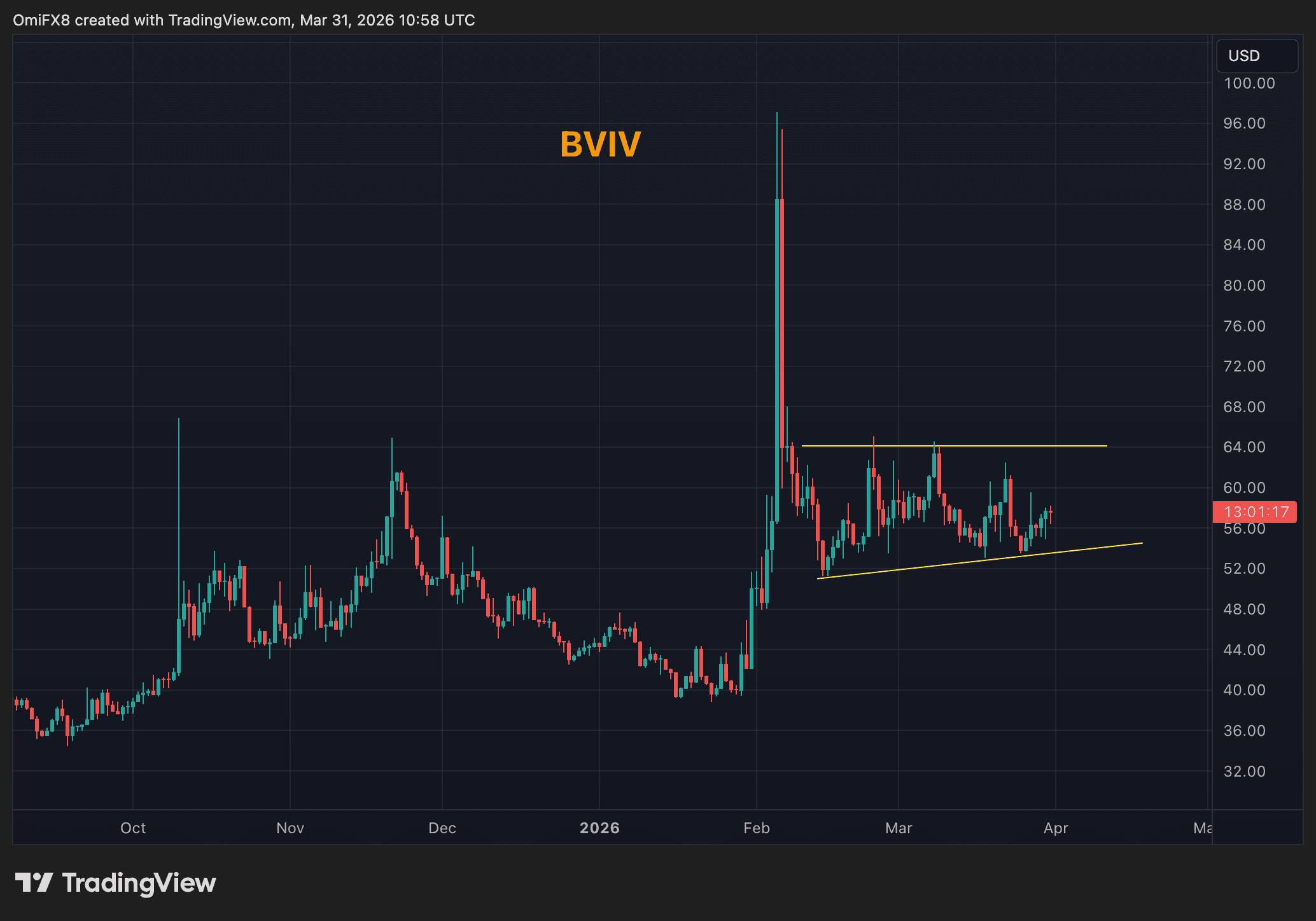
    • The chart shows daily swings in bitcoin’s 30-day implied volatility index, BVIV.
    • The index remains stuck in a sideways grind, pointing to market calm and low volatility.
    • Traders should watch for a breakout against the backdrop of the latest quantum-computing threat, as it would signal panic and increased price turbulence.

    Crypto Equities

    • Coinbase Global (COIN): closed on Monday at $160.79 (-0.22%), +0.47% at $161.54 in pre-market
    • Circle Internet (CRCL): closed at $89.91 (-4.00%), +0.12% at $90.02
    • Galaxy Digital (GLXY): closed at $17.15 (-4.72%), +1.52% at $17.41
    • Bullish (BLSH): closed at $33.27 (-3.37%), +0.69% at $33.50
    • MARA Holdings (MARA): closed at $7.80 (-2.74%), -0.13% at $7.79
    • Riot Platforms (RIOT): closed at $11.83 (-7.58%), unchanged in pre-market
    • Core Scientific (CORZ): closed at $13.91 (-7.70%), +1.01% at $14.05
    • CleanSpark (CLSK): closed at $8.18 (-5.54%), +0.73% at $8.24
    • CoinShares Valkyrie Bitcoin Miners ETF (WGMI): closed at $32.33 (-8.13%), +2.78% at $33.23
    • Exodus Movement (EXOD): closed at $6.20 (-4.32%), +2.74% at $6.37

    Crypto Treasury Companies

    • Strategy (MSTR): closed at $121.44 (-3.64%), +0.45% at $121.99
    • Strive (ASST): closed at $9.37 (-4.92%), +1.18% at $9.48
    • SharpLink Gaming (SBET): closed at $6.01 (-0.50%), unchanged in pre-market
    • Upexi (UPXI): closed at $0.95 (-5.10%), +0.63% at $0.95
    • Lite Strategy (LITS): closed at $1.04 (-5.45%)

    ETF Flows

    Spot $BTC ETFs

    • Daily net flows: $69.4 million
    • Cumulative net flows: $55.98 billion
    • Total $BTC holdings ~1.29 million

    Spot $ETH ETFs

    • Daily net flows: $5 million
    • Cumulative net flows: $11.56 billion
    • Total $ETH holdings ~5.7 million

    Source: Farside Investors

    While You Were Sleeping

    • Giant oil tanker off Dubai hit by Iranian strike after Trump’s latest threats (Reuters): Iran set ablaze a fully loaded crude oil tanker off Dubai after ​President Donald Trump said the U.S. would obliterate Iran’s energy plants and oil wells if it does not open the Strait of Hormuz.
    • Breaking Bitcoin with quantum may be easier than thought, with Taproot partly to blame, Google says (CoinDesk): In a new whitepaper, researchers found that cracking the cryptography used by Bitcoin and Ethereum could require fewer than 500,000 physical quantum bits, or qubits, well below the “millions” often cited in recent years.
    • US gasoline tops $4 for first time since 2022 on Iran war (Bloomberg): The U.S.-wide average retail price for regular unleaded gasoline rose to $4.018 a gallon. Prices have surged more than $1 since the start of the war.
  • Keyrock’s Billion-Dollar Leap: Ambitions Fueled by Fresh Funding

    Keyrock’s Billion-Dollar Leap: Ambitions Fueled by Fresh Funding

    Keyrock, a digital asset services provider headquartered in Brussels, has wrapped up a significant Series C funding round. The company’s valuation has now surged to an impressive $1.1 billion. Leading the financing effort is SC Ventures, the investment arm associated with banking giant Standard Chartered. Previous investor Ripple, recognized for its blockchain infrastructure solutions, also participated in this round. This pivotal financing marks a crucial step in solidifying Keyrock’s stronghold in the digital currency arena.

    Where Will New Funds Take Keyrock?

    The influx of new capital is set to bolster Keyrock’s financial health, broaden their range of services, and explore potential acquisitions. Keyrock executives are optimistic that the ongoing round may eventually amass up to $100 million in investments. While focusing on enhancing financial robustness, the company is simultaneously scouting for new opportunities in the fast-evolving digital asset market.

    By harnessing this financial boost, Keyrock seeks to cement its market presence and fuel expansion efforts. The firm is charting a course to diversify offerings and explore new geographic realms. A blend of organic development along with strategic takeovers forms the core of Keyrock’s growth strategy across varied business arenas.

    “By 2026, our goal is to expand our service range, increase our clientele, and amplify our global outreach, reinforcing our leadership in the industry,” stated Keyrock’s CEO, Kevin de Patoul.

    What Does Keyrock’s Operational Blueprint Look Like?

    Launched in 2017, Keyrock maintains a presence on over 80 trading platforms, both centralized and decentralized. The company, with a global team exceeding 200 employees, provides market making, asset management, OTC trading, and options services. This diverse portfolio caters to a wide spectrum of institutional and individual participants within the cryptocurrency sector.

    Keyrock positions itself as a vital connector between conventional finance and the burgeoning cryptocurrency landscape. Upholding its vision, the firm tailors solutions for corporate as well as private investors, striving to strengthen its prominence within the dynamic fintech realm.

    Last September saw Keyrock expand its horizon by acquiring Turing Capital in Luxembourg, symbolizing its foray into asset and wealth management. This acquisition broadened its service palette, appealing to both institutional entities and affluent individuals. Subsequently, Keyrock launched an exclusive Asset and Wealth Management division.

    Strategic acquisitions remain integral to Keyrock’s growth narrative. These ventures are crafted to augment the company’s suite of innovative digital asset solutions and elevate its stature in the industry’s broader spectrum.

    As Keyrock embarks on this transformative journey, its strategic choices signify its unwavering commitment to maintaining a leadership stance in the world of digital finance.

  • Quantum computers could break crypto wallet encryption with just 10,000 qubits, researchers say

    Quantum computers could break crypto wallet encryption with just 10,000 qubits, researchers say

    The quantum computing power required to break the encryption that secures blockchains continues to decline, at least in theory, raising the question of whether the industry can migrate to quantum-resistant platforms before they become vulnerable at an affordable cost.

    A new paper by Caltech and quantum startup Oratomic suggests a system with around 26,000 qubits could break ECC-256, the encryption standard that secures the Bitcoin and Ethereum blockchains, in about 10 days. RSA-2048, used by financial institutions to secure their Web2 platforms, is more challenging, they found.

    The researchers found the cryptography protecting bitcoin and ether (ETH) wallets could be broken using as few as 10,000 physical qubits, collapsing prior estimates that until this week still ran into the hundreds of thousands.

    Qubits are the basic units of quantum computers, similar to bits in traditional machines. They are a measure not of speed, like gigahertz or teraflops, but rather reflect the scale of the system, closer to the number of cores or transistors in a chip.

    The paper, posted Monday to the arXiv preprint server, landed alongside a Google Quantum AI whitepaper that pegged the threshold at fewer than 500,000 physical qubits.

    The two are closely connected: the Oratomic team uses Google’s quantum circuits designed to break 256-bit elliptic curve cryptography, the system securing bitcoin and ether wallets, and shows a neutral-atom setup — laser-controlled atoms acting as qubits — could run them with about a 50th of the qubits Google estimated.

    Together, the papers mark one of the sharpest compressions yet in the timeline of quantum threats. Estimated requirements for running Shor’s algorithm, the quantum method for breaking public-key encryption, have now fallen five orders of magnitude in two decades, from roughly 1 billion physical qubits in 2012 to about 10,000 today.

    Those gains translate into clearer timelines for potential attacks.

    Under the paper’s assumptions, a system with around 26,000 qubits could break ECC-256, the encryption standard that secures the Bitcoin and Ethereum blockchain, in about 10 days, effectively allowing a quantum computer to derive private keys and take control of funds.

    RSA-2048, used by financial institutions to secure their web2 platforms, would require closer to 102,000 qubits and roughly three months in a highly parallelized setup. Elliptic curve cryptography is more exposed because it achieves comparable security with smaller keys, making it easier work for a quantum machine.

    That roughly 10-day window makes the rapid “on-spend” attack outlined in Google’s paper, where a quantum computer cracks a key in minutes and front-runs a live bitcoin transaction, unlikely under these assumptions.

    It does little, however, to reduce the longer-term risk to funds already sitting in vulnerable addresses, including an estimated 6.9 million BTC tied to early wallets and reused addresses.

    That framing comes with caveats. All nine authors are shareholders in Oratomic, with six employed by the company, positioning the paper as both a scientific result and a roadmap for its hardware approach.

    The direction, however, is becoming harder to ignore. The question is no longer whether quantum systems can break crypto, but whether the industry can migrate before the cost of doing so collapses further.

  • Bearish sentiment builds in crypto as volatility and hedging rise

    Bearish sentiment builds in crypto as volatility and hedging rise

    The crypto market exhibited signs of volatility on Tuesday, with bitcoin spiking to $68,300 shortly after midnight UTC before tumbling back to $66,500.

    The initial spike was spurred by reports that U.S. President Donald Trump was willing to end the war in Iran without the Strait of Hormuz being opened. The optimism faded after Israeli officials said they were prepared to “keep operating for weeks to come.”

    The war, now in its 32nd day, has sent energy prices surging, with Brent crude trading around $107 per barrel, leading to inflation concerns and widespread risk-off sentiment.

    Crypto, while being relatively resilient throughout March, is beginning to show signs of weakness after bitcoin failed to rise above $75,000 on two occasions.

    U.S. equities diverged from the crypto market on Tuesday, with Nasdaq 100 and S&P 500 index futures both adding 0.8%.

    Derivatives Positioning

    • Cumulative industry-wide crypto futures open interest (OI) dropped over 3% to $103.79 billion in 24 hours, continuing the risk-off trends observed throughout the first quarter. The tally has declined by over 18% since the start of the year.
    • OI has declined across BTC, ETH, SOL, and XRP futures, indicating capital outflows from the major cryptocurrencies. Other tokens, such as $BCH, AVAX and LTC, have seen double-digit percentage declines in open interest.
    • Privacy-focused ZEC stands out, with its futures market exhibiting bullishness. The token’s OI rose more than 3% alongside mildly positive funding rates and cumulative volume delta. This combination points to an increasing demand for bullish exposure.
    • At the other end is DOGE, which has the most negative 24-hour cumulative volume delta among major tokens.
    • Bitcoin’s 30-day implied volatility index, BVIV, has ticked up to 58% from 54% late last week, topping its 50-day average to suggest more gains ahead. This means potential for increased price turbulence.
    • Ether’s volatility index remains dead flat between 70% and 80% for the seventh straight day.
    • On Deribit, bitcoin risk reversals out to the June end expiry show a strong bias for put options. These downside hedges trade at an 8 to 10 volatility-point premium to calls. Meanwhile, bearishness is relatively measured in ether.
    • The $60,000 bitcoin put remains the most popular play with a total open interest of $1.50 billion.

    Token talk

    • The altcoin market suffered more than bitcoin on Tuesday, with tokens like NEO, HBAR and PUMP losing between 2.6% and 3.3% since midnight UTC.
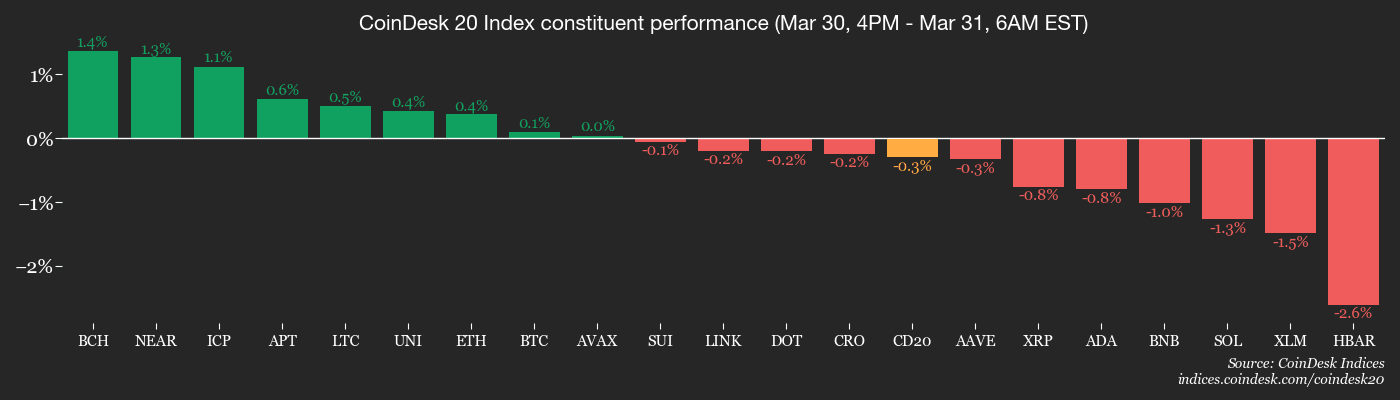
    • A select few tokens are bucking that trend, including $BCH and AI-related coins, which are in the black.
    • CoinMarketCap’s “Altcoin Season” indicator is currently printing 51/100, reflecting relative strength over the past few weeks in spite of Tuesday’s selloff.
    • However, the next major move will still be determined by bitcoin and whether it can either break above $75,000 or below $62,000. Altcoins typically perform well when bitcoin consolidates, but lose ground during big swings.
  • Attention Binance Users: Announcement Made, New Cryptocurrency Feature Coming!

    Attention Binance Users: Announcement Made, New Cryptocurrency Feature Coming!

    Binance, the world’s largest cryptocurrency exchange, is preparing to enter the prediction market.

    According to recent news, Binance Wallet has announced the launch of its prediction market service. With this move, Binance is testing an in-app prediction market feature and joining the growing list of cryptocurrency exchanges venturing into this new sector.

    Binance Wallet announced in an official statement that it will be sourcing features from third-party providers and has partnered with Predict.fun, a protocol running on the $BNB Smart Chain, to integrate prediction markets into Binance Wallet. Accordingly, a prediction market will be launched with Predict.fun acting as the provider.

    Users will be able to participate in various bets created on Predict.Fun, a decentralized protocol based on $BNB Smart Chain (BSC). This feature will allow users to bet on future outcomes in areas such as sports, economics, world events, culture, and cryptocurrencies.

    All transactions are conducted using Tether (USDT). Service may be restricted depending on local regulations.

    With the new feature, users will need to create a separate, dedicated forecasting account to trade on event contracts, distinct from their spot trading accounts.

    However, it remains unclear when Binance will officially roll out this feature or in which jurisdictions it will be available.

    Binance’s move comes at a time when many major global cryptocurrency exchanges are entering the prediction market. As a reminder, in January Coinbase partnered with Kalshi and expanded its prediction market service to users across the US. Meanwhile, in February, Crypto.com launched an independent prediction market platform called OG.

    *This is not investment advice.

  • Jack Dorsey’s Square Automatically Enables Bitcoin Payments for Millions of Sellers

    Jack Dorsey’s Square Automatically Enables Bitcoin Payments for Millions of Sellers

    In brief

    • Square has automatically enabled Bitcoin payments as the default setting for eligible U.S. sellers.
    • The shift affects 4 million merchants who can now accept Bitcoin with zero fees.
    • Sellers receive USD by default through background conversion, though they can opt out or adjust settings.

    Block’s Square payments platform has begun automatically enabling Bitcoin payments for eligible U.S. sellers, shifting from an opt-in to an opt-out model in a move that could significantly expand mainstream Bitcoin payment adoption.

    The change, which co-founder and CEO Jack Dorsey—an outspoken Bitcoin maximalist—confirmed began rolling out on Monday, affects an estimated 4 million merchants.

    “Starting today, eligible U.S. Square sellers will begin having Bitcoin payments automatically enabled. Sellers who accept Bitcoin will receive USD as default,” said Miles Suter, Block’s Bitcoin product lead. He added that the ability will roll out to all sellers in the coming month.

    Under the new system, merchants who accept Bitcoin payments will receive USD as their default settlement currency, with the conversion handled automatically in the background. The feature comes with zero fees for accepting Bitcoin payments.

    Merchants retain control over the feature and can opt out or adjust settings if they prefer not to accept Bitcoin payments. The automatic enablement represents a strategic shift in how payment processors approach cryptocurrency integration, moving from requiring merchants to actively choose Bitcoin acceptance to making it a default option.

    Block first launched the Bitcoin payments feature for all sellers last November, after testing and then gradually rolling out the functionality. Previously, Square users would have to optionally enable the feature, ahead of the shift announced Monday.

    Dorsey has led Block towards a number of Bitcoin initiatives beyond Square payments terminals, including buying and selling BTC in Cash App, launching a Bitcoin hardware wallet, and developing a modular Bitcoin mining system. Despite Dorsey’s own personal Bitcoin fandom, Cash App is enabling stablecoin support—though he’s grumbled about the move.

    Block recently laid off over 4,000 people—representing about 40% of its staff—in a move to maximize efficiency and further embrace AI tools. Block’s stock (XYZ) is up more than 1% on the day to $56.76, as of this writing, down about 11% over the last month.

    Daily Debrief Newsletter

    Start every day with the top news stories right now, plus original features, a podcast, videos and more.