Alchemy Pay has added support for Reserve Protocol’s $RSR on its on-ramp, a move the company described as bringing “crypto portfolios” into a single token experience. In practical terms, the integration is meant to let users buy $RSR with local payment methods through Alchemy Pay’s ramp service, lowering the friction that usually comes with moving from traditional money into crypto. Alchemy Pay’s own infrastructure is built around on and off-ramp services and supports integration through page redirect, API, and SDK tools, while its ramp products are designed to connect users to broader fiat payment options.
The announcement fits neatly with Reserve Protocol’s broader pitch. Reserve describes its system as a decentralized platform for creating Decentralized Token Folios, or DTFs, which are essentially tokenized baskets of assets that can be redeemed onchain and accessed through a single token. The protocol has positioned DTFs as a DeFi version of an ETF, with the idea that users can buy exposure to a theme, strategy, or basket of assets without having to manually assemble every position themselves. Reserve also says $RSR is its governance and utility token, intended to align incentives around the long-term health of the protocol.
That framing helps explain why this partnership matters. If a user wants exposure to Reserve’s ecosystem, the hardest part is often not understanding the idea, but getting in through a payment method that feels familiar. Alchemy Pay’s support for local payment methods could make that process feel closer to a standard fintech checkout than a typical crypto exchange flow. That is an inference based on how Alchemy Pay presents its ramp products and how Reserve presents DTFs, but it is exactly the kind of bridge crypto projects are trying to build as they chase broader adoption.
Simplifying Access to Digital Assets
Reserve has been pushing the DTF narrative for some time. In its own explanation, the protocol says DTFs are meant to let users “just buy the haystack,” a reference to the idea of buying a diversified basket instead of searching for a single winner. Reserve says DTFs can track themes such as AI, DePIN, DeFi, GameFi, memecoins, and other sectors, while its ecosystem is built around permissionless creation and governance. The company also says its protocol has been deployed on Ethereum mainnet, Base, and Arbitrum One, showing that the project is not merely conceptual but already active across major chains.
For Alchemy Pay, the addition of $RSR also continues a pattern of expanding token coverage through its ramp rails. The company has repeatedly positioned itself as a fiat-to-crypto gateway designed to simplify access to digital assets by working with cards, mobile wallets, and local bank transfer options across multiple currencies. Adding Reserve’s token into that flow gives Alchemy Pay another way to present its service as more than a standard on-ramp. Instead, it is increasingly acting as an access layer for emerging token ecosystems that want mainstream users to get in with as little friction as possible.
The bigger picture is that this is less about a single token and more about how crypto products are being packaged for everyday users. Reserve is trying to make token baskets feel simple, while Alchemy Pay is trying to make the entry point feel familiar. Put together, the two projects are chasing the same outcome from different sides of the funnel: making decentralized finance easier to reach without forcing users to learn every technical step along the way. In a market where usability often matters as much as innovation, that kind of integration can be just as important as any headline-grabbing launch.
A top U.S. central banker sounded a stark warning about the risks posed by stablecoins on Tuesday, saying that even after the passage of landmark stablecoin legislation, gaps in oversight could leave the financial system vulnerable to stress and instability.
Federal Reserve Governor Michael S. Barr cautioned that although the Guiding and Establishing National Innovation for United States Stablecoins Act (GENIUS Act) established a first‑of‑its‑kind regulatory framework for dollar‑linked stablecoins, much work remains to fully mitigate systemic risks.
Although it is a step forward, the new rules have yet to eliminate a lot of the risks. When stablecoins fail to take root, they can become unstable without proper discipline and oversight, he said.
Congress introduced the GENIUS Act to put order and predictability in the rapidly growing stablecoin industry. It sets the parameters for how such digital assets must be issued and backed, thereby providing the industry with far greater protection.
Barr conceded that the law could facilitate innovation and make stablecoins more common. But he said that history has shown what can happen when private cash is created without adequate safeguards.
“Stablecoins will be stable only if they can be reliably and promptly redeemed at par in a wide range of conditions, including during stress in the market that can put pressure on the value of otherwise liquid government debt and during episodes of strain on the individual issuer or its related entities,” Barr said.
Why stablecoins could still be risky
Stablecoins are guaranteed to maintain a stable value, usually pegged to the U.S. dollar. But for that to work, the companies behind them need enough good assets—cash and government bonds, etc.—to back every coin they are issuing.
Barr stressed that stability depends on one thing: customers can redeem their stablecoins for real dollars at any time during a financial crisis. And if that trust erodes, everyone can withdraw all their money at once in what is known as a “run.” And it gets even worse, because those issuing the coin try to boost financial profits by taking on the riskiest assets.
That may result in higher stock losses and a worse system if they are unstable and are hard to sell. Barr said reserve assets should be secure and liquid. Well, stablecoins can still go bad, and their value quickly disappears in the process, harming not only our wallets but the rest of society if you lose them.
At the same time, he also admitted, in a very different way, that the value of stablecoins could be misused, be harmful to businesses and legal businesses, and that there is a need to ensure people have a clear understanding and to protect U.S. currency.
Why regulation doesn’t always match reality
Barr’s warning highlights a bigger point: passing laws is only part of the solution. For stablecoins to be truly secure, regulators, banks, and state agencies must collaborate to implement and enforce them efficiently.
The CLARITY Act is based on the existing stablecoin laws. In July 2025, the GENIUS Act, signed into law by President Trump, included a regulation for dollar-backed payment stablecoins.
The GENIUS Act requires issuers to maintain fully backed liquid pools. The required reserve assets are physical currency and short-term government bills. To maintain investors’ trust in issuers, they are required to disclose all balances with their reserves every month.
Barr said, though, that there are still gaps that need to be filled. For instance, as stablecoin issuers are evaluated, there will need to be coordination among the various financial bodies to monitor and maintain compliance with government regulations; for that matter, all of these actors must coordinate with each other, and such coordination is critical. So without that, risks could slip through the cracks and get lost.
The same concerns also apply to those trying to regulate digital assets. Lawmakers are still struggling to come together to craft new proposals, such as the Clarity Act, which more broadly guides industry regulation of cryptocurrencies. Stablecoin risks could be one of the main reasons things are cooling down.
Previously, Barr had predicted that the GENIUS Act could reduce the risk of sudden market panic to the point of strict regulation. Still, he believes strong oversight is needed to achieve that.
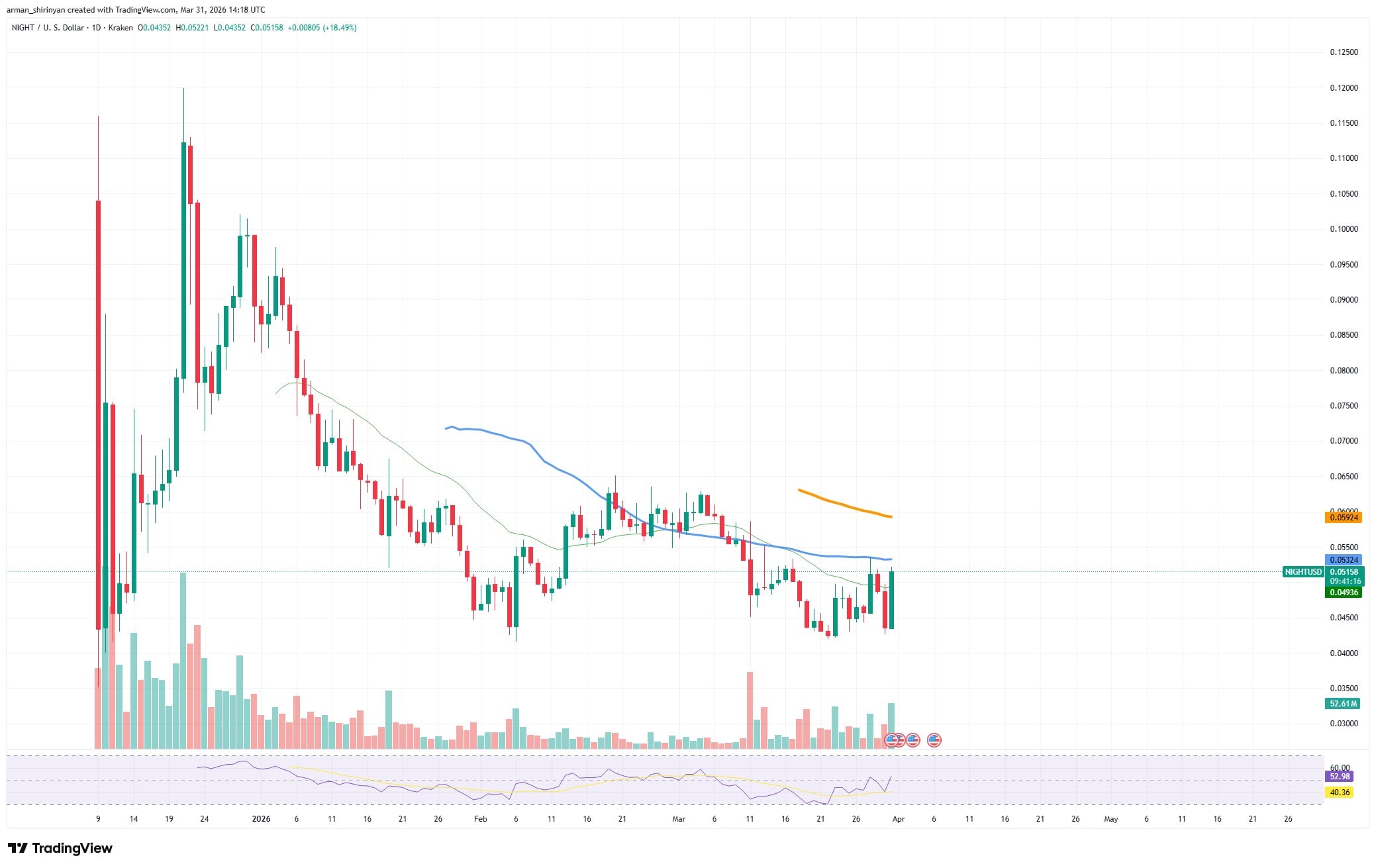
Since its initial explosive debut, Midnight is about to undergo its first significant technical test. The context is crucial because the asset is now in stabilization rather than price discovery. The price has since cooled off considerably and retraced into the $0.04-$0.05 zone, following a strong launch-driven rally that propelled $NIGHT toward the $0.10-$0.11 range.
We are currently witnessing a shift from expansion driven by hype to a more structured market phase. Candles have tightened, volatility has decreased and the asset is starting to respect horizontal levels and moving averages.
$NIGHT/$USDT Chart by TradingView
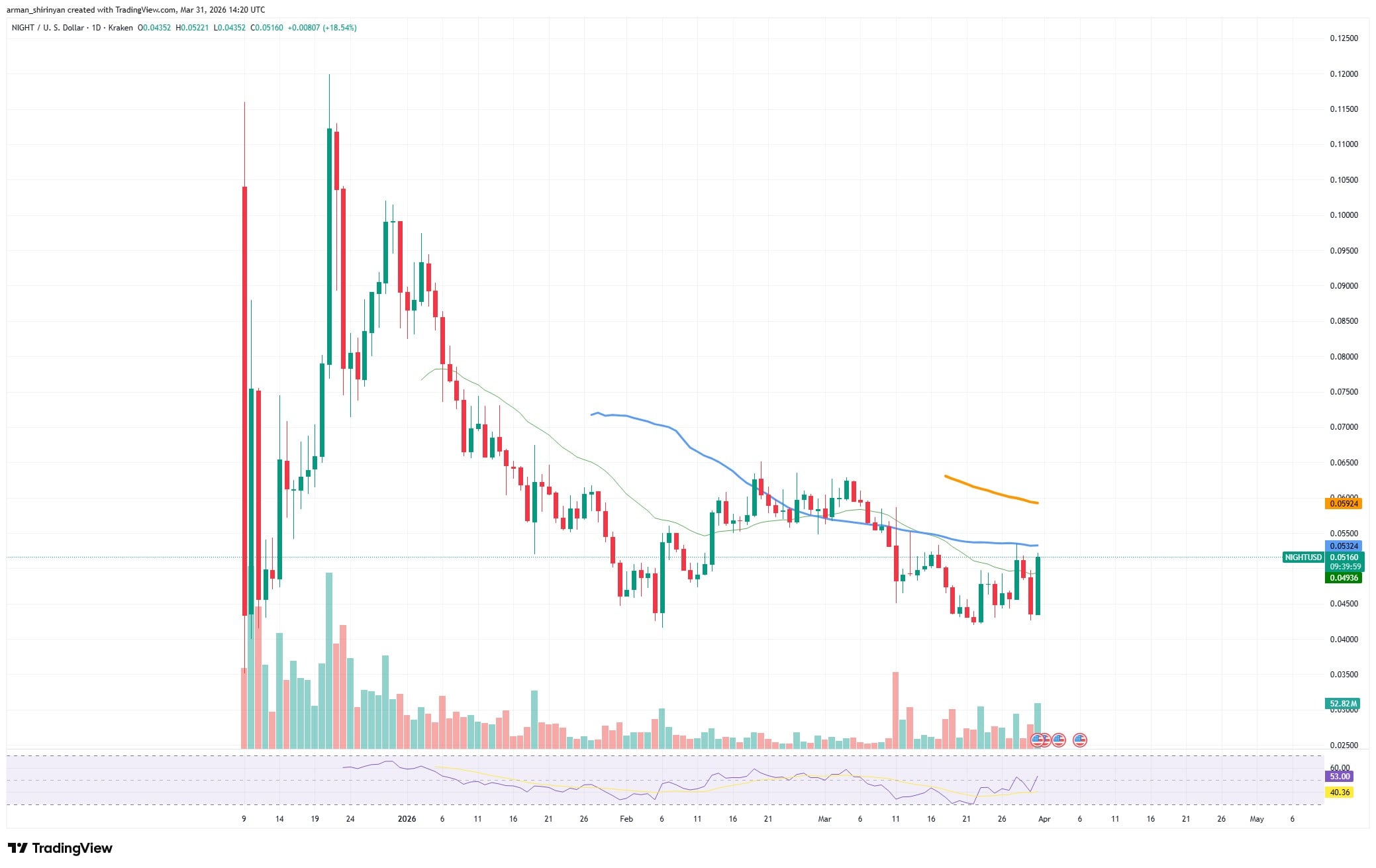
$NIGHT is currently pushing into its first significant resistance cluster, which is located between $0.053 and $0.055. This zone is a technically significant barrier because it coincides with previous rejection levels and short-term moving averages.
Buyers are still there, as evidenced by the recent bounce, but it is unclear if they have enough strength to take back control, or whether this is just another lower high in an impending downtrend. Volume conveys conflicting information. As is common following a launch spike, the initial spike in participation has significantly decreased.
Midnight not suffocating Cardano
As of right now, its influence on the Cardano ecosystem is minimal. Although the narrative presents Midnight as a privacy-focused extension or complementary layer within the Cardano network, there is not any concrete proof that it is currently significantly altering Cardano’s larger market dynamics — at least not based on price or on-chain activity.
Early-stage tokens seldom have an instantaneous impact on the entire ecosystem, unless they are consistently adopted and useful. Instead of acting as a catalyst for Cardano, Midnight is currently acting more like a stand-alone speculative asset. Investors can easily understand this stage.
A recovery toward higher levels is possible if $NIGHT breaks and holds above the $0.055-$0.06 resistance — with increasing volume. A return to consolidation, or even a lower range, is likely if it fails here as the structure is still weak.
Shiba Inu’s volatility moving forward
Shiba Inu is subtly preparing for an increase in volatility, which could result in a short-term squeeze of about 16%. However, the context of the move is more important than the actual number.
For months, $SHIB has been in a distinct downtrend, characterized by steadily declining highs and ongoing pressure from declining moving averages. The price action has been structurally weak. The 50-day and 100-day averages, which continue to serve as dynamic resistance, are among the important trend indicators that the asset is still trading below. Despite recent stabilization, this maintains the overall bias: pessimism.
$SHIB/$USDT Chart by TradingView
But the compression has altered. In recent weeks, $SHIB has developed a tightening structure with rising local support, as evidenced by higher lows, while upside attempts are frequently capped. This results in a traditional squeeze setup: a market that is essentially coiling, decreasing volatility and a narrowing price range.
Technically speaking, a move toward the $0.0000068-$0.0000070 region — which roughly corresponds with that 16% upside projection — is made possible by a breakout above the immediate resistance zone surrounding recent highs. Additionally, this region aligns with the subsequent resistance cluster created by earlier moving averages and consolidation zones.
Indicators of momentum show this shift. Selling pressure appears to be waning, but it is still present, as the RSI is gradually returning from oversold territory and heading toward neutral. The idea that the current structure is preparatory rather than impulsive is reinforced by the comparatively low volume.
Participation is necessary for a squeeze. This arrangement can just as easily resolve to the downside, maintaining the dominant trend in the absence of a significant increase in inflows or wider market support. Because of the fragility of the ascending support line, a breakdown below it would invalidate the compression thesis and probably cause $SHIB to return to its lower range.
Ethereum faces negative signs
Although it might not have the same significance as a full 50/200-day crossover, Ethereum is getting close to what could be called a mini-death cross, and the implications are still negative, given the state of the market.
The shorter-term averages (probably the 20 and 50 EMA) are rolling over and converging downward on the chart, while $ETH is still stuck below its important moving averages. Short-term momentum is being weakened by this compression and downward alignment.
The location of the crossover is just as problematic as the crossover itself. Ethereum continues to trade significantly below its declining 100 and 200-day moving averages. This increases the significance of any bearish crossover in the short-term structure since it takes place within a larger downtrend.
$ETH recently made an attempt at a comeback but was unable to maintain momentum above local resistance, creating a lower high. Though it is comparatively shallow and vulnerable, the current structure exhibits a rising support trendline from recent lows. The mini-death cross might serve as confirmation rather than merely a warning if that support breaks, paving the way for a retest of the $1,800-$1,900 range.
Strong accumulation is not indicated by volume either. The lack of conviction in the recovery effort suggests that buyers are still cautious and primarily reactive rather than proactive.
However, this is not a scenario where a breakdown is certain. The mini-death cross will turn into a failed signal if Ethereum is able to recover the short-term moving averages and turn them back into support. This setup has the potential to spur upside through short covering.
Tether’s USAT stablecoin is launching on the Celo blockchain, its first expansion beyond Ethereum.
Google Cloud provides infrastructure support for the stablecoin’s distribution system.
A privacy-preserving faucet allows verified users to access USAT tokens through proof-of-humanity verification.
Tether announced Tuesday that the USAT stablecoin is expanding to the Celo blockchain, an Ethereum layer-2 scaling network, marking the regulated digital dollar’s first deployment beyond the Ethereum mainnet.
The launch will bring USAT—a stablecoin issued by Anchorage Digital and targeted at the U.S. market—to Celo, with Google Cloud providing infrastructure support alongside plans for the stablecoin to serve as a gas currency on the layer-2 network.
“More than 566 million people globally use USDT as a reliable way to access and move dollars, particularly in markets where traditional financial infrastructure falls short. Expanding USAT to Celo builds on that foundation by bringing regulated digital dollar infrastructure into one of the most active on-chain economies today,” said Tether CEO Paolo Ardoino, in a statement.
“This is how we continue to extend access to trusted, programmable money at a global scale,” he added. “What matters now is ensuring these systems are accessible in the environments where people are already transacting every day.”
Celo brings significant mobile reach through Opera MiniPay’s 14 million wallet users globally. Celo co-founder and CEO Rene Reinsberg called the launch “a powerful validation of the infrastructure we’ve spent years building,” highlighting Tether’s selection of Celo for its first layer-2 deployment for USAT following its initial January rollout on Ethereum.
The technical implementation includes a mainnet faucet system enabling verified users to access USAT through privacy-preserving proof-of-humanity verification developed with Self and Google Cloud. Following deployment, Celo governance will begin the process to enable USAT as a gas currency on the network.
“By bringing USAT to Opera MiniPay’s millions of mobile-first users, we are showing what the next generation of financial access looks like: trusted, compliant, and instantly available,” said Celo co-founder Rene Reinsberg, in a statement.
Deloitte performed the first USAT attestation report, released earlier this month, showing that the firm had $17.6 million in reserves—comprised of cash and U.S. Treasuries—backing about $17.5 million in tokens as of January 31.
Tether’s flagship USDT stablecoin, which leads the industry with an $184 million market cap, has never had a full independent audit from one of the “Big Four” accounting firms. However, last week, Tether said that it had signed one of the firms for an audit, but did not reveal which firm would do it. A subsequent Financial Times report said KPMG would conduct the audit.
Editor’s note: This article was updated after publication for clarity.
Daily Debrief Newsletter
Start every day with the top news stories right now, plus original features, a podcast, videos and more.
Solana is holding a key range while traders watch for the next clear move. At the same time, derivatives data shows fresh long interest building after the latest drop.
Solana Holds Between $80 and $95 as Higher Time Frame Levels Stay in Focus
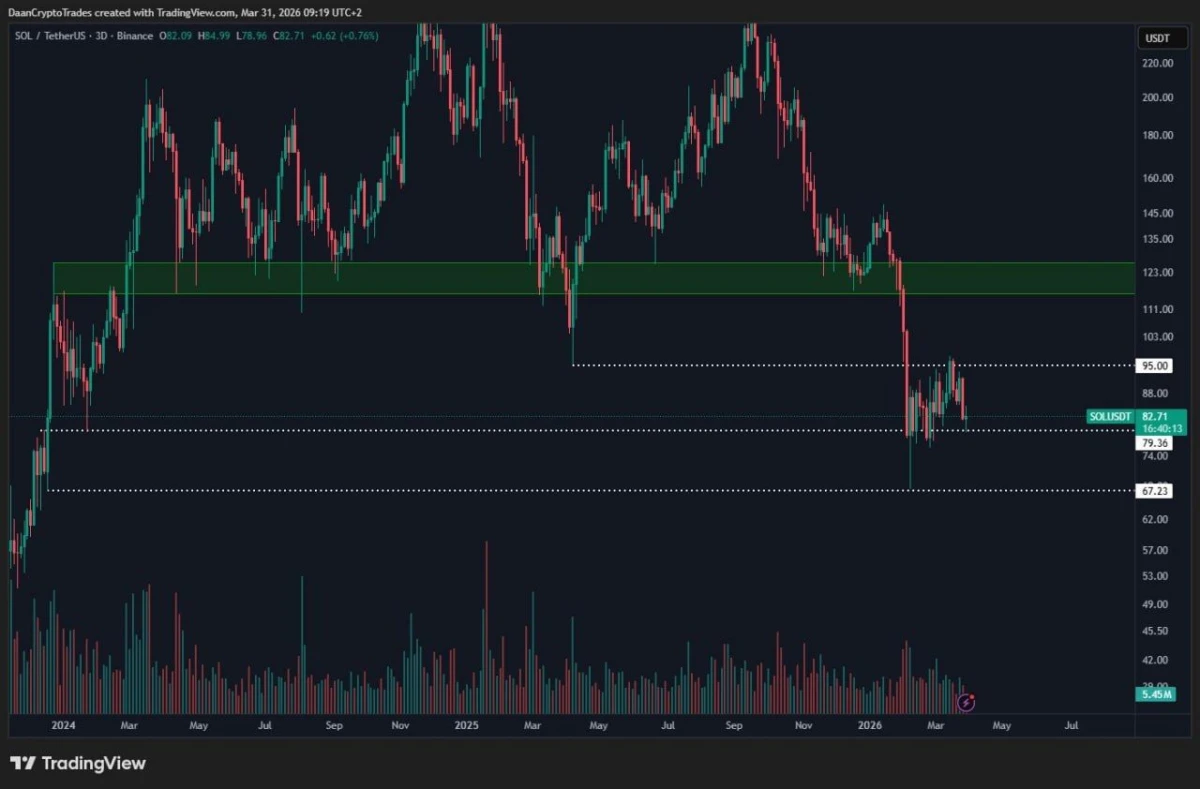
Solana remained locked between about $80 and $95 on the three day chart, according to a chart shared by Daan Crypto Trades on X.
At the time of the post, $SOL traded near $82.71 against Tether on Binance. The chart showed price moving sideways after a sharp drop earlier this year, with repeated reactions at support near the low $80s and resistance near $95.
$SOL/$USDT 3D Chart: Source: TradingView,Daan Crypto Trades on X
The broader structure also highlighted a former support zone around $115 to $123 that has turned into resistance. Meanwhile, a lower horizontal level near $67.23 marked the next major support if $SOL loses the current range.
Daan Crypto Trades said Solana was “chopping around between $80-$95 for now” and noted that the asset was “respecting the horizontals pretty well on the higher timeframes.” That suggests the marked levels continue to guide price action.
For now, the chart shows a market without a confirmed directional break. A move above $95 could open the way for a stronger recovery, while a drop below the lower boundary could shift attention to deeper support near $67.23.
Solana Open Interest Rises as Traders Add Long Positions After Drop
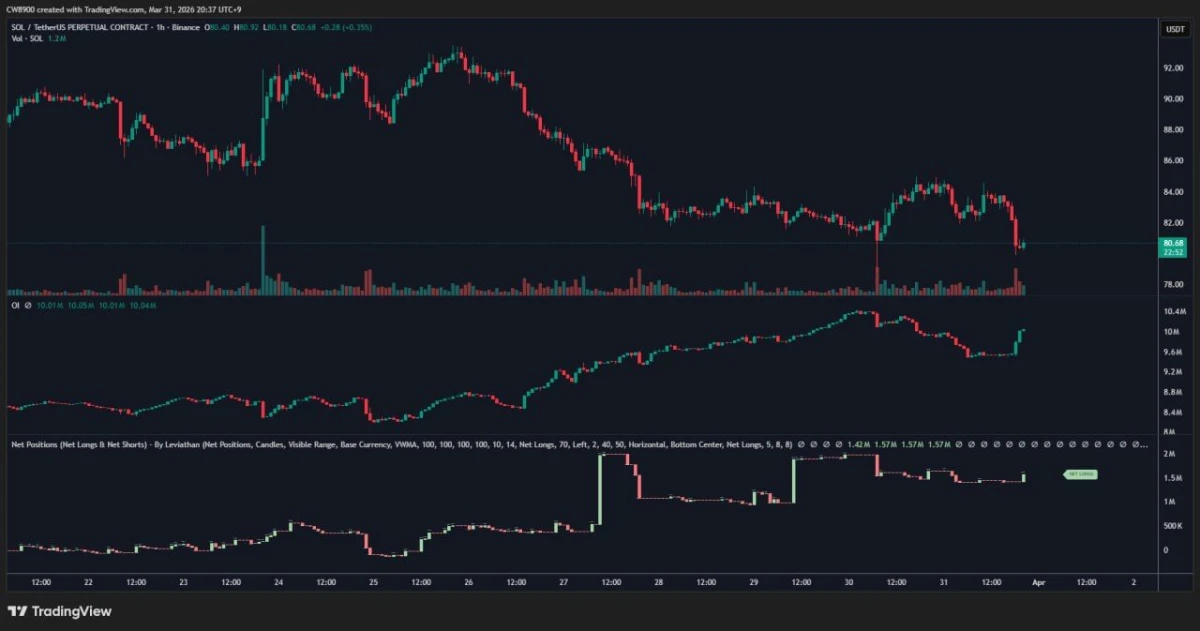
Solana showed fresh signs of long positioning after a recent decline, according to a one hour chart shared by CW on X.
The chart showed $SOL trading near $80.68 on Binance perpetuals at the time of the post. Price had fallen sharply toward the $80 level before stabilizing. After that move, the lower panels pointed to a pickup in open interest and net long positions, suggesting traders started adding exposure even as price remained under short term pressure.
$SOL/$USDT Perpetual Contract 1H Chart: Source: TradingView, CW on X
Open interest climbed back above 10 million, while the net positions indicator also turned higher. That combination can signal that more market participants are opening new positions rather than only closing old ones. In this case, the post argued that the added activity has leaned to the long side.
CW wrote that “following the decline, long position buying and OI on $SOL are increasing” and added that “buying pressure is occurring again.” The chart supported that view by showing a rebound in positioning data after the selloff, even though price had not yet broken into a stronger recovery.
Still, the setup does not confirm a trend reversal on its own. Rising open interest with growing longs can support upside momentum, but it can also increase liquidation risk if price fails to hold. For now, the chart points to renewed bullish positioning around the $80 area as traders watch whether buying pressure can push Solana higher.
The real-world asset (RWA) sector is making a staggering evolution in the crypto world. In this respect, tokenization and perpification are fundamentally serving diverse purposes and audiences in the wider financial markets.
Particularly, tokenization brings capital markets to institutional participants, permitting fractional ownership, programmable contracts, and real-time settlement. Contrarily, perpification strengthens retail traders by offering self-custodial and synthetic exposure to conventional assets to democratize access.
Difference Between Tokenization and Perpification in Modern Finance
RWA perpification and tokenization often get debated interchangeably, but the structural benefits and target audiences of both differ significantly. Tokenization takes into account the provision of conventional assets such as fixed-income instruments, commodities, and equities onto the blockchain network while sustaining legal ownership.
The respective procedure provides institutional players with advantages like programmable smart contracts, faster cycles of settlements, and fractional ownership. Nonetheless, it tends to work on permissioned entities that need KYC verification, compliance with local rules, and brokerage relationships. Due to this, retail investors often stay outside these markets.
On the other hand, perpification totally flips his framework. Promoted by innovators such as Ostium and Kaledora, it utilizes futures-first strategies or perpetual swaps for non-crypto-native assets’ provision on-chain. The respective products serve as synthetic products based on their nature, freeing traders from the compulsion of holding the underlying asset. T
his sidesteps custody or legal barriers. Additionally, perpetual contracts, merged with dependable price feeds, enable seamless market creation across pre-IP ventures, commodities, and equities. Retail traders can utilize perpification for directional and intuitive exposure with substantial leverage and permissionless access without any expiry, making perps a leading non-spot primitive within the crypto market.
The Structural Transformation of Blockchain Industry
The rising demand for perpification is more than just an anomaly, indicating a much broader structural shift across the retail market sentiment. Gen Z and Millennial traders are becoming a part of the financial markets while showing no commitment to the previous generations’ buy-and-hold strategy.
Several find conventional wealth-building paths, institutional investment, retirement accounts, or home ownership financially inaccessible. While responding to this, leveraged trading emerges as a reasonable plan for those looking for substantial returns in short timeframes.
This concept, sometimes called “Retail Speculation Supercycle,” has remained effective in reshaping wider derivatives markets. In this respect, the retail speculation surpassed fifty percent of the options volumes in the United States last year. Additionally, Contracts for Difference (CFDs) touched unparalleled highs, with diverse brokers displaying monthly volumes surging above the $1T mark.
Perpetual DEXs on-chain deliver a natural fit in this respect, bringing simplicity in comparison with conventional options. At the same time, they remove apprehensions such as implied volatility, time decay, or expiry dates, apart from offering self-custodial, capital-efficient exposure. Along with that, tokenization enables fractional access to different institutional funds with a 5% per-annum yield. As opposed to this, perpification unlocks possibility for noteworthy wealth creation.
Growing Significance and Adoption of Cutting-Edge RWA Perps On-Chain
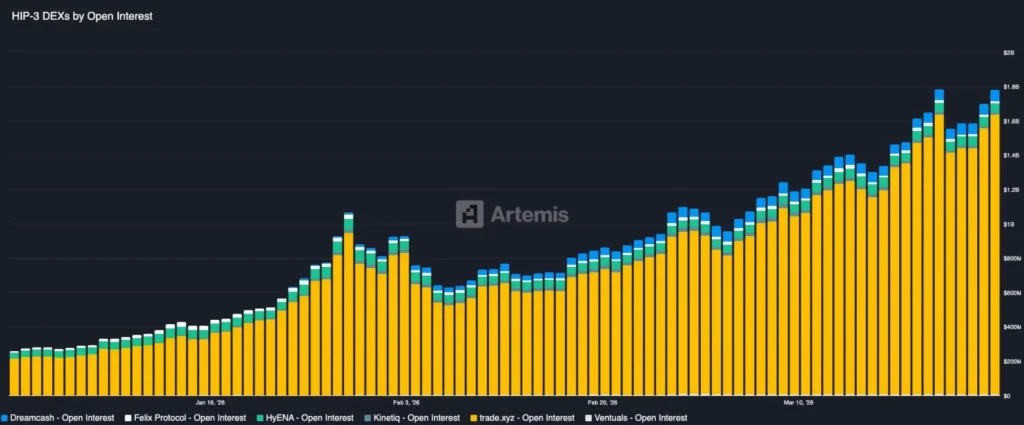
Ostium, Hyperliquid, and other such platforms have advanced the RWA perpetual adoption. Specifically, the HIP-3 launch of Hyperliquid in October last year unlocked perpetual futures access for more than one hundred RWA markets operating across equities, pre-IPO firms, FX, indices, and commodities. After launch, HIP-3 markets kept on generating trading volume, surpassing the $130B mark in total. So, as of March this year, the total open interest hit $1.7B while RWA markets contributed more than ninety percent.
The 2nd top RWA perp entity, Ostium, has shown considerable growth, processing nearly $46B in overall volume while taking into account 25,500 traders. Particularly, its 85% to 95% open interest deals with conventional assets like equities, FX, and commodities. The platform even controlled more than 50% of open interest in gold perpetuals on-chain during the past rallies, underscoring significant reliance of mainstream retail and crypto-native traders.
Challenge of RWA Pricing in 24/7 Markets
Irrespective of the swift adoption of the RWA perps, the platforms providing them face a crucial technical issue of pricing conventional assets continuously. So, without a comprehensive 24/7 reference, entities are required to balance capital safety and market availability.
For this purpose, Ostium utilizes a halt-and-freeze model through the Composite Oracle Services of Stork Network. This model delivers tailor-made feeds in the case of each of the asset classes. The framework enables precise pricing and mitigates risks from different futures contract rolls.
Simultaneously, Trade.xyz implements a 2-mode oracle mechanism concerning market closed and open hours. It prioritizes continuous price discovery and availability. Both the respective approaches disclose the trade-offs inherent within the design of RWA perps. Ostium provides more attention to capital protection and predictability, while Trade.xyz stresses market availability.
Risks and Opportunities in 24/7 Regulated Markets
The arrival of 24/7 trading within the conventional finance, led by top exchanges like ICE and NYSE, indicates a wider paradigm shift, impacting RWA perpification. Additionally, consistent access to market enhances oracle quality, improves institutional legitimacy, and shrinks arbitrage costs, bringing market makers to robust on-chain venues.
Moreover, it reduces the differentiation gap for crypto-native entities because regulated markets start providing some advantages formerly exclusive to decentralized perpetual exchanges. While consistent pricing decreases basis risk as well as volatility in the funding rates for trading on-chain, it also offers opportunities for retail-centered companies for innovation.
Features such as higher leverage, deep liquidity, and cross-collateralization may be fundamental for competitive edge. Therefore, RWA perp firms must transform their core infrastructure to compete with or complement conventional derivatives markets.
Road Ahead for RWA Perpification
At the moment, RWA perpification is ready to become the 2nd top export of the crypto sector, coming after perpetual futures. Over the upcoming 3 to 5 years, the respective metrics could enter mainstream adoption, backed by enhanced execution quality and improved oracle infrastructure. The demand is growing to wider audiences interacting in directional trading and macro hedging.
Overall, the real-world asset (RWA) perpification sector’s future depends on infrastructure, user experience, and liquidity. Platforms that offer dependable pricing, intuitive interfaces, and deep liquidity will overwhelm market formation. What started as a workaround for direct exposure to oil, gold, and other conventional assets, is revolutionizing into structural financial infrastructure.
When it comes to retail traders, perpetuals on-chain are not only an alternative, as they often underscore the only option. In the meantime, the wider financial network stands to leverage more inclusive, continuously active, and accessible derivatives markets.
Claims that Google has cracked Bitcoin’s encryption system have recently caused a stir on social media. However, experts say these claims are untrue and that the content of the scientific study has been distorted.
At the heart of the allegations are findings from Google’s quantum computing research suggesting that the resources needed to break Bitcoin’s secure cryptographic systems have been reduced by 20 times. Comments circulating on social media dramatized this development with statements such as, “Bitcoin can now be broken,” “Google did it but isn’t disclosing details,” and “Crypto has been given until 2029.”
However, cryptocurrency analyst Ahmet Usta, commenting on the issue, stated that these claims are significantly exaggerated. According to Usta, the relevant academic study does indeed indicate a reduction in the computational load required for quantum attacks; however, this does not mean that Bitcoin, in its current state, can be broken.
Related NewsTurkey’s Cryptocurrency Tax Regulation Passed the Committee with a Minor Amendment – Here’s the Latest Update
Usta added that the research in question mainly revealed theoretical advancements and that some approaches were validated with advanced cryptographic methods such as “Zero-Knowledge Proof,” but this did not directly mean that the Bitcoin network’s security had been compromised.
On the other hand, it is stated that the claims circulating on social media such as “Google is deliberately slowing down research” or “the crypto ecosystem has been given until 2029” are not included in the article. Usta said that the study only contains a technical approach regarding the possibility of not immediately disclosing some findings, and that interpreting this as an “ultimatum” is incorrect.
Experts say that while quantum computers have the potential to have significant long-term effects on cryptography, the Bitcoin network is generally secure at present. However, they point out that wallet addresses created in the early days, and whose public keys are visible on the blockchain, theoretically carry a higher risk.
Bitget Wallet has integrated the $XRP Ledger into its ecosystem, giving its 90 million users access to $XRP transfers, $RLUSD transactions, and cross chain swaps tied to one of crypto’s biggest non custodial wallet platforms.
The move gives XRPL broader retail distribution while positioning Ripple’s dollar backed stablecoin inside a wallet built around payments, not just trading.
The rollout plugs XRPL into Bitget Wallet’s wider Onchain Payments Matrix, which the company describes as infrastructure linking blockchains with bank rails, cards, and merchant payments. Bitget says users will be able to send and receive $XRP and $RLUSD on XRPL, swap XRPL assets across multiple chains, use fiat on and off ramps for $RLUSD, and interact with XRPL based applications directly inside the wallet.
Ripple says $RLUSD is issued natively on both $XRP Ledger and Ethereum, is fully backed by segregated cash and cash equivalent reserves, and is redeemable one to one for US dollars. That structure has made $RLUSD one of the more visible challengers in the regulated dollar stablecoin race, even if it remains far smaller than market leaders.
For XRPL, the Bitget Wallet tie up also adds another retail distribution channel at a time when the network is leaning harder into payments and real world financial use cases. XRPL’s official site pitches the ledger around low cost transfers and payments, while recent Bitget materials have also pointed to XRPL native card based spending as part of that broader push into daily use.
Bitget Wallet framed the integration as part of a larger shift in which crypto wallets become full financial interfaces rather than simple asset storage tools. The company said it will pair the integration with limited time incentives aimed at encouraging $RLUSD usage, liquidity, and activity across XRPL based applications.
The tax regulation for the cryptocurrency market in Turkey has passed through the commission and is preparing to be voted on in the General Assembly of Parliament. The new regulation includes significant changes in terms of both transaction tax and the taxation of earnings.
According to the proposal, a transaction tax of three per ten thousand (0.03%) will be levied only on sales and transfer transactions carried out or brokered by crypto asset service providers. While the authority to determine this tax rate is given to the President, the procedures and principles regarding its implementation will be determined by the Ministry of Treasury and Finance.
One of the most notable aspects of the regulation is the taxation of gains from crypto assets. Accordingly, income from the disposal of crypto assets will be classified as “capital gains.”
Related NewsBitcoin Report from Japanese Research Company: “Big Whales Are Selling, Institutions Are Buying” – What Does It Mean?
Article 5 of the proposal stipulates a 10% withholding tax on gains and income derived from crypto assets. For investors trading on domestic platforms under the supervision of the Capital Markets Board ($SPK), this withholding tax will be considered the “final tax,” and there will be no obligation to file a tax return. Thus, the taxation process will be automatically handled through the platforms.
In contrast, a different approach will apply to investors trading on foreign or global cryptocurrency platforms that are outside the scope of the Capital Markets Board ($SPK) oversight. These investors will be required to declare their earnings themselves through their annual income tax returns. It is stated that the tax rate could reach up to 40% for earnings exceeding 5 million TL.
XWIN Research Japan, a Japan-based research firm, pointed to a notable supply structure in the Bitcoin ($BTC) market, indicating a clear divergence between large investors and institutional buyers.
According to the company, while the Bitcoin price appears stuck around the $70,000 level, a weak market structure is evident on the surface. In particular, the Exchange Whale Ratio metric, prominent in on-chain data, reveals increased activity by large investors in exchanges and strengthening short-term selling pressure. This aligns with a picture where the market is struggling to produce an upward breakout.
However, more in-depth analyses indicate a significant shift in market dynamics. It is reported that approximately 62,000 $BTC were purchased by publicly traded companies in the first quarter of 2026, with these purchases largely corroborated by official financial statements and regulatory filings. In particular, MicroStrategy’s continued accumulation of Bitcoin through capital increases and debt financing is creating a sustained source of demand in the market.
Related NewsOn-Chain Data Shows Large Whales Are Concentrating in an Altcoin
The report notes that these institutional actors, unlike traditional long-term investors, actively utilize capital markets. It adds that these purchases, made through debt and equity issuance, create a demand flow independent of price movements, absorbing supply even in weak market conditions.
On the other hand, a mixed picture prevails in spot Bitcoin ETFs. While inflows are seen in the products of some large companies like BlackRock, the ongoing outflows from Grayscale are said to indicate a rotation among funds rather than new money entering the market. Therefore, it is stated that total ETF assets will be flat or slightly declining in the first quarter of 2026.
When all this data is considered together, it appears that the Bitcoin market has become fragmented. Large investors are driving short-term volatility with sales, while institutional companies are steadily accumulating in the background. ETF investors are not showing a clear direction, while individual investors are generally on the selling side.
XWIN Research Japan argues that Bitcoin is not simply in a “weak” market, but rather undergoing a transitional period where who controls the supply is changing.