Category: Business

  • Most Visited Cryptocurrencies on CoinMarketCap: $BTC, $PI and $XRP Dominate

    According to the data collected by CoinMarketCap (CMC), here is a list of the top 10 most viewed cryptocurrencies: Bitcoin ($BTC), Pi ($PI), $XRP ($XRP), Ethereum ($ETH), Solana ($SOL), BlockDAG ($BDAG), PAX Gold ($PAXG), OFFICIAL $TRUMP ($TRUMP), Bittensor ($TAO), and Hyperliquid ($HYPE). These are the coins on which people show their concern, maybe due to an upcoming listing or sometimes a change in their prices over the period of time.

    Bitcoin ($BTC) Leads the Trends While Pi ($PI) Follows Closely

    Bitcoin ($BTC) is in the leading position among other altcoins due to a consistent change in price over the period of time. Bitcoin ($BTC) is currently trading at $71830.60 with a market cap of $1436780145295. At the same time, $BTC holds a volume of $21364140051 by last 24 hours.

    Pi ($PI) remains runner-up in this race and has caught the attention of more people frequently over the short period of time, especially for its listing and price fluctuation respect. $PI trades at $0.1925 with volume of $63239592. Although it’s low price, it still has a market cap of $1865635574.

    Crypto Watchlist Highlights $XRP ($XRP), Ethereum ($ETH), and Solana ($SOL)

    $XRP ($XRP) and Ethereum ($ETH) gain 3rd and 4th position in this list with prices of $1.41, $2119.12, and market caps of $86628186814, $255760784749, respectively. Moreover, $XRP and Ethereum hold volumes of $1247195298 and $9488640913. Solana ($SOL) is also among the most viewed cryptocurrencies, with a current price of $88.75 and a market cap of $50708172558 with a volume of $2109325979.

    BlockDAG ($BDAG) and PAX Gold ($PAXG) hold volumes of $8444137 and $92296033 with current prices of $0.0653 and $5014.21, respectively. PAX Gold ($PAXG) is at the 7th position with a market cap of $2508935388. OFFICIAL $TRUMP ($TRUMP) holds 8th position with a current price of $4.02, along with a volume of $579687282. OFFICIAL $TRUMP ($TRUMP) has a market cap of $934275617.

    Hyperliquid ($HYPE) Gains Attention as Bittensor ($TAO) Appears in Most Viewed Cryptos

    As per the CMC leaderboard, Bittensor ($TAO) holds a market cap of $2855964996 with a current price of $265.23. Bittensor ($TAO) got the 2nd last position in the given list of most viewed cryptocurrencies. Bittensor ($TAO) has a volume of $374759189. Last but not least, Hyperliquid ($HYPE) is at the 10th position in the given list of most viewed cryptocurrencies over time.

    Hyperliquid ($HYPE) is trading at $37.33 in the market and also attracts the attention of people toward it. Furthermore, Hyperliquid ($HYPE) has a market cap of $9602916012 along with the volume of $253260763 over the previous 24 hours.

  • Billionaire Investor Stanley Druckenmiller Bullish on Stablecoin Growth

    Billionaire Investor Stanley Druckenmiller Bullish on Stablecoin Growth

    In brief

    • Billionaire investor Stanley Druckenmiller is bullish on the future of stablecoins.
    • The former hedge fund manager believes stablecoins will underpin the entire financial system in 10-15 years.
    • However, he said the rest of crypto is “a solution looking for a problem.”

    Billionaire investor Stanley Druckenmiller thinks that stablecoins are “incredibly useful”—so much so that he expects them to become the backbone of the financial system in the coming decades. 

    “I assume our whole payments systems will be stablecoins in 10 or 15 years,” he said in a newly posted video interview with Morgan Stanley, calling the fiat-pegged tokens highly productive thanks to their efficiency and cost-effectiveness. 

    The former hedge fund manager did not speak as highly about the rest of the crypto industry.

    “It’s a solution looking for a problem,” he said when asked what came to his head about “crypto” in a word association game. “I’m very sad that it ever happened as a store of value, ‘cause it wasn’t needed.”

    “But it’s a brand, and these people love it, so it’s going to be a store of value,” he added, not specifically singling out Bitcoin or any other tokens. 

    The commentary jives a bit with previous remarks from Druckenmiller, who noted in 2020 that he believed the “Bitcoin bet” could work better than a bet on gold, should the established store of value and precious metal ultimately go up. 

    At the time, with Bitcoin priced around $15,000, he cited the token’s illiquidity and volatility as positives that could lead to a stronger rise. As Bitcoin trades around 5x higher now, it seems the billionaire’s thesis may have played out in the last six years.

    But even then, Druckenmiller noted that the top crypto asset was an unnecessary creation, saying, “I don’t understand why we need this thing.” 

    Six years later, the asset has climbed to a $1.4 trillion market cap as it changes hands around $71,520 on Friday, a rebound of around 8.5% in the last 30 days. At that price, BTC is still down around 43% from its October all-time high of $126,080. 

    On the other hand, the growing market cap of stablecoins has largely been up and to the right, now sitting around $315 billion, according to data from DeFiLlama. That marks an increase of more than $180 billion in circulating supply since the beginning of 2024, and high-ranking officials like U.S. Treasury Secretary Scott Bessent think that mark could triple by 2030.

    Daily Debrief Newsletter

    Start every day with the top news stories right now, plus original features, a podcast, videos and more.

  • Kraken-Linked SPAC Could Target Crypto Firm Valued at Up to $10 Billion

    Kraken-Linked SPAC Could Target Crypto Firm Valued at Up to $10 Billion

    In brief

    • KRAKacquisition may find a target that’s worth as much as $10 billion.
    • The goal is to align a small- or mid-cap company with the crypto exchange.
    • The search comes as Kraken contemplates its own public offering.

    KRAKacquisition Corp., a special purpose acquisition company formed in January, is searching for a target that could be worth as much as $10 billion, director Ravi Tanuku told Decrypt.

    The blank-check firm, sponsored by an affiliate of crypto exchange Kraken, hasn’t determined what that firm could look like, but Tanuku noted that Wall Street’s interest in firms associated with stablecoins and tokenization reached new heights last year.

    “The market is clearly paying up for those and starting to realize there’s big changes afoot,” he said. “In our mind, that’s a good signal to be aware of.”

    SPACs are shell companies that are specifically designed to take private companies public via a reverse merger. In January, KRAKacquisition completed a $345 million public offering, marking the start of a two-year countdown for the firm to identify an acquisition target.

    Tanuku underscored that the $10 billion threshold is an approximation, and KRAKacquisition’s target could ultimately be valued closer to $2 billion. Still, the range highlights the breadth of the company’s interest in helping small- and mid-cap companies explore public markets.

    “It’s not easy to take a company in that smaller market cap range public anymore,” he said. “We’re looking at things that are related to crypto, but also things related to stablecoins, DeFi, and all kinds of areas in payments.”

    The search comes as Kraken contemplates its own public offering this year. In November, the crypto exchange said it had confidentially filed a registration statement with the SEC, not long after announcing a massive $800 million fundraising round that valued it at $20 billion.

    Tanuku described KRAKacquisition as a strategic investment tool for Kraken, potentially aligning another firm with the exchange economically through a reasonably significant stake. He noted that the exchange’s commitment is reflected in its willingness to lend its brand.

    In KRAKacquisition’s registration statement, the firm references inflation. It argues a decline in the U.S. dollar’s purchasing power has bolstered “hard assets as hedges” like Bitcoin over time.

    Daily Debrief Newsletter

    Start every day with the top news stories right now, plus original features, a podcast, videos and more.

  • Strategy Founder and Major Bull Michael Saylor Has Issued the Anticipated Weekly Bitcoin Signal

    Strategy Founder and Major Bull Michael Saylor Has Issued the Anticipated Weekly Bitcoin Signal

    Michael Saylor has fueled speculation in the market about a possible new buy signal by reposting data from his company’s “Saylor Tracker,” which monitors Bitcoin holdings.

    Strategy founder Saylor, in a social media post, used the phrase “extend the orange dot,” which investors interpreted as a sign that the company may soon announce a new Bitcoin purchase. In the chart shared by Saylor, the orange dots represent $BTC purchases.

    In the past, the company is known to announce Bitcoin purchases shortly after similar announcements.

    According to the data, Strategy’s Bitcoin reserves are worth approximately $53 billion. The company’s total holdings are calculated at 738,731 $BTC, with an average purchase cost of $75,863. Based on current market prices, the company’s portfolio shows an unrealized loss of approximately 5.42%, indicating a loss in value of approximately $3.04 billion.

    Strategy has recorded a total of 102 Bitcoin purchases to date. The most recent transaction took place last Monday, when the company bought 17,994 $BTC at an average price of $70,946, totaling approximately $1.28 billion. Following this transaction, the company’s total Bitcoin holdings rose to 738,731 $BTC.

    *This is not investment advice.

  • Bitcoin set for best week since September 2025 as correlation with tech stocks weakens

    Bitcoin set for best week since September 2025 as correlation with tech stocks weakens

    Bitcoin is on track to close its strongest week since September 2025, rising about 8.5% and trading above $71,000.

    The move stands out relative to other major assets.

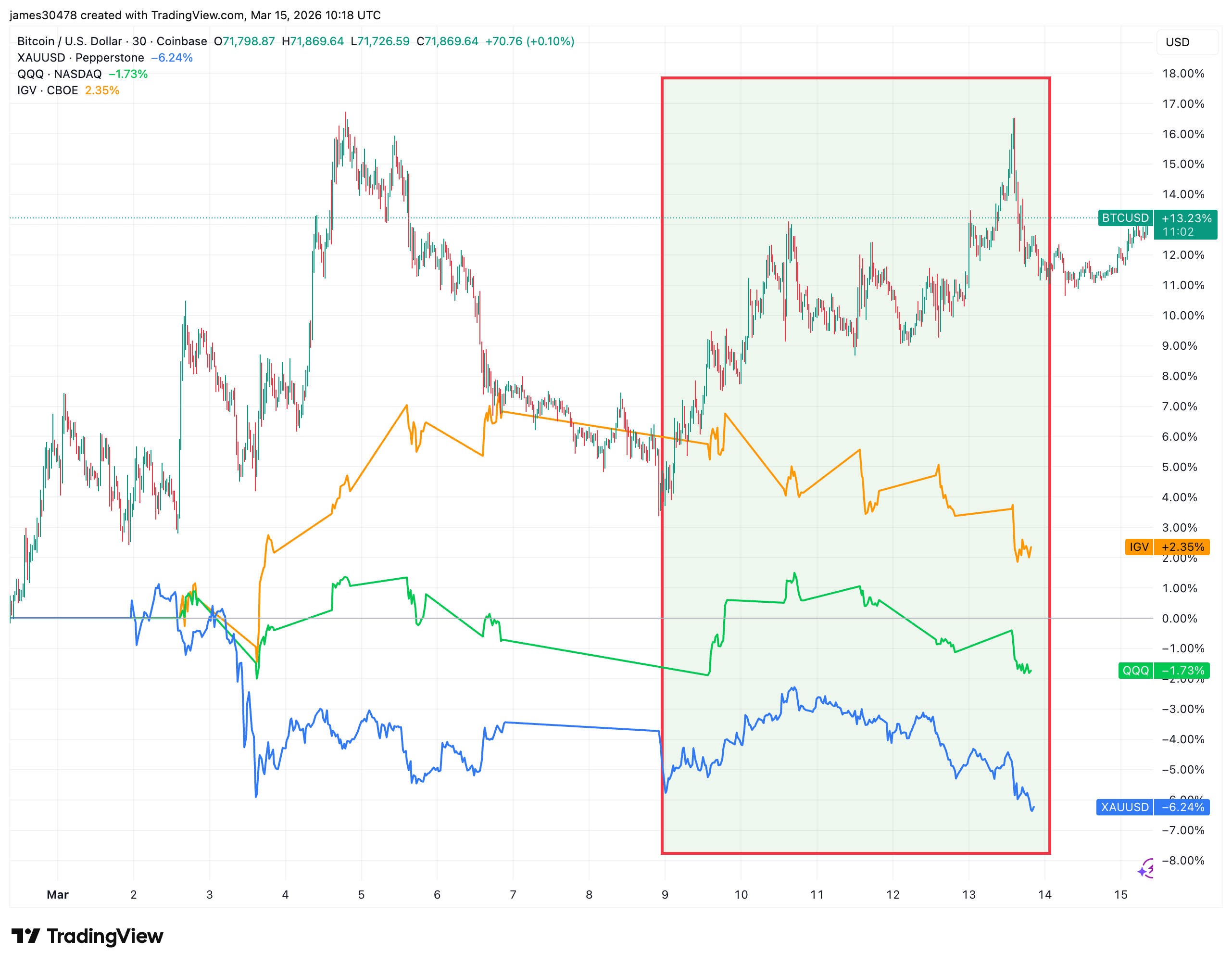
    Over the past week, bitcoin has begun to diverge slightly from the broader market. Using BlackRock’s iShares Bitcoin Trust (IBIT) as a five-day proxy, IBIT is up roughly 3.5% and approached a one-month high on Friday.

    In contrast, iShares Expanded Tech Software ETF (IGV), gold and U.S. equities all trended lower as the week progressed. This suggests bitcoin is starting to lose its strong correlation with software and tech, at least in the short term.

    BTC divergence versus IGV, QQQ and Gold. (TradingView)

    The divergence comes as bitcoin started to diverge from its traditional counterparts. Since the start of the conflict in the Middle East, over two weeks ago, bitcoin has gained roughly 13%, outperforming traditional risk assets and safe havens alike. Over the same period, IGV has risen about 3%, while gold has fallen around 6%, and U.S. equities have also posted losses.

    On a monthly basis, the asset is up about 7% so far in March, which would mark its first positive month since September. That rebound follows five consecutive negative months in which bitcoin declined as much as 50% from its October all-time high.

    The buyers of the largest digital asset appear to be U.S., as institutional demand from the region appears to be gradually returning. US spot bitcoin ETFs have recorded approximately $1.3 billion in net inflows so far in March, putting them on track for their first month of net inflows since October.

    However, the divergence doesn’t mean that bitcoin is completely out of the woods yet.

    The market sentiment remains extremely cautious. The crypto fear and greed index has stayed in “extreme fear” territory. At the same time, perpetual futures funding rates remain negative. Funding rates are periodic payments exchanged between traders in perpetual futures markets to keep contract prices aligned with the spot market. When funding rates are negative, short sellers pay long positions, indicating that bearish positioning is dominant and traders are willing to pay to maintain short exposure.

    While it may not mean bitcoin is all-clear to take off, it does show that investors aren’t pricing it as a purely risk asset anymore.

    As CoinDesk analysis showed, the move might just mean bitcoin has potentially become a 24/7 leading indicator of how the overall market might trade in response to a macro event. The Middle East conflict is the perfect example of this, as the price moved before any other asset classes when the war first started. And now, it seems everything else is following its price action, while bitcoin remains steady.

    Read more: Bitcoin’s recent crash to $60,000 warned stocks first – now they’re following

  • Bitcoin whales are starting to accumulate again at $71K: Santiment

    Bitcoin whales are starting to accumulate again at $71K: Santiment

    Large Bitcoin wallets are increasing their holdings again as the asset’s price holds around $71,000, according to crypto sentiment platform Santiment.

    “Their recent shift to accumulation is a bullish signal,” Santiment said in a report on Saturday, referring to wallets holding between 10 and 10,000 Bitcoin ($BTC).

    “This is a positive reversal,” Santiment added. Santiment data shows wallets holding 10 to 10,000 Bitcoin ($BTC) now control 68.17% of Bitcoin’s total supply, up from 68.07% seven days earlier.

    Santiment eyeing retail investor activity

    Santiment said that a potential local bottom in Bitcoin could be forming if whales continue accumulating while retail investors’ share of holdings begins to decline.

    “Ideally, we want to see small wallets (retail) drop while this group rises, signaling a transfer of coins from weak hands to strong hands,” Santiment said.

    An increase in retail buying suggests over-optimism, since Bitcoin’s price has historically bottomed when everyday investors start losing hope and selling.

    At the same time, the Crypto Fear & Greed Index stayed in “Extreme Fear” on Sunday at 16, signaling investors are still cautious.

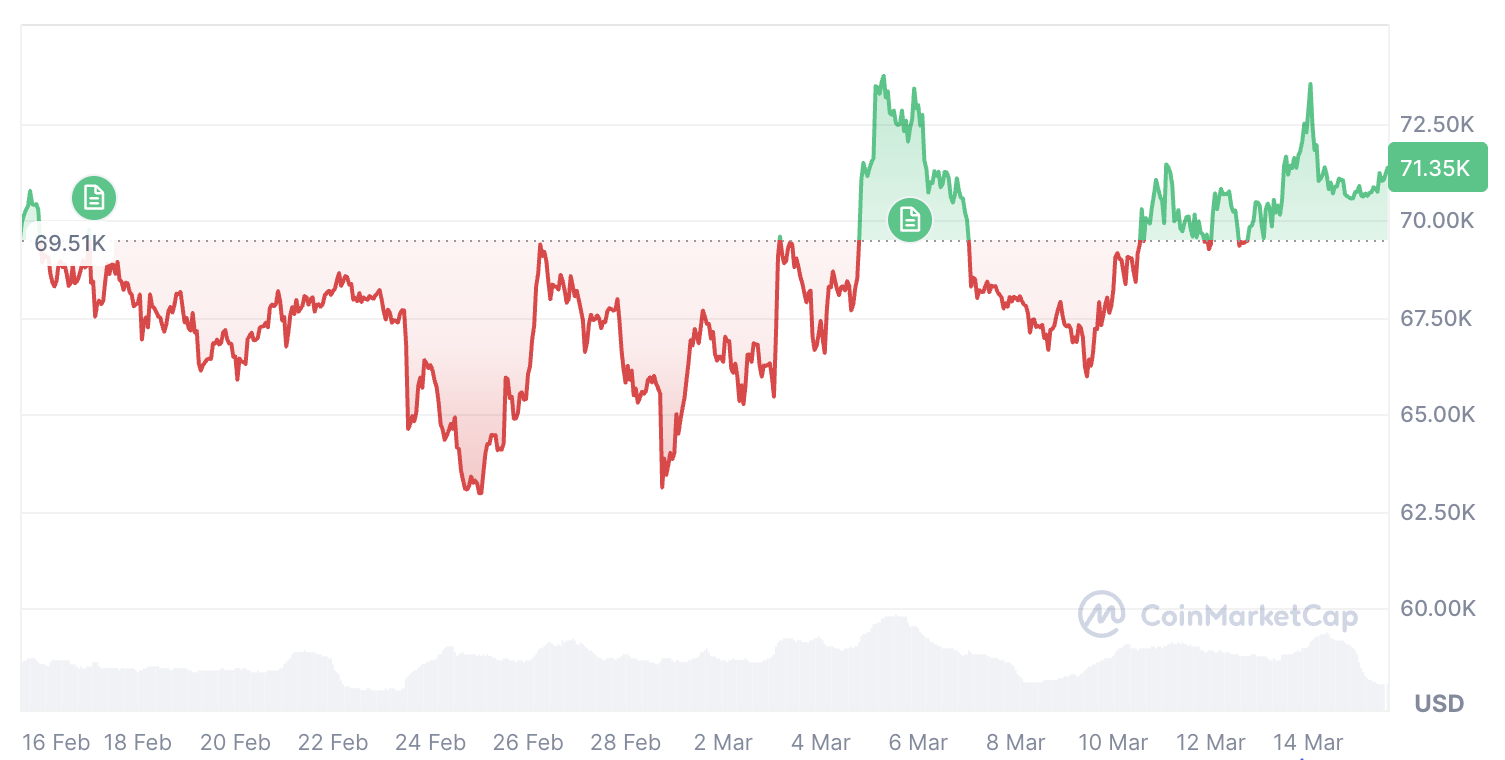
    Bitcoin is trading at $71,350 at the time of publication, up 6.30% over the past seven days.

    Cryptocurrencies, Bitcoin Price, Adoption

    Bitcoin is up 7.55% over the past 30 days. Source: CoinMarketCap

    Just over a week ago, Bitcoin whale activity was vastly different. Santiment reported on Mar. 6 that, in the two days prior, whales had sold 66% of the Bitcoin they bought between Feb. 23 and Mar. 3, just as Bitcoin surged past $70,000 and briefly touched $74,000.

    Market bottom still uncertain

    However, Santiment said that if retail investors keep buying Bitcoin, it could mean more downside ahead.

    “Historically, markets tend to bottom when the ‘crowd’ loses hope. The persistence of retail optimism is currently the biggest argument against a confirmed bottom,” Santiment said.

    “Markets rarely reward the majority consensus immediately,” Santiment added.

    Bitcoin onchain analyst Willy Woo echoed a similar view, recently saying that Bitcoin is “solidly in the middle of its bear market through a lens of long-range liquidity.”

    It comes as US spot Bitcoin exchange-traded funds (ETFs) logged their first five-day inflow streak of 2026, bringing in roughly $767.32 million this week.

  • 65% of Bitcoin Safe From Quantum Computing Threat

    65% of Bitcoin Safe From Quantum Computing Threat

    A new research report suggests quantum computing poses a long-term risk to bitcoin but is unlikely to threaten the network anytime soon. Experts say advances will occur gradually, giving developers and investors time to implement post-quantum security upgrades.

    New Research Says Quantum Risk to Bitcoin Is Real but Not Immediate

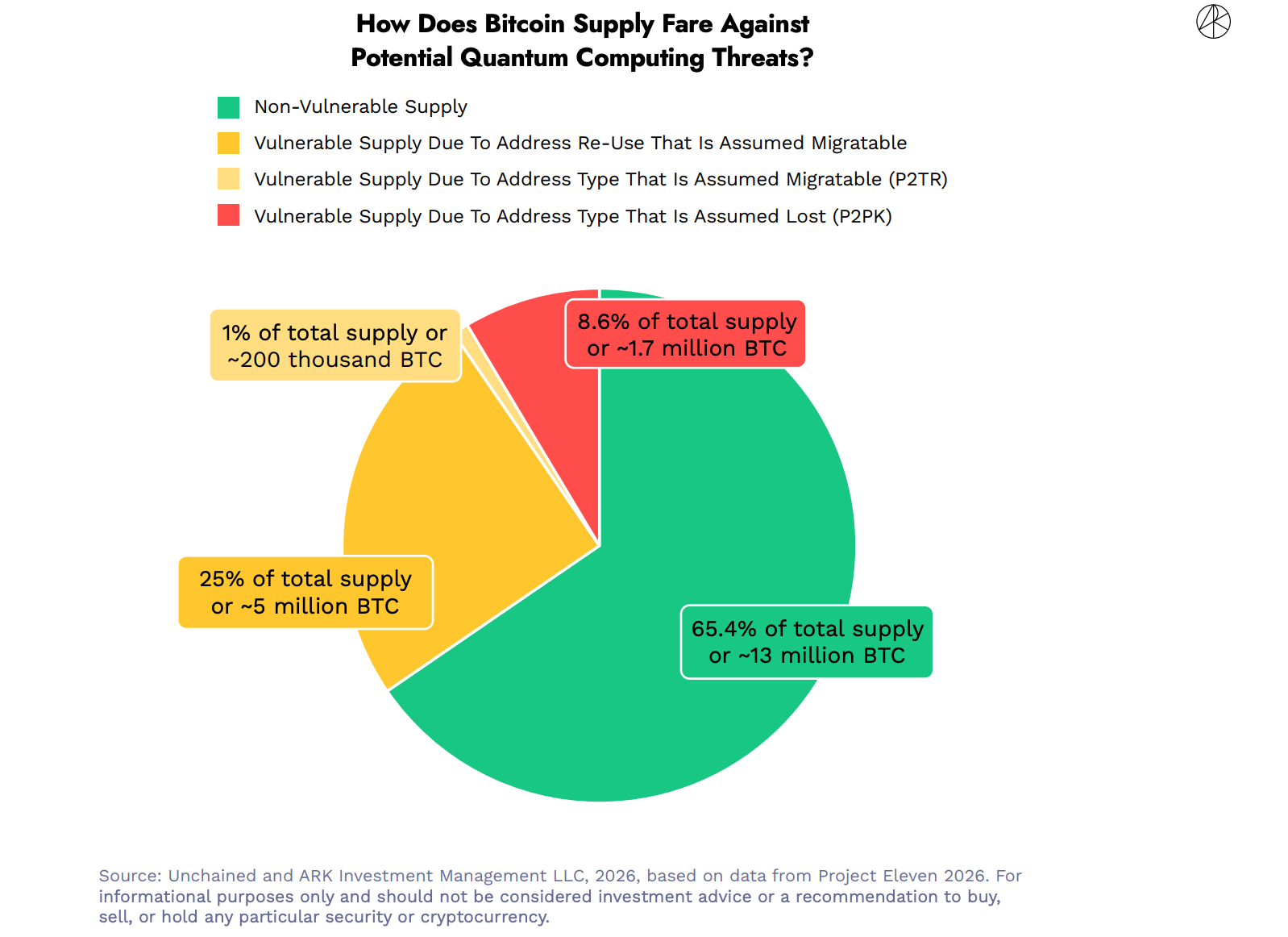
    A new research report by Ark Invest and bitcoin-focused financial services company Unchained, examining the intersection of quantum computing and bitcoin security, concluded that while quantum technology could eventually challenge the network’s cryptography, the threat remains far from imminent.

    According to the study, current quantum systems operate in what researchers call the “Noisy Intermediate-Scale Quantum” (NISQ) era, where machines typically run with fewer than 100 logical qubits and limited computational depth. Breaking bitcoin’s elliptic curve cryptography would require at least 2,330 logical qubits and millions to billions of quantum operations, far beyond today’s capabilities.

    Instead of a sudden “Q-day” where bitcoin security collapses, researchers argue that quantum progress will likely unfold through a series of gradual technological milestones. These stages range from early scientific applications, such as materials simulation and chemistry, to the eventual ability to attack weak cryptographic systems.

    Only in later stages could quantum computers begin to threaten bitcoin’s elliptic curve digital signature algorithm (ECDSA), which secures private keys and transactions.

    Even then, attacks would likely be slow and costly, requiring significant computational resources. The report estimates that electricity costs alone could reach around $100,000 to break a single bitcoin key in early quantum attack scenarios.

    Vulnerable Bitcoin Supply

    Researchers estimate that roughly 35% of the total Bitcoin supply could theoretically be exposed to future quantum risks. This includes about 1.7 million $BTC stored in older address types believed to be lost and roughly 5.2 million $BTC in reusable addresses that could be migrated to safer formats.

    However, the majority of bitcoin remains stored in quantum-resistant address formats, and developers already have potential solutions in motion.

    Several initiatives are underway across the crypto ecosystem. Exchanges like Coinbase have established quantum advisory boards, while developers are discussing proposals such as Bitcoin Improvement Proposal (BIP) 360, which explores new address types designed to withstand quantum attacks.

    Preparing Before the Threat Arrives

    Security researchers emphasize that the broader internet, including banking systems, government communications, and cloud infrastructure, would face disruption long before bitcoin itself becomes vulnerable.

    In parallel, post-quantum cryptography (PQC) standards are already being developed and deployed across the internet infrastructure. If necessary, bitcoin could eventually integrate similar cryptographic upgrades through protocol changes.

    For investors and network participants, the takeaway is clear: quantum computing represents a long-term technological challenge rather than an urgent security crisis.

    As with most transformative technologies, progress will likely unfold over decades, providing the bitcoin ecosystem ample time to adapt.

  • Bitcoin sold off first when the U.S.-Iran war began. Two weeks later, it’s outperforming nearly everything

    Bitcoin was the first asset to price the Iran war because it was the only liquid market open when U.S. and Israel first launched their attack on a Saturday, a few weeks ago.

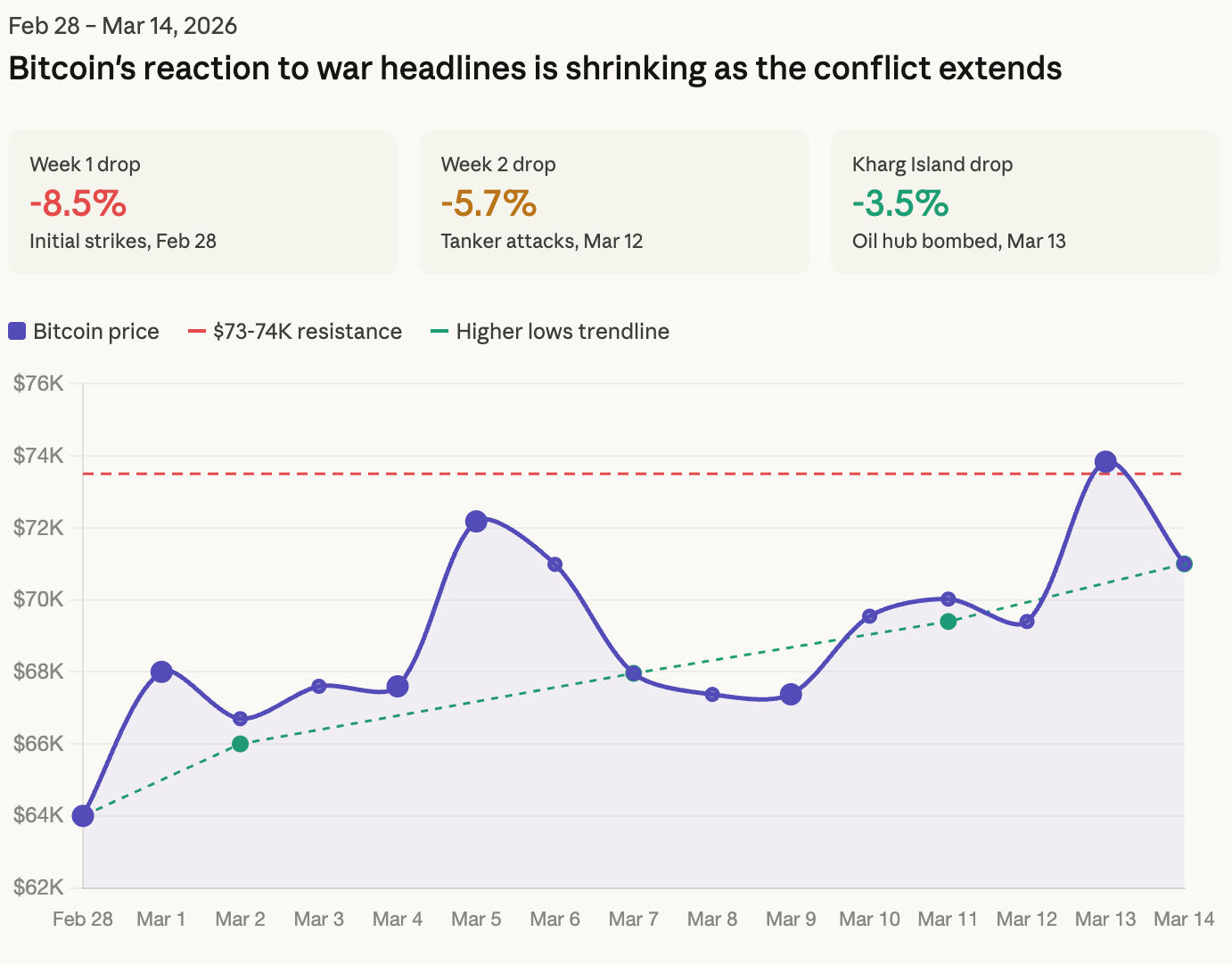
    It dropped 8.5% that day. Two weeks later, it has outperformed gold, the S&P 500, Asian equities, and the Korean stock market. Only oil and the dollar have done better, and both are direct beneficiaries of the conflict itself.

    Bitcoin’s safe-haven status — a notion that was contested amid late last year’s price lull — seems to be back in investors’ minds. On top of that, it’s acting like the fastest shock absorber in global markets as escalations are getting bigger while drawdowns are getting smaller.

    The pattern becomes clearer when looking at where bitcoin found buyers after each sell-off.

    On Feb. 28, the day of the initial strikes, it bottomed at $64,000. On March 2, after Iran’s retaliatory missiles hit Gulf states, the floor was $66,000. By March 7, after a week of sustained conflict, the low was $68,000. After the tanker attacks on March 12, it held $69,400. And after Kharg Island on Saturday, the low was $70,596.

    In simpler terms, each selloff finds buyers at a higher level than the last.

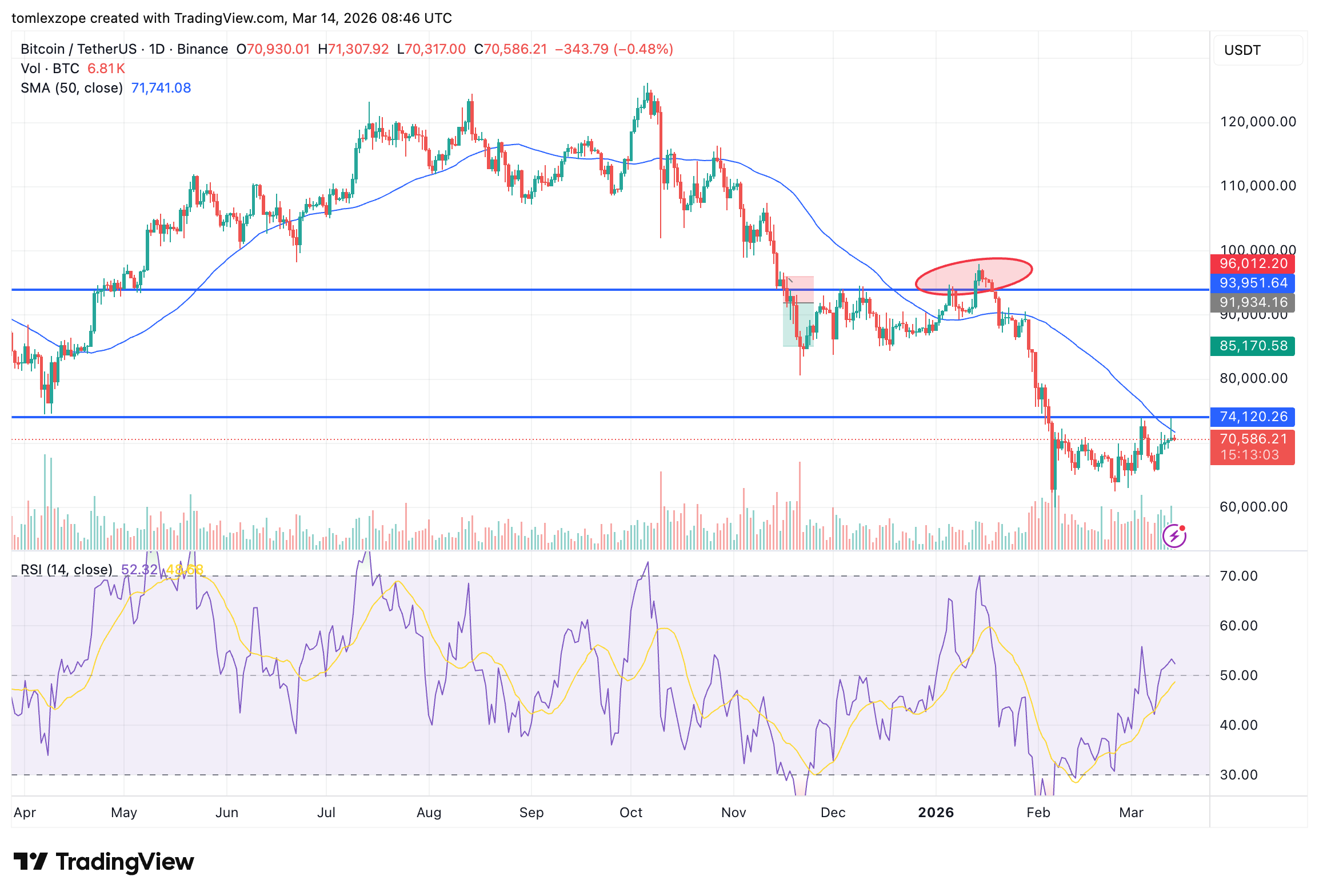
    The trendline of higher lows has been rising by roughly $1,000-$2,000 per event, compressing the range from below, while $73,000-$74,000 holds as a ceiling that has now rejected bitcoin four times.

    That compression has to resolve eventually. Either the floor catches the ceiling and bitcoin breaks above $74,000 on the next attempt, or the pattern breaks, and a larger escalation finally overwhelms the buying.

    Holding strong

    The most striking part is what bitcoin has done relative to other assets over the same two weeks.

    Oil is up more than 40% since the war began, as the chart below shows. The S&P 500 is down. Gold has been volatile in both directions. Asian equities had their worst week since March 2020.

    All this doesn’t mean bitcoin is suddenly a safe haven, however, as it still sells on every headline. But it recovers faster each time, and each recovery holds at a higher level.

    The contrast with earlier this year is sharp. In early February, a sudden liquidation cascade wiped out $2.5 billion in leveraged positions over a single weekend as bitcoin plunged to $77,000, erasing roughly $800 billion in market value from its October peak.

    That episode looked like the kind of event that could break market confidence for months. Instead, it appears to have cleared out the weakest hands and reset positioning, leaving a leaner market that has absorbed every war headline since without repeating that kind of forced selling.

    The macro overlay adds context, meanwhile. Trump said late Friday he spared oil infrastructure on Iran’s oil-producing Kharg Island “for reasons of decency” but would “immediately reconsider” if Iran kept blocking the Strait of Hormuz. Iran responded that any strike on energy infrastructure would trigger retaliatory attacks on U.S.-linked facilities.

    That conditional threat is new, and if it materializes, the supply disruption the IEA already called the largest in history will get dramatically worse.

    But bitcoin’s adaptation to the war tells traders something about what this market has become.

    It’s not a haven and not purely a risk asset. It has become a 24/7 liquidity pool that absorbs shocks faster than anything else because it’s the only thing trading when the shocks arrive.

  • On-Chain Data Shows Why Bitcoin’s Next Stop Could Be At $82K

    On-Chain Data Shows Why Bitcoin’s Next Stop Could Be At $82K

    The Bitcoin price has not particularly impressed over the past two weeks, but it appears to have steadied its movement within a clear consolidation range. In its latest attempt to shine, the premier cryptocurrency faced fierce resistance around $74,000 on Friday, March 13.

    Interestingly, the latest on-chain data suggests that the $74,000 resistance might not be the barrier it appears to be. According to a prominent crypto analyst on the social media platform X, the Bitcoin price seems to have a free runway to return to above the $80,000 mark.

    $BTC Price Has Free Runway To $82,000: Analyst

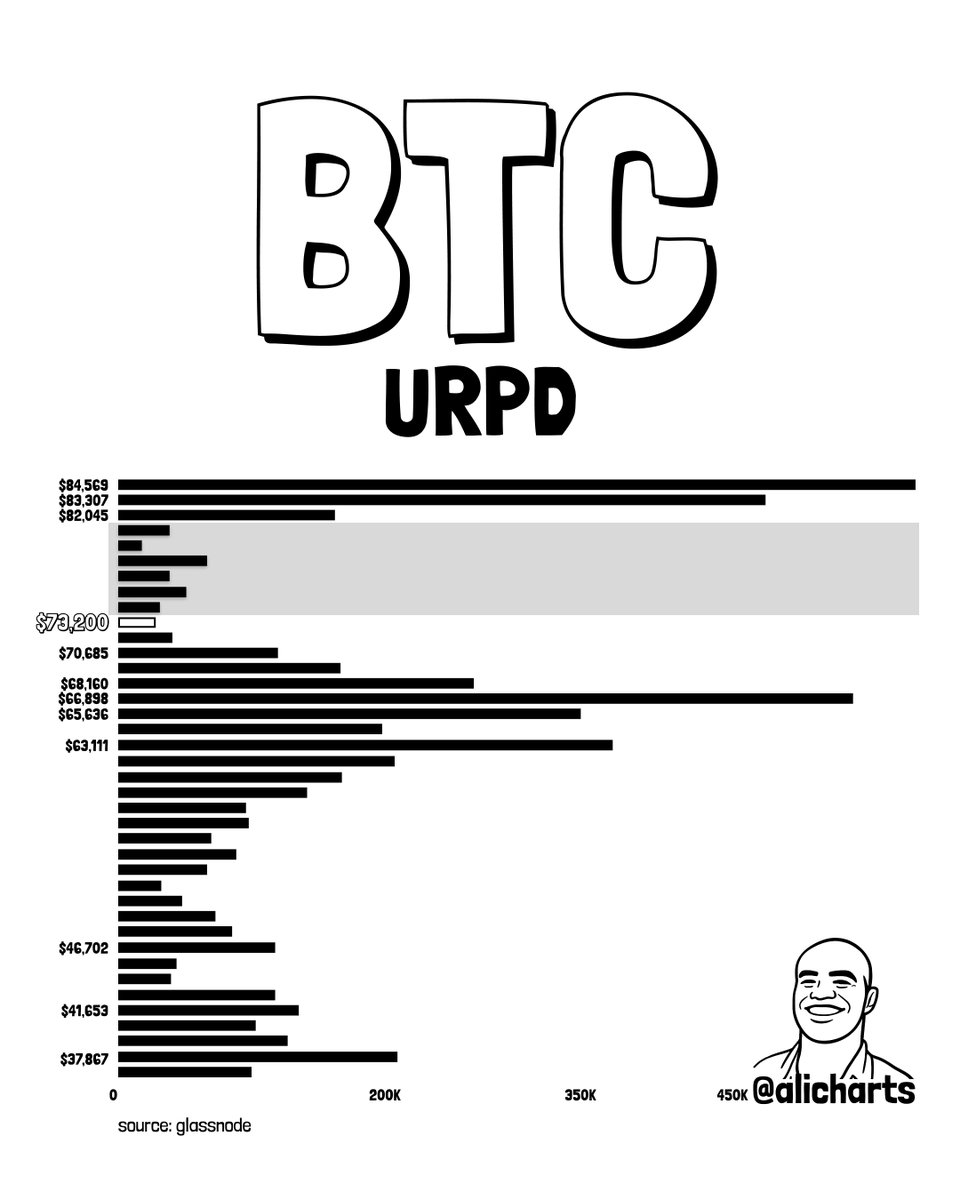
    Market pundit Ali Martinez took to the X platform to share an on-chain insight into the Bitcoin price movement over the coming weeks, with a return to around $82,000 looking more likely with no obstacles. This on-chain observation is based on the UTXO Realized Price Distribution (URPD) metric, which shows the next relevant levels for $BTC.

    The URPD metric shows how critical a price level is by tracking the volume of cryptocurrency purchased at a specific level. This is because the capacity for a Bitcoin price level to function as a support or resistance zone usually depends on the number of $BTC investors who have their cost basis at the given level.

    Typically, price levels below the current spot value with substantial buying activity are often considered major support regions. Meanwhile, levels above the current price with significant investor cost bases usually function as major resistance areas.

    According to Martinez, the Bitcoin price has entered a low-resistance region, with barely any obstacles in its way until around $82,045. This puts into question the rejection recently faced around the $74,000 mark, which has insignificant investor activity per the UTXO Realized Price Distribution metric.

    A move to this next major on-chain resistance would mean an over 17% surge from the current price point, with an upward movement of that magnitude not seen so far this year. However, if the Bitcoin price doesn’t find the bullish momentum necessary to spur a rally toward the $82,000 mark, the next major support cushion sits at around $66,898.

    Ultimately, it appears that Bitcoin price might be looking to expand its consolidation range, with $82,000 as the potential upper boundary.

    Bitcoin Price Overview

    As of this writing, the price of $BTC stands at around $70,820, reflecting a mere 0.5% jump in the past 24 hours. According to data from CoinGecko, the flagship cryptocurrency is up by more than 3% in the past seven days.

    Featured image from DALL-E, chart from TradingView

  • Ethereum Foundation sells 5,000 ETH to Bitmine to fund operations and grants

    Ethereum Foundation sells 5,000 ETH to Bitmine to fund operations and grants

    The Ethereum Foundation announced today it executed an OTC sale of 5,000 $ETH to Bitmine, the largest Ethereum treasury firm led by Thomas “Tom” Lee.

    0/ Today, the Ethereum Foundation finalized the terms of a 5,000 $ETH sale at an average price of $2,042.96 via OTC.

    For this sale, our OTC counterparty was @BitMNR.

    — Ethereum Foundation (@ethereumfndn) March 14, 2026

    The EF plans to use proceeds from the sale to support its ongoing activities, including protocol research and development, ecosystem growth initiatives, and community grant programs.

    The Foundation still holds approximately 170,000 $ETH worth around $356 million, according to Arkham Intelligence data. The entity has begun staking its treasury $ETH, starting with 2,016 in February and planning to stake about 70,000 $ETH in total.

    Bitmine has steadily accumulated $ETH since launching its treasury strategy last June. The company’s holdings have exceeded 4.5 million units, valued at $9.5 billion at current market prices.

    Over 3 million $ETH is currently staked, producing annualized staking revenues of roughly $174 million, with potential to reach $259 million when fully deployed through its upcoming MAVAN validator network.

    Ethereum Foundation outlines mission and principles in new EF Mandate

    The sale follows the Foundation’s recent release of the EF Mandate, a document defining its role and guiding philosophy in supporting the development of Ethereum.

    The foundation said its primary responsibility is safeguarding Ethereum’s commitment to user self-sovereignty.

    The mandate says the network must remain censorship-resistant, open source, private, and secure, while emphasizing that the foundation is one steward among many, not the network’s authority.

    Disclosure: This article was edited by Vivian Nguyen. For more information on how we create and review content, see our Editorial Policy.