Category: Business

  • Thursday Has Been Designated as a Critical Day in the Peace Talks Between the U.S. and Iran

    Thursday Has Been Designated as a Critical Day in the Peace Talks Between the U.S. and Iran

    While diplomatic contacts intensify between the US and Iran regarding a possible peace process, it has been reported that the parties have not yet reached a concrete agreement and uncertainty persists.

    According to two sources close to the matter, the US and regional mediators are considering the possibility of holding a high-level peace summit as early as Thursday. However, the Washington administration remains awaiting an official response from Tehran.

    While the process is shaped by US President Donald Trump’s desire to end the war, Iran’s influence over the Strait of Hormuz and the military balance in the region are complicating a possible exit strategy. Although it is claimed that the US shared a 15-point plan to end the war with Israel and that Iran accepted some critical points of this plan, there is no concrete evidence to support this. Iranian officials, while denying claims of behind-the-scenes negotiations, confirm that they have received various messages and proposals from the US.

    On the Israeli front, developments are being watched cautiously. Prime Minister Benjamin Netanyahu is reportedly concerned that the Trump administration may reach an agreement that falls short of Israel’s goals and that significant concessions may be made to Iran. Israeli sources, while skeptical of the US claims that Iran has made concessions, indicate that the difference in positions between the two countries remains significant.

    It is reported that Pakistan, Egypt, and Turkey have assumed mediating roles in the diplomatic process, with Pakistan specifically stating its readiness to host talks if the parties agree. Trump’s public sharing of this message reveals his interest in a possible summit. While it is stated that the US Vice President may also be involved in the process if the talks take place, sources say that it is not even clear yet whether there is a concrete basis for negotiations.

    *This is not investment advice.

  • MNT price prediction as Mantle DeFi TVL surpasses that of Sui

    MNT price prediction as Mantle DeFi TVL surpasses that of Sui

    • Mantle’s DeFi TVL surges, surpassing major rival networks.
    • Mantle ($MNT) price lags despite strong ecosystem growth.
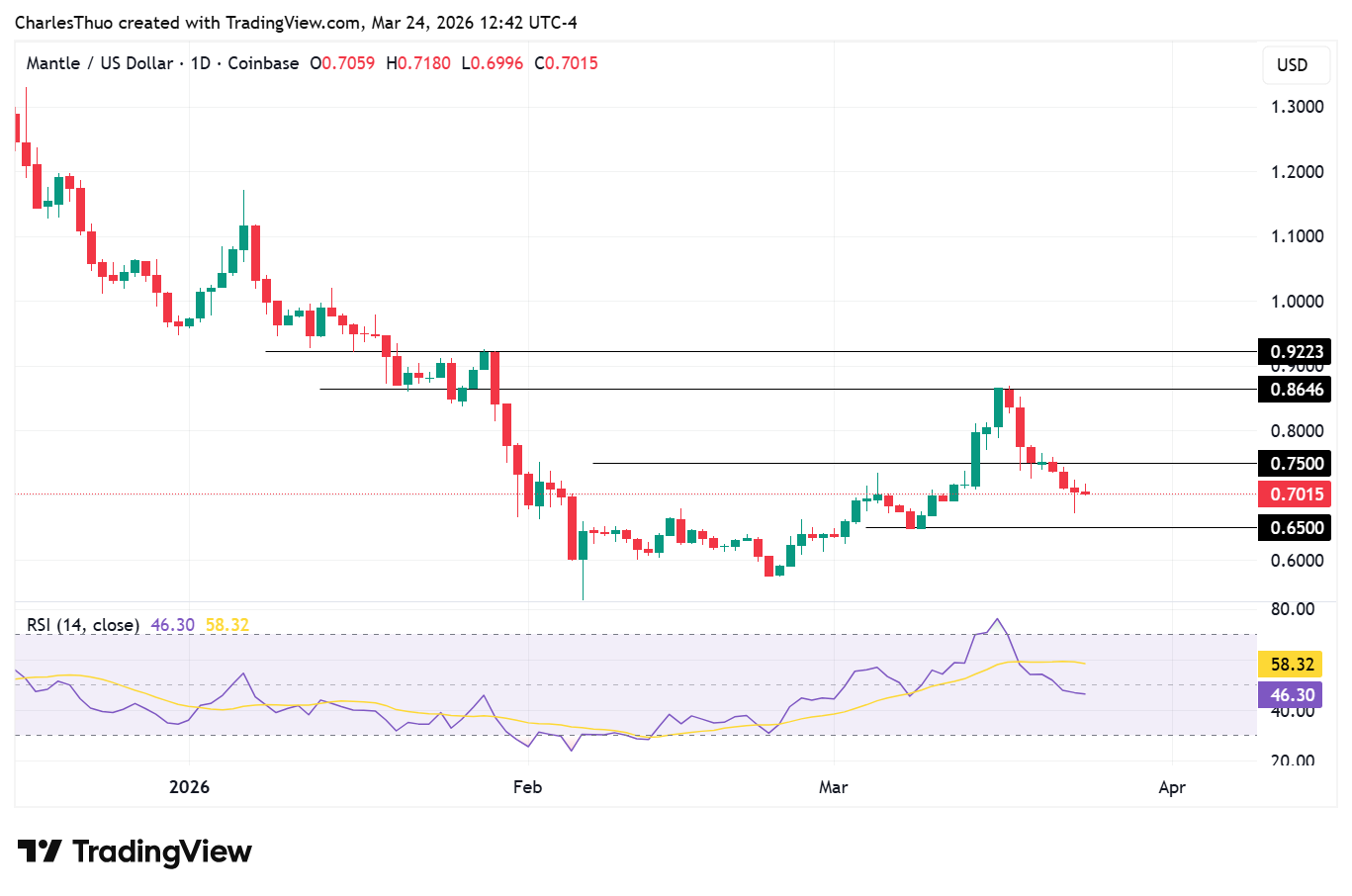
    • The key $MNT price levels to watch are the $0.75 resistance and the $0.65 support.

    Mantle ($MNT) network’s DeFi ecosystem has expanded rapidly and overtaken Sui in total value locked (TVL).

    The milestone reflects a sharp increase in capital flowing into Mantle, even as broader market conditions remain uncertain.

    In just one month, Mantle’s ecosystem has recorded a significant surge in locked assets, signalling rising confidence from both users and developers.

    According to data obtained from DeFiLlama, Mantle’s total value locked in DeFi is currently valued at around $632.17 million, while that of Sui stands at $589.5 million.
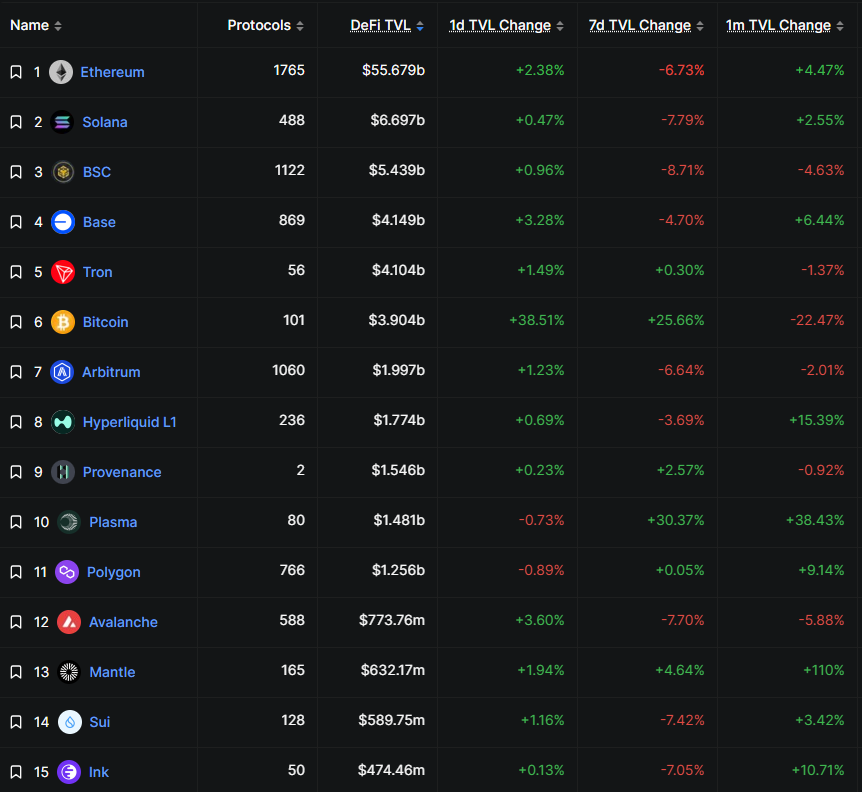
    Blockchain ranking in terms of their DeFi TVL

    This kind of growth is rarely accidental and often points to deeper structural strength within a network.

    Mantle’s DeFi expansion

    The surge in Mantle’s DeFi activity has been driven by a combination of strategic positioning and ecosystem development.

    One major factor behind the growth is its focus on real-world assets, which continues to attract institutional interest.

    By integrating traditional financial instruments into blockchain systems, Mantle is positioning itself for long-term adoption rather than short-term speculation.

    Another key driver is its connection to centralised exchange infrastructure, which helps onboard liquidity more efficiently.

    This hybrid model allows users to move seamlessly between centralised and decentralised finance, reducing friction that often limits adoption.

    At the same time, integrations with major DeFi protocols have boosted activity across lending and borrowing markets.

    These developments have helped create a steady inflow of capital rather than relying on temporary incentives.

    Such consistency is often a sign of a maturing ecosystem rather than a hype-driven spike.

    Despite this strong growth, the price of $MNT has not followed the same upward trajectory.

    This divergence between fundamentals and price action is becoming increasingly noticeable.

    $MNT price struggles to reflect strong fundamentals

    While the network’s DeFi metrics continue to improve, $MNT remains significantly below its previous highs.

    The token is still trading far from its peak, reflecting broader weakness across the altcoin market.

    Short-term price action has also been mixed, with recent declines interrupting what appeared to be a recovery phase.

    This suggests that traders are still cautious, even in the face of improving fundamentals.

    Market sentiment continues to play a dominant role, especially with altcoins reacting closely to movements in Bitcoin.

    Without a strong catalyst, $MNT has struggled to build sustained upward momentum.

    This creates a situation where the asset shows promise on paper but remains technically fragile.

    Such conditions often lead to periods of consolidation before a clearer trend emerges.

    Mantle price forecast

    The near-term outlook for $MNT is defined by a tight range that is likely to determine the next major move.

    The $0.75 level stands out as the most important resistance zone, acting as a barrier that bulls have yet to overcome.
    Mantle (<span class=$MNT) price”>

    A confirmed move above this level would signal a shift in short-term momentum and could open the door for further upside towards $0.8642 and even $0.9223 as projected by CoinLore.

    On the downside, the $0.65 level is providing immediate support and remains critical for maintaining stability.

    A break below this support would reinforce the current bearish structure and increase the risk of further declines.

    For now, the price remains trapped between these two levels, creating a clear decision zone for traders.

    Until a breakout or breakdown occurs, the current bounce should be treated with caution.

    If buyers manage to push the price above resistance, it could mark the beginning of a recovery phase supported by strong fundamentals.

    However, failure to hold support would likely confirm that bearish pressure is still dominant in the short term.

  • Shiba Inu Exchange Outflows Spike: Is Accumulation Enough to Offset Bearish Signals?

    Shiba Inu Exchange Outflows Spike: Is Accumulation Enough to Offset Bearish Signals?

    As Shiba Inu gradually recovers from recent bearish pressure, on-chain data now signals the potential emergence of a fresh downside risk.

    Despite Shiba Inu’s recent price rebound, underlying metrics point to a fragile technical structure. These developments suggest that $SHIB may soon experience selling pressure.

    Key Points

    • On-chain data signals the potential emergence of fresh downside risk.
    • A death cross has formed on the one-hour chart.
    • Despite these bearish signals, $SHIB has climbed over 5% in the past day, supported by a strong rebound in trading volume and rising exchange outflows.
    • A golden cross on the 4-hour chart, formed on March 19, remains intact, offering some technical optimism.

    Weak Technicals

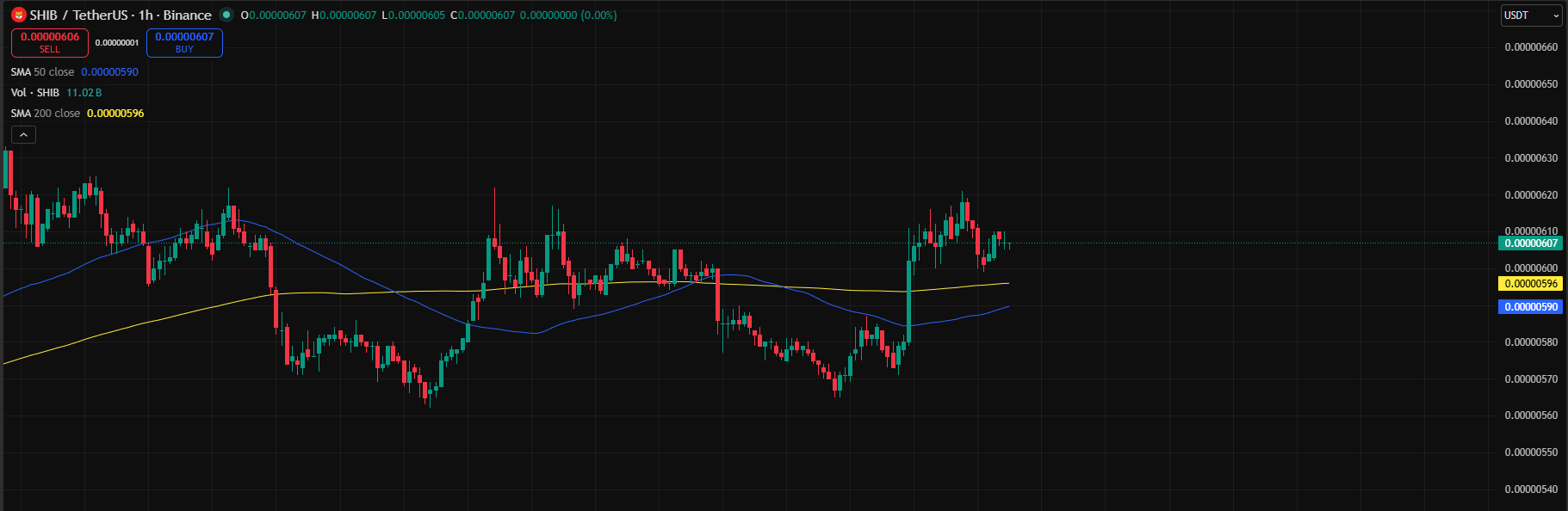
    $SHIB’s technical outlook remains bearish. The asset remains below key resistance levels, particularly around $0.0000065. Adding to the concern, $SHIB recently formed a death cross on the 1-hour chart after failing to establish a golden cross on the same timeframe.

    In this case, the 200-period simple moving average crossed above the 50-period SMA, reinforcing short-term bearish momentum.

    Shiba Inu Death Cross on 1H Chart

    Shiba Inu Soars 5%, Maintains Golden Cross on 4-Hour Timeframe

    Despite these negative indicators, $SHIB has posted a notable short-term recovery. The token has surged by more than 5% over the past day and is currently trading above $0.0000060.

    Currently trading at $0.000006116, $SHIB is up 5.81% in the last 24 hours and 0.43% over the past week, although it remains down 1.72% on the 30-day timeframe. In the meantime, the broader picture presents a mixed outlook.

    Shiba Inu previously formed a golden cross on the 4-hour chart on March 19 and has maintained it since then. In addition, trading activity has rebounded sharply after an earlier dip, with volume surging 69.35% in the past 24 hours to $188.21 million.

    Rising Exchange Outflows

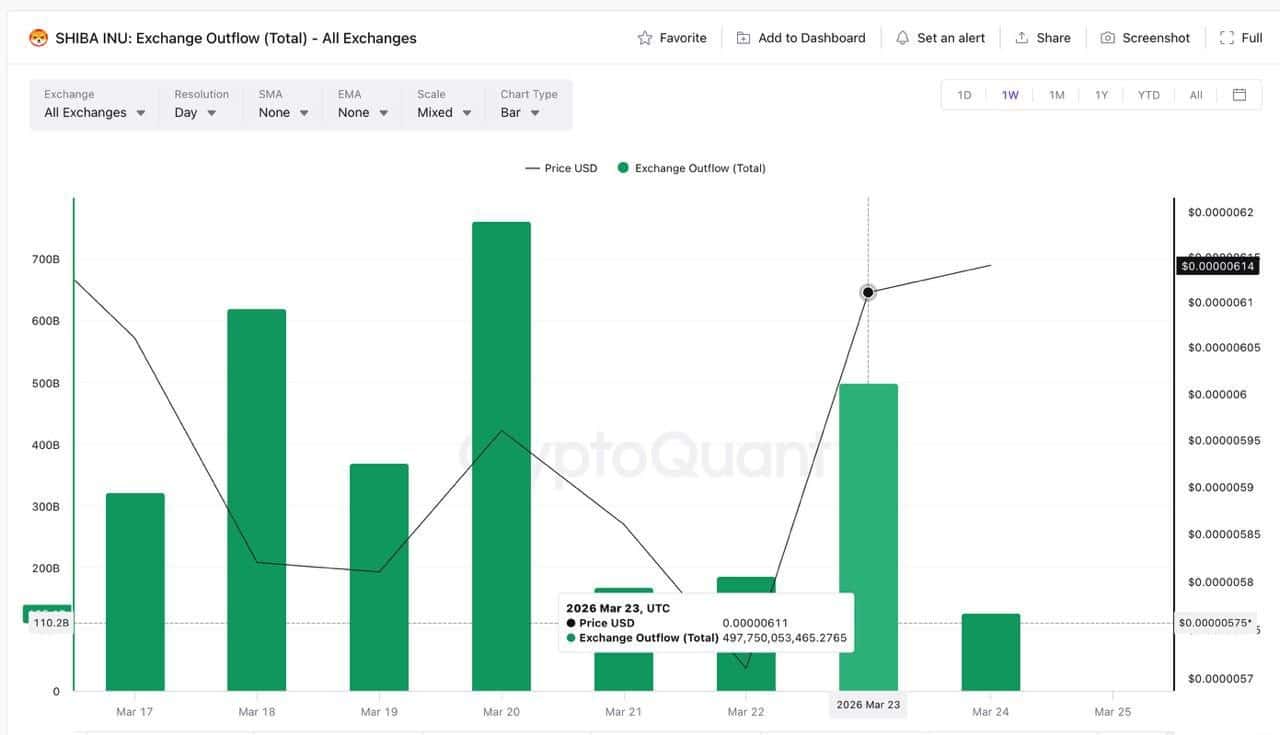
    Meanwhile, Shiba Inu exchange outflows have trended upward in recent days, according to data from CryptoQuant. The metric shows that outflows rose from 163 billion tokens on March 21 to 185 billion on March 22. Subsequently, the figure surged sharply to approximately 497.75 billion tokens yesterday, March 23.

    Shiba Inu Exchange Outflows

    Shiba Inu Exchange Outflows

    Notably, rising outflows typically signal strong accumulation, as investors move $SHIB from exchanges into private wallets for long-term holding, thereby reducing immediate selling pressure.

    Conversely, declining outflows, such as the dip observed between March 21 and 22, indicate weaker accumulation. In such cases, more tokens remain on exchanges, where they remain liquid and readily available for potential selling.

    While short-term momentum appears to be improving, the underlying technical signal suggests that caution remains warranted as bearish pressure could re-emerge.

  • Ripple CTO Emeritus Says Bitcoin’s Decentralization Doesn’t Come From PoW

    Ripple CTO Emeritus Says Bitcoin’s Decentralization Doesn’t Come From PoW

    David Schwartz, former CTO of Ripple, recently argued that Bitcoin’s decentralization does not come from its use of the PoW mechanism.

    Schwartz’s latest comments followed a recent event where a single mining entity showed significant control. This led to discussions about how secure and balanced Bitcoin’s network truly is with the Proof-of-Work consensus mechanism.

    Key Points

    • Foundry USA, the largest Bitcoin mining pool, recently mined 7 consecutive Bitcoin blocks, leading to a chain reorganization and raising concerns about mining concentration.
    • Vet, an XRPL validator, noted that Foundry USA’s hashrate is near the profitability threshold for selfish mining, suggesting large miners could exploit the system.
    • David Schwartz argued that Proof-of-Work is itself a centralizing force, and Bitcoin must continuously work to maintain decentralization.
    • Schwartz explained that changing the mining algorithm could weaken trust in Bitcoin’s immutability, but leaving it unchanged could rely too much on miner behavior.
    • He stressed that the Bitcoin community may choose to live with the issue for now, as fixing it prematurely could lead to even bigger problems.

    Schwartz Speaks on Growing Concerns in Bitcoin Mining

    Schwartz’s recent comments came in response to concerns raised by Vet, an XRPL validator. Notably, Bitcoin proponents still see PoW as a force of decentralization, but recent events show that mining power may be becoming more concentrated.

    Specifically, Vet pointed out in a recent post that Foundry USA, the largest Bitcoin mining pool in the world, mined 7 Bitcoin blocks in a row, which raised concerns about how much control one mining group could have.

    This led to a quick blockchain reorganization involving Antpool and ViaBTC, something that can happen when competing chains briefly exist. Some network participants suggested this dominance could result in a possible case of selfish mining, where a miner tries to gain an advantage by holding back blocks.

    Responding to these concerns, Schwartz argued that Bitcoin’s decentralization does not come directly from PoW. Instead, he said PoW can actually push the system toward centralization, meaning the network must keep working to stay decentralized.

    It really demonstrates a point that I’ve made several times which is that bitcoin’s decentralization doesn’t come from its use of PoW, rather PoW is a centralizing force bitcoin has to keep fighting against.

    — David ‘JoelKatz’ Schwartz (@JoelKatz) March 23, 2026

    “Bitcoin’s decentralization doesn’t come from its use of PoW,” the former Ripple CTO said, “rather, PoW is a centralizing force bitcoin has to keep fighting against.”

    Concerns Around Selfish Mining

    Vet also showed concerns about how Bitcoin handles these situations. He explained that chain reorganizations are a major weakness, as they show that transactions do not have absolute finality. He said, in contrast, the $XRP Ledger does not face the same type of reorganization risks, boasting true final settlement.

    Further, the XRPL validator noted that Foundry USA’s hashrate is close to the level where selfish mining could become profitable, based on several academic studies. This raises the risk that large miners could take advantage of the system if it becomes beneficial for them. As a result, he stressed that the Bitcoin network needs to spread mining power more evenly.

    Notably, Schwartz suggested that the issue presented a conundrum for the community. He explained that changing the mining algorithm could show that Bitcoin’s rules are not as fixed as many believe. At the same time, leaving things unchanged could mean the network depends too much on large players acting in good faith.

    Bitcoin and XRPL Consensus Mechanisms

    For context, Bitcoin uses the PoW mechanism, where miners compete to solve complex problems, and the longest chain becomes the valid one. While this method is slow, costly, and energy-intensive, Bitcoin proponents insist that it remains secure and decentralized.

    On the other hand, the $XRP Ledger uses the Ripple Protocol Consensus Algorithm. In this system, trusted validators agree on transactions within seconds using a supermajority vote. This allows for faster and more efficient processing. However, the Bitcoin community argues that relying on a set of validators can also lead to centralization.

  • MoonPay Launches Open-Source Wallet Standard for AI Agents

    MoonPay Launches Open-Source Wallet Standard for AI Agents

    In brief

    • MoonPay has introduced the Open Wallet Standard (OWS), an open-source framework for AI agents to manage funds across blockchains.
    • Contributors include PayPal, Ethereum Foundation, Solana Foundation, Ripple, OKX, Tron, and TON Foundation, among others.
    • The standard addresses wallet and key management fragmentation challenges while enhancing security for AI developers.

    Crypto payments infrastructure company MoonPay has launched an open-source wallet standard designed for AI agents to manage funds and execute transactions across multiple blockchains, addressing key infrastructure challenges that have limited AI-crypto integration.

    The Open Wallet Standard (OWS), announced Monday, was developed with contributions from PayPal, the Ethereum Foundation, the Solana Foundation, Ripple, OKX, Tron, TON Foundation, and Base, among other companies.

    “The agent economy has payment rails. It didn’t have a wallet standard. We built one, open-sourced it, and now the full stack exists,” said MoonPay co-founder and CEO Ivan Soto-Wright in a statement.

    The framework aims to solve fragmentation issues in wallet and key management that have complicated financial operations for autonomous AI systems, according to MoonPay, which is an investor in Decrypt’s sister company Myriad.

    OWS supports the x402 open payment protocol developed by Coinbase, along with Stripe and Tempo’s Machine Payments Protocol (MPP) for session-based micropayments. It also builds on MoonPay’s earlier collaboration with Ledger that enables hardware wallet signing for MoonPay Agents transactions.

    “On-chain payments originate from wallet addresses, and every chain represents them a bit differently,” said Mysten Labs co-founder and CTO Sam Blackshear in a statement, explaining that a “unified representation” streamlines processes and enables agents to focus on high-level tasks instead of details.

    According to MoonPay, OWS is designed in such a way that a wallet’s private key is never exposed to agents, the LLM context or parent applications when transacting.

    The launch comes as AI agents increasingly require sophisticated financial capabilities to operate autonomously, and forms part of a “deliberate shift” at MoonPay towards AI-native infrastructure.

    Agentic payments are a growing concern for crypto infrastructure developers, with Coinbase launching a wallet specifically for AI agents with built-in guardrails, Stripe-backed Tempo Network focusing on enabling AI agent payment capabilities, and Sam Altman’s World tapping Coinbase’s protocol to verify humans behind AI agents.

    Daily Debrief Newsletter

    Start every day with the top news stories right now, plus original features, a podcast, videos and more.

  • Turkey’s Cryptocurrency Taxation Bill Postponed Until Tomorrow

    Turkey’s Cryptocurrency Taxation Bill Postponed Until Tomorrow

    According to breaking news, the bill, which also determines the critical cryptocurrency taxation process, has been postponed until tomorrow in the Turkish Grand National Assembly due to the lack of a sufficient majority.

    The discussions will begin tomorrow at 2 PM (UTC+3).

    More details coming soon…

    *This is not investment advice.

  • Crypto finance is beginning to look at lot more traditional, Aave and Ethena founders say

    Crypto finance is beginning to look at lot more traditional, Aave and Ethena founders say

    Crypto finance is only now beginning to provide an environment that matches traditional finance: ways to earn steadier, more predictable returns — similar to bonds or savings products, according to Aave Labs founder Stani Kulechov and Ethena CEO Guy Young.

    “Most fixed income is like the distribution of risk in different formats … basically just slicing and dicing and distributing risk,” Young said during a panel at Digital Asset Summit (DAS) in New York. “This piece of DeFi was probably the least featured two years ago.”

    Until recently, crypto users mostly traded tokens or borrowed against them, often chasing high, unpredictable yields. New tools make it possible to lock in returns, even in a market known for big swings.

    “What you’re doing with Pendle is providing a fixed-to-floating rate swap,” Young said, referring to a system that lets users choose between more stable or more variable returns — similar to choosing between fixed or adjustable interest rates.

    That’s not easy in crypto. “It’s very difficult to know three months out what the market is actually going to look like,” he said.

    Kulechov said Aave has helped support this shift by providing deep pools of capital that other projects can tap into. “Aave is sort of acting as a liquidity sink,” he said, helping “bootstrap a lot of the new coming products in DeFi.”

    For now, much of the money being made still depends on trading rather than traditional lending. “A lot of DeFi yield … is largely still based on … leverage,” Kulechov said.

    Over time, that could change as more real-world assets move onchain, a process known as tokenization.

    “A lot of the yields and a lot of the economics will come from the traditional finance,” he said.

    Read more: Ethena-backed suiUSDe stablecoin goes live on Sui with $10 million yield vault launch

  • US Critical Institution CFTC Launches New Bullish Initiative for Cryptocurrencies! Here Are the Details

    US Critical Institution CFTC Launches New Bullish Initiative for Cryptocurrencies! Here Are the Details

    Bitcoin (BTC) and altcoins continue to hold strong despite the ongoing conflict between the US and Iran.

    As the five-day deadline given by US President Donald Trump to Iran awaits to determine whether the next move will be an uptrend or a downtrend, a move in favor of cryptocurrencies has come from the US.

    Accordingly, Michael Selig, Chairman of the US Commodity Futures Trading Commission (CFTC), announced today the establishment of an “Innovation Task Force.”

    The task force aims to establish regulatory standards for innovative companies developing new products and technologies in the U.S. derivatives market.

    The Innovation Task Force will create regulatory frameworks for several designated areas: “1) Cryptocurrency and blockchain technology, 2) Artificial intelligence and autonomous systems, 3) Prediction markets and event contracts.”

    CFTC Chair Selig stated, “By creating a clear regulatory environment for companies driving innovation in new areas of finance, we can encourage responsible innovation and ensure that U.S. market participants don’t fall behind.”

    The Innovation Task Force will be chaired by Michael J. Passalacqua, special advisor to President Selig.

    The Innovation Task Force will work with the U.S. Securities and Exchange Commission (SEC) and the CFTC on innovation.

    While the CFTC is taking steps in favor of cryptocurrencies, the SEC, another major US financial regulator, also clarified in guidance published last week that crypto assets like Bitcoin are commodities, not securities. It was also stated that 16 altcoins, including Ethereum (ETH), are not securities.

    *This is not investment advice.

  • OKX Rolls Out Round the Clock Trading for Mag Seven Stocks Using Crypto Collateral

    OKX Rolls Out Round the Clock Trading for Mag Seven Stocks Using Crypto Collateral

    In brief

    • The contracts track major U.S. stocks and indices but do not grant ownership, functioning as synthetic exposure products.
    • Traders can post Bitcoin, Ethereum and yield-bearing crypto assets as collateral under a unified margin system.
    • The launch comes as exchanges race to offer real-world asset exposure to retail traders outside traditional brokerage systems.

    OKX has launched more than 20 equity perpetual swap contracts, offering users across Asia, the CIS region, Latin America, and Türkiye exposure to trade major global stocks around the clock using crypto as collateral.

    The launch includes the full “Magnificent 7”—Nvidia, Tesla, Apple, Alphabet, Microsoft, Amazon, and Meta, according to a statement shared with Decrypt.

    It also covers crypto-linked firms such as Strategy, Coinbase, Robinhood, and Circle, as well as technology stocks Palantir, Intel, Micron, and SanDisk, and the S&P 500 tracker SPY.

    The equity perp launch is framed as the first phase of a broader rollout, with OKX planning to expand its range of equity contracts and tokenized real-world asset exposure in the coming months.

    It’s OKX’s latest push into real-world assets, as crypto exchanges increasingly compete to offer traditional market exposure to retail investors who face hurdles accessing U.S. equities through conventional brokerages in many parts of the world.

    All contracts are denominated in USDT and offer up to 5x leverage, allowing traders to respond to earnings releases, macroeconomic developments, and market-moving events even when traditional equity markets are closed, the statement said.

    Unlike tokenized equities that represent actual shares, equity perpetual swaps are derivatives that track price movements without granting ownership, placing them closer to synthetic exposure products already offered by other exchanges.

    “I think these instruments will command a good following from momentum-driven retail investors,” Peter Chung, head of research at Presto Labs, told Decrypt. “Crypto exchanges are far more accessible venues for retail investors in many jurisdictions around the world.”

    “On traditional rails, these names are often beyond their reach due to various hurdles,” he added.

    Asked how the product differs from those offered at rival platforms, including Binance, an OKX spokesperson told Decrypt its offering is differentiated by its “unified trading account.”

    The spokesperson said the platform allows users to stake assets and use them as collateral for equity perpetual positions, with those assets continuing to generate yield while positions remain open.

    A unified trading account allows users to deploy a range of crypto assets, including Bitcoin, Ethereum, USDT, and staked holdings, as collateral across positions.

    “This is one step towards bringing a broader range of real-world assets into our platform,” the spokesperson said when asked about the choice of perpetual swaps over tokenized equities representing actual shares.

    “We will keep expanding our infrastructure to support exposure to global equities while allowing traders to use their crypto portfolios for this,” they said.

    The rollout follows OKX’s high-profile tie-up with Intercontinental Exchange, the New York Stock Exchange’s parent company, which invested in OKX earlier this month at a $25 billion valuation. 

    The deal is also expected to enable OKX users to trade tokenized stocks and derivatives listed on the NYSE starting in the second half of the year. 

    OKX’s native token, OKB, is trading at $85, up 0.3% in the last day, and down 11.7% in the last 7 days, according to CoinGecko data.

    Daily Debrief Newsletter

    Start every day with the top news stories right now, plus original features, a podcast, videos and more.