Category: Business

  • Oscar Winner Matt Damon to Headline Ripple Event as Featured Speaker

    Oscar Winner Matt Damon to Headline Ripple Event as Featured Speaker

    Academy Award winner Matt Damon will appear at the upcoming Ripple Swell event, scheduled for October 27-29, 2026.

    Ripple is bringing together the global financial community for the Swell event in New York City. For the first time, Ripple is combining the Swell event and XRPL Apex developer summit into a single event intended for institutional leaders and fintech innovators, as well as the developers and researchers building on the $XRP Ledger.

    As seen on the official Swell page, actor and screenwriter Matt Damon, who is also the co-founder of water.org, is named as a featured speaker at the event alongside top Ripple executives including CEO Brad Garlinghouse, President Monica Long and CTO Emeritus David Schwartz.

    Others include Tom Farley, Chairman and CEO of Bullish; Johann Kerbrat, SVP & GM of Crypto at Robinhood; Laide Majiyagbe, Global Head of Markets at BNY; Michael Blaugrund, Vice President of Strategic Initiatives at Intercontinental Exchange (ICE); and Raghuram Rajan, former Governor of the Reserve Bank of India.

    In a Friday X post, the Swell event updated its speaker list to include Alastair Sewell, Senior Investment Director at Aviva; Chase Lax, CEO of Susquehanna Crypto; Gary White, CEO and co-founder of water.org; and Jenny Just, co-founder of PEAK6.

    More voices are joining the Swell speaker lineup:

    Alastair Sewell, Senior Investment Director at Aviva

    Chase Lax, CEO of Susquehanna Crypto

    Gary White, CEO and co-founder of https://t.co/SBdXm1OVeI

    Jenny Just, co-founder of PEAK6

    See all speakers: https://t.co/LB3NRvg1iB pic.twitter.com/7mMxA7WebP

    — Swell (@RippleSwell) August 28, 2026

    Water.org, co-founded by Damon, is a Ripple partner, which makes his appearance significant. The connection gives Damon’s appearance a more practical angle than a typical celebrity keynote; however, the exact details of what Damon will discuss were scarce at press time.

    Ripple expands

    In October 2025, Ripple revealed that several of the world’s leading development and humanitarian nonprofit organizations, including Water.org, are leveraging Ripple Payments and the Ripple USD (RLUSD) stablecoin to help improve the speed, transparency, and impact of aid delivery and funding.

    In an announcement on Friday, Ripple unveiled the launch of its Delta One business within Ripple Prime, its global, multi-asset prime brokerage platform. Ripple Prime’s Delta One enables clients to execute Total Return Swaps across U.S.-listed equities, indices, and digital assets.

  • Analyzing Bitcoin’s 14M profit milestone – BTC’s next move hinges on THIS level

    Analyzing Bitcoin’s 14M profit milestone – BTC’s next move hinges on THIS level

    Sentiment around Bitcoin [$BTC] remained largely positive as the cryptocurrency repeatedly tested $80,000. However, Bitcoin still faced key levels before confirming a decisive bullish move.

    Investor reactions to recent gains could now determine whether the rally extends or loses momentum.

    Will profitable holders support Bitcoin?

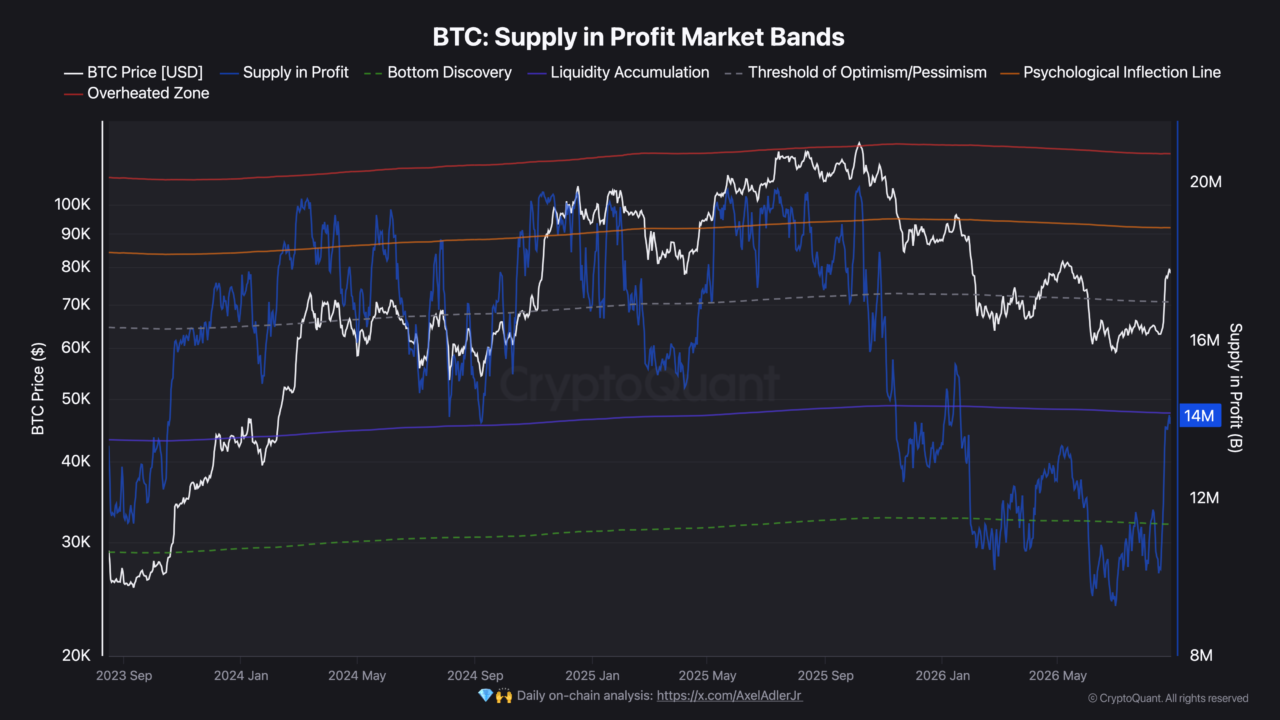
    Bitcoin’s Supply in Profit reached 14 million $BTC at press time, indicating widespread unrealized gains across the market.

    Interestingly, this coincided with the chart’s Liquidity Accumulation level. Historically, this zone influenced whether $BTC extended its recovery.

    Source: CryptoQuant

    Bitcoin last entered this zone in January but failed to move above it. It subsequently fell from $95,000 toward $60,000 in February.

    By contrast, Bitcoin remained above the Liquidity Accumulation level from October 2023. That strength preceded its 2024 all-time high. This history places investors at an interesting crossroads.

    Continued accumulation could support the rally. However, profit-taking among 14 million profitable $BTC could create significant selling pressure.

    Are investors still accumulating?

    Investor behavior suggested that confidence was gradually returning.

    Bitcoin’s Spot Market Netflow remained negative for three consecutive days, according to CoinGlass. Cumulative Netflows reached approximately -$261 million. Negative Netflows indicated that more Bitcoin left exchanges than entered them.

    Such movements could reduce immediately available selling supply.

    Source: CryptoQuant

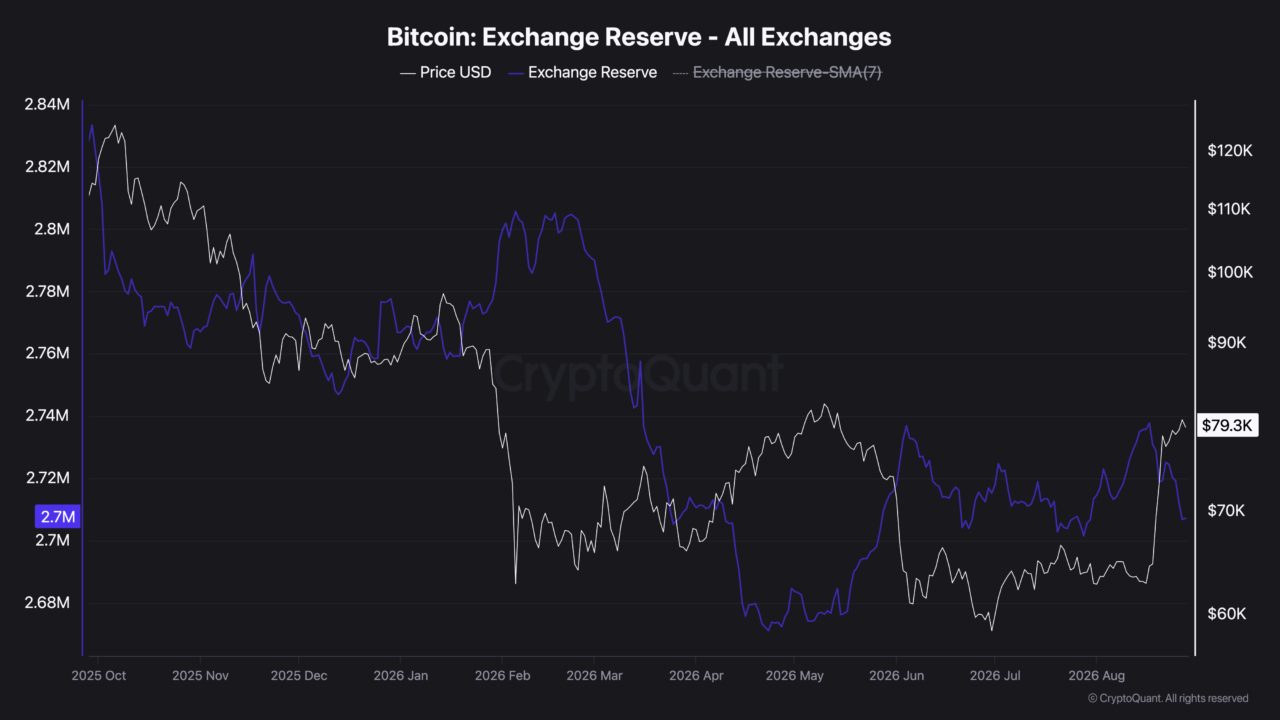
    That move aligned with a broader decline in Exchange Reserves.

    Exchange Reserves fell from 2.735 million Bitcoin [$BTC] on the 15th of August to 2.707 million $BTC. The decline suggested that holders were moving Bitcoin away from trading venues despite recent price gains.

    Can institutions push $BTC above $80K?

    Institutional participation remained critical because sustained ETF demand could absorb selling from profitable holders.

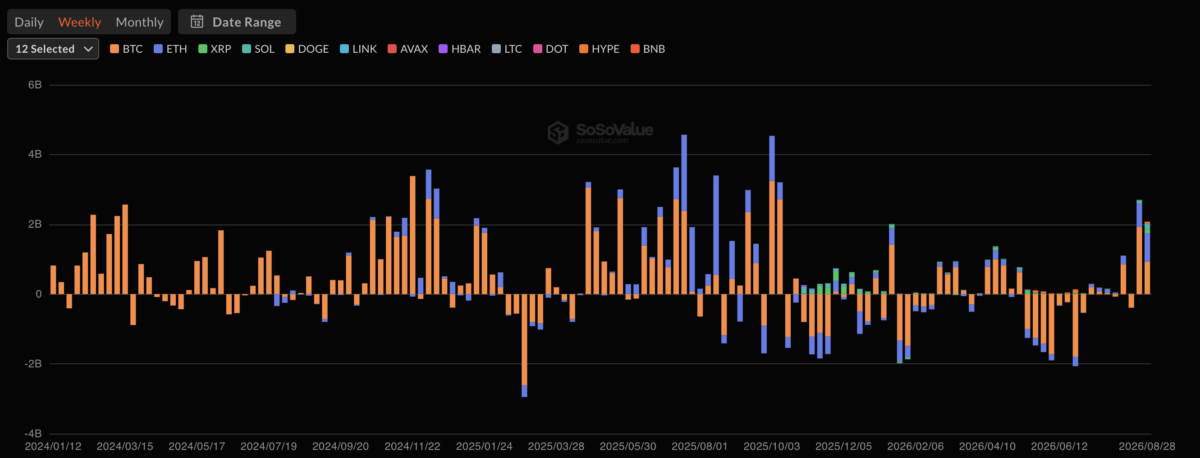
    BlackRock recently acquired 3,260 $BTC, according to AMBCrypto’s tracking. Meanwhile, Bitcoin exchange-traded funds [ETFs] recorded $3.51 billion in August inflows, according to SoSoValue.

    Bitcoin’s next move could therefore depend on which force acts first: institutional accumulation or profit-taking near $80,000.


    Final Summary

    • Bitcoin repeatedly tested $80,000 but had yet to confirm a decisive breakout.
    • Bitcoin’s Supply in Profit reached 14 million $BTC, increasing possible profit-taking pressure.
  • Solana ETFs attract $138M in 10 days – Is SOL ignoring the demand?

    Solana ETFs attract $138M in 10 days – Is SOL ignoring the demand?

    As the market sees fresh bullish optimism, the spot Solana [$SOL] ETF recorded its strongest period of investor demand since these products launched.

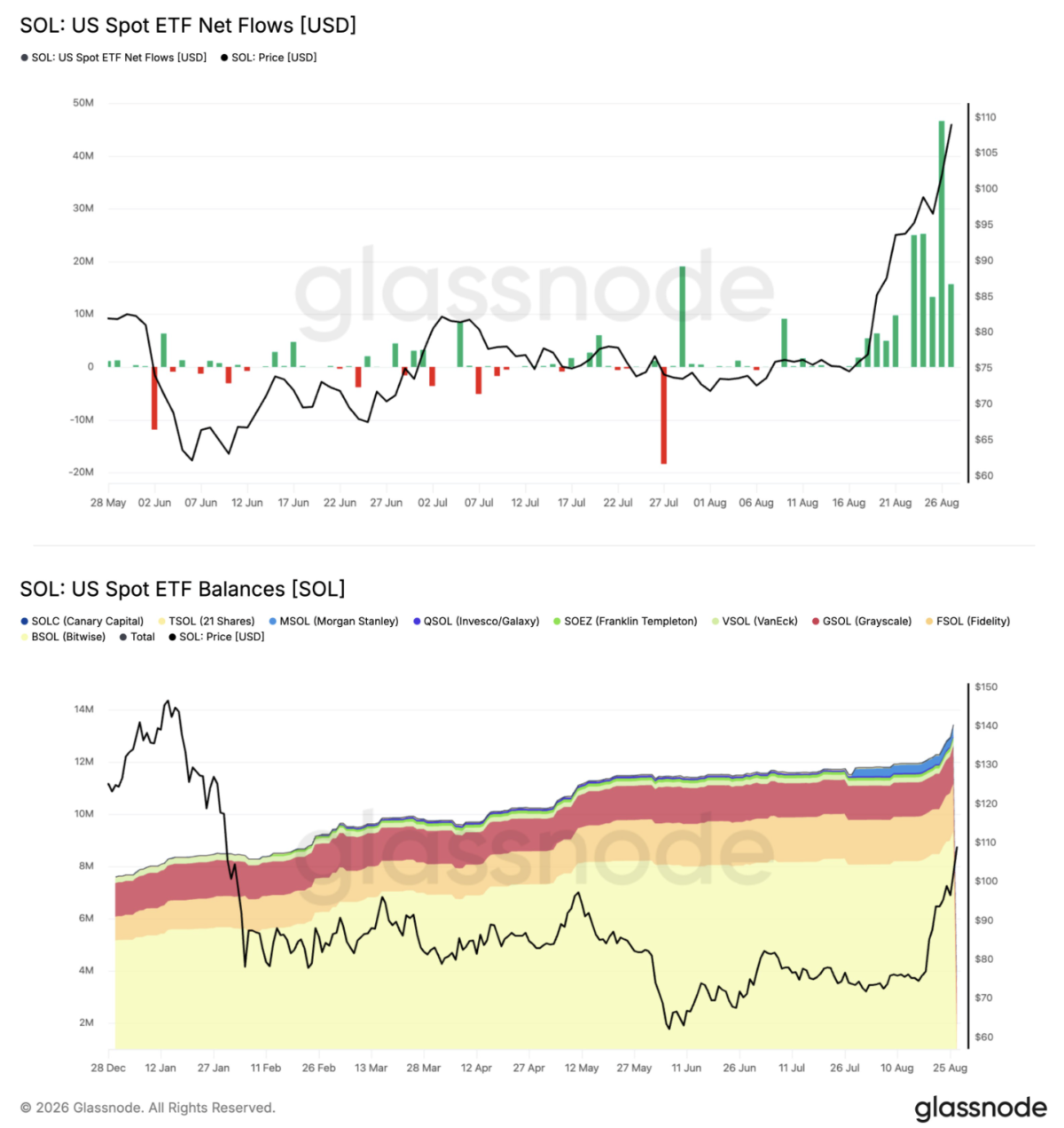
    According to Glassnode, Solana spot ETFs recorded $138 million in net inflows over the course of 10 days. Of these, the most eye-catching day was the 25th of August when the Solana products collectively attracted around $47 million in a single day.

    Solana ETF breaks record, but…

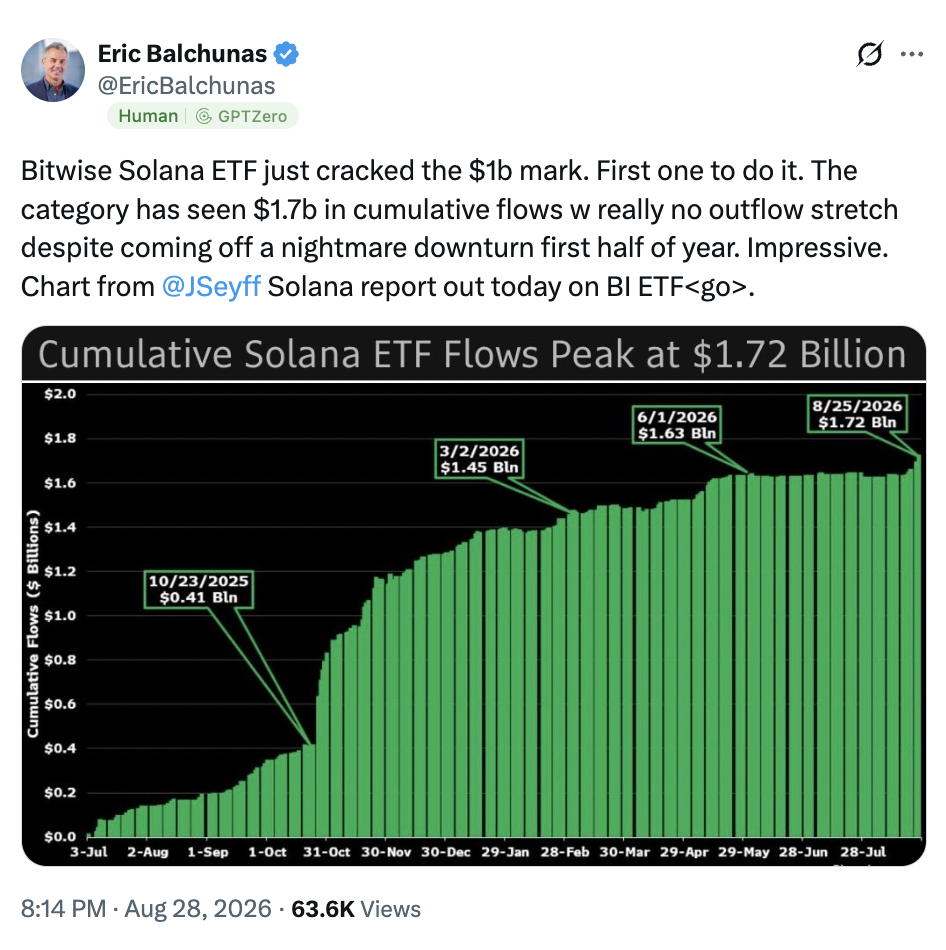
    At the same time, the overall Solana ETFs accumulated roughly $1.7 billion in total inflows, according to Bloomberg ETF analyst Eric Balchunas.

    Source: Eric Balchunas/X

    Interestingly, the category avoided prolonged Net Outflows despite difficult market conditions during the first half of 2026.

    Bitwise’s Solana Staking ETF, BSOL, emerged as the largest beneficiary. The fund crossed $1 billion in Assets Under Management [AUM], becoming the first Solana ETF to reach that milestone.

    Source: Glassnode

    Bitwise’s official fund data shows that BSOL held 9,332,360.79 $SOL, worth approximately $1.018 billion, as of the 26th of August. In fact, the fund was launched in October 2025, meaning it reached the $1 billion mark in roughly 10 months.

    However, the ETF inflows should not be interpreted as a guaranteed bullish signal for $SOL’s price. This is because $SOL was trading at $104.05 at press time, after a drop of 3.1% in the past 24 hours but a hike of over 10% in the past week.

    Meanwhile, Bitcoin ETFs, along with other altcoin ETFs, all exhibited an inflow streak during the same period.

    Source: SoSoValue

    Solana’s governance voting adds to the optimism

    At the same time, Solana’s first round of on-chain governance voting has now concluded, with the community approving two proposals—SGP-0001, “The Solana Constitution,” and SGP-0002, “Double Disinflation.”

    While rejecting SGP-0003, the “Resource and Inclusion Fee” proposal.

    For its purpose, SGP-0002 doubles Solana’s annual disinflation rate from 15% to 30%, allowing $SOL to reach its 1.5% terminal inflation rate in about 2.8 years instead of 5.7 years.

    Meanwhile, SGP-0003 failed with 53.90% support.

    The latter proposed splitting transaction fees into a fixed inclusion fee and a resource fee, with the latter fully burned.

    All in all, Solana approved faster disinflation but rejected the proposed new fee-and-burn structure. This comes on the heels of the Solana-based AVICI price crashing 37% after a reported $600K card withdrawal incident.


    Final Summary

    • Solana ETF category has accumulated roughly $1.7 billion in cumulative flows.
    • Bitwise’s Solana Staking ETF, BSOL, alone crossed $1 billion in assets under management (AUM).
  • What Can We Expect from Bitcoin (BTC) and Dogecoin (DOGE) Prices in the Coming Days?

    What Can We Expect from Bitcoin (BTC) and Dogecoin (DOGE) Prices in the Coming Days?

    Crypto analyst Ali Martinez assessed the technical outlook for Bitcoin and Dogecoin, highlighting critical price levels investors should watch. According to Martinez, the $73,880 level for Bitcoin is a crucial threshold for maintaining the bullish scenario.

    Martinez noted that the “-0.5” level in Bitcoin’s MVRV price bands currently corresponds to approximately $73,880. According to the analyst, if $BTC manages to stay above this region, the next major target indicated by the MVRV price bands could be $100,000.

    Martinez also stated that Bitcoin’s current price structure shows similarities to the movements that followed the bear market bottom in 2022.

    According to the analyst, after breaking its long-term downtrend in 2023, Bitcoin tested its previous August peak, then retreated to around $20,000 before entering a strong bull run.

    Martinez believes a similar pattern may be forming again right now. He noted that the critical area to watch in this scenario is the peak of approximately $83,000 seen in May 2026.

    If Bitcoin is rejected around $83,000, the analyst stated that the potential pullback could present the next significant buying opportunity for $BTC.

    Another cryptocurrency on Martinez’s radar is Dogecoin ($DOGE). According to the analyst, a bullish flag pattern may be forming on $DOGE’s hourly chart.

    Martinez stated that, within the framework of the formation, there is still a possibility that the price will first retrace to the important support level at $0.081, while the critical level for an upward move is $0.090.

    The analyst stated that a technical breakout could be confirmed if $DOGE closes the hourly candle above $0.090, and in such a scenario, the price could rise to $0.115.

    *This is not investment advice.

  • A Verified Donald Trump Account Announced the Launch of a New Altcoin: Its Price Plummeted to Zero Overnight

    A Verified Donald Trump Account Announced the Launch of a New Altcoin: Its Price Plummeted to Zero Overnight

    The memecoin GOLD, launched within the Solana ecosystem with the theme “Trump Digital Gold,” lost almost all of its value after a sharp rise in value in a short period. While the token’s launch from an official social media account linked to Donald Trump initially generated great interest, claims emerged that the account may have been hacked.

    Trump Digital Gold (GOLD) reached a market capitalization of over $60 million within approximately two hours of its launch in the morning. However, the price subsequently declined rapidly. Initially falling to $10 million, the token briefly recovered to around $36 million, but selling pressure intensified.

    In the following minutes, it was reported that GOLD’s market value plummeted by over 95% in just one minute, falling to approximately $1.8 million. After the post promoting the project was deleted, its market value reportedly dropped further to around $600,000.

    The GOLD token was initially introduced by an account called @realtrumpcoins1, which sells official Trump-themed collectible coins and medals. The fact that this account operates as an official partner of The Trump Organization led to speculation that the token might initially be associated with the Trump family.

    However, the lack of further confirmation from the Trump family or The Trump Organization regarding the project has raised suspicions within the cryptocurrency community. Social media users have suggested that the account may have been hacked and that the GOLD token may have been launched by attackers.

    The initial promotional post reportedly reached approximately 400,000 views.

    Posts Deleted One by One

    The initial post introducing the GOLD token was later removed from the @realtrumpcoins1 account. It was then reported that a new post was made from the account saying “More to come, invest and wait,” but this post was also quickly deleted.

    The subsequent removal of all content related to GOLD from the account was interpreted on social media as a sign that the account may have been regained by its owners.

    In the latest post allegedly published by the person who supposedly hacked the account, it was claimed that over $8.2 million in profits were generated with the launch of the GOLD token.

    The attacker also claimed that the funds obtained would be used for a bounty on the relatives of US President Donald Trump. This post was later deleted.

    Allegations of Iranian Hacker Take Center Stage

    Following the incident, claims emerged that the attack may have been carried out by individuals with Iranian connections. These claims stem from Israeli media reports that Iranian state television had previously aired a program discussing ways to contact Donald Trump’s son, Barron Trump.

    According to news reports, the approximately three-minute broadcast showed locations and online platforms allegedly linked to Barron Trump, and also made various claims about Trump’s son’s social circle and the US Secret Service’s security system.

    However, it is stated that the claims in the publication in question are largely based on fabricated images and that no evidence is presented to prove that actual contact was made with Barron Trump.

    Therefore, claims linking the GOLD incident to Iranian hackers have not been independently verified at this stage.

    On-chain data showed that following the token’s launch, there was noticeable activity in newly created wallets allegedly linked to the project team.

    According to shared data, 15 new wallets allegedly linked to the project sold a total of 224.5 million GOLD tokens. The sales yielded approximately 3,178 SOL, which was valued at around $330,000 at the time of the transaction.

    Considering the initial cost of the wallets, it was calculated that they generated approximately $312,000 in profit, representing about a 17-fold return on investment.

    On-chain data also shows that these addresses still hold a significant amount of GOLD tokens, indicating that the token supply is concentrated in a limited number of wallets.

    *This is not investment advice.

  • BTCs of a Bitcoin Whale That Has Been Dormant for 15 Years Have Started Moving

    BTCs of a Bitcoin Whale That Has Been Dormant for 15 Years Have Started Moving

    According to Galaxy Research data, six Bitcoin wallets created between 2011 and 2014 that had been inactive for a long time have become active again. These addresses transferred a total of 553.59 $BTC between August 16 and 26. At current prices, the total value of the transferred Bitcoins is approximately $40 million.

    One notable point was that one of the wallets that moved hadn’t been active for over 15 years. This suggests that some assets from Bitcoin’s very early days have started moving again on the chain.

    According to Galaxy Research’s analysis, five out of six wallets sent their Bitcoins to addresses not linked to any known cryptocurrency exchanges. Therefore, there is no clear indication that these transfers were directly intended for sale.

    The other wallet transferred 40 $BTC to Boerse Stuttgart Digital, a Germany-based cryptocurrency custody and transaction services provider. However, this transfer does not necessarily mean the Bitcoins were sold. It is believed that the assets may have been transferred to a custody service or moved for a different institutional transaction purpose.

    Galaxy Digital Research Head Alex Thorn also pointed out that on-chain activity in Bitcoins, which have been dormant for a long time, has decreased significantly recently. According to Thorn, the activity of legacy coins, described as “sleeping Bitcoin,” has fallen to its lowest level since the third quarter of 2022, by the second quarter of 2026.

    Thorn also predicts that the total amount of transfers from long-inactive Bitcoin wallets throughout 2026 could be less than half of the level recorded last year.

    *This is not investment advice.

  • Despite Bitcoin’s Recent Gains, One Analyst Remains Cautious: “I Haven’t Seen What I’m Looking For Yet”

    Despite Bitcoin’s Recent Gains, One Analyst Remains Cautious: “I Haven’t Seen What I’m Looking For Yet”

    While Bitcoin’s recent recovery in the cryptocurrency market has rekindled bullish expectations, Alphractal founder Joao Wedson stated that on-chain data presents a more cautious picture. According to Wedson, the ultimate price bottom of the cycle for Bitcoin may not yet have been reached, and if certain historical indicators are repeating themselves, the BTC price could fall to $53,000 or even lower.

    In his analysis, Wedson specifically highlighted the MVRV Z-Score indicator, which is used to measure investor behavior and the realized value of the market. The analyst stated that on-chain metrics reflect investor behavior, arguing that this behavior is directly linked to periods of euphoria and fear in market cycles.

    Wedson Pointed Out the 2018 Bitcoin Crash

    Wedson compared the current market structure to the 2017-2018 cycle. According to the analyst, the MVRV Z-Score formed three significant peaks during the 2017 bull market before Bitcoin reached its all-time high.

    Wedson noted that after Bitcoin peaked and then declined, the indicator formed a base between approximately 0.25 and 1.16, adding that at the time, a large portion of the market did not expect a new and sharp drop. However, Bitcoin experienced another sharp decline in November 2018, falling to around $3,180.

    According to Wedson, the MVRV Z-Score formed three separate peaks during the 2024-2025 period. However, the analyst stated that the enthusiasm at these peaks was more limited compared to 2017, as the market became more complex than in previous cycles.

    Wedson noted that following Bitcoin’s recent decline after its peak, the MVRV Z-Score formed a base in an area similar to that seen in 2018, but the indicator has recently risen again, with the Bitcoin price following suit.

    “MVRV Z-Score Has Not Yet Fallen into Negative Zone”

    The main risk highlighted by the analyst is that the indicator has not yet reached the negative zone, which has been associated with major cycle lows in Bitcoin in the past.

    Wedson stated that based on the available data, he constantly asked himself the same question: If the MVRV Z-Score needs to go down, will the Bitcoin price follow the indicator?

    According to the Alphractal founder, considering only on-chain data, there aren’t enough signals to be certain that the current decline is the ultimate bottom for Bitcoin.

    Wedson said that for the conditions he is tracking to be met, Bitcoin might need to fall to at least around $53,000 or even lower.

    The analyst specifically emphasized that this assessment was not financial advice, stating that it questioned the data directly, not the current bullish narrative in the market.

    Wedson, recalling that in 2018 too, the majority of market participants did not expect another sharp decline, said that the critical question was whether the current cycle would conclude similarly to past cycles.

    According to the analyst, on-chain indicators at this stage suggest that downside risks have not completely disappeared, rather than definitively indicating that “the bottom has been reached” for Bitcoin.

    *This is not investment advice.

  • Why Bitcoin Crashed After Warsh’s Jackson Hole Speech – and What Happens Next

    Why Bitcoin Crashed After Warsh’s Jackson Hole Speech – and What Happens Next

    Bitcoin’s rally from under $65,000 to over $81,000 faced its first major macro setback after Fed Chair Kevin Warsh delivered a hawkish message at Jackson Hole on Friday. The bigger question now is whether potentially higher rates and rising Treasury yields can derail the impressive market recovery.

    Although $BTC remained relatively stable during the speech, it dumped by $3,000 in hours after its conclusion, slipping below $77,000 for the first time in almost a week. The sell-off extended to essentially all other financial markets, including stocks, precious metals, and other risk-sensitive assets.

    So, What Really Happened?

    Warsh didn’t say directly that the Fed is seriously contemplating hiking the rates, but he didn’t have to. His message was quite clear: inflation remains too high, the US economy is still strong, and the Federal Reserve cannot simply declare victory. Its preferred PCE inflation gauge currently stands at 3.7% YoY, while its six-month annualized rate is even higher at 4.1%. Both remain far above the central bank’s target.

    He emphasized that the Fed’s 2% inflation objective is “firm and fixed” and argued that price stability won’t simply restore itself without additional actions from the central bank.

    He also dismissed some of the most promising inflation readings this summer, including the June numbers, saying they had not convinced him and his colleagues that the underlying trend had improved significantly. Until the Fed reassures that inflation is moving toward 2% “clearly and at sufficient speed,” policymakers will continue to “have work to do,” he added.

    Rate-Hike Odds Rise, $BTC Drops

    Traders had assigned a one-third probability to a rate increase in September before the speech, but these odds jumped toward 60% after its conclusion, according to market pricing cited by Reuters. US Treasury yields climbed again, while the dollar strengthened sharply after its decline last week.

    That’s essentially the exact opposite of the macro environment that helped $BTC explode higher 10 days ago. Perhaps that’s why the asset went from a then-peak of over $80,000 to under $77,000 in a few hours, dragging most altcoins with it.

    Warsh also pointed to business investments growing at roughly 9% per year, the S&P 500 surging by 20%, while unemployment remained at around 4% and credit conditions were relatively easy. In other words, the economy isn’t currently giving the central bank an obvious reason to tolerate elevated inflation.

    In general, higher expected policy rates push Treasury yields upward, which increases the return investors can obtain from the assets that are considered much safer. A more hawkish Fed also tends to support the dollar and tighten broader financial conditions. History shows that such an environment is not ideal for $BTC and more speculative altcoins.

    Treasury and Fed

    Treasury Secretary Scott Bessent’s recent bond-market intervention, which contributed to $BTC’s major rally, helped push long-term yields lower, at least in the short term. However, Warsh reminded investors that the Fed’s mandate is quite different.

    The Treasury might want to reduce borrowing costs and improve market liquidity, but the country’s central bank still has to deal with inflation running above its target.

    This means that markets are still split between two powerful forces: Treasury support for financial conditions and a Fed that may need to keep monetary policy tighter than investors expected.

  • New York Warns of Fake Crypto and AI as Scam Losses Hit $8 Billion

    New York Warns of Fake Crypto and AI as Scam Losses Hit $8 Billion

    Investment Scam Losses Rise 38%

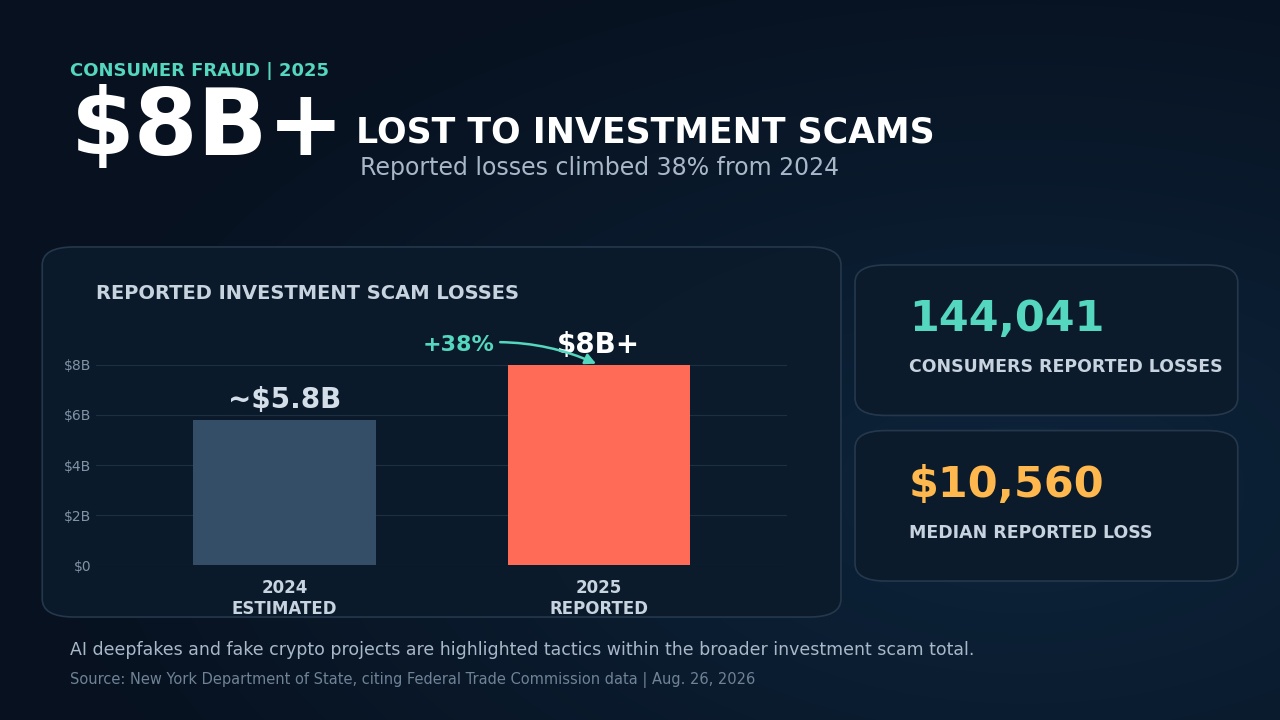
    Investment scams became the costliest fraud category tracked by the Federal Trade Commission in 2025, according to New York officials. The state’s Division of Consumer Protection issued an AI investment scam warning on Aug. 26 after 144,041 consumers reported losing more than $8 billion, a 38% increase from 2024. The median reported loss reached $10,560.

    The schemes can begin through social media, dating apps, text messages, emails, online advertisements, or apparently friendly conversations. The FTC’s own April consumer alert put the same 2025 total at more than $7.9 billion, with a median individual loss above $10,000. That agency listed cryptocurrency alongside stocks and forex among the investments scammers pitch through fake coaching offers.

    Secretary of State Walter T. Mosley cautioned:

    “New Yorkers need to be vigilant against scammers, who may be able to create increasingly sophisticated and realistic messaging using AI technology or other means to steal your hard-earned money. If it seems too good to be true, it probably is.”

    Reported investment scam losses exceeded $8 billion in 2025, up 38% from 2024, while the median reported loss reached $10,560. Chart generated by Bitcoin.com News using New York Department of State figures citing Federal Trade Commission data.

    AI Deepfakes Promote Fake Crypto Investments

    Artificial intelligence allows fraudsters to clone voices, fabricate videos, impersonate financial figures, and produce polished social media advertisements. An April warning from New York Attorney General Letitia James described schemes involving deepfake celebrity endorsements, fraudulent cryptocurrencies, pump-and-dump operations, and fake trading platforms promoted across Facebook, Instagram, and Whatsapp.

    Victims may encounter professional-looking applications that display fabricated balances, returns, and trading activity. Some operators permit small initial withdrawals to establish credibility before pressing targets to deposit larger amounts. Similar tactics have appeared internationally, with Australian regulators recently dismantling 3,106 fraudulent cryptocurrency investment platforms during the 2026 financial year as AI-generated endorsements became increasingly difficult to distinguish from authentic promotions.

    Fake Platforms Build Trust Before Demanding Fees

    A separate Australian case showed how organized groups build an entire fake internet around a crypto investment that does not exist. Investigators detailed counterfeit trading platforms, fabricated news articles, and chatbots posing as support staff, deployed before a woman lost nearly $74,690. Operators may then ask for additional fees before releasing funds, which New York’s alert tells consumers never to pay.

    New York officials advised consumers to confirm the identity of any promoter, verify the company and investment, and establish where their money will go before transferring funds. Common crypto scam warning signs include guaranteed high returns, unsolicited investment offers, high-pressure sales tactics, and projects lacking clear documentation. Anyone who suspects fraud should stop sending money immediately and report it to the FTC, the FBI’s Internet Crime Complaint Center, the SEC, or the New York Attorney General.

  • Hyperliquid’s $249B volume lead – Can HYPE survive the crowd it created?

    Hyperliquid’s $249B volume lead – Can HYPE survive the crowd it created?

    Hyperliquid [$HYPE] is unstoppable, but markets rarely stay that simple. Behind the strong exterior, things are looking shaky.

    Here’s why.

    Hyperliquid is now in a league of its own

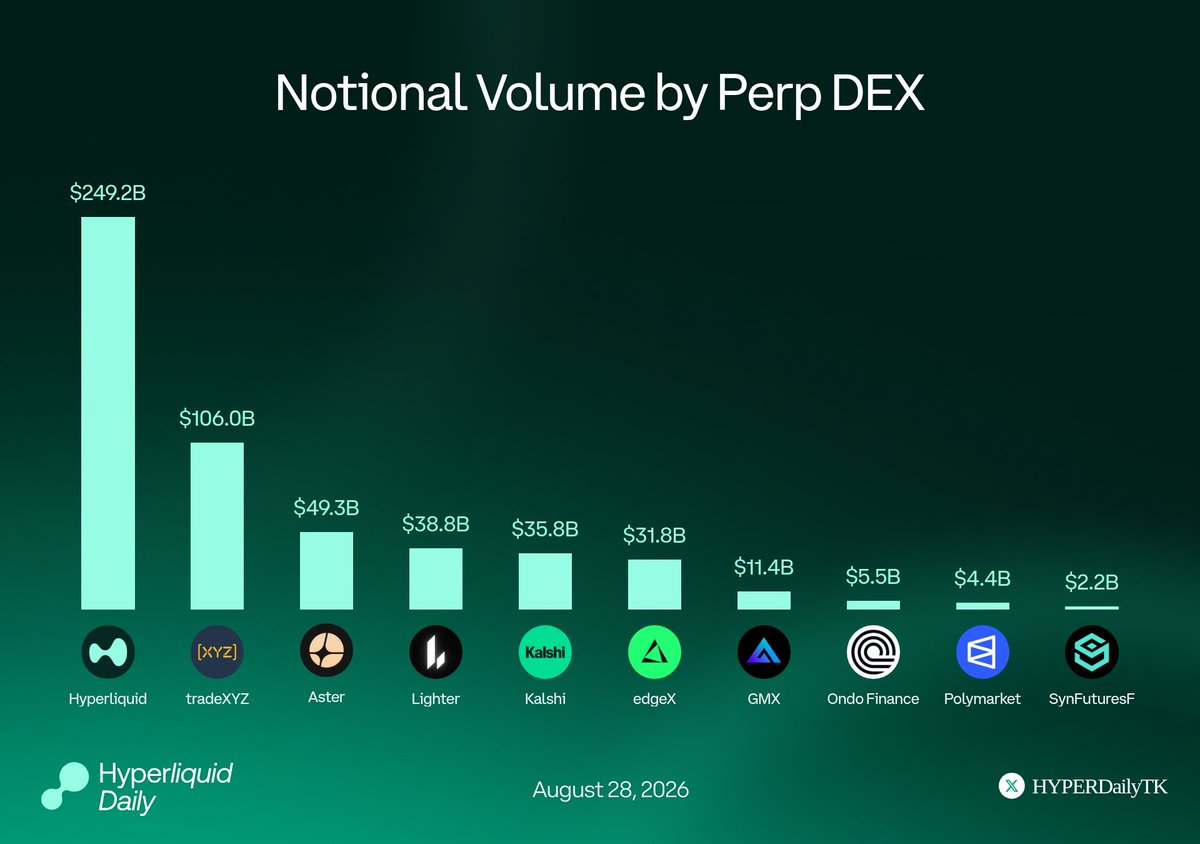
    Hyperliquid’s notional volume is at $249.2 billion. That’s more than double the $106 billion recorded by its nearest competitor, TradeXYZ.

    The gap only gets wider from there.

    Source: X

    Aster was at $49.3 billion, while Lighter, Kalshi and edgeX are all below $40 billion.

    LIquidity tends to attract even more liquidity, and that becomes self-reinforcing real quick. More volume brings deeper markets, and in turn, more traders.

    Hyperliquid Strategies turned $HYPE into a big balance sheet bet

    It’s not just the traders who believe.

    Nasdaq-listed Hyperliquid Strategies more than doubled its $HYPE treasury to 29.3 million tokens. They were worth $1.9 billion at the end of the fiscal year on June 30.

    The company raised $647 million through equity financing. Since then, it has deployed another $773.4 million to buy 16.5 million $HYPE tokens.

    That is a sizeable commitment to a single ecosystem. Most of those tokens are also being staked, so those assets are being put to work for more yield.

    Too many traders on one side?

    Now, it’s not all sunshine and rainbows. We have too many traders leaning the same way.

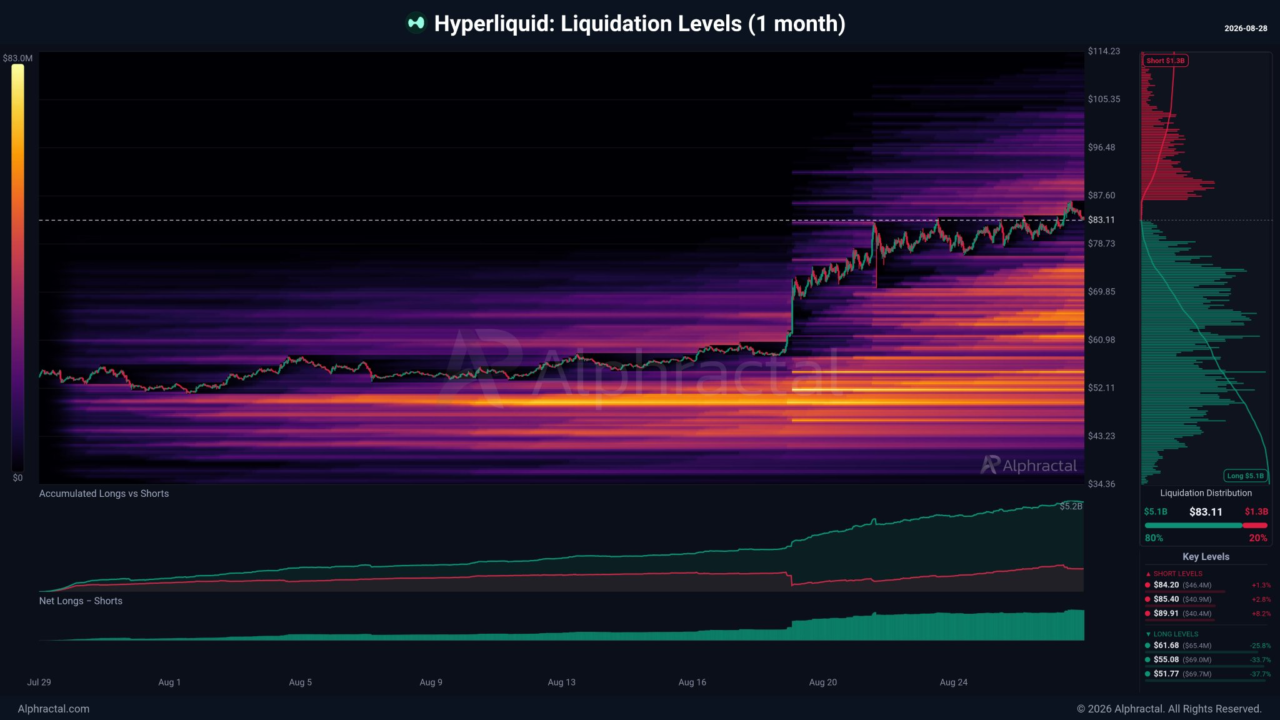
    Over the one-month liquidation window, about 80% of liquidation exposure is on the long side, versus 20% on shorts.

    Source: Alphractal

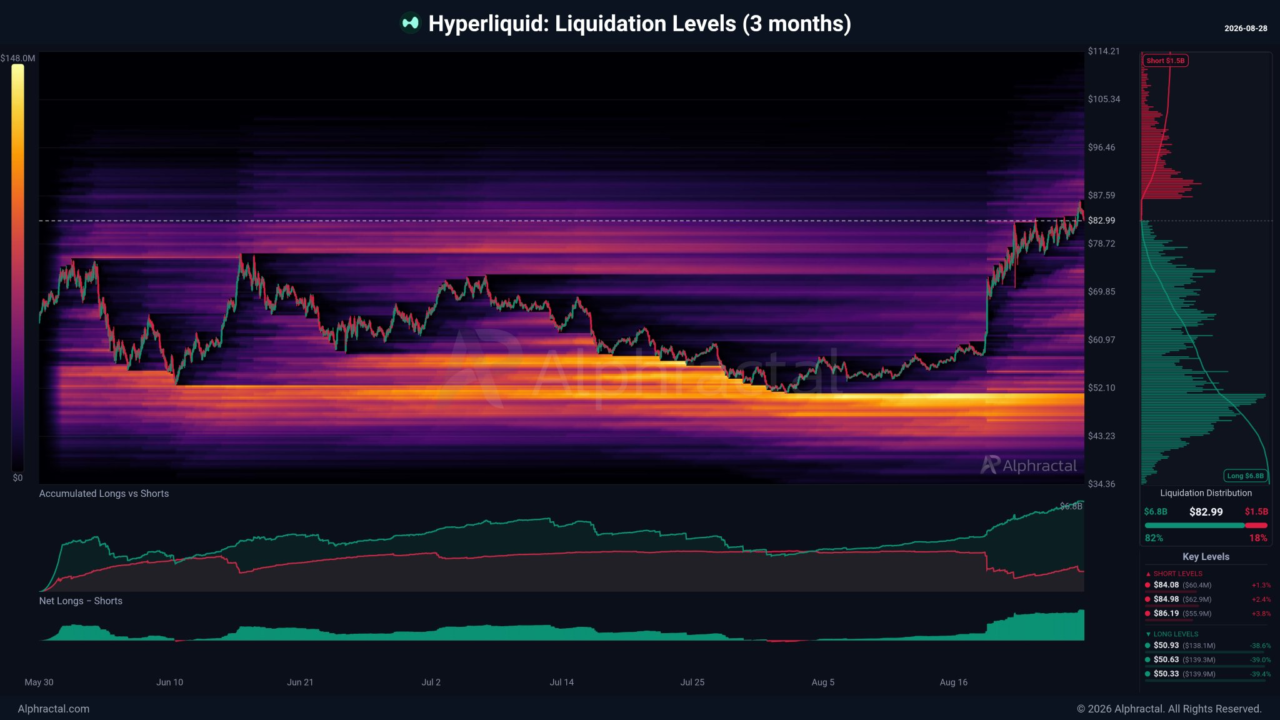
    It’s a lot more stretched at three months: 82% longs and 18% shorts.

    Source: Alphractal

    According to Joao Wedson, CEO of Alphractal, that imbalance may be dangerous.

    A price decline appears to be the more likely scenario.

    The concern is that $HYPE’s success pulled too much bullish positioning into the market. The short-term structure is going to punish late buyers.

    Will we survive a shakeout?

    The next move may matter less than it first appears.

    If $HYPE holds this level, it could be strong enough for another move higher. If too many long positions start closing, price could fall to the lower liquidity levels.

    A yellow fork in the road that’s worth watching.

    Final Summary

    • Hyperliquid leads perp DEX volume; Hyperliquid Strategies holds about $1.9B in $HYPE.
    • If bullish positioning unwinds, things could go south quick.