The Russian State Duma will consider a bill aimed at creating a comprehensive legal framework for cryptocurrency activities in the country for its second and third readings on July 21.
According to TASS, the bill aims to strengthen the fight against illegal transactions and fraud while defining the legal conditions for the use of cryptocurrencies in Russia. The regulation will also create a legal framework for the use of cryptocurrencies in international trade and cross-border transactions.
Anatoly Aksakov, chairman of the State Duma’s Financial Markets Committee, announced at a press conference held at the Rossiya Segodnya Center that the bill would undergo its second and third readings.
Aksakov stated that the regulation would create the necessary legal conditions for cryptocurrencies to operate in Russia, saying, “On the one hand, we are creating a legal framework to combat the illegal use of cryptocurrencies within the country. On the other hand, we are providing legal opportunities for those who use cryptocurrencies in international relations.”
Related NewsA List of the 15 Most-Searched Altcoins in Recent Hours Has Been Published
The bill would allow unqualified investors to purchase cryptocurrencies under certain conditions. Accordingly, individual investors would be able to buy the most liquid crypto assets, as determined by legislation, after passing a special qualification test.
Unqualified investors will be able to purchase cryptocurrencies up to 300,000 rubles (approximately $3,800) annually through each brokerage firm. The liquidity and eligibility criteria for crypto assets eligible for investment are expected to be determined separately under the relevant legislation.
In December, the Russian Central Bank introduced a regulatory framework that would allow both qualified and unqualified investors access to crypto assets. However, the bank continues to classify cryptocurrencies as high-risk financial instruments.
If the bill is approved in its second and third readings, Russia will have transitioned to a more comprehensive regulatory system for the cryptocurrency market, covering topics such as investor access, combating illegal activities, and use in international transactions.
Ethereum treasury company Bitmine barely moved the needle on its ETH stack last week, adding just 7,430 ETH—about $14 million—as it steered capital toward buying back its own shares instead.
This week’s buy pushed Bitmine’s holdings to about 5.78 million ETH tokens, or nearly 4.8% of Ethereum’s circulating supply, according to the company. That leaves the firm inching toward its stated goal of cornering 5% of the token’s supply. Bitmine, which trades as BMNR, is currently trading for $16.61, up almost 6% on the day.
Bitmine now holds roughly $11 billion worth of Ethereum, making it the largest corporate holder of ETH in the world. It’s also one of the biggest digital asset treasuries, second only to Michael Saylor’s Strategy, which itself holds roughly $54 billion in Bitcoin.
Still, for Bitmine, this latest purchase marks one of the company’s thinnest weekly additions since it kicked off its Ethereum treasury strategy in June 2025. The contrast is stark: Bitmine scooped up more than 111,000 ETH in a single week back in May.
Bitmine Chairman Tom Lee pinned the slowdown on a share repurchase, telling shareholders the firm bought back roughly 5.5 million common shares at an average price of $15.62 under its $4 billion buyback authorization. (Disclosure: Tom Lee is an investor in Dastan, Decrypt’s parent company.)
“The reduced pace of buys reflects that Bitmine repurchased 5.5 million common shares,” Lee said. He noted the company has bought ETH every week since launching the strategy just over a year ago.
Apart from its ETH holdings, the company also today reported a stash of 207 Bitcoin, $385 million in cash and securities, a $180 million stake in Beast Industries and a $58 million position in Eightco Holdings.
The company also said it has staked 4.92 million ETH—about 85% of its holdings—for projected annualized revenue near $247 million via its MAVAN validator platform.
Daily Debrief Newsletter
Start every day with the top news stories right now, plus original features, a podcast, videos and more.
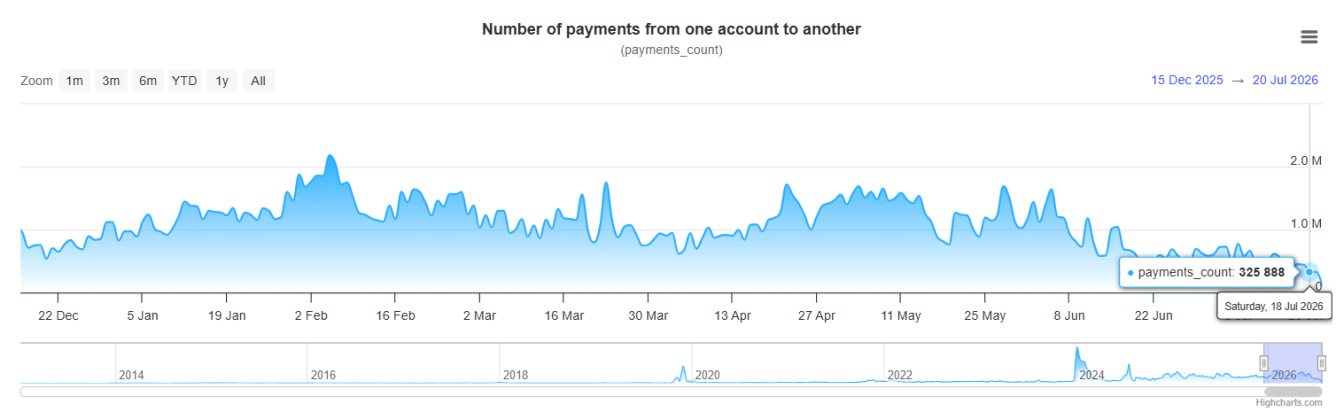
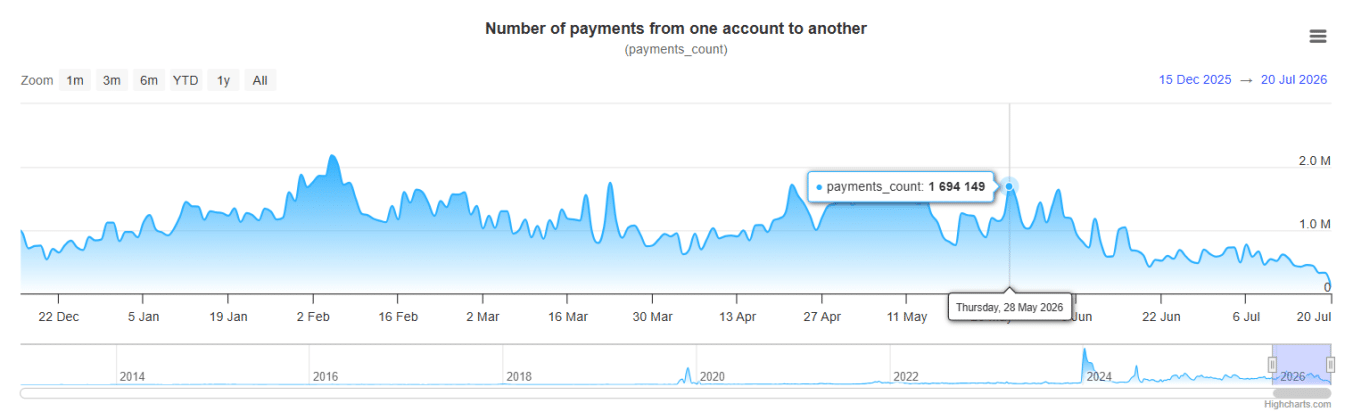
The number of daily payments on the $XRP Ledger (XRPL) has now crashed 80% from the May 2026 highs of over 1.69 million.
This comes amid the ongoing market-wide downtrend that has dealt a blow to investor sentiment. Notably, since hitting the $3.6 peak in July 2025, $XRP has collapsed more than 70%, currently trading for $1.08. As a result, bearish sentiments recently hit extreme levels.
$XRP Payment Volume Slumps 80%
Data from $XRP Scan, a leading XRPL explorer, confirms that these bearish sentiments have now begun impacting on-chain activity.
Specifically, the number of payments from one account to another on the $XRP Ledger dropped to a low of 325,888 on Saturday, July 18. This represents the lowest reading recorded on the network since the crash to 28,760 on Oct. 2, 2025, which occurred as a result of an unprecedented event.
$XRP Ledger Payment Crash
After that October 2025 crash, the number of XRPL payments remained above 500,000 every day until late June, when they dropped to around 400,000. Now, this figure has reduced further to a 9-month low of 325,888, indicating that payment activity has continued to decline.
Following the drop to 325,888 on Saturday, payment volume recovered slightly to 327,497 the next day, but this marked a drop below the 400,000 mark.
Importantly, the 325,888 figure represents an 80.7% crash from the recent highs of around 1.694 million daily payments recorded on May 28, 2026. Moreover, it also marks an 85% decline from the yearly peak of 2.188 million payments from February 2026.
The May 2026 High
Slowdown in Overall $XRP On-chain Activity
Meanwhile, further data confirms an overall slowdown in XRPL on-chain activitybesides the crash in the number of daily payments, as prices continue to hit lows around the $1 psychological mark.
For instance, the number of active users on the XRPL, when considering source tags and destination tags, dropped to a low of 123,986 on Sunday, coinciding with the crash in payment volume.
In addition, the number of transactions executed on the network also slumped to 1.129 million that day. This represented a 78% crash from the yearly peak of 5.172 million transactions executed on April 6, 2026.
$XRP Seeing Bearish Price Action
As earlier mentioned, this overall slowdown in network activity has been largely due to the broader market downturn that has led to increased selling pressure surrounding $XRP.
After recovering to $2.41 on Jan. 6, 2026, $XRP witnessed one of its steepest declines over the next few weeks, crashing to a low of $1.11 in early February before rebounding above $1.40. The asset maintained this level until early June, when it lost the support area from $1.1 to $1.4.
Now, $XRP changes hands below $1.1, down nearly 41% this year despite seeing a 4.85% gain in July 2026 so far. $XRP must hold above the $1 level to hedge against any steeper declines from here, which could push prices down to the $0.7 to $0.8 range.
Bitcoin price has slipped below $64,000 as renewed US-Iran tensions, volatile oil prices, and a technology-sector sell-off tied to China’s Kimi K3 launch drove investors away from risk assets.
According to data from crypto.news, Bitcoin ($BTC) price fell nearly 2% to $63,785 on Monday before recovering toward $64,000, still down about 1% over the past 24 hours. The Crypto Fear & Greed Index remained in “Fear” territory at 29, while Ether, XRP, BNB, and Dogecoin also posted slight daily losses.
Middle East risks intensified after a projectile set a vessel ablaze in the Strait of Hormuz, forcing its crew to abandon ship before a tugboat rescued them. US strikes also killed one person in Tabriz, while Tehran condemned attacks on the unfinished Darkhovin nuclear facility.
CENTCOM separately reported that a US service member died during the controlled detonation of an unexploded Iranian drone in northern Iraq.
The attacks initially drove crude oil higher as traders assessed the threat to Middle Eastern production and shipping. Brent briefly exceeded $85 per barrel before falling toward $82 after Iran’s Foreign Ministry confirmed that international mediators had submitted proposals to reduce tensions.
Tehran also left the door open to negotiations with Washington if talks served Iran’s national interests. The diplomatic opening reduced immediate supply fears, although attacks on vessels, Iranian cities, and nuclear infrastructure kept the risk of another oil-price surge in place.
Technology stocks added another source of pressure after Beijing-based Moonshot AI released Kimi K3, a 2.8 trillion-parameter model designed for coding and agent-based tasks. Moonshot’s internal tests placed Kimi K3 ahead of several Western rivals in frontend coding, although those performance claims await independent confirmation when the model weights become available.
The launch intensified concerns that cheaper Chinese models could disrupt US artificial intelligence companies and their semiconductor suppliers. Bitcoin has traded closely with technology-heavy equity indices during recent risk-off sessions, leaving the cryptocurrency exposed as investors reduced positions across speculative markets.
US equity funds recorded $4.8 billion in withdrawals during the week ended July 15, according to LSEG Lipper data cited by Reuters. The Philadelphia Semiconductor Index lost 8.48% during the same period, while growth funds suffered $7.18 billion in net redemptions.
Bitcoin price must reclaim $65,000 to confirm a sustained recovery
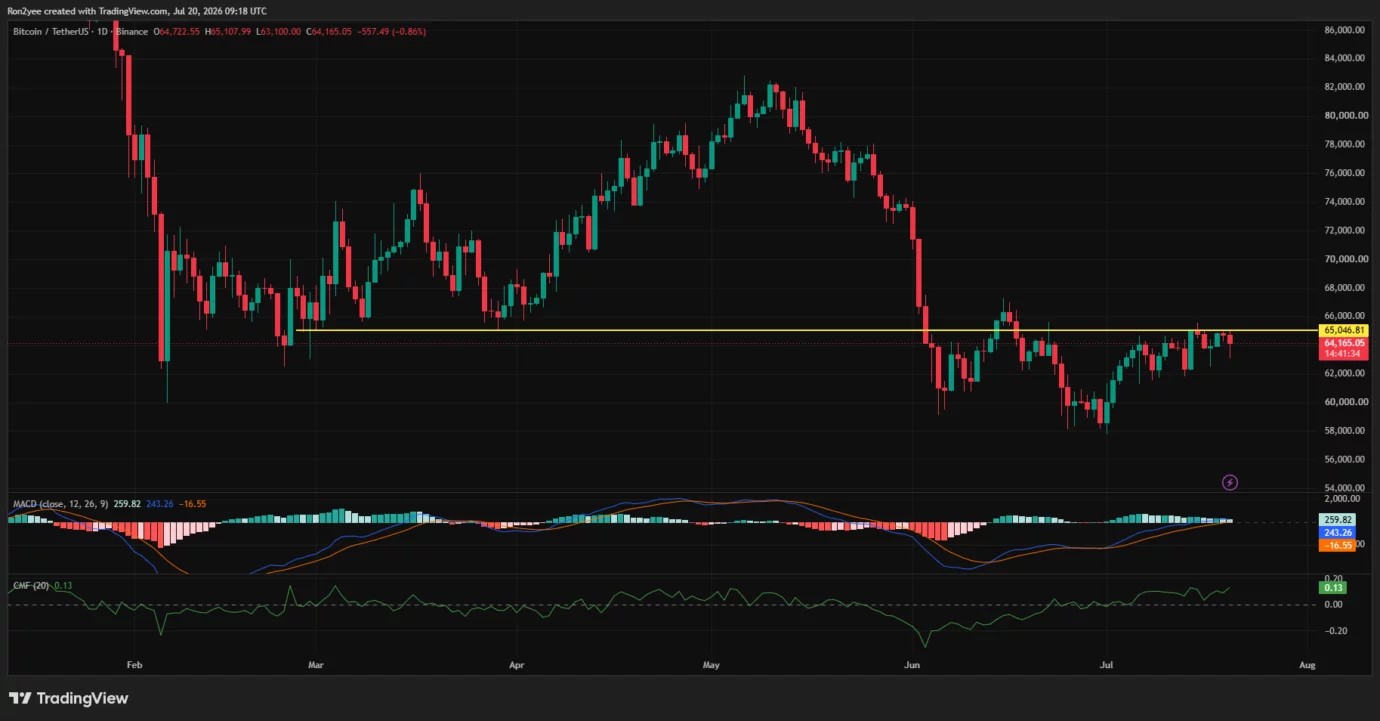
Bitcoin’s daily chart shows repeated failures around $65,047, a former support level that has turned into resistance. Buyers have tested the barrier several times since early July, but each attempt has ended without a daily close above it.
Bitcoin price daily chart — July 20 | Source: crypto.news
A decisive close over $65,047 would restore the recovery structure and expose the June swing high near $67,000. Until then, Bitcoin remains inside the range between roughly $60,000 and $65,000 that has controlled price action for most of July.
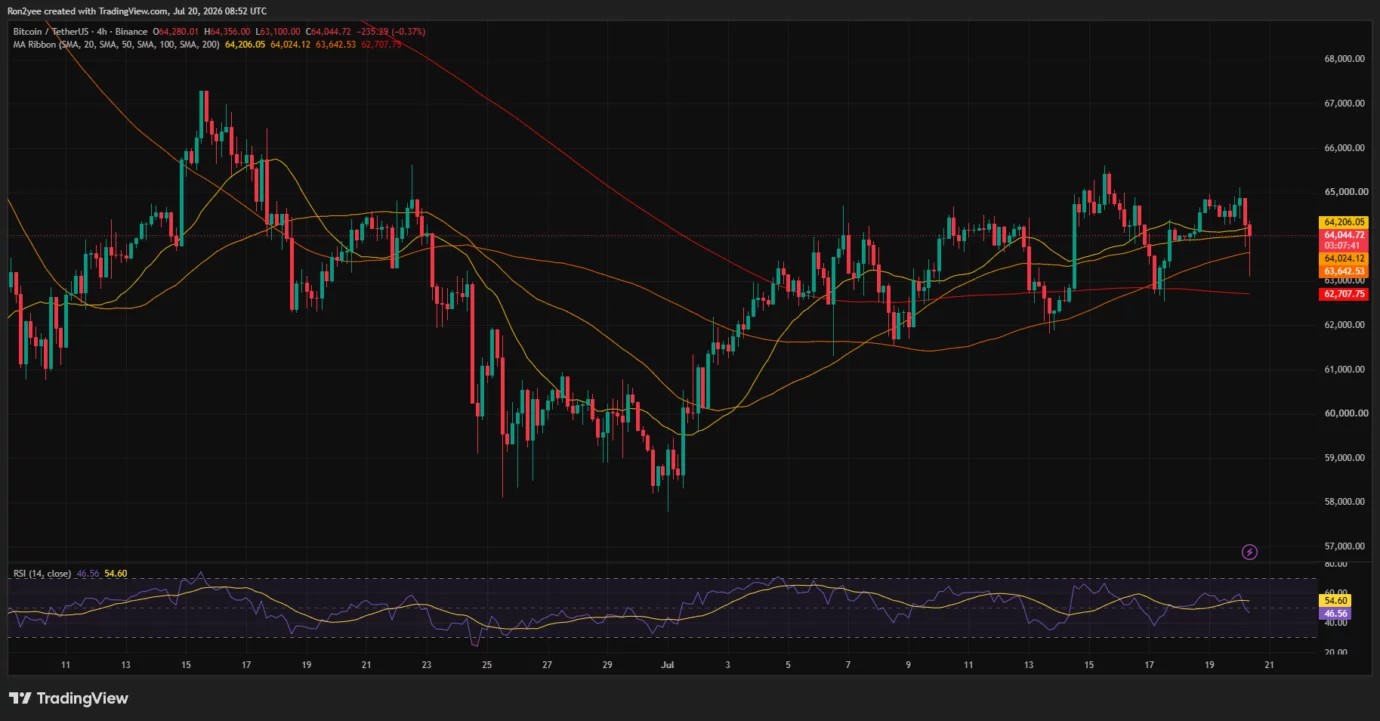
On the 4-hour chart, $BTC has fallen below its 20-period simple moving average at $64,206 but remains close to the 50-period average at $64,024. The 100-period SMA at $63,642 offers the next support, followed by the 200-period SMA near $62,708.
Bitcoin price 4-hour chart — July 20 | Source: crypto.news
4-hour relative strength has dropped to 46.56, below its moving average of 54.60. The reading shows that sellers have regained control of short-term momentum, though $BTC has not yet entered oversold territory.
Daily momentum presents a mixed picture. The MACD histogram has slipped below zero to -16.55 as the MACD and signal lines converge, raising the risk of a bearish crossover. However, the Chaikin Money Flow reading remains positive at 0.13, which shows that capital has not left the market at the same pace as the price decline.
According to trader Daan Crypto Trades, Bitcoin is still attempting to close above its weekly 200-period moving average, but a stronger advance is needed to challenge the weekly 200-period exponential moving average.
“Until then, we’re just caught in this $60K choppy price range.”
Spot Bitcoin ETFs have provided limited relief after more than eight weeks of heavy withdrawals, SoSoValue data shows. US-listed funds posted a second consecutive week of net inflows, while BlackRock’s IBIT helped drive a $132 million inflow on Friday despite a $4.2 million withdrawal from Fidelity’s fund. The improvement remains too small to establish aggressive institutional accumulation.
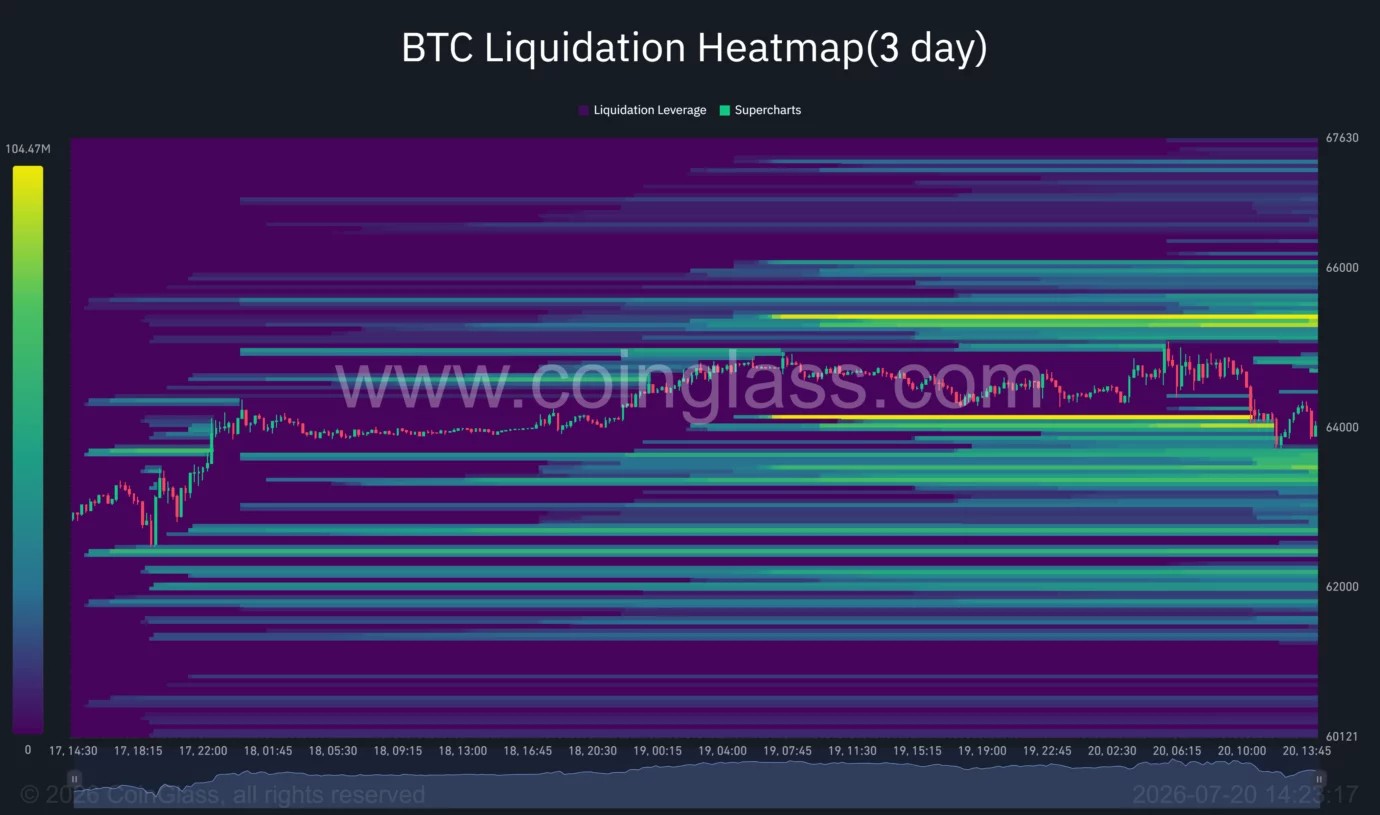
The three-day liquidation heatmap places the largest overhead liquidity concentration around $65,200 to $65,500. A move into that band could force leveraged short positions to close and help $BTC challenge the daily resistance near $65,047.
Bitcoin liquidation heatmap | Source: CoinGlass
Below the market, liquidation pools sit between $63,300 and $63,600, with another concentration around $62,500 to $62,800. Price frequently moves toward dense leverage zones, making either cluster a potential target if volatility expands.
Loss of $62,700 would expose Bitcoin to another capitulation leg
Bitcoin’s recovery thesis would weaken if sellers force a 4-hour close below the 100-period SMA at $63,642. A subsequent break under the 200-period SMA at $62,708 would expose $60,000, followed by the late-June low near $58,000.
Analyst Ardi warned that the current bear-market decline has not produced the severe capitulation seen before previous cycle bottoms. In his view, either months of range-bound trading must exhaust sellers or a deeper liquidation event must clear the remaining leverage.
I don’t necessarily think $BTC needs to bottom in Q4 this year.
But if the bottom comes sooner, we need a larger capitulation to front-run it.
Every prior cycle low was preceded by a brutal capitulation.
The kind of flush that pushed the average holder underwater, cleared the…
— Ardi (@ArdiNSC) July 19, 2026
Oil remains the main external risk. Failed US-Iran negotiations or renewed threats to regional energy routes could send crude higher again, revive inflation fears, and reinforce the Federal Reserve’s higher-for-longer policy stance.
For bulls, a daily close above $65,047 would invalidate the immediate bearish setup and open the path toward $67,000. Without that breakout, Bitcoin remains vulnerable to another sweep of leveraged positions below $63,600.
Hyperliquid said its HIP-4 upgrade, which introduced “outcome trading” to the decentralized exchange, will support permissionless deployment of the contracts in a future enhancement.
Once live, anyone will be able to offer a prediction market on the platform, subject to templates approved by validators, Hyperliquid said on Telegram on Sunday. In the meantime, they remain under the authority of validators.
Prediction markets, a sector dominated by Polymarket and Kalshi, allow participants to bet on event outcomes and have evolved into a multibillion-dollar sector of the blockchain industry. Users take positions on events from central bank interest-rate decisions to who performs at the Super Bowl halftime show.
The growing popularity of the platforms — the FIFA World Cup, which wrapped up Sunday with Spain winning its third title, drew more than $50 billion in bets — has attracted centralized trading platforms like Coinbase and Robinhood into the sector to offer customers a one-stop shop for predictions markets alongside more conventional financial trading.
AZ-COM Maruwa Holdings, a major Japanese logistics company, plans to adopt the JPYC stablecoin to make payments to around 2,300 business partners, in what is expected to be the first large-scale corporate use of the yen-denominated JPYC stablecoin in Japan.
According to a report from Nikkei, the stablecoin will be used to pay fees and compensation to individual contractors who handle transportation, including truck drivers, while the use of the stablecoin will allow faster and more frequent payments, as it does not charge transfer fees.
AZ-COM Maruwa is also considering a partnership with JPYC and an investment of over 1 billion Japanese yen ($6.2 million).
AZ-COM Maruwa is a mid-sized Japanese logistics company in Japan and counts Amazon Japan among its major customers.
“We will continue to advance the integration of logistics and commercial payment flows with JPYC,” said Noritaka Okabe, founder and CEO of JPYC Inc.
Strike founder and Twenty One Capital CEO Jack Mallers has made a forceful argument that Bitcoin’s long-term value lies not in attracting speculative capital, but in its potential to replace traditional savings and function as a reliable form of money. His comments, posted on X, directly challenge a recent critique from former Facebook executive Chamath Palihapitiya, who described Bitcoin’s current weakness as a structural issue tied to shifting liquidity and the rise of competing sectors.
Responding to Structural Concerns
Palihapitiya had argued that Bitcoin is facing a structural headwind as liquidity moves toward prediction markets, equities, and artificial intelligence (AI) ventures. He also suggested that Bitcoin mining power could earn 10 to 20 times more if redirected to AI computing. Mallers rejected this framing, stating that the new money flowing into prediction markets, meme coins, and AI was never sustainable demand for Bitcoin in the first place.
In his own words, Mallers wrote: “$BTC is not successful because it attracts speculative capital. It succeeds by replacing savings and becoming money.” This distinction is central to his thesis: Bitcoin’s ultimate value proposition is not as a high-risk asset for traders, but as a stable, decentralized store of value for long-term holders.
The Protocol’s Adaptive Design
Mallers also emphasized that Bitcoin’s creator, Satoshi Nakamoto, designed the protocol to adapt automatically even if power conditions change. He pointed to the network’s difficulty adjustment mechanism, which recalibrates when the hash rate shifts, ensuring that Bitcoin continues to produce blocks regardless of external market conditions. “We need $BTC much more than $BTC needs us,” Mallers added, suggesting that the network will remain operational long after speculative manias and tech bubbles fade.
Implications for Investors and the Market
This perspective carries weight for both retail and institutional investors. If Mallers is correct, Bitcoin’s current price volatility may be a feature of its speculative phase, not a flaw in its fundamental design. The argument positions Bitcoin not as a competitor to AI or prediction markets, but as a parallel system for preserving wealth outside of traditional financial and technological cycles.
For miners, the debate raises strategic questions. While some may consider pivoting to AI computing for higher short-term returns, Mallers’ view suggests that Bitcoin mining remains a critical and resilient component of the network’s security, with long-term value that may outweigh immediate profit opportunities.
Conclusion
Jack Mallers’ remarks offer a counterpoint to growing skepticism about Bitcoin’s role in a rapidly evolving digital economy. By framing Bitcoin as a monetary system rather than a speculative asset, he invites a reassessment of what constitutes success for the cryptocurrency. Whether the market agrees remains to be seen, but the debate underscores a fundamental divide in how Bitcoin’s future is understood.
FAQs
Q1: What did Jack Mallers say about Bitcoin’s success? Mallers argued that Bitcoin will succeed by replacing savings and becoming money, not by attracting speculative capital. He believes its value is in its role as a stable store of value, not as a high-risk investment.
Q2: How did Chamath Palihapitiya criticize Bitcoin? Palihapitiya described Bitcoin’s weakness as a structural issue, noting that liquidity is moving to prediction markets and equities, and that mining power could be more profitable if redirected to AI computing.
Q3: What is the Bitcoin difficulty adjustment mechanism? The difficulty adjustment is a built-in feature of the Bitcoin protocol that automatically recalibrates the mining difficulty when the network’s hash rate changes. This ensures that blocks are produced at a consistent rate, even if the total computing power on the network fluctuates.
A cryptocurrency wallet associated with Dutch exchange Bitvavo has withdrawn 3.89 million Chainlink ($LINK) tokens, valued at approximately $32.59 million, from Coinbase Prime. The funds were transferred to a newly created address, according to on-chain data.
Details of the Transaction
The large-scale movement was detected by blockchain tracking services on [Date of transaction, e.g., Tuesday]. The address, identified as belonging to Bitvavo, initiated the withdrawal from Coinbase Prime, a platform widely used by institutional clients for custody and trading. The receiving address was previously inactive, suggesting a new wallet setup, possibly for internal treasury management or long-term holding.
Why This Matters
Large withdrawals from centralized exchanges to private wallets are often interpreted as a bullish signal by market observers, as they typically indicate an intent to hold rather than sell. For Bitvavo, a regulated Dutch exchange serving a European user base, such a transfer could reflect routine treasury rebalancing, cold storage security upgrades, or preparation for staking activities. Chainlink ($LINK) is a prominent oracle network token, and large movements by exchanges can influence market liquidity and sentiment.
Context and Market Impact
The transfer represents a significant portion of Bitvavo’s known $LINK holdings. While the exchange has not publicly commented on the transaction, similar moves by other platforms have historically preceded staking integrations or enhanced security protocols. At the time of the transfer, $LINK was trading around $8.38, showing relative stability despite the large withdrawal. The on-chain data provides transparency into exchange reserve management, a key factor for user trust in the wake of past industry failures.
Conclusion
Bitvavo’s $32.6 million $LINK withdrawal from Coinbase Prime is a notable on-chain event that underscores ongoing treasury management by European exchanges. While the specific intent remains unconfirmed, the move aligns with industry practices of securing assets in cold storage. The transaction has not triggered significant market volatility, suggesting it was an operational decision rather than a trading signal.
FAQs
Q1: What is Coinbase Prime? Coinbase Prime is a platform designed for institutional investors and large-scale traders, offering custody, staking, and advanced trading services. It is commonly used by exchanges and funds to manage significant crypto holdings.
Q2: Why would an exchange withdraw such a large amount of $LINK? Exchanges often move assets to private wallets for enhanced security (cold storage), to prepare for staking, or to rebalance internal reserves. It can also signal a long-term holding strategy rather than immediate selling.
Q3: Does this transfer affect the price of Chainlink? Large withdrawals can sometimes reduce sell pressure on exchanges, which may be viewed positively by the market. However, the immediate price impact was minimal in this case, as the move appeared to be an operational transfer rather than a market trade.
A year on, the rules aren’t quite ready for implementation, but we have a much clearer idea as to how the regulators are thinking about stablecoins and where they’re likely to land on those rules.
In an emailed statement, Crypto Council for Innovation CEO Ji Hun Kim called the passage of the bill “a landmark moment.”
“A year in, agencies, institutions, and innovators are building on a clearer foundation, and stablecoins are moving rapidly toward mainstream adoption,” he said.
The various regulators have proposed rules out for comment on the different aspects of stablecoin governance and regulation, including a proposal that would require stablecoin issuers to conduct similar know-your-customer checks to more traditional financial firms. The FDIC published 144 questions a few months ago about how it would oversee stablecoin issuers, looking at concerns like custody, capital and liquidity standards. The OCC, for its part, put out its own proposal in February laying out how it was interpreting the law.
There’s still a few months left before these rules start being finalized. And in the meantime, the industry is still working on getting the Digital Asset Market Clarity Act passed.
The text of the combined Clarity Act drafts is not yet public, at least as of Friday night. While industry sources expected the bill to be released last week, the timeline has constantly evolved. On Thursday, Senators Cynthia Lummis and Bernie Moreno were supposed to brief Trump on the bill. There was no public readout of that meeting available after, but both lawmakers tweeted about Trump’s remarks on the election later Thursday.