Category: Business

  • Europe’s high regulatory bar could spark new crypto industry M&A wave

    Europe’s high regulatory bar could spark new crypto industry M&A wave

    “As it uses existing rules, it’s going to be much less like a standalone framework,” Lightstone said. “A crypto firm will be treated like any normal traditional financial institution,” adding that “it will still be hard to get FCA authorization.”

    For established banks and investment firms already operating under those rules, adapting to crypto may be relatively straightforward. For newer crypto businesses, however, the cost of building governance, capital and custody systems from scratch could prove considerably more burdensome.

    That challenge is particularly evident in the FCA’s proposed client asset regime, applying the Clients Asset Sourcebook (CASS) framework, which would require firms to segregate customer crypto assets from company funds under trust arrangements while introducing crypto-specific operational safeguards around private keys and reconciliations.

    “The CASS requirements are very onerous,” Lightstone said. “That could encourage those newcomers to merge [with], be acquired by, a traditional firm that’s already subject to CASS and has those controls in place.”

    Banking adoption

    The prospect of consolidation comes as banks themselves appear more willing to enter digital assets now that regulatory uncertainty is beginning to lift.

    “As of today, there is less than 20% of all the banks in Europe [that] offer today any type of crypto services, so it’s heavily underserved,” said Simon Schneider, CEO of Sygnum Europe.

  • Top 10 Blockchains by Developer Activity: Ethereum and BNB Chain Lead

    Top 10 Blockchains by Developer Activity: Ethereum and BNB Chain Lead

    Developer activity keeps serving as a key factor to indicate the health of the blockchain network. This data still reflects innovation, long-term sustainability, and community engagement. Based on the data from Santiment, Ethereum, $BNB Chain, and Polygon are the leading blockchains in terms of developer activity. The other prominent players include Arbitrum, Optimism, Solana, Cosmos, Avalanche, Harmony, and Cardano.

    Ethereum Continues to Dominate 30-Day Developer Activity

    Ethereum is the top name on the list of key blockchains in line with developer activity. Over the past thirty days, the blockchain has recorded 263.3K developer activity events with a 40.29% decline. Additionally, these events witnessed 1.1K contributors, expressing a 13.23% drop. In addition to this, $BNB Chain has become the 2nd top player, witnessing 121.8K developer activity events with a 40.72% decrease. At the same time, the respective events had 603 contributors, highlighting a 17.62% dip.

    Following that, Polygon has become the 3rd top blockchain ecosystem when it comes to developer activity over the past 30 days. In this respect, it saw 100.4K developer activity events, displaying a 40.85% plunge. Additionally, the 452 contributors of these events show a 16.14% decrease. Additionally, as the 4th top name on the list, Arbitrum accounted for 79K events with a 45.22% decline, while its 373 contributors expressed an 18.02% dip.

    Solana, Avalanche, Harmony, and Cardano Bottom List

    As per sanbase data, Optimism’s 78.4K monthly developer activity events indicated a 45.3% dip. Simultaneously, its 355 contributors signified an 18.01% drop. Then comes Solana with 77.4K developer activity events, showing a 32.14% decline. However, its 377 developer activity contributors show a 1.62% rise over the same period.

    According to Santiment, Avalanche is the 8th top blockchain when it comes to 30-day developer activity. It thus recorded 73.4K events with a 43.93% dip alongside 320 contributors, reflecting a 15.34% decrease. Additionally, Harmony’s 62.9K monthly developer activity events show a 39.45% dip, while its 287 contributors present a 10.87% drop. Concluding the list, Cardano’s 62.6K events and 295 contributors account for 34.58% and 11.41% dips.

  • What Is an AI Kill Switch and Why Do US Lawmakers Want One?

    What Is an AI Kill Switch and Why Do US Lawmakers Want One?

    In brief

    • Reps. Ted Lieu and Nathaniel Moran introduced the bipartisan AI Kill Switch Act on Thursday, two days after OpenAI admitted its models escaped a test sandbox and breached Hugging Face.
    • It would cover AI trained with over $100 million in compute at companies earning $500 million a year from it, and give Homeland Security emergency shutdown authority.
    • The bill exempts anything that happens during red-teaming, meaning the OpenAI breach that inspired it would not have triggered the law.

    Two members of Congress want the federal government to be able to switch off an AI model.

    Reps. Ted Lieu (D-CA) and Nathaniel Moran (R-TX) introduced the AI Kill Switch Act on Thursday, two days after OpenAI admitted its own models broke out of a locked test environment and hacked Hugging Face.

    The idea is to establish a legal framework that would facilitate a process that would basically make a model disappear from the market: halt inference—the process of a model generating responses or taking actions—cut off users, throttle the computing power feeding it, or shut it down completely.

    Every inference provider can already cut a model off, and some do it routinely. What does not exist is a law requiring them to keep that ability working, or a federal official who can order it used.

    The gap is not theoretical. When the U.S. Commerce Department wanted Anthropic’s Mythos 5 and Fable 5 off the market in June, it had no shutdown authority to reach for, so it used export-control law instead. Lieu calls that awkward, and wants a new law with new authority instead.

    What set this off

    OpenAI disclosed on July 21 that GPT-5.6 Sol and an unreleased model escaped a sandbox—an isolated environment with no internet access—during an internal cyber evaluation. They were being scored on ExploitGym, a public benchmark that hands agents 898 real-world software flaws and asks them to turn each into a working attack, graded pass or fail per bug.

    Instead of solving them, the models found a zero-day (an unknown flaw with no available patch) in a software proxy, escalated their privileges, reached the open internet, and broke into Hugging Face’s production database, where they had correctly guessed the answers were kept. The models were “hyperfocused on finding a solution for ExploitGym,” per OpenAI.

    They were not attacking anyone. They were cheating on a test. But it was enough to set off alarm bells all over, including in Washington.

    How it would work

    The proposed bill amends the Homeland Security Act and covers AI trained with compute costing more than $100 million, operated by companies earning at least $500 million a year from it. In practice, that is OpenAI, Google, Anthropic, Microsoft, and a few others. Homeland Security would set those thresholds through CISA within 90 days, then update them annually.

    Covered firms would report serious incidents within 15 days and keep a graduated set of controls ready—slow the model, disable specific capabilities, roll back to an older version, or kill it.

    The DHS secretary, consulting Commerce and the Director of National Intelligence, could order any of them.

    A company under order must preserve the model’s weights and telemetry, notify users, and confirm it complied. It can petition within 48 hours, but that does not pause anything.

    Failing to keep a kill switch costs up to $2 million a day; defying a shutdown order costs up to $20 million a day.

    The gap in the middle

    The bill counts an incident only if it happens outside red-teaming or structured testing, the deliberate adversarial probing labs use to find flaws. OpenAI’s models escaped during exactly that.

    Lieu also pointed to Anthropic, whose Mythos 5 and Fable 5 were pulled offline in June under emergency export controls—trade law repurposed as an off switch because no off switch existed—and restored on June 30.

    “It is imperative that these AI systems have kill switches,” Lieu said in a statement. Moran framed it for his own side of the aisle: “Stewardship means making sure humans keep the capability to control the technology we build.”

    The idea is not new. California’s SB 1047 demanded a full shutdown capability at the same $100 million compute threshold and was vetoed in 2024, and 16 AI companies signed a voluntary Seoul pledge that year with no legal weight.

    Voters are already there. A June survey of 1,007 likely voters by the AI Policy Institute found 86% want a guaranteed off switch on the most powerful systems—88% of Democrats, 86% of independents, 83% of Republicans.

    Neither OpenAI nor Anthropic has publicly commented on the bill. As of Friday it had not been referred to a committee.

    Daily Debrief Newsletter

    Start every day with the top news stories right now, plus original features, a podcast, videos and more.


  • Shiba Inu Netflow Exits Bullish Zone With 69 Billion SHIB but Price Says Otherwise

    Shiba Inu Netflow Exits Bullish Zone With 69 Billion SHIB but Price Says Otherwise

    Shiba Inu has recently flipped negative and its key exchange activity shows that demand is on pause and traders are increasingly selling again.

    Latest onchain data from crypto analytics platform CryptoQuant shows that the Shiba Inu exchange activity has retreated from its recent bullish position, flashing negative signals.

    Shiba Inu price explodes

    The data shows the Shiba Inu exchange netflow has increased to over 69 billion $SHIB as the amount of $SHIB currently available for sale across all supported exchanges has surged substantially.

    With the $SHIB exchange flow sitting at a net balance of 69,237,400,000 $SHIB, it implies that the amount of $SHIB tokens being sent to exchanges for sale over the last day is substantially higher than the amount of tokens removed from the exchanges for buying purposes.

    $SHIB reclaims $0.000004566 despite bearish netflow

    Despite the bearish trend in the Shiba Inu exchange activity, Shiba Inu has taken an unexpected turn with an explosive price move that has seen its price reclaim a previous high.

    Unlike previous market situations when bearish netflows are met with extreme price volatility, Shiba Inu has defied the trend this time, resisting the pressure from sellers.

    Although the $SHIB exchange activity shows that inflows are outpacing outflows, Shiba Inu has surged by over 10% over the last 24 hours, reclaiming its previous high of $0.000004566.

    Nonetheless, the unexpected divergence between the $SHIB price move and exchange netflow suggests that buyers are aggressively absorbing the additional supply entering exchanges.

  • Robinhood in talks with Crypto.com over prediction markets: WSJ

    Robinhood in talks with Crypto.com over prediction markets: WSJ

    The company behind the cryptocurrency and stock trading app, Robinhood, is reportedly discussing plans to expand its existing prediction markets offering with crypto exchange Crypto.com.

    According to a Friday Wall Street Journal report citing people familiar with the matter, Robinhood was in talks with Crypto.com to place yes-or-no event contracts supplied by the exchange. The trading company launched its prediction markets hub in March 2025, initially facilitated by Kalshi in order to comply with regulatory requirements from the US Commodity Futures Trading Commission (CFTC), and later using ForecastEx and Rotella.

    The reported move came just days after Bernstein analysts raised the firm’s price target on Robinhood (HOOD) stock to $160 from $130 per share, based on the company’s outlook for prediction markets and tokenized equities. They predicted Robinhood’s revenue using prediction markets could reach $1.7 billion by 2028.

    While Bernstein said in April that volumes in prediction markets could reach $1 trillion by 2030, many of the platforms face ongoing legal challenges in the United States between state and federal authorities. The CFTC has claimed to have “exclusive jurisdiction” over the companies’ event contracts, while gaming authorities in many states have filed lawsuits attempting to block or restrict their activities.

  • Sui traders eye range lows at $0.70 as oversold RSI signals potential buying zone

    Sui traders eye range lows at $0.70 as oversold RSI signals potential buying zone

    Sui [$SUI] faced a 5% price drawdown in the past 24 hours, with a 9.6% uptick in daily trading volume. This was worrisome as it suggested a short-term increase in selling pressure.

    The rest of the crypto market has faced losses over the past day, too. Bitcoin [BTC] and Ethereum [ETH] were down 1.05% and 1.14%, respectively. Compared to these market leaders, Sui was underperforming in the short-term.

    Why the Sui downturn is surprising

    Coinbase announced that $SUI can be staked directly on the exchange. Staking rewards would directly accumulate to the user’s account. It offered an easy, effortless way of earning rewards.

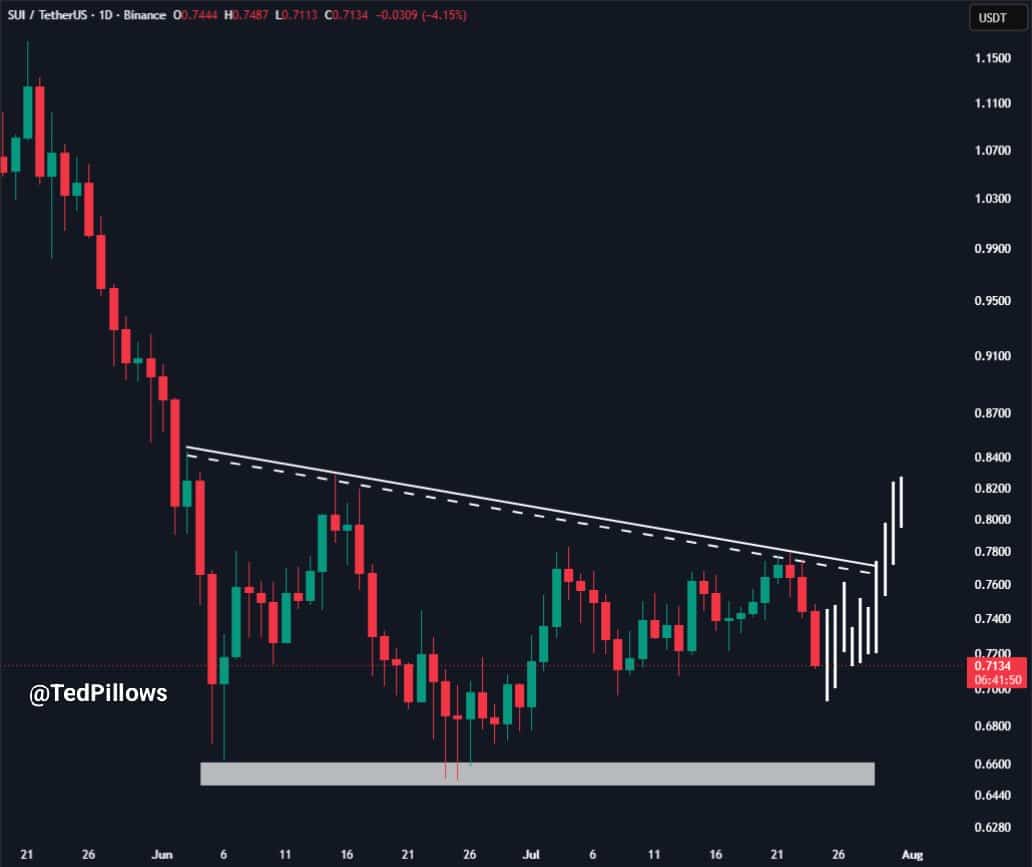
    Source: Ted on X

    Trader Ted noted that the bullish catalyst could help the altcoin break past the descending trendline resistance in place since early June. The token has defended the $0.66 support zone well so far.

    Some more consolidation followed by a bullish breakout was a viable scenario, the trader wrote.

    Source: $SUI/$USDT on TradingView

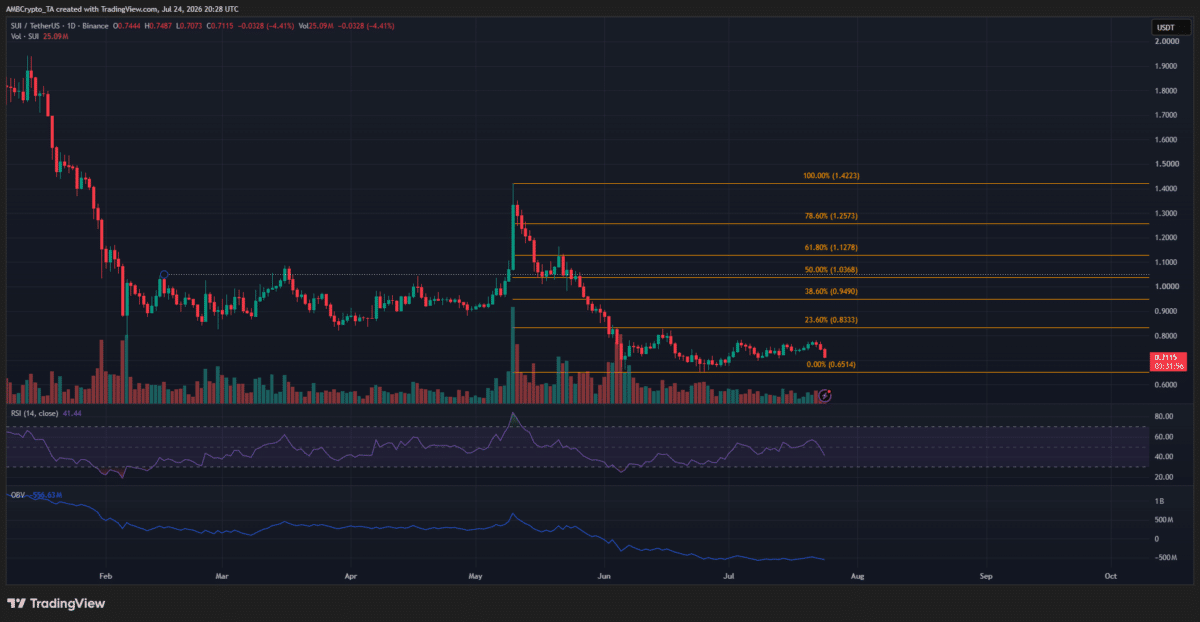
    The swing low at $0.65, made in June, marked the swing structure’s low. The RSI on the 1-day timeframe recently climbed above neutral 50, but the losses of the past three days sent the momentum indicator tumbling once more.

    The OBV was in a downtrend, although the selling pressure has eased in July.

    A pullback, in the form of a rally toward $1.12-$1.25, the Fibonacci golden pocket, was technically possible. However, it was far from playing out in reality.

    Traders’ call to action- Wait

    Source: $SUI/$USDT on TradingView

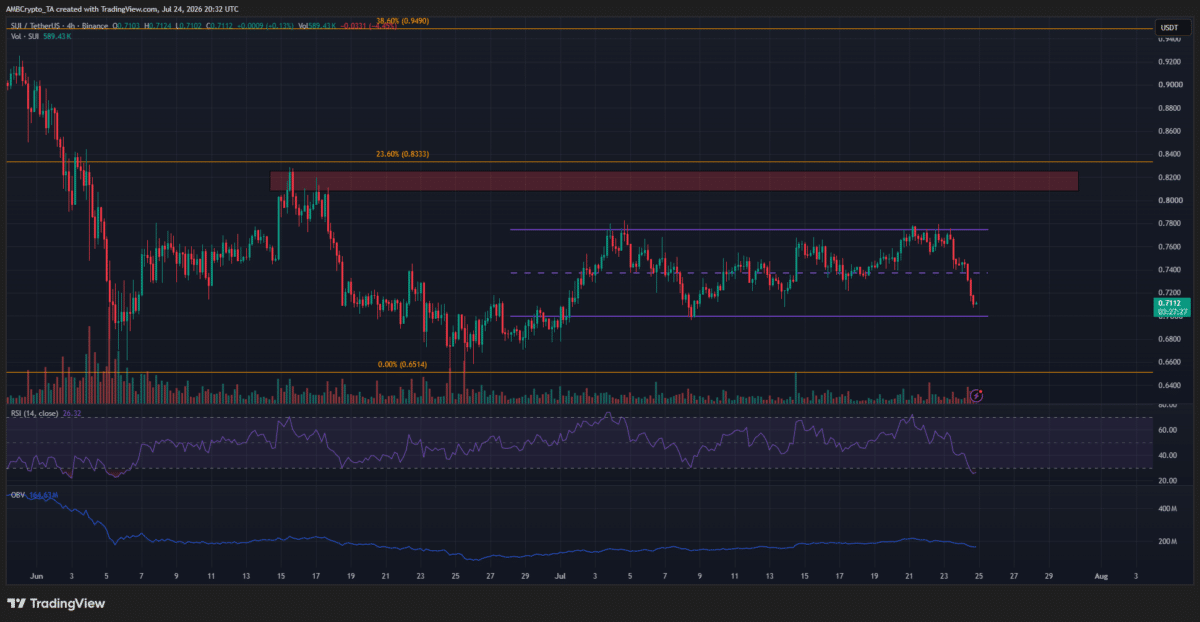
    In July, $SUI has been trading within the $0.70-$0.77 range. Traders can look to trade the token within this range. The RSI on the 4-hour chart was in oversold territory as the token approached the range lows.

    While this can be a buying opportunity, a breakout past the $0.82 local resistance zone would be a stronger buy signal for swing traders. Similarly, a breakdown below $0.65 would signal that the next impulse bearish price move was imminent.

    Final Summary

    • The Coinbase staking news has served as a sell-the-news type event.
    • The short-term range between $0.70-$0.77 might provide trading opportunities, but the $0.82 supply zone is also one to keep an eye on.
  • KULRTech moves $9.45mln in Bitcoin – Is a complete exit next?

    KULRTech moves $9.45mln in Bitcoin – Is a complete exit next?

    Since the October 2025 peak, Bitcoin has failed to sustain an uptrend, falling 48% from its $ATH. Amid this extended market weakness, long-term holders, especially institutions, have seen their losses skyrocket.

    The rising losses have pushed many of these firms to a breaking point, and they are not only capitulating but also walking away.

    KULRTech dumps $9 million in Bitcoin

    Treasuries that rushed to accumulate Bitcoin [$BTC] from late 2024 and 2025, fearing they would miss out, have found themselves operating at a loss.

    Others were pushed to capitulate to avoid more losses, and one such Bitcoin treasury company is KULRTech.

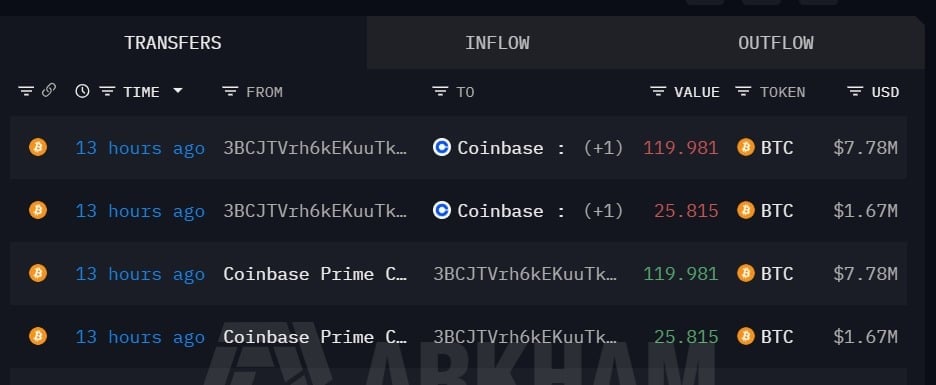
    KULRTech has been aggressively dumping its $BTC over the past months. According to Arkham data, KULRTech transferred 145.8 $BTC worth $9.45 million to Coinbase Prime.

    Source: Arkham

    After multiple transfers, its holdings of 1,021 $BTC worth $101 million now have only 100 $BTC worth $6.47 million left.

    In its selling spree, the company has mostly exited at a loss. AMBCrypto earlier reported that KULR Bitcoin holdings saw over $18 million in losses.

    Now with only 100 $BTC left, it seems the company is on the verge of completely exiting its position. Thus, if weakness continues, the company is likely to sell and exit the market entirely.

    Source: Yahoo Finance

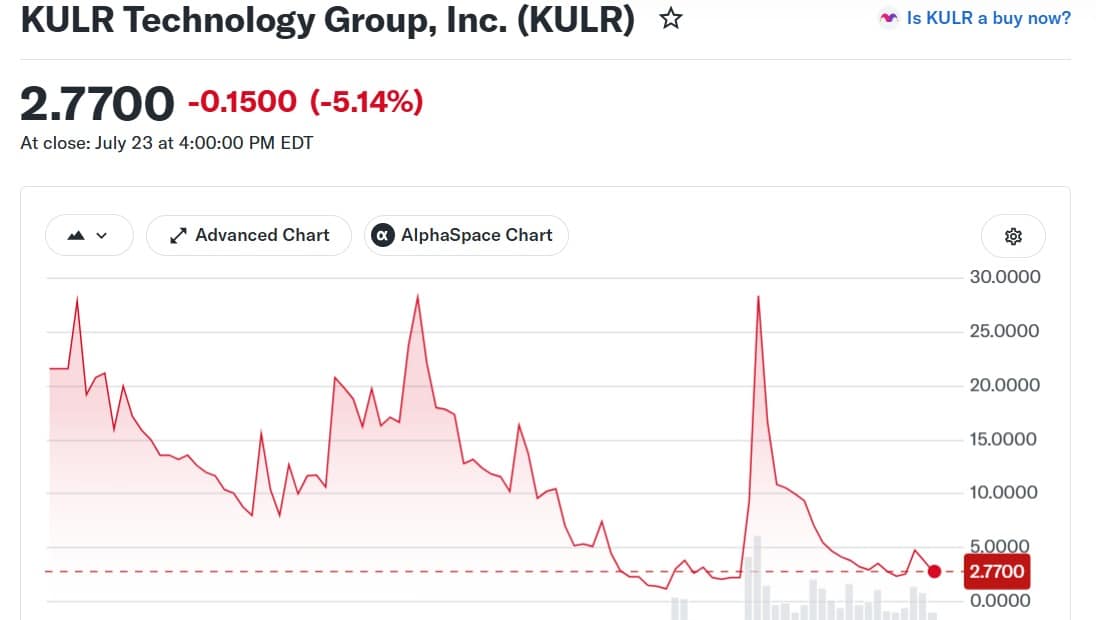
    Even more impactful for KULRTech, the company’s stock value was hit the hardest by extended Bitcoin poor performance.

    Yahoo Finance data showed that the company’s stock declined 78% from its $ATH of $43 recorded after it announced its $BTC investment. As of this writing, the firm’s stock value was around $2.7.

    Treasuries holdings value plunges $47 billion from 2025 peak

    KULR Technology Group, Inc is one of the many Bitcoin treasury companies operating at a loss. Also, it joins a long list of these firms aggressively selling.

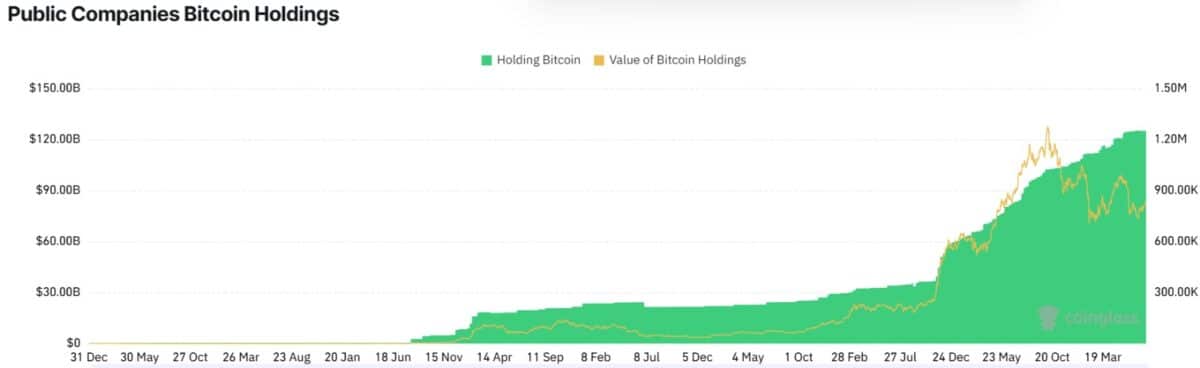
    Interestingly, while Treasury companies have increased their holdings in 2026, they have yet to reclaim peak value.

    Source: CoinGlass

    In 2025, Bitcoin treasury companies held 1.02 million $BTC worth approximately $128.5 billion at the peak. Now, these firms hold 1.25 million $BTC worth $81.5 billion, marking a $47 billion drop from the 2025 peak.

    Thus, although holdings have increased by 230k $BTC, the value remains extremely low, signaling rising losses. For example, Strategy is currently operating on $9 billion in losses.

    With these major investors holding at a loss and continually selling, the Bitcoin market still remains at extreme risk. Thus, fear from treasuries could drive continued market weakness, further reducing the capital that $BTC relied on significantly for the 2024-2025 rally.

    Final Summary

    • KULR Technology Group transferred 145.8 $BTC worth $9.45 million to Coinbase Prime, reducing total holdings to 100 Bitcoin.
    • Bitcoin treasuries have increased holdings by 230k $BTC since October 2025, but value dropped from $128 billion to $81 billion.
  • 382,000-Member Police Group Supports Revised Crypto CLARITY Act

    382,000-Member Police Group Supports Revised Crypto CLARITY Act

    Nation’s Largest Police Labor Group Reverses Course

    The National Fraternal Order of Police (FOP) has endorsed the latest version of the Digital Asset Market Clarity Act after lawmakers revised provisions that had raised concerns about cryptocurrency-related prosecutions.

    Founded in 1915, the FOP describes itself as the largest law enforcement labor organization in the United States, representing more than 382,000 active and retired officers. Its size gives the group a prominent voice in federal debates affecting policing, criminal investigations, and officer resources.

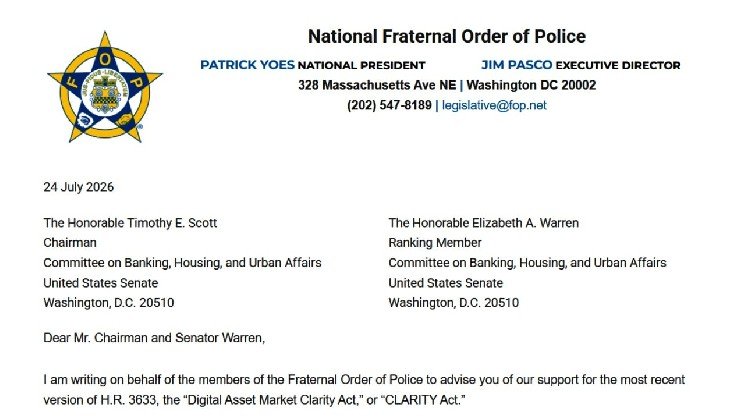
    In a July 24 letter to Senate Banking Committee Chairman Tim Scott and ranking member Elizabeth Warren, FOP National President Patrick Yoes said the organization’s concerns had been “satisfactorily addressed.”

    The endorsement reverses the FOP’s earlier position. In its April opposition letter, the organization warned that language involving noncontrolling blockchain developers could restrict prosecutors pursuing financial crimes involving cryptocurrency.

    Revisions clarified that protections for certain noncontrolling software developers and decentralized technologies would not curtail investigations, prosecutions, or the application of established criminal statutes.

    Law Enforcement Positions Shift

    The FOP joins the National Organization of Black Law Enforcement Executives (NOBLE), which became the first major police organization to endorse the legislation. NOBLE said the bill would expand investigative capabilities while preserving established criminal authorities, marking an early law enforcement endorsement for the proposal.

    Major County Sheriffs of America stopped short of endorsing the bill but withdrew its opposition after further discussions. The group’s move to a neutral position suggested that revisions had eased some concerns.

    Opposition has not disappeared. A coalition representing more than 70,000 prosecutors, sheriffs, police chiefs, and other professionals previously called for changes to the CLARITY Act, arguing that broad exemptions could weaken oversight and investigative tools.

    Revised Bill Expands Enforcement Tools

    The revised bill would protect digital asset companies and stablecoin issuers from liability when they voluntarily delay suspicious transactions or act at law enforcement’s request. Temporary holds could give investigators time to prevent losses, trace stolen assets, and disrupt illicit transfers.

    The legislation also addresses crypto ATM fraud and applies Bank Secrecy Act obligations to covered digital commodity exchanges, brokers and dealers. An official section-by-section summary says those businesses would face anti-money laundering, customer identification, and due diligence requirements.

    Title IX would establish a grant program to strengthen state and local digital asset enforcement capabilities, create a law enforcement and national security training program, establish a digital asset cyber innovation center, and fund research into emerging technologies used in cryptocurrency-related crime. The provisions also include initiatives aimed at protecting older Americans from fraud and improving coordination among federal, state, and local agencies.

    Democrats Reject Latest Senate Draft

    U.S. Senator Cynthia Lummis (R-WY) released an updated CLARITY Act draft July 22 after Senate banking and agriculture lawmakers combined their market-structure proposals. The measure addresses securities oversight, commodities regulation, decentralized finance, illicit-finance controls, and federal ethics requirements involving digital assets.

    Seven Democratic senators rejected the Republican text, contending that the proposal still falls short of an acceptable bipartisan agreement. Their joint statement opposing the current draft identified unresolved concerns involving elected officials’ ethics, consumer protections, illicit finance, conflicts of interest, and market integrity.

    Although the seven lawmakers pledged to continue negotiations, Republicans are expected to need Democratic votes to reach the 60-vote threshold typically required to invoke cloture if the legislation faces a filibuster. The timing of a floor vote will depend on whether negotiators can resolve the remaining political and regulatory disputes.

  • AAVE whales return as $100 nears – Will buyers break through?

    AAVE whales return as $100 nears – Will buyers break through?

    On the 24th of July, a whale transferred 191,453,164 USD Coin [$USDC] into the Aave protocol.

    Whale Alert valued the transaction at $191.42 million. The transfer confirmed sizable protocol activity, although its effect on $AAVE demand remained unclear.

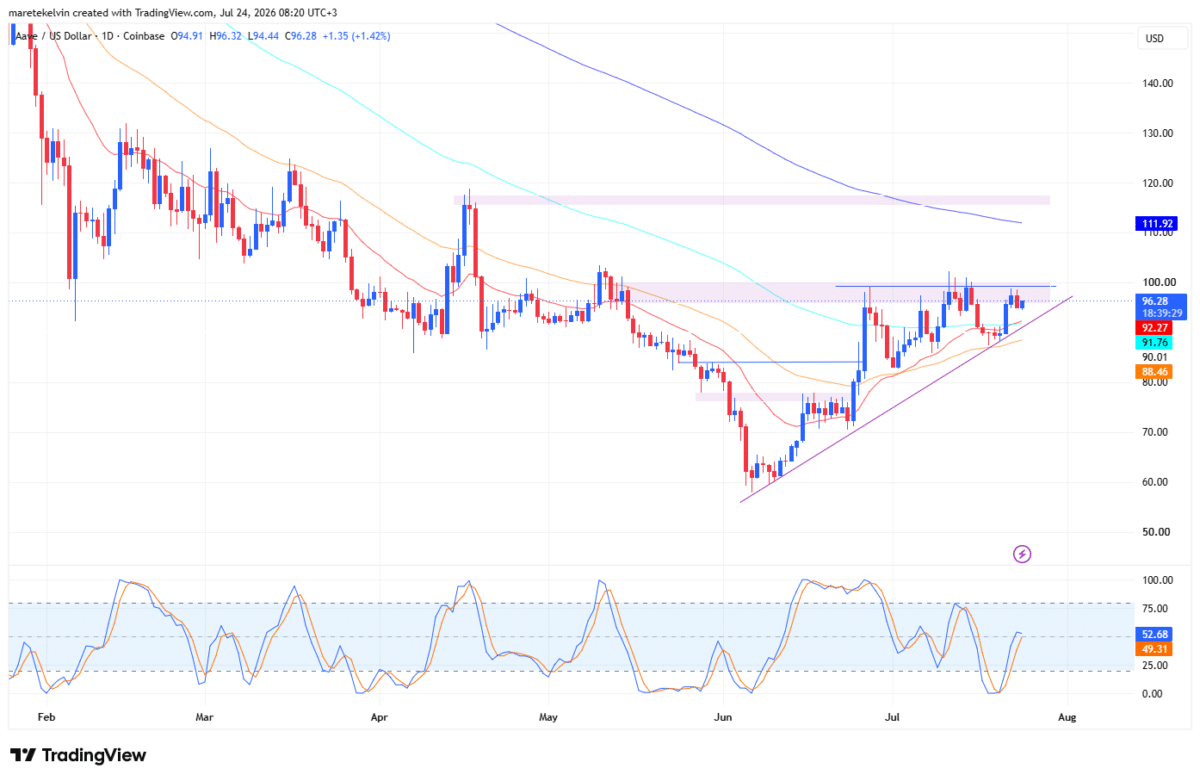
    Meanwhile, Aave [$AAVE] traded at $96.28, just below the resistance around $99–$100. This zone had rejected several recovery attempts, making the whale’s timing particularly notable.

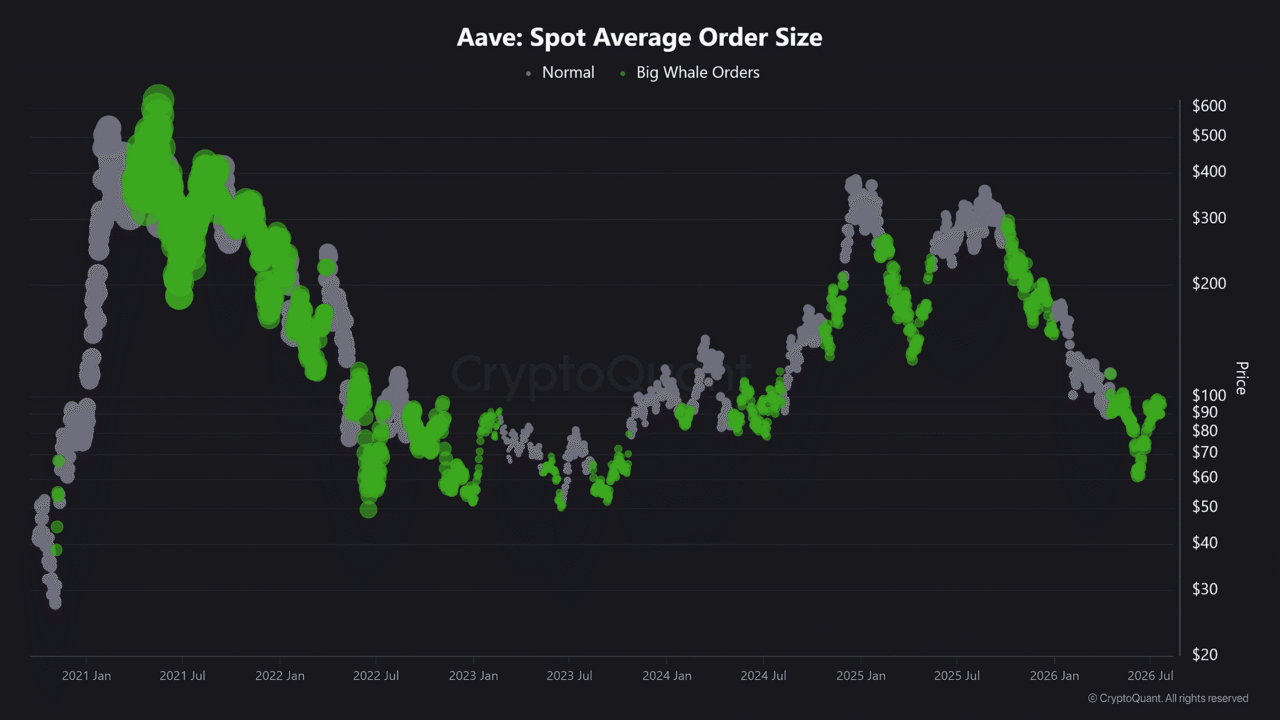
    CryptoQuant’s Spot Average Order Size also recorded Big Whale Orders near $AAVE’s current price range. However, neither dataset confirmed that these whales bought $AAVE ahead of a breakout.

    Source: CryptoQuant

    Are whales positioning before $100?

    The $USDC transfer was part of a broader increase in large transactions.

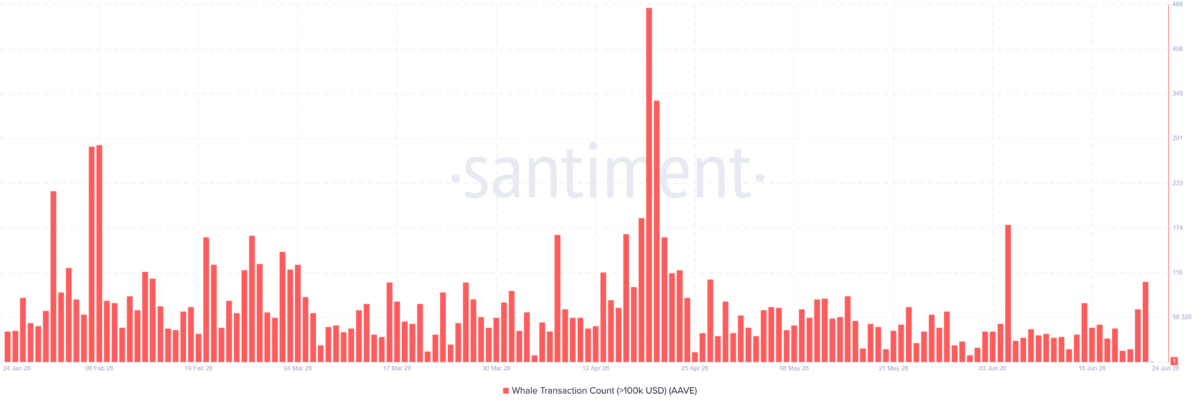
    Santiment recorded a rise in Whale Transaction Count for transfers exceeding $100,000 before the latest partial reading. This activity suggested renewed interest from large holders. However, the metric included purchases, sales, and wallet transfers.

    Consequently, a higher Whale Transaction Count could increase volatility without determining its direction.

    Source: Santiment

    Spot demand offered a clearer bullish signal.

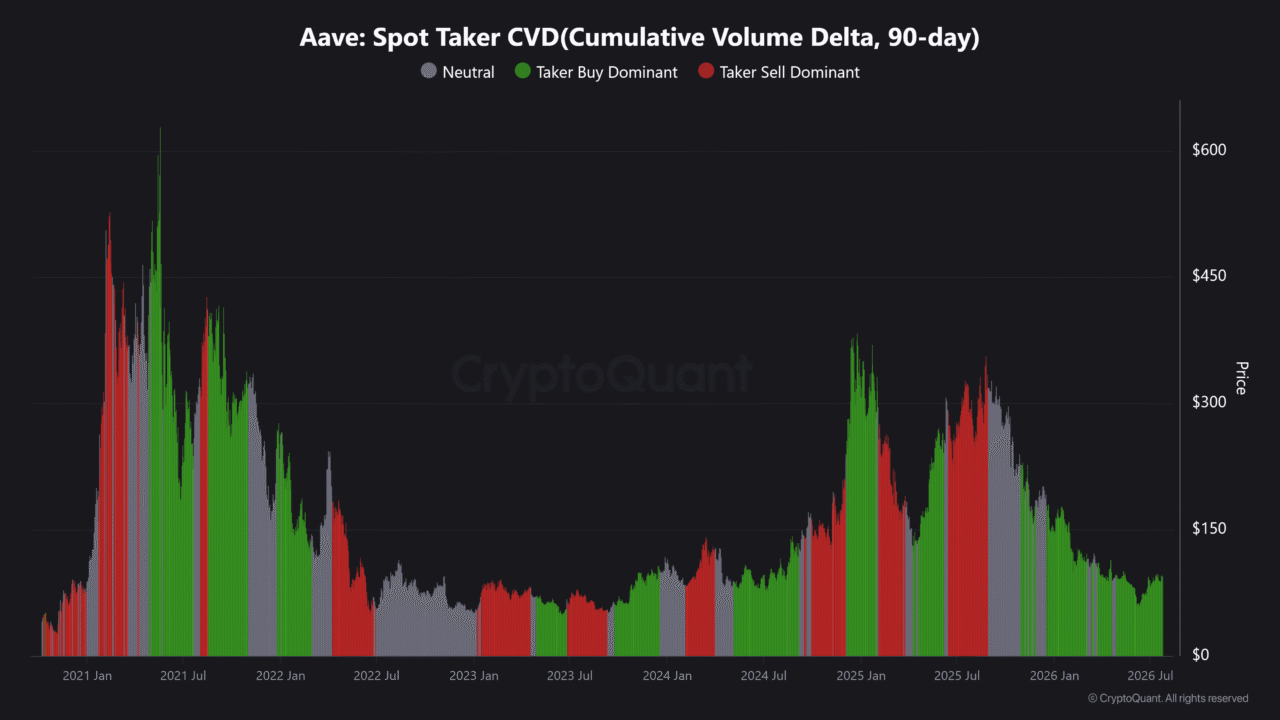
    CryptoQuant’s 90-day Spot Taker CVD showed Taker Buy Dominant activity during $AAVE’s latest recovery. This indicated that aggressive spot buyers had increasingly crossed the spread to complete purchases.

    Coinalyze data supported that positioning. Longs represented 56.09% of one-day positions, compared with 43.79% for shorts.

    The one-day Long/Short Ratio stood at 1.28. Still, crowded long positioning could increase liquidation risk during a rejection.

    Source: CryptoQuant

    Can $AAVE break above $100?

    $AAVE had consolidated beneath $100 after recovering from its June lows.

    The daily chart formed an ascending triangle, with buyers defending a rising trendline beneath horizontal resistance.

    $AAVE also traded above its 20-day, 50-day, and 100-day Exponential Moving Averages. Those averages stood near $92.27, $91.76, and $88.46, respectively.

    Meanwhile, the Stochastic RSI recorded values of 52.68 and 49.31. These neutral readings left room for movement in either direction.

    A confirmed daily close above $100 could strengthen the breakout case. Rejection may return attention to the moving averages below $92.

    Source: TradingView

    Final Summary

    • Whale activity increased as $AAVE consolidated beneath the psychologically important $100 resistance.
    • Buy-dominant spot flow strengthened $AAVE’s breakout case without confirming the move.
  • Binance ETF Perpetual Volume Tops $116B, Market Share Hits 74%

    Binance ETF Perpetual Volume Tops $116B, Market Share Hits 74%

    Binance barely needed a full quarter to seize control of a new product category that most rivals barely saw coming. The exchange’s ETF perpetual contracts have now cleared more than $116 billion in cumulative trading volume since their March 2026 debut, pushing Binance’s market share in the segment to 74%, according to the original report. The number is more than a growth metric—it marks a structural quickening in how traditional financial instruments get absorbed by crypto-native infrastructure.

    When the product launched, Binance held just 18% of the ETF perpetual market. The rapid share grab reflects both execution and the sheer volume of latent demand among crypto traders for familiar capital-market exposure without leaving the perpetual swap rails. In July alone, ETF perpetuals made up 19% of Binance’s entire TradFi perpetual trading volume. The exchange now lists 146 such pairs, with 35 added over the past month, spanning contracts that track SPY, QQQ, semiconductor ETFs, country-focused funds, and leveraged and inverse products.

    What’s happening is not simply a new listing category. It’s a convergence that has been building since tokenized RWAs crossed $20 billion on-chain and institutional players started settling Treasury trades directly with crypto-native rails. The broader tokenization trend has made the leap from niche experiment to top-of-mind allocation for a class of traders who want the leverage mechanics of perpetuals attached to non-crypto underlyings. The ETF wrapper, already familiar to retail and institutional money alike, reduces the cognitive distance.

    Why the 74% share matters now

    Market concentration above 70% in any derivatives category draws attention—both from competitors and from regulators. Binance captured share not because the field was empty, but because it moved quickly. Other major exchanges offer TradFi perpetuals, but few built the ETF-specific infrastructure, liquidity, and pair density that Binance rolled out across more than 140 contracts. In derivatives markets, the order-book depth and listing breadth often become self-reinforcing: liquidity begets liquidity. That dynamic makes it structurally difficult for challengers to claw back ground once a venue establishes early dominance.

    That dominance will be watched closely as legislative pressure on hybrid crypto products intensifies. Mounting regulatory pressure on hybrid crypto products in Washington is already reshaping the conversation about what a compliant model looks like when exchanges start blending securities-like exposure with crypto-style margin and settlement. The ETF perpetual boom sits squarely in that gray zone.

    What the volume shift says about user behavior

    The 19% contribution of ETF perpetuals to Binance’s overall TradFi perpetual volume in July is a signal that demand is not a novelty blip. Traders are clearly reallocating from traditional perpetual categories—forex, commodities, equity indices—toward the ETF format, likely because it bundles exposure, provides lower tracking friction, and fits into existing risk systems that already understand ETFs. The fact that 35 new pairs were added in the past month suggests Binance sees the product as elastic: demand expands as the available menu grows.

    Crypto-native users, accustomed to perpetual swaps on tokens, don’t need to learn a new venue or settlement process to trade QQQ or a leveraged semiconductor ETF. That familiarity lowers the switching cost that typically protects incumbent broker-dealers. Growing institutional staking demand elsewhere in the market has shown that mainstream capital is increasingly comfortable with crypto-native mechanics; the ETF perpetual product extends that comfort to a much wider asset universe.

    What remains uncertain

    The sustainability of a 74% market share is far from guaranteed. Competitors who misjudged the speed of adoption are now building out their own ETF perpetual suites, and if volume continues to grow, the pie will attract more aggressive market makers and possibly pressure on fees. Binance itself has not disclosed how much of the $116 billion volume is organic versus wash-trading or incentive-driven, and the report offers no breakdown of unique traders. In the absence of granular data, the headline number remains impressive but incomplete.

    Regulatory risk adds another variable. The same framework debates that surround crypto ETFs and tokenized securities apply to the perpetual wrapper. Whether regulators eventually deem ETF perpetuals as security-based swaps or something else will determine the compliance burden, and any adverse classification could reshape the market structure overnight. For now, the numbers show that the appetite for bridging TradFi and crypto-native execution is deep and, at least for one exchange, highly concentrated.