Category: Business

  • Aave is Gradually Removing 75 Low-Utilization Reserve Assets from its Platform! Here are the Details

    Aave is Gradually Removing 75 Low-Utilization Reserve Assets from its Platform! Here are the Details

    Aave, a leading lending protocol in the decentralized finance (DeFi) sector, has announced a comprehensive restructuring process aimed at improving the platform’s efficiency. Aave founder Stani Kulechov stated that the protocol will gradually phase out assets with low usage rates and scale back its operations on some blockchain networks.

    According to the announcement, Aave plans to gradually end support for 50 reserve assets on its own network that are not seeing sufficient usage. In addition, support will be phased out for 25 reserve assets on the Sonic, Scroll, zkSync, Metis, Soneium, and Aptos networks. Thus, a total of 75 reserve assets with low usage rates will be affected by the restructuring process.

    Aave management stated that this step aims to ensure more efficient use of platform resources and to focus on assets that users show strong interest in. The protocol, which has expanded to different blockchain networks in recent years, had begun supporting numerous digital assets. However, due to some reserves failing to reach the expected transaction volume and user demand, the decision was made to simplify the system.

    According to the data released, the restructuring process will affect approximately $98.1 million in reserve assets and $15.6 million in loan positions. Aave stated that support will be phased out gradually and necessary transition plans will be implemented to minimize customer inconvenience during this process.

    Experts point out that it is common practice in the industry for DeFi protocols to occasionally remove assets with low liquidity or insufficient usage from the system. Such decisions can help platforms reduce maintenance costs while improving security and operational efficiency.

    Aave is among the world’s largest decentralized finance protocols in terms of total locked assets (TVL) and offers lending and borrowing services to its users across different blockchain networks. Analysts believe that the restructuring decision may lead to liquidity shifts in affected reserve assets in the short term, but in the long term, it could support Aave’s goal of creating a more efficient and sustainable ecosystem.

    *This is not investment advice.

  • Robinhood CEO Vlad Tenev Says Trump Administration Crypto-Friendly, But Regulatory Clarity Needed So That the Floor Doesn’t Shift ‘Every Four Years’

    Robinhood CEO Vlad Tenev Says Trump Administration Crypto-Friendly, But Regulatory Clarity Needed So That the Floor Doesn’t Shift ‘Every Four Years’

    Legislation Brings Regulatory Stability, Says Tenev

    During the company’s second-quarter earnings call, Tenev said that while the Trump administration has been “great” for the industry, regulatory stability is necessary.

    “We want the foundation of the industry in the U.S. to be durable,” Tenev added. “We don’t want the floor to be shifting out from under us every four, eight years, and new rules to be put in place.”

    The top executive viewed the Clarity Act as an “important step” in this direction and could boost many of the company’s offerings currently under development, .

    Record Revenue But Crypto Share Shrinks

    Robinhood beat , with quarterly revenue clocking a record $1.3 billion.

    Transaction-based revenues surged 44% year-over-year to $776 million, driven by equities, options and prediction markets. However, cryptocurrency revenue plunged 38%, adding to another quarter of decline.

    Robinhood has expanded beyond asset trading in recent years by launching offerings centered around blockchain, tokenized assets and prediction markets.

    Its prediction market revenue has exploded tenfold year-over-year to $156 million, while the number of contracts traded soared to a record 13.6 billion.

    Price Action: Robinhood shares fell 1.01% in after-hours trading after closing 3.15% lower at $89.84 during Tuesday’s regular trading session. Year-to-date, the stock has plunged 15.43%.

    Benzinga’s Edge Stock Rankings indicate that HOOD stock maintains a stronger price trend over the medium term, while underperforming in the short and long terms.

    Photo courtesy: Thrive Studios ID / Shutterstock.com

  • Ether, XRP flat as chip stocks steady on Samsung’s 250-fold profit surge

    Ether, XRP flat as chip stocks steady on Samsung’s 250-fold profit surge

    Crypto’s largest tokens were close to unchanged on Thursday as the semiconductor selloff that has driven markets for two weeks showed its first real sign of easing.

    Ether traded at about $1,905 and bitcoin at $64,100, both flat on the day, with $XRP at $1.07, solana at $74, $BNB at $572 and TRON at 33 cents. Hyperliquid’s $HYPE slipped to $54. Volumes were modest, with roughly $28 billion changing hands in bitcoin and $10 billion in ether.

    Electronics giant Samsung said chip profit rose more than 250-fold on AI memory shortages, and the Kospi swung between a 6% gain and a 2% loss before settling, after a stretch that took the index down more than 40% from its June peak.

    Samsung’s reaction is the tell on how high the bar has become. Profit up 250-fold moved the shares 2%. SK Hynix reported profit up 557% on Wednesday and fell 17%. Results are not the problem, expectations are.

    U.S. earnings split overnight. Microsoft gained nearly 9% in extended trading on its fastest cloud growth in four years, while Meta fell 8% on a weak revenue forecast. Nasdaq 100 futures rose 1% after the index entered a technical correction on Wednesday.

  • Cautious Atmosphere Remains in the Market, Crypto Fear and Greed Index Stays at 35! Here Are the Details

    Cautious Atmosphere Remains in the Market, Crypto Fear and Greed Index Stays at 35! Here Are the Details

    The Crypto Fear and Greed Index, a key indicator measuring investor sentiment in cryptocurrency markets, remained at 35 points, suggesting a continued cautious outlook in the markets. Calculated by CoinMarketCap, the index showed no change compared to the previous day, revealing that investor risk appetite remains low.

    The index indicates “excessive fear” in the market as it approaches zero, and “excessive greed” as it approaches 100. The current level of 35 points is in the “fear” zone, indicating that investors continue to act cautiously due to uncertainty and that market confidence has not yet fully recovered.

    CoinMarketCap considers a variety of data points related to the cryptocurrency market when creating its index. The calculation takes into account indicators such as price movements of the top 10 cryptocurrencies by market capitalization, market volatility, put/call ratios in derivative markets, stablecoin supply ratio (SSR), and user search data on the CoinMarketCap platform. This allows the index to reflect not only price changes but also investor behavior and market trends.

    Recently, global macroeconomic uncertainties, expectations regarding central bank monetary policies, and volatile price movements in crypto assets have been cited as the main factors limiting investors’ willingness to take risks. The fact that the index has remained at the same level for several days also indicates that the market is struggling to determine a new direction.

    Analysts note that the Fear and Greed Index alone is not sufficient for making investment decisions, but it is considered an important indicator for understanding market psychology. Historically, periods when the index fell to very low levels sometimes presented buying opportunities, while excessively high levels increased the risk of profit taking.

    *This is not investment advice.

  • Robinhood posts record quarter, but crypto revenue slides 38%

    Robinhood posts record quarter, but crypto revenue slides 38%

    Online brokerage Robinhood posted record second-quarter revenue and earnings, though cryptocurrency transaction revenue fell 38% from a year earlier.

    According to the company’s earnings report on Wednesday, revenue increased 32% year over year to $1.31 billion, while its net income rose 48% to $573 million.

    The company reported that cryptocurrency transaction revenue fell to $100 million from about $160 million a year earlier. Separately, it recorded $40 billion in crypto trading volume during the quarter, including $18 billion on the Robinhood app and $22 billion from Bitstamp, the crypto exchange it acquired in June 2025.

    During the quarter, Robinhood continued expanding its digital asset business, launching the public mainnet of Robinhood Chain, introducing tokenized US stocks to eligible users in more than 120 countries and debuting its first decentralized lending product, Robinhood Earn.

    The company also completed its acquisition of Canadian crypto platform WonderFi, said it plans to expand its crypto offerings in the United Kingdom and reported that nearly 100,000 customer accounts are now enrolled in Agentic Trading, representing more than $100 million in assets under custody.

    The price of Robinhood shares were down 3.15% on Wednesday ahead of the company’s earnings release, according to Yahoo Finance data.

    Magazine: Bitcoin price wedged into ‘most divided’ FOMC as Iran war spikes oil prices 8%

  • Microsoft Quietly Adds New Windows App That Wants to Scan Your Face

    Microsoft Quietly Adds New Windows App That Wants to Scan Your Face

    In brief

    • Microsoft is rolling out a new OneDrive Photos app to some Windows 11 PCs.
    • The app indexes local photo libraries and adds AI-powered search and optional facial grouping.
    • The rollout follows Microsoft’s broader push to integrate AI features into Windows.

    Some Windows 11 users are discovering a new Microsoft app they never installed. Called OneDrive Photos, it automatically indexes local images and offers AI-powered search and optional facial grouping.

    The rollout, first spotted by industry publication Windows Latest, comes via Windows Update or updates to the existing OneDrive client rather than as a separate download.

    According to Windows Latest, OneDrive Photos can detect and display images stored locally on a PC even if the user is not signed into a Microsoft account. After signing in, the app enables AI-powered search that can locate photos using natural-language queries and optical character recognition.

    The app also includes an optional People feature that groups similar faces, which are visible only to the user, aren’t shared with third parties, and can be deleted by disabling the feature. However, Windows Latest noted that the feature requires users to opt in because facial data may be considered biometric information in some jurisdictions.

    The news comes two years after Microsoft was forced to overhaul its AI-powered Recall feature following a privacy backlash that prompted the company to make the screenshotting tool opt in by default.

    More recently, in May, Google began downloading its roughly 4GB Gemini Nano AI model to eligible Chrome installations through browser updates to power on-device AI features, adding to concerns about AI capabilities arriving through routine software updates.

    According to Windows Latest, OneDrive Photos is tied to the existing OneDrive client and cannot currently be removed on its own. Users who want to uninstall the app must remove OneDrive entirely from Windows.

    Microsoft did not immediately respond to a request for comment by Decrypt.

    Daily Debrief Newsletter

    Start every day with the top news stories right now, plus original features, a podcast, videos and more.

  • Long-term bearish trend threatens Bitcoin Cash’s recovery from $200

    Long-term bearish trend threatens Bitcoin Cash’s recovery from $200

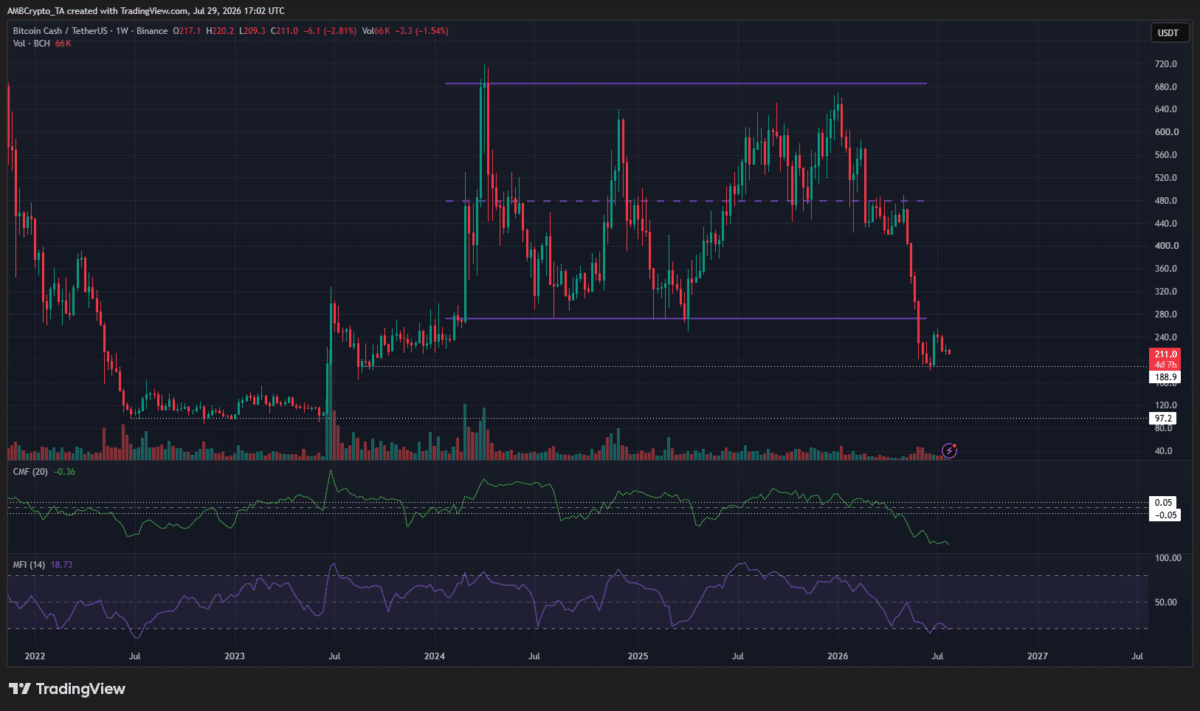
    Bitcoin Cash [$BCH] fell below a range that it had traded within for over two years. The critical support level at $272 was shattered by the selling pressure in May. A test of the $188 long-term support yielded a bounce to $240, which has begun to reverse since the end of June.

    The altcoin’s relative strength against Bitcoin [BTC] evaporated in May. In that month, $BCH had shed nearly 42%, a sizeable decline that continued into June.

    With Bitcoin struggling to climb back above $67k, and the market maintaining a bearish bias, here’s what Bitcoin Cash investors need to watch out for.

    Will Bitcoin Cash bulls sink or swim at $200?

    Source: $BCH/$USDT on TradingView

    As covered earlier, the downward momentum picked up in May. The MFI raced from 49.8 in the second week of May to 14.64 by the third week of June. Similarly, the CMF also slid below -0.05 to indicate incessant selling underway.

    In August 2023, the swing low at $165.4 had been the one that propelled the Bitcoin Cash uptrend up to $719. Therefore, this swing low is the one that must be breached to flip the weekly swing structure bearishly.

    It appeared likely that this bearish scenario would soon unfold.

    Lower timeframe Bitcoin Cash price action shows bullish signs

    Source: $BCH/$USDT on TradingView

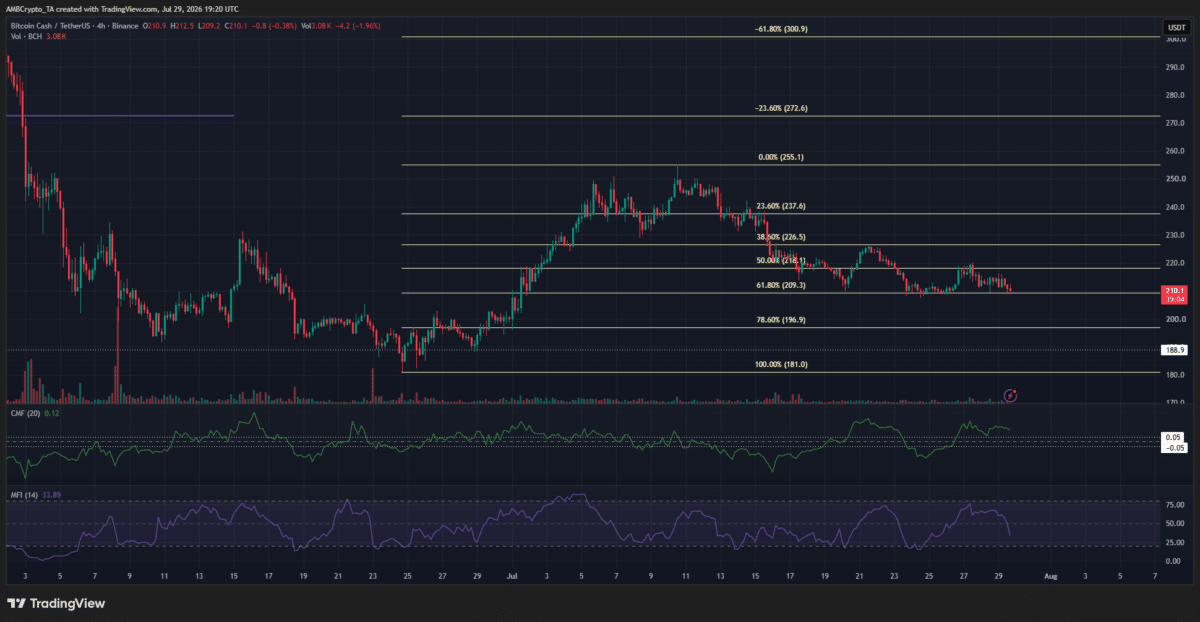
    The 4-hour chart had a bullish swing structure. The CMF was at +0.12, showing buying pressure was dominant. Yet, the token was in a retracement phase. Over the past week, the buyers have desperately defended the $209.3 support.

    A drop toward $196.9 would not be a buying opportunity, given the higher timeframe downtrend.

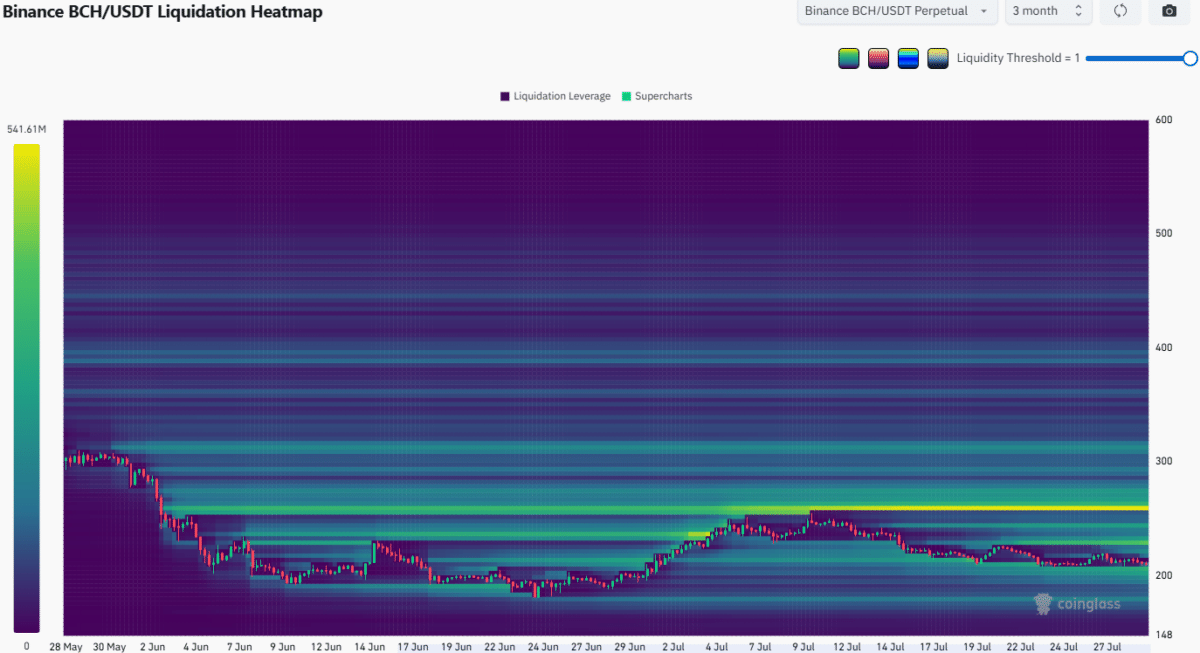
    Source: CoinGlass

    The rally toward $255 likely came as a liquidity hunt. There still is a pocket of unswept short liquidations around $260. The rally earlier this month peaked at $255 and has retraced since then.

    In the short-term, despite the H4 chart’s structure, a bounce up to $227 and $243 were possible. It was more likely that prices would continue below $200, due to the bearish momentum seen since May.


    Final Summary

    • The Bitcoin Cash range of over two years was shattered by the strength of selling in May and early June.
    • The long-term bearish momentum is likely to continue and push $BCH below $200.

  • Breaking: CFTC Loses Fight to Protect Kalshi in Wisconsin Prediction Markets Case

    Breaking: CFTC Loses Fight to Protect Kalshi in Wisconsin Prediction Markets Case

    Kalshi’s fight to keep its sports prediction contracts under federal protection just hit a major roadblock. A Wisconsin federal judge has refused to block state gambling laws against Kalshi and four other major prediction platforms, rejecting the CFTC’s push for exclusive federal control.

    Wisconsin Court Rejects CFTC’s Emergency Push

    On July 29, 2026, U.S. District Judge William Griesbach denied the CFTC’s request for a preliminary injunction against Wisconsin. The regulator wanted the court to stop the state from enforcing its gambling laws against prediction platforms offering sports event contracts.

    The CFTC argued that federally regulated prediction markets fall under its exclusive jurisdiction. However, the court rejected that argument at this stage, finding that registration with the CFTC does not automatically shield these platforms from state gambling laws.

    The court also rejected motions from Kalshi and Crypto.com to intervene in the CFTC’s case.

    Judge Says CFTC Rules May Not Override States

    The decision centers on preemption, or whether federal law overrides state law. Judge Griesbach found that the Commodity Exchange Act does not automatically cancel Wisconsin’s gambling rules.

    The court also indicated that the plain language of Wisconsin’s gambling laws could cover sports-related event contracts.

    That creates a key problem for Kalshi and other prediction markets. While these platforms describe their contracts as financial products, state regulators argue that contracts tied to sports outcomes are effectively sports bets.

    The judge also found that the CFTC had not shown enough “irreparable harm” to justify blocking Wisconsin from enforcing its laws.

    Five Prediction Markets Are Already Facing Wisconsin Lawsuits

    The ruling follows Wisconsin’s April lawsuits against Kalshi, Polymarket, Crypto.com, Robinhood and Coinbase. The state claims the platforms offered sports contracts without the required gaming licenses, violating Wisconsin gambling laws under Chapter 945.

    The CFTC responded by suing Wisconsin, arguing that states cannot interfere with federally regulated derivatives markets.

    That broader fight has now created a major regulatory clash between Washington and state authorities.

    Where The Wisconsin Sports Case Is Heading Next

    The Wisconsin decision adds to an increasingly divided legal landscape. The 3rd Circuit in New Jersey has ruled in favor of Kalshi’s position that federal law can preempt state restrictions.

    For now, the Wisconsin cases are expected to return to state court. Legal expert Daniel Wallach said Wisconsin judges could issue preliminary injunctions preventing prediction platforms from offering sports contracts in the state.

    BREAKING: CFTC loses BIG in Wisconsin, as federal court denies its motion for preliminary injunction and holds that sports-event contracts are not “swaps,” and, that even if they satisfied definition, CFTC is unlikely to prevail on its argument that the CEA preempts state law. pic.twitter.com/a9vf8HfKIc

    — Daniel Wallach (@WALLACHLEGAL) July 29, 2026

    Kalshi and the CFTC are also expected to appeal the decision to the 7th Circuit, setting up another major test of who ultimately controls America’s fast-growing prediction market industry.

  • What Are Tokenized Stocks? The $9 Billion Trend Explained

    What Are Tokenized Stocks? The $9 Billion Trend Explained

    Imagine buying a slice of Apple stock at 3 a.m. on a Sunday, settling in seconds, from a crypto wallet, with no broker involved. That is the promise of tokenized stocks, and it stopped being theoretical this year: on-chain transfer volume for tokenized equities reached $9.22 billion in a single month. This guide explains what tokenized stocks actually are, how they work, who is building them, what you really own when you buy one, and the risks that most coverage skips.

    What are tokenized stocks?

    A tokenized stock is a blockchain-based token that represents ownership or economic exposure to a real company’s shares. Instead of your Apple or Tesla position living only in a broker’s database, a token representing it lives on a blockchain, where it can be transferred, traded, or used in other applications around the clock.

    The key word is “represents.” In most current models, an authorized issuer buys and holds the actual shares with a regulated custodian, then issues tokens backed one-to-one against them. The token tracks the share’s value and, depending on the product, may pass through dividends. You are typically holding a claim on a share rather than the registered share itself, which is the single most important distinction to understand before buying one.

    Why anyone bothers: the actual advantages

    Traditional stock markets run on infrastructure built decades ago, with fixed hours and multi-day settlement. Tokenization targets exactly those limits.

    Trading never closes. Blockchains do not have opening bells. Tokenized equities can trade on weekends and overnight, which matters enormously for investors outside US time zones who currently trade American stocks at inconvenient hours or not at all.

    Settlement is near-instant. Traditional equity settlement takes a business day or more. On-chain settlement happens in seconds, freeing capital and removing counterparty risk in the gap.

    Fractional access is native. Tokens divide easily, so a $500 share can be bought in tiny increments without a broker building that feature.

    Global reach. Someone in a country with limited access to US brokerage accounts can, in principle, hold exposure to US equities through a wallet.

    Composability. This is the crypto-native advantage: a tokenized stock can be used inside decentralized finance applications, for example as collateral, in ways a brokerage position cannot.

    How big is this actually?

    Big enough to stop being a curiosity. Monthly on-chain transfer volume for tokenized stocks reached $9.22 billion in June 2026 (live RWA data on rwa.xyz), a sharp increase that reflects real usage rather than pilot projects.

    The activity is heavily concentrated on Solana, which handles roughly 95% of global tokenized equity trading volume, with single-day records around $644 million. The trend reached a symbolic milestone when Securitize, a tokenization firm, tokenized $295 million of its own stock on Solana on the day of its NYSE debut, the largest issuer-sponsored tokenized stock at launch.

    Institutional infrastructure is following. Moody’s launched credit ratings for tokenized assets, South Korea has explored tokenizing government bonds and state assets, and traditional finance firms have been building settlement rails on public blockchains. Ripple and BCG have projected the broader tokenized real-world asset market could exceed $19 trillion across blockchains by 2033, a forecast worth treating as directional rather than precise.

    What you actually own (read this part twice)

    This is where enthusiasm meets fine print, and it deserves plain language.

    In most tokenized stock products, you do not become a shareholder of record. You typically hold a token issued by a company, backed by shares that company or its custodian holds. That usually means no voting rights, dividend treatment that depends on the specific product, and, critically, a dependency on the issuer remaining solvent and honest.

    Compare that with a normal brokerage account, where you are a beneficial owner with regulatory protections, insurance schemes in many jurisdictions, and a clear legal claim. Tokenized stocks trade convenience for a different, generally thinner, set of protections. That is a legitimate trade for some investors, but it is a trade, not a free upgrade.

    The risks

    Issuer and custody risk. Your token is only as good as the entity holding the underlying shares. If that issuer fails or the backing is not what it claims, the token’s value is at risk regardless of what the real stock does.

    Regulatory uncertainty. Rules for tokenized securities are still forming in most jurisdictions. Products can be restricted, geo-blocked, or forced to change structure. Availability to US retail investors in particular is limited and shifting.

    Liquidity gaps. Headline volume is concentrated in a handful of popular names. A thinly traded tokenized stock can have wide spreads and poor exits, especially during volatility.

    Price tracking can break. In stressed markets, a token’s price can drift from the underlying share, particularly when traditional markets are closed and there is no way to arbitrage the gap efficiently.

    Smart contract risk. These are blockchain products, and blockchain products can have code vulnerabilities, as DeFi’s history shows.

    Corporate actions get messy. Splits, mergers, and special dividends are straightforward in traditional markets and genuinely complicated to represent on-chain.

    Who is building tokenized stocks

    The ecosystem splits roughly into three groups. Tokenization specialists like Securitize handle issuance and compliance infrastructure. Blockchains compete to host the activity, with Solana currently dominant on volume thanks to low fees and fast settlement, while Ethereum hosts much of the broader real-world asset market. And trading venues, both crypto exchanges and emerging on-chain platforms, provide the access layer.

    An interesting wrinkle: because Solana’s fees are so low, billions in tokenized stock volume generate relatively little direct fee revenue for the network. Hosting the boom and monetizing it are not the same thing, which is a genuine open question for the chains involved.

    Is this the future of stock trading?

    The honest answer is that it is a real trend with real limits. The advantages, continuous trading, instant settlement, global access, are genuine and solve actual problems that traditional market infrastructure has not. Institutional adoption is no longer speculative: rating agencies, governments, and NYSE-listed firms are participating.

    But the ownership structure is weaker than direct share ownership, regulation is unsettled, and most volume today comes from crypto-native traders rather than mainstream investors. The likely path is not tokenized stocks replacing brokerages, but traditional finance gradually adopting blockchain settlement underneath products that look familiar to investors. Tokenization is more likely to become invisible plumbing than a consumer revolution.

    Bottom line

    Tokenized stocks are blockchain tokens representing real company shares, offering round-the-clock trading, near-instant settlement, fractional ownership, and global access. The trend became substantial in 2026, with $9.22 billion in monthly on-chain volume and Solana handling around 95% of it, alongside serious institutional participation.

    The catch is what you own: usually a claim backed by an issuer rather than a registered share, with fewer protections than a brokerage account and unsettled regulation around it. Tokenized stocks are a genuine infrastructure advance worth understanding, and a product category that demands you read the specific terms before buying, not just the pitch.

    This is not investment advice. Tokenized assets carry issuer, regulatory, and liquidity risks in addition to normal market risk. Always do your own research.


  • Flock Cameras Face Growing Backlash as Privacy Concerns Reach Capitol Hill

    Flock Cameras Face Growing Backlash as Privacy Concerns Reach Capitol Hill

    In brief

    • Rep. Thomas Massie plans legislation that would withhold federal funding from agencies deploying Flock cameras.
    • Local governments from California to Indiana have suspended, canceled, or reconsidered Flock deployments following public opposition.
    • Flock CEO Garrett Langley recently apologized for referring to anti-surveillance activists as “terrorists.”

    Public opposition to Flock Safety’s automated license plate reader cameras is spreading from city council meetings to Capitol Hill as lawmakers prepare legislation targeting federal funding for agencies that deploy the technology while communities across the country reconsider its use.

    The protests come amid mounting evidence that Flock’s technology has been used in ways critics say extend well beyond its stated purpose of investigating crimes and locating missing people.

    A recent report by The Institute for Justice identified over two dozen cases nationwide in which officers resigned or were arrested for allegedly using automated license plate reader systems to stalk current or former romantic partners.

    In February, Milwaukee prosecutors charged an officer accused of using the system to track a romantic partner and her former partner. In July, an internal affairs detective who investigated that case was arrested after authorities alleged he also used Flock to track people for personal reasons.

    Privacy advocates also cite broader uses of the technology. The Electronic Frontier Foundation says agencies searched license plate databases during protests, including the No Kings protests in 2025. That same year, the group reported that Texas deputies queried Flock data during an abortion investigation that authorities initially described as a missing-person case.

    Opposition has also moved beyond public meetings. During June and July, activists across the country spray-painted, taped over, disabled and destroyed Flock cameras in protest of automated surveillance. The Guardian identified at least 33 incidents across 23 states. Online communities have shared camera maps, tips for avoiding the devices and methods for obstructing them, while several people now face criminal charges after allegedly destroying multiple cameras.

    Founded in 2017, Atlanta-based Flock Safety sells internet-connected license plate reader cameras that automatically photograph passing vehicles, read license plates, and use computer vision to identify characteristics such as a vehicle’s make, model, color, decals, roof racks, and other distinguishing features. Participating law enforcement agencies can search the database during criminal investigations, receive alerts when vehicles linked to cases pass a camera, recover stolen vehicles, and locate missing people.

    Flock says its cameras do not use facial recognition and typically retain data for 30 days unless local laws require a different retention period. CEO Garrett Langley said the company takes privacy concerns seriously and believes many critics reconsider their views once they understand how the technology works.

    “Once they understand what the technology actually does, not what it might do in 50 years, not what someone thinks it could do, but what it actually does day in and day out, it takes a picture of a car. Most people go, ‘This makes a lot of sense. I want my kids to be safe,’” Langley told ABC7.

    In a post on X on Saturday, Kentucky Congressman Thomas Massie said that he plans to introduce legislation that would withhold federal funding from municipalities and law enforcement agencies that deploy automated license plate reader systems, including Flock cameras.

    The proposal follows a series of disputes over Flock cameras across the United States.

    In St. Petersburg, Florida, 77-year-old Carl Gunn has drawn attention by staging solo protests beneath Flock cameras, holding a sign that blocks their view.

    “This is just another thing to take our information and to spy on us,” Gunn told news outlet Creative Loafing Tampa Bay. “I have a constitutional right to my privacy. I’m a law-abiding citizen, and I don’t need anyone sticking their nose in my business. And if they do, I’m going to chop it off.”

    In Fresno, California, residents packed a community forum to urge city officials to remove Flock cameras, arguing the technology allows broad government surveillance. Police defended the system, saying it helped investigators solve homicide and shooting cases and emphasizing that it does not use facial recognition.

    “We have to find a balance between safety and liberty,” Fresno Police Chief Mindy Casto reportedly said.

    However, not all law enforcement agencies are on board with using Flock cameras and are re-evaluating their use of the technology. On Thursday, the Los Angeles Police Department suspended its partnership with Flock over concerns involving privacy, data sharing, security, and contract terms. Monroe County, Indiana, also voted to end its contract a year early, despite commissioners acknowledging the cameras had helped solve serious crimes. Earlier in July, Leon County, Florida, delayed funding for additional Flock cameras after residents questioned how the data is collected, stored, and shared.

    The scrutiny has prompted a response from the company. Earlier this month, Langley apologized for previously describing anti-Flock activists as a “terroristic organization,” saying the comments were a mistake and that the company has spent more time listening to critics while trying to balance public safety and privacy.

    “My comments were a mistake, and I apologize,” he told Forbes. “There are groups today that have real valid criticisms of the business, and I think what’s changed for us is, as we’ve listened to them and heard them out, what we’re trying to do is find this balance. We believe in a world where we can have safety and privacy.”

    Daily Debrief Newsletter

    Start every day with the top news stories right now, plus original features, a podcast, videos and more.