Author: rb809rb

  • Monica Bellucci Plays a Mother Who Yells and Is the “Victim of a Social Role” in Luca Guadagnino-Produced ‘Ketticè’

    Monica Bellucci Plays a Mother Who Yells and Is the “Victim of a Social Role” in Luca Guadagnino-Produced ‘Ketticè’

    An Italian film, whose cast features Monica Bellucci and whose list of producers includes Luca Guadagnino, took the spotlight at the 79th edition of the Locarno Film Festival on Saturday. Its title: Ketticè.

    The coming-of-age drama is the sophomore feature of former Guadagnino assistant Giovanni Tortorici (Diciannove), who wrote and directed it, and stars Salvatore Gallina and Rachele Testagrossa.

    Set in Palermo, Sicily, in 2012, the era of media mogul-turned-populist politician Silvio Berlusconi, the movie revolves around Giulio, a listless and dissatisfied 16-year-old who drifts through his days without any enthusiasm for school and no real future prospects. “His encounter with Ketty, a more self-assured peer, offers him an escape from the monotony,” reads a synopsis. “The two form an exclusive friendship, a shared refuge in their search for freedom, far from the judgmental gaze of the adult world.”

    With cinematography by Camilla Cattabriga and editing by Marco Costa, the film has been boarded by PiperPlay to handle international sales.

    The film’s title refers to Ketty’s nickname in the Sicilian dialect. Bellucci plays Giulio’s mother in an aristocratic Sicilian family that leaves her feeling oppressed.

    During a press conference with the three stars and Tortorici, Bellucci shared about her character: “It was interesting to play a different role because this wife and mother tells us about the frustration behind the entire perfection of society. … She is the victim of a social role [she must play]. So she tries to counterbalance this frustration by eating up snacks. There [is a] scene where she’s sleeping in front of the TV, and she has plenty of snacks.”

    The star also addressed how body and voice are key to her role. “This is a woman who forgot about her femininity. She doesn’t take care of herself,” Bellucci explained. “And when she talks, she yells.”

    That keeps the relationship with her son on the edge throughout much of the movie. “She creates this constant tension with her son,” Bellucci offered. “There is a mutual humiliation that [shows] a true impossibility of exchange between generations. You see a generation of adults who can no longer understand the youth. And we are talking about 2012. Imagine how it is now!”

    Tortorici was asked about a scene in which a girl expresses admiration for former Italian fascist dictator Benito Mussolini. “I remember I had a girlfriend who would say such things,” the writer-director explained. “So I think this would represent a youth culture, which is a bit absurd. I mean, the girl I knew was refined and educated, and then she would admire Mussolini. It’s a reference to my own biography, but I think it was very symptomatic and significant, and it was representing that age of Berlusconi.”

    Bellucci lauded the director and the young stars of Ketticè who were discovery via an extensive street casting process. “It’s been a wonderful experience being on this set,” she shared. “Giovanni Tortorici is a young director who knows exactly what he wants, and he’s very self-confident, determined, and he made a very personal and really unique film. … This film confirms his talent as an auteur. And these two teenagers are fantastic. They’re awesome. They are so natural and so spontaneous.”

  • Cardano up 19% after Dijkstra launch – Can ADA stay above $0.20?

    Cardano up 19% after Dijkstra launch – Can ADA stay above $0.20?

    Cardano [$ADA] is among the top blockchains across the globe and recently hit a new peak in the Nakamoto coefficient of 16. This put Cardano as one of the most decentralized chains as prices slowly rebound.

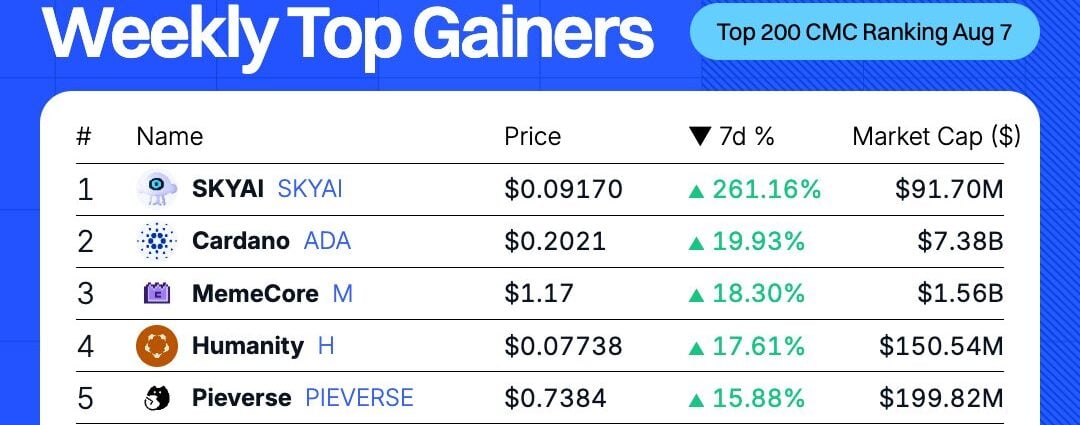
    The altcoin has surged by more than 19% this week with daily gains averaging more than 6%. These gains resulted from Cardano transitioning to the Dijkstra development era. Can the price keep surging?

    Dijkstra launch fuels Cardano’s weekly gains

    According to CoinMarketCap, Cardano came a distant second among the largest weekly gainers. SKYAI recorded 261% with MemeCore [M], Humanity Protocol [H], and Pieverse [PIEVERSE] wrapping up the top 5 list for this week.

    Source: CoinMarketCap

    Cardano’s transition to the Dijkstra development era drove these weekly gains. This was a newly approved roadmap that made it the first chain to fund core development directly from its treasury.

    Additionally, the ecosystem was expanding to other blockchains. For instance, the chain connected with Injective [$INJ] via The Inter-Blockchain Communication Protocol (IBC), which was on testnet. Both $INJ and $ADA will be usable across the two ecosystems.

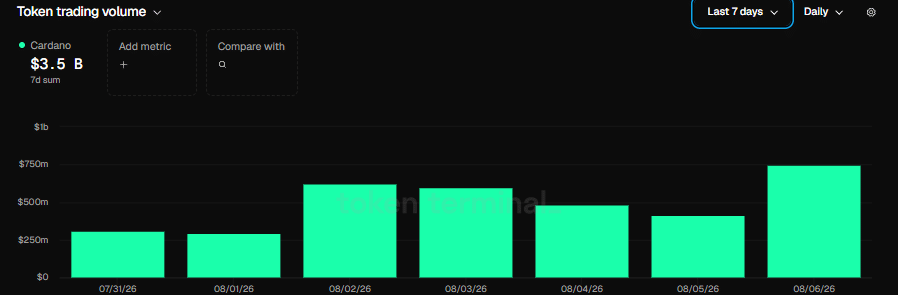
    As a result, the daily trading volume has also jumped by more than 78%, recording about $747 million. It jumped from $412.8 million to A 7-day sum of $3.50 billion.

    Source: Token Terminal

    Furthermore, the Total Value Locked (TVL) rose by around 3%, reaching $88 million. The chain’s weekly DEX volume also increased by 17%, reaching $13 million.

    Moreover, such developments prompted the big players to position themselves. According to Santiment data, whales have accumulated over 240 million $ADA in the past few days.

    Can $ADA stay above $0.20?

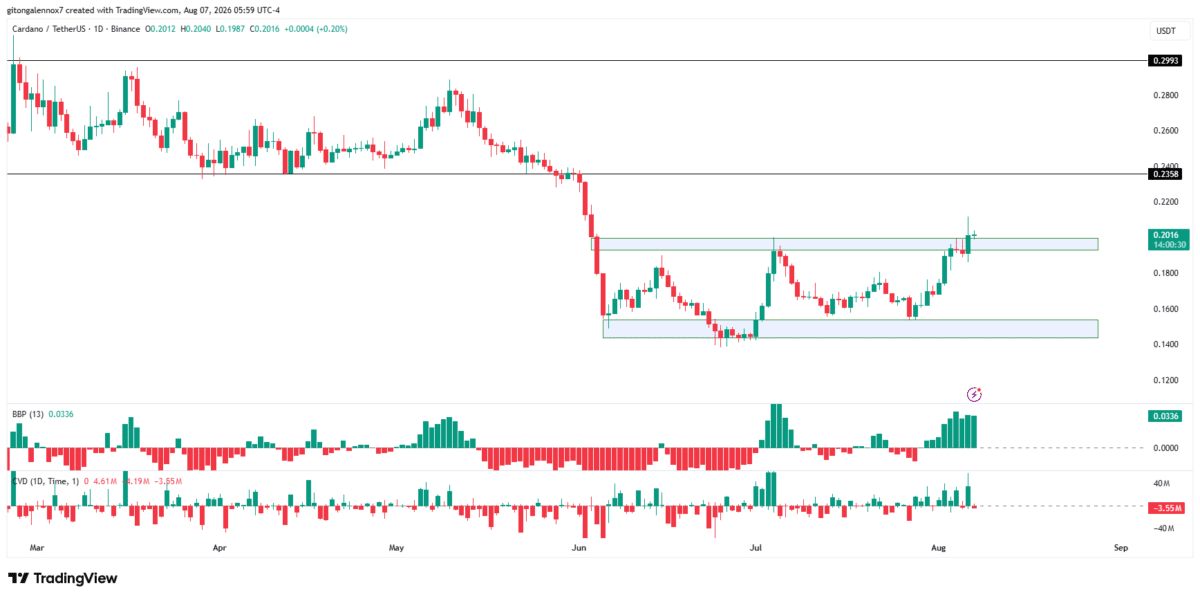
    Meanwhile, Cardano’s price broke above the $0.20 resistance level, but there was some lag at this zone. The altcoin price has been ranging between $0.14 and $0.20 since July, aligning with whale positioning. The range followed a 41% sharp drop from $0.24 to $0.14.

    In support of this trend was the Bull/Bear Power indicator, which turned green. The CVD showed that traders on Binance’s spot market bought more than 40 million $ADA tokens.

    With the token clearing the $0.20 resistance that capped every recovery attempt this year, it exposed $0.24 and $0.30 as the next target areas. But failing to hold above $0.20, the altcoin may revert back to the range.

    Source: $ADA/USDT on TradingView

    Therefore, Cardano’s native $ADA may rally higher if the chain developments continue.

    Final Summary

    • Cardano surged by more than 19% this week after transitioning to the Dijkstra era, funding its development directly from its community treasury.
    • $ADA price broke above a resistance level at $0.20, which has capped every recovery attempt this year.
  • Coldcard Exploit Confirmed at 1,719 BTC Stolen as Galaxy Research Warns Losses May Top $130 Million

    Coldcard Exploit Confirmed at 1,719 BTC Stolen as Galaxy Research Warns Losses May Top $130 Million

    The scale of the Coldcard hardware wallet exploit is becoming sharply clear. Galaxy Research has now confirmed with high confidence that at least 1,719 $BTC have been stolen across multiple user accounts, valuing the compromise at roughly $111 million at recent prices. But that number may not be the ceiling. Total losses, according to the research team’s latest assessment cited in the original report, are likely to surpass $130 million once all outstanding cases are verified.

    More than 25 distinct attack patterns have been identified, and investigators now believe that multiple threat actors are actively exploiting the vulnerability. The number of victims is piling up; Galaxy confirmed it has received reports from over 250 individuals. If every case is ultimately confirmed, the total haul could climb past 2,300 $BTC. For now, the only hardware known to be affected are Coldcard Mk3, Mk4, Mk5, and the Q model. There is no evidence that the bug has spread to other signing devices or wallets, and Galaxy has not indicated that any affiliated software or firmware outside of Coldcard’s ecosystem is compromised.

    A self-custody nightmare

    This incident hits at the very foundation of self-custody culture. Coldcard is widely considered one of the most secure Bitcoin hardware wallets, specifically designed for air-gapped, paranoid-grade storage. The fact that it has been cracked at this scale, with what appears to be a long-running exploitation window, will rattle confidence among users who have staked their entire net worth on it. It also complicates the already tense legislative conversation around self-custody protections in Washington. Just days before a crucial Senate vote on landmark crypto legislation—discussed in our coverage of how banks are attempting to reshape the bill—an exploit of this magnitude gives opponents of liberal self-custody rules a powerful new data point.

    Hardware wallets have been sold as the ultimate defense against hacks, yet they remain vulnerable to supply chain attacks, firmware tampering, and physical side-channel exploits. In this case, the exact entry vector has not been publicly detailed by Coinkite or Galaxy, but the existence of so many distinct patterns suggests it was not a single bug. A misconfigured random number generator, a compromised supply chain component, or a flaw in the device’s communication protocols could all be at play. For users who lost funds, there is the added bitterness that Bitcoin’s immutability makes fund recovery virtually impossible.

    What’s next for victims and the market

    With over 250 victims already identified, legal and reputational consequences are mounting for Coinkite, the manufacturer of Coldcard. The firm has yet to release a detailed technical postmortem, and the market is waiting to see whether a patch is even feasible for existing hardware or if replacements are necessary. So far, only Coldcard’s own line appears infected, but the discovery of multiple independent attackers suggests the vulnerability may have been widely known in certain circles before it became public. That raises the uncomfortable possibility that the exploit was first discovered and traded privately, only becoming a headline after losses spiraled.

    From an institutional perspective, this event will push funds and large holders toward scrutinizing their device choices more intensely. Multi-sig setups and custodian-based cold storage solutions may see renewed interest. The insurance question also re-emerges: most self-custody users carry zero coverage, while regulated custodians bundle insurance into their service. The $130 million-plus figure, though small compared to total Bitcoin market cap, is large enough to attract regulatory attention at a time when lawmakers are weighing how to classify and supervise wallet providers.

    Uncertainty looms

    Several unanswered questions make this a story that will develop further. Galaxy’s report does not clarify how the attackers managed to exfiltrate private keys or sign transactions without physical access to the devices. It is possible that the vulnerability allowed an attacker who gained temporary access—perhaps during shipping or through a compromised reseller—to later drain funds without ongoing access. The fact that over 25 patterns exist indicates that multiple techniques were employed, and it cannot be ruled out that some victims unknowingly used malicious firmware updates from unofficial sources.

    The community is left to weigh whether the Coldcard brand can recover its reputation. Hardware wallet security is as much about trust as it is about cryptographic design. Once that trust is broken at a scale of thousands of coins, the road back is long. Meanwhile, other manufacturers will likely use this event to market their own devices as superior, and the broader lesson for the industry is clear: self-custody demands constant vigilance, and no single device should be treated as a magic shield.

  • Trump White House Uses Spider-Man Imagery To Promote ICE Deportations

    Trump White House Uses Spider-Man Imagery To Promote ICE Deportations

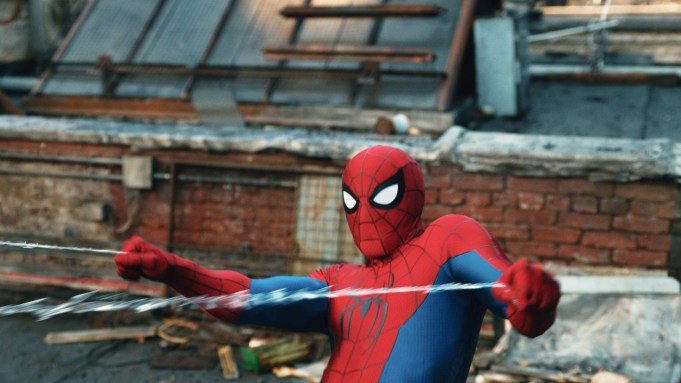
    The White House once again turned to pop culture in characterizing their immigration strategy, this time using Spider Man imagery to portray ICE agents as “friendly neighborhood” figures and on the heroic side of deportations.

    An Instagram post this week, features Spider-Man‘s hand spinning out a web. That leads to an image of web-covered detainees, and the message, “Criminal aliens will be caught and deported.”

    “Your friendly neighborhood ICE agents,” the message from the White House reads.

    The post comes as Sony has enjoyed runaway success with the latest in the superhero franchise, Spider-Man: Brand New Day, which has passed $1 billion at the global box office, per Box Office Mojo.

    Last year, the White House featured a meme of Donald Trump as Superman, just as Warner Bros/DC Studios released the James Gunn-directed movie. Gunn had noted in an interview that Superman was an immigrant, triggering some of the right to claim that the superhero had “gone woke.” The film grossed more than $600 million worldwide, per Box Office Mojo.

    Spokespersons for Sony and Disney did not immediately return requests for comment.

  • XRP Flirts With Sub-$1 Territory as Clarity Act Fails in August: Is This the Ultimate Buying Zone?

    XRP Flirts With Sub-$1 Territory as Clarity Act Fails in August: Is This the Ultimate Buying Zone?

    A massive retreat is unfolding in the $XRP market after the main fundamental driver of recent weeks — the U.S. Crypto CLARITY Act — was officially put on hold.

    The U.S. Senate has gone into recess, postponing the final vote until September 2026. The reaction from capital was immediate, and $XRP led the decline among market leaders, settling at $1.02.

    While retail traders are getting rid of the asset, the emerging Washington deadlock is weighing on the price, forcing major players to assess whether an inevitable drop below $1 would be a catastrophe or an ideal buying opportunity.

    Bollinger Bands narrow the room

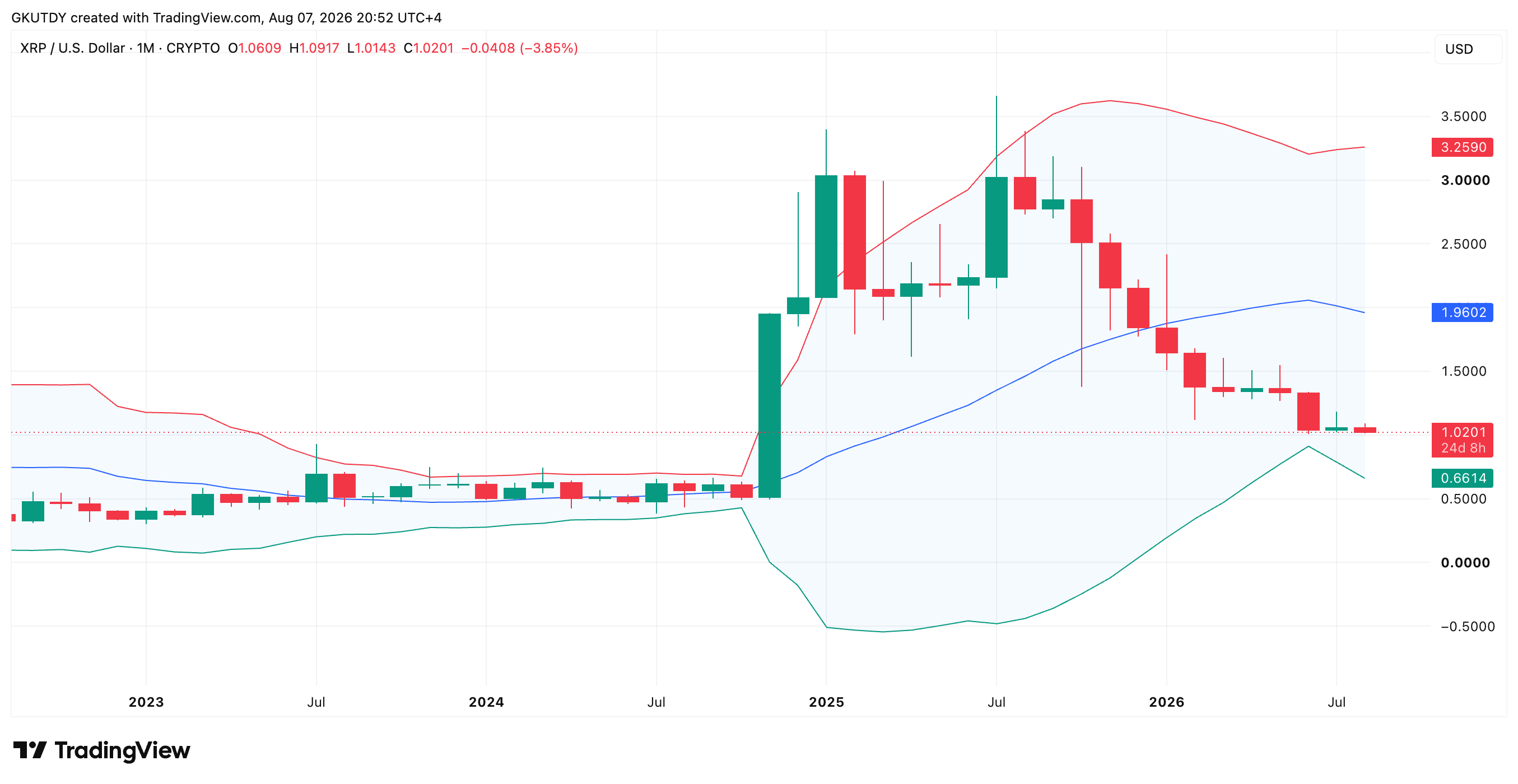
    TradingView chart data clearly maps out sellers’ targets as $XRP attacks the $1 boundary. Right now, the decline has temporarily stalled exactly at the lower daily Bollinger Band — $1.0240.

    The indicator’s bands have converged into an extremely narrow corridor, which historically signals that the market is preparing for a powerful price move. Due to local oversold conditions, a short technical rebound toward the middle band at $1.0831 or the upper band at $1.1423 is possible, but this would not reverse the broader downtrend.

    $XRP price action on a monthly time frame within Bollinger Bands, Source: TradingView

    If sellers finally push through the psychological $1.00 level, the next stop will be a test of the lower weekly band at $0.9572. In the worst-case scenario and a full-scale market capitulation, the true lower support boundary on the monthly timeframe would be around $0.6625.

    Risks and opportunities for $XRP investors

    The token’s next move depends on two key factors that are currently shaping the behavior of major players:

    • Bearish pressure: The freezing of U.S. institutional capital until mid-September and the loss of the key monthly middle line at $1.9605 open the door for a drop below the psychological $1.00 level.
    • Bullish potential: Buyers’ firm defense of the daily support at $1.0240, the potential for a strong technical rebound due to the compression of the bands, and continued demand across the global payments network are preventing the asset from an immediate collapse.

    In such an environment, short-term speculative capital will most likely continue avoiding $XRP in the coming weeks.

    However, for large strategic investors, a price decline into the $0.90–$0.95 zone, or in the event of a panic sell-off toward the monthly target of $0.6625, may be seen not as the collapse of the project but as a rare window of opportunity to build a long-term position at a deep discount.

  • US Senate passes Russia sanctions that could hurt India and China

    US Senate passes Russia sanctions that could hurt India and China

    NewsFeed

    The US Senate approved its strongest move against Russia under Trump, advancing sanctions that could impose tariffs on major buyers including India and China.

  • Spencer Pratt To The Rescue? Failed L.A. Mayoral Candidate Wants To Help Trump Save Hollywood, Supposedly

    Spencer Pratt To The Rescue? Failed L.A. Mayoral Candidate Wants To Help Trump Save Hollywood, Supposedly

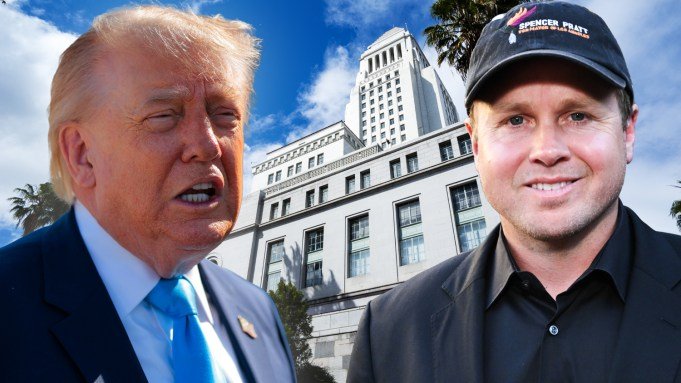
    Spencer Pratt may have flamed out in his bid to be L.A. Mayor, but the reality TV enfant terrible has seemingly found a new calling — saving Hollywood with Donald Trump.

    Just days after the deeply unpopular former Apprentice host swooped into Southern California for a behind-closed-doors RNC fundraiser, The Hills alum revealed online that he sat down with Trump to discuss a 25% federal tax credit for the admittedly ailing film and TV industry.

    “Working with the President on a 25% FEDERAL film tax credit to bring back Hollywood,” wrote Pratt with an accompanying pic with Trump at the MAGA boss’ Trump National Golf Club in Rancho Palos Verdes, California on August 4.

    Just days after the deeply unpopular former Apprentice host swooped into Southern California for a behind-closed-doors RNC fundraiser, The Hills alum revealed online that he sat down with Trump to discuss a 25% federal tax credit for the admittedly ailing film and TV industry.

    In and around Trump’s orbit since he was beaten out of a runoff spot in the L.A. mayoral campaign by incumbent Karen Bass and Councilmember Nithya Raman earlier this summer, Pratt offered few details of what he and Trump could be cooking up. The former City Hall contender didn’t respond to a comment for more info Deadline left on his IG post. Also, to that, the White House did not respond to a request from Deadline today on the conversation the two men had and the apparent resurrection of a stalled federal incentives package.

    RELATED: Trump Celebrity Supporters: Famous Folks In Favor Of The 47th President

    As he has so often in the past since stepping into the political arena what ex-Palisades resident Pratt (who lost his and Heidi Montag’s home in the horrific fires of early 2025) did do was sh*t on everyone else (including Canada) and lather up the easily flattered POTUS.

    “While Gavin Newsom’s commissioner is actively outsourcing production jobs to Hungary, and his rogue AG is trying to destroy CA production companies, the adults in the room are actually trying to repatriate the most quintessential American industry,” Pratt said on IG and X with swipes at California’s $750 million incentives program and Golden State Attorney General Rob Bonta’s antitrust lawsuit against the Paramount-WBD merger. “I’m committed to saving Hollywood, and I’m very grateful for the President’s remarkable generosity and focus on this issue. He is very passionate about revitalizing the entertainment industry and we will not let Canada, or the UK or Budapest steal our lunch anymore. Speaking of lunch…best clam chowder I ever had. We discussed several other very important topics, as well. I’m humbled and grateful for all the time and discussion from the President. Unlike many other cynical doomers out there, he refuses to write off California.”

    Okay. Lots to unpack there, and not just the chowder obviously.

    On one aspect of all that, Gov. Gavin Newsom’s crew had this to say when informed of Pratt’s post and that 25% federal tax credit for Tinseltown: “You mean Gavin Newsom’s idea from last year? Go, Spencer, go!”

    In fact, possible 2028 White House contender Newsom is far from the only one long advocating for a federal tax credit for the entertainment industry since past Emmy nominee Trump’s return to power. Trump’s sworn foe Sen. Adam Schiff (D-CA) is on board for such a program, as are SAG-AFTRA, the DGA, the WGA, studio execs and industry lobby groups.

    Also pushing for an incentive up around 10-20% is Enemy of the State star and MAGA cheerleader Jon Voight.

    One of Trump’s trifecta of Ambassadors to Hollywood, Voight and some producer pals submitted a tax incentive-heavy Make Hollywood Great Again to the White House in May 2025. Even as Trump raged, as he has on numerous occasions since, for a baffling 100% tariff on movies made outside the USA, a Voight-led letter to POTUS in May 2025 praised him for “the support you have shown the industry.”

    To give a sense of the support the industry needs, jobs and production has hit bleak levels in the home of Hollywood. The pandemic, the end of the Peak TV era, the 2023 strikes, consolidation and corporate debt, high costs and changing consumer habits has seen the L.A. region lose swaths of projects to the likes of the UK, Canada and several other incentive-offering states. That loss has translated into over 40,000 industry jobs gone, vendors boarding up their storefronts and an exodus of below and above-the-line talent from the high cost of living in the City of Angels.

    In that urgent context, the missive from Voight, the guilds, and others last year also said: “We also appreciate your understanding of the need to increase domestic film and television production to bring back American jobs and write seeking your support for the inclusion of three film and television priorities in the reconciliation package currently being drafted in Congress.”

    Unfortunately, despite the best bipartisan intentions of all concerned over the last 18 months, any initiative for a federal TV and film has withered on the Executive Office and Congressional vine. With the combative midterms taking center stage after Labor Day, hurting Hollywood shouldn’t expect any real movement this year on any such federal credits or out of Sacramento …regardless of how good the clam chowder is.

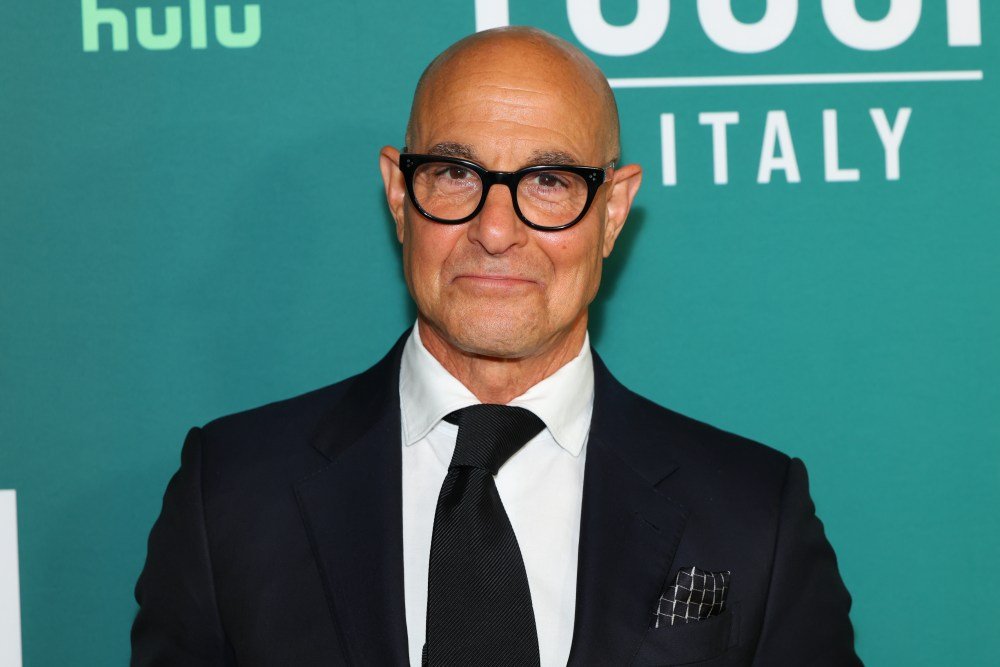
  • Stanley Tucci on Why His Emmy-Nominated ‘Tucci In Italy’ Is Moving to the United Kingdom Next Season

    Stanley Tucci on Why His Emmy-Nominated ‘Tucci In Italy’ Is Moving to the United Kingdom Next Season

    Italy remains Stanley Tucci‘s first love. But a man can travel, right? After winning three Emmys for CNN’s “Stanley Tucci: Searching for Italy,” followed by two nominations (including this year) for Nat Geo’s “Tucci in Italy,” the star is on the move. Tucci tells Variety‘s Awards Circuit Podcast that he’s currently filming his new season in the United Kingdom, where he lives full time.

    “I wanted to do the U.K. because I just feel like there’s so much here,” he says. “I’ve been here for almost 15 years now, and London was just voted the best food destination in the world. But I’m not just talking about fancy restaurants and all that. I’m talking about the U.K. as a whole. I think that the produce that’s here — the seafood that’s here, the meat that’s here, the devoted people like these fishermen or lobstermen, or a guy who raises pigs that will be like the best pork you’ll ever eat — that kind of stuff is amazing. And then, really amazing chefs that are devoted to farm to table or farm to fork, I guess is the new expression.”

    Having now done travel shows for a while, Tucci says he considers it “a great honor to meet so many of these people, because they’re just extraordinary. Their devotion to what they do. Amazing chefs and home cooks alike, farmers, cheese makers. I mean, their whole life is invested into this one thing. This singular focus is really so impressive to me.”

    Tucci is once again nominated as executive producer and host of “Tucci in Italy,” nominated for outstanding hosted nonfiction series or special. He talks to the Awards Circuit Podcast about what it was like to become a host, the skills he has developed in interviewing everyday people, and whether he’s OK with us calling him “The Tooch.” He also takes our 10 Questions quiz, and looks back at his first time in the pages of Variety.

    But first, on the Roundtable, Gold Derby editor-in-chief Debra Birnbaum joins us to give her takes on the Emmy race, including how “Widow’s Bay” has become the comedy front-runner. Listen below!

    “Tucci in Italy” comes at an interesting time for Tucci, who remains busy in front of the camera as well — including this year’s “The Devil Wears Prada 2.” “I’m really happy about having a lot to do, and yet at the same time, at the age of almost 66, I think, ‘how long can I do this?’” he says. “There’s a part of me that wants to spend more time at home, and so I’m trying to orchestrate things so that I can do that without compromising my career. Because there are still things I want to do, stories I want to tell, movies I want to make, plays I want to direct. It’s finding that correct balance.”

    Hosting a travel show didn’t seem like part of the plan, but Tucci notes that he first came up with the idea of traveling through Italy and breaking it down by region about 20 years ago.

    “I’d never seen a show like that,” he says. “I brought it up to a few people, and everyone looked at me like I was crazy. And then six or seven years ago, CNN came to me and said, ‘Do you have any ideas for a show?’ And I did. I had two other ideas: One was about refugees and food, and the other was about cancer, finding a balance between standard of care and alternative treatments. No one seemed very keen on either of those. So, and then I said, ‘Oh, I want to go through Italy and break it down region by region.’ And they went, ‘OK!’”

    So here’s the big question: What’s the most underrated region of Italy that we should check out? “I think Le Marche is a really beautiful region, which is right next to Tuscany. I shouldn’t even be saying this because I know that people will go to it. But it’s a really beautiful region, and it’s not packed with a huge number of tourists. The seaside is really pretty. The food is absolutely wonderful, and it’s not crazy expensive. But it’s gorgeous.”

    As for hosting, Tucci says there was a learning curve at first. “I was very nervous when I first did it. I thought, ‘What am I doing? I don’t know how to do this.’ I know how to memorize lines, or I know how to improvise, but with an actor, not with a normal person. But now I’m much better at it, and I feel more comfortable.”

    The secret, he says, is to listen. “If you’re not listening in the scene and responding truthfully, it’s not going to work,” he says.

    For Tucci’s first time in Variety, it was Oct. 6, 1982, in a review of Broadway’s “The Queen and the Rebels.” Tucci was listed as one of the travelers/soldiers, alongside his pal Campbell Scott.

    “I had just graduated from college,” he says. “I felt very lucky. I grew up with Campbell, and his mom was doing the play, and she cast us. He had one more year of university to do, I think. We were doing the play in the summer, so it was amazing for me. I understudied a role, and we were cast as extras for all practical purposes, and it was great because it got me my equity card and health insurance. That made a big difference. I was paid $550 a week, and I was in heaven. I thought this is the greatest thing ever. I got an agent, so I had all those things right out of college, SUNY Purchase. That’s a huge thing for an actor starting their career.”

    10 QUESTIONS WITH STANLEY TUCCI:

    1. Childhood nickname: “Tooch.”

    2. Something you loved as a kid but can’t believe you were into it now: “Velveeta.”

    3. Go-to karaoke or sing-in-the-shower song: “You don’t want to hear me sing. If you’ll notice in those reviews you spoke of, there’s not a single musical in them, and in a 40-45 year long career, and there’s not a musical. But I sing in the shower, thinking I’m brilliant. Something like ‘Our Love is Here to Stay,’ which is a song that I always sang to my kids when they go to sleep.”

    4. Give me an alternate title for your show: “Oh God, you don’t know how long it took us to come up with the simplest title in the book. ‘Tucci Eats Italy’? Just bad.”

    5. What’s your secret talent?: “I would say drawing and painting.”

    6. Favorite ice cream flavor: “I don’t really eat ice cream. If I had to say, it would be chocolate. It’s so boring. I’m so sorry.”

    7. The one item you couldn’t live without: “A knife that I have. That sounds scary, doesn’t it? But no, it’s a chef’s knife.”

    8. What TV show in all of history do you wish you were a cast member of?: “Wild Wild West.”

    9. Fictional character you most admire: “I really loved doing ‘Captain America.’ I did it like 15,16, years ago, and it was one of the best work experiences I’ve ever had. And I absolutely loved playing that role, even though when I was sent the script, it said, ‘German scientist in his 70s,’ and I was 50. I was like, ‘Oh man, come on!’ But it was so well written, and I just loved it. I just watched it again with my kids the other day.”

    10. Your favorite piece of advice: “My acting teacher George Morrison, who passed away a number of years ago, said, ‘go beyond what’s comfortable.’ And the second one is that ‘the undoing of something is as important as the doing of it.’ That was from my father who told me that. And Alberto Giacometti.”

    Variety’s “Awards Circuit” podcast, hosted by Clayton Davis, Jazz Tangcay, Emily Longeretta and Michael Schneider, who also produces, is your one-stop source for lively conversations about the best in film and television. Each episode, “Awards Circuit” features interviews with top film and TV talent and creatives, discussions and debates about awards races and industry headlines, and much more. Subscribe via Apple Podcasts, Stitcher, Spotify or anywhere you download podcasts.


  • Dwayne Johnson Addresses ‘Moana’ Mixed Reviews After Film Underperformed at Box Office

    Dwayne Johnson Addresses ‘Moana’ Mixed Reviews After Film Underperformed at Box Office

    Dwayne Johnson is speaking out on Disney‘s live-action Moana not exactly being a hit with critics.

    Johnson, who voiced Maui in the original 2016 animated film Moana and its 2024 follow-up, recently spoke to People magazine about how the movie’s early reviews started positively before the reception shifted.

    “Our first two reviews came out. I’ll never forget it… They were amazing. I was like, wow,” the actor recalled, before adding that then “it went another way — as sometimes happens. That’s just the way it goes because we’re in this business.”

    The Hollywood Reporter’s chief film critic, David Rooney, did, however, give the film a favorable review, calling it “one of Disney’s better live-action remakes.” He added, “The new Moana is a captivating family entertainment that deserves to find an audience.”

    The live-action Moana, released in theaters last month, earned a 31 percent critics score on Rotten Tomatoes, while its audience score was significantly higher at 88 percent.

    The Smashing Machine star added that he and his wife, Lauren Hashian, had many conversations about the response. “The challenge was, OK, let’s remember, though, what’s going to be beyond this opening weekend. Let’s remember what’s happening right now and the noise that’s happening right now,” he said.

    “If you love it, great. If you don’t, no problem,” the Jumanji actor said. But what meant the most to him was that “the culture really stood up,” as Johnson is of Samoan heritage.

    “Because of me and our kids who can now look at the big screen and go, ‘That’s us for the first time on a big screen. That’s us up there. How cool is that?’,” he said.

    Catherine Laga’aia starred in the title role, taking over from Auliʻi Cravalho, who voiced the character in the animated films. Johnson reprised his role as Maui in the live-action adaptation.

    The film, though, didn’t make waves at the box office, grossing $264 million worldwide against a reported $250 million production budget. 

  • Bitcoin, Ether ETFs Add $220 Million as Blackrock Leads Again

    Bitcoin, Ether ETFs Add $220 Million as Blackrock Leads Again

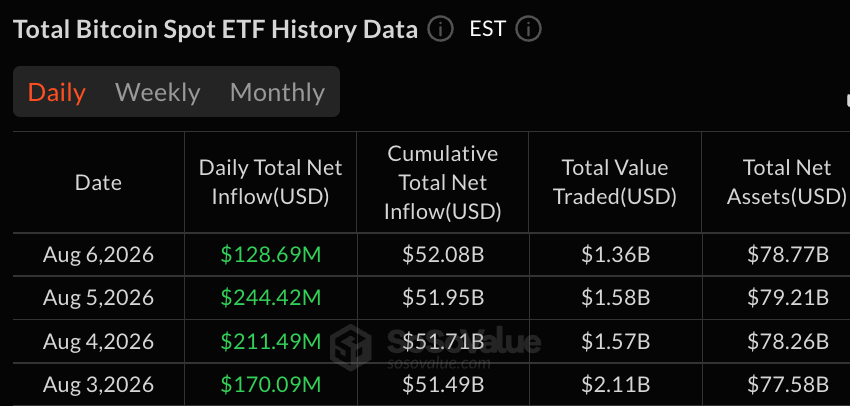
    Bitcoin Streak Hits 4 Days With $128.69M Inflow

    Capital continued to flow into the largest crypto ETFs as the week progressed. Bitcoin funds added another nine-figure haul, ether demand strengthened sharply, and several altcoin products found fresh buyers.

    The broad tone remained constructive across the market, although solana ETFs slipped into a modest outflow.

    Blackrock Leads Another Strong Bitcoin Session

    Bitcoin ETFs recorded $128.69 million in net inflows across six funds. Blackrock’s IBIT once again carried most of the load, attracting $128.33 million. Morgan Stanley’s MSBT added $14.94 million, while Fidelity’s FBTC brought in $11.20 million.

    Grayscale’s GBTC and Bitcoin Mini Trust contributed $7.48 million and $6.83 million, respectively. Bitwise’s BITB added another $1.75 million. Withdrawals from two funds partially reduced those gains. Vaneck’s HODL lost $32.77 million, while Valkyrie’s BRRR recorded a $9.07 million outflow.

    Four days of inflows for bitcoin ETFs worth $755 million. Source: Sosovalue.

    Total bitcoin ETF trading value reached $1.36 billion. Combined net assets closed at $78.77 billion. The latest inflow extended Bitcoin’s streak to four sessions.

    Austrian economist and investment manager Lawrence Lepard highlighted the durability of ETF ownership during the broader market decline. He noted that while bitcoin ETF values have fallen sharply from their peak, total shares outstanding have declined by far less, suggesting limited net selling among holders.

    Ether Builds Momentum as $HYPE Recovery Continues

    Ether ETFs produced one of the day’s strongest results, drawing $92.15 million across five funds.

    Blackrock’s ETHA dominated with an $81.14 million inflow. Grayscale’s Ether Mini Trust and ETHE added $4.55 million and $3.07 million, respectively. Blackrock’s ETHB received $1.96 million, while Fidelity’s FETH added $1.42 million. No Ether ETF posted an outflow.

    Total ether ETF trading value reached $435.46 million, with net assets closing at $10.64 billion.

    $XRP ETFs also returned to positive territory with $3.45 million in inflows. Bitwise’s $XRP fund attracted $2.89 million, while Franklin Templeton’s XRPZ added about $562,000. Net assets ended at $964.21 million.

    $HYPE ETFs extended their recovery with a $2.84 million inflow into Bitwise’s BHYP. Trading value reached $5.10 million, while net assets closed at $265.04 million.

    Solana ETFs moved the other way. Fidelity’s FSOL recorded an $859,450 outflow, leaving combined net assets at $857.24 million.

    Thursday’s flows reinforced the week’s strongest theme: institutional demand remains concentrated in bitcoin and ether, with Blackrock continuing to capture the largest share of new capital.