Author: rb809rb

  • Connecticut Judge Says Kalshi Sports Contracts Were Never Swaps

    Connecticut Judge Says Kalshi Sports Contracts Were Never Swaps

    Not Swaps, and Not Preempted Even If They Were

    U.S. District Judge Vernon D. Oliver’s ruling rests on a threshold point rather than preemption: for the CFTC’s exclusive jurisdiction to attach, a contract must be a swap traded on a designated contract market. Oliver held it is the judiciary’s role, not the agency’s, to decide what counts as a swap, rejecting Kalshi’s argument that any such challenge must be brought against the CFTC itself.

    On the statute, Oliver read “the occurrence, nonoccurrence, or the extent of the occurrence of an event” to concern whether an event happens and to what degree, not its outcomes. He adopted the reasoning of the District of Nevada in a case brought by a Crypto.com-owned exchange – which found that dictionaries treat “event” as meaning “outcome” only in an archaic sense. A boxing match can occur, not occur, or run three rounds; who wins is an outcome of the event, not a separate event. Oliver expressly declined to decide whether contracts on whether a game reaches overtime or a series reaches a seventh game would fare differently, since neither was in the record.

    His second ground was the requirement that the event be associated with a potential financial, economic, or commercial consequence. That connection must be embedded in the event itself, Oliver held, not created by endorsement contracts, bonus provisions, side wagers, or other downstream arrangements made by independent actors. A sporting event has consequences built in through ticket sales, broadcast rights, and advertising; who wins it does not. He also noted Kalshi’s own concession in earlier litigation before the D.C. Circuit that contracts on games are unlikely to serve any commercial or hedging interest.

    Between 80% and 90% of the contracts listed on Kalshi’s exchange were sports-event contracts, responsible for a similar portion of company revenue. The CFTC has not subjected a single one to review under the special rule, let alone prohibited any. Kalshi was valued at roughly $11 billion at February’s hearing and has about 24,000 Connecticut users.

    Oliver reached preemption anyway and rejected it on both theories. The special rule at § 7a-2(c)(5)(C), which lets the CFTC bar contracts involving gaming or activity unlawful under state law, reflects an intent to preserve state authority rather than displace it. Federal impartial-access rules bar discriminatory access criteria; they do not require a DCM to offer contracts nationwide. And he was unwilling to read Dodd-Frank as handing exclusive authority over sports betting to a financial regulator with no history in the field, noting that Congress has never appropriated funds to the CFTC for that purpose.

    Kalshi also lost on irreparable harm. Its asserted injuries were largely monetary, and to a significant extent self-inflicted, given that it kept listing the contracts through repeated regulatory warnings and adverse rulings. Because Kalshi is already building geofencing for other states, Oliver found Connecticut compliance unlikely to add much cost. He noted Kalshi has issued no warnings to users while advertising itself as the first app for legal sports betting in all 50 states.

    The crypto exposure runs through a separate five-page order. Coinbase Financial Markets began offering Kalshi’s contracts through its platform in January 2026 as a futures commission merchant rather than a DCM, and Connecticut never directed any enforcement at it. Oliver denied the motion “largely in line with” the Kalshi order and attached that opinion as an exhibit. Connecticut’s December sweep had also named Robinhood Derivatives and Crypto.com: DCP announced all three orders on Dec. 3, with Gaming Director Kris Gilman saying a prediction market wager is not an investment, and Commissioner Bryan T. Cafferelli saying the platforms would violate other state laws even if licensed, including by taking wagers from people under 21.

    Oliver’s order counted 14 suits Kalshi has filed against states, with federal courts split and every state court to rule so far ruling against it. He cited KalshiEX LLC v. Cox, decided in Utah on Aug. 4, and went further than Minnesota’s judge, who blocked that state’s ban while treating a World Cup winner contract as likely a swap. Massachusetts, Nevada, and Michigan state courts have all ordered geofencing; Kalshi pledged to implement it in Nevada by Aug. 12 and faces the same date in Michigan.

    A Kalshi spokesperson told Sports Betting Dime (a Sportradar subsidiary) the company respectfully disagrees with the decision and is considering all legal options. Oliver ordered the parties to file their Rule 26(f) report by Aug. 24, with Connecticut’s response to the complaint due Aug. 31.


  • WGA Slams David Ellison’s Plan to Pull Paramount From California: ‘This Type of Behavior Is Precisely Why the Merger Should Be Blocked’

    WGA Slams David Ellison’s Plan to Pull Paramount From California: ‘This Type of Behavior Is Precisely Why the Merger Should Be Blocked’

    The Writers Guild of America has fired back at Paramount Skydance CEO David Ellison after he threatened to start pulling Paramount out of California on Oct. 1 if California AG Rob Bonta refused to come to the bargaining table and settle the antitrust suit to stop the studio’s acquisition of Warner Bros.

    “By threatening to leave the state because it doesn’t want the government to enforce the law, Paramount further proves the danger of its outsized power over the industry and what that will mean for writers and the creative community,” the WGA told Variety in a statement. “This type of behavior is precisely why the merger should be blocked.”

    The WGA, along with Bonta and his coalition of 12 states, is suing to block the $110 billion Paramount-Warner Bros. merger. Filed jointly with the WGA West and East branches, the guild’s suit claims the merger violates antitrust law and would inflict irreparable harm on industry scribes.

    The AG’s lawsuit claims the transaction violates the Clayton Act by diminishing competition in three key markets: wide-release theatrical distribution, “top-grossing” theatrical distribution and basic cable licensing. Bonta, in response to the news that Paramount may split town, wrote on X Tuesday, “In a span of weeks, Paramount agreed to halt the merger until a court decision or until June 2027, asked for a November trial, and is now back with another attempt to blackmail the state into letting an illegal deal through. Paramount has lost the plot as it continues to lose in court. It didn’t work the first time — on the eve of our July lawsuit — and it won’t work this time.”

    Oct. 1 is the day when Paramount will begin paying Warner Bros. shareholders a $7 billion ticking fee for every day that passes without a closed deal. The AG’s lawsuit is set to go to trial on March 2, 2027. If no settlement is reached, Paramount would be on the hook for over $1 billion to WBD shareholders by the end of the trial.

    Ellison wrote in a recent New York Times op-ed that he believes the reason the states are opposed to a combined Paramount-Warner Bros. is not because of industry consolidation, but because Ellison would have control over CNN if the two studios were allowed to merge. During the acquisition process Ellison has made no secret that he is a friend of President Donald Trump, a longtime critic of the network. The turbulence behind the scenes at CBS News and its marquee program, “60 Minutes,” has also stoked fear that CNN may be mismanaged under Ellison’s control.

    “Great news organizations like CNN and CBS News are here to tell it straight down the middle,” Ellison wrote. “That requires newsrooms that reflect the whole world, not one side of it. And it requires independence. Our journalists will continue to answer to the facts and to all the people they serve — not to any party or cause. These were founding principles for both CNN and CBS News, for legends like Ted Turner and Edward R. Murrow, and it is exactly that kind of independence that has always fueled the greatness of ‘60 Minutes.’”

  • Spritehood NFTs raise $1.28M on Robinhood Chain

    Spritehood NFTs raise $1.28M on Robinhood Chain

    Spritehood has sold 42,956 paid NFTs on Robinhood Chain in about 53 minutes, generating nearly $1.28 million for Pudgy Penguins co-founder Cole Villemain.

    Spritehood $NFT sale reached $1.28 million

    The Defiant reported that Villemain launched Spritehood on Aug. 11 after previously being removed from the founding team of Pudgy Penguins, with the paid portion of the sale selling out in less than one hour.

    On-chain analyst 0xlaplaced calculated that the mint generated about $1.2829 million, or approximately 684.28 $ETH, based on the price of Ether during the sale. The final total came in well above an earlier estimate of roughly $755,000 that circulated before the mint had finished.

    According to the analyst’s transaction review, buyers minted 37,430 NFTs for $17 each, producing $636,310 in proceeds. A second group of 5,526 NFTs sold for $117 each, adding another $646,542.

    Combined, the two paid tiers generated $1,282,852 from 42,956 tokens. The deploying address had already distributed 1,488 NFTs at no charge through 20 zero-price transactions before the public sale, taking the full reported supply to 44,444 items.

    Although the available figures show how many tokens moved at each price, the supplied report did not identify what determined whether a buyer paid $17 or $117. It also did not provide details about any benefits, future access, or other features attached to the collection.

    Unverified code limits review of Spritehood’s mint

    Spritehood’s contract appears with an “unverified” label on Robinhood Chain’s Blockscout explorer, according to The Defiant. An unverified contract can still operate and record transactions on-chain, but its human-readable source code has not been matched publicly with the deployed bytecode through the explorer.

    Without that verification, buyers cannot use Blockscout to inspect the complete source code governing Spritehood’s pricing and distribution process. The label does not establish that the contract is malicious or faulty, though it reduces the information available for independent review through the explorer.

    The reported mint figures instead come from an analysis of completed blockchain transactions. Since every paid tier can be calculated separately, the on-chain totals explain why the final proceeds exceeded the figure shared while the sale was still underway.

    No information in the supplied report indicates that Robinhood organized, promoted or endorsed the Spritehood launch. Robinhood describes its network as a permissionless Ethereum Layer 2, meaning independent developers can deploy applications and tokens without each project representing an official Robinhood product.

    Robinhood Chain has attracted speculative assets

    Spritehood arrived about six weeks after Robinhood opened its Layer 2 network to the public. As crypto.news reported in July, Robinhood Chain launched as an Arbitrum-based Ethereum scaling network designed for tokenized stocks and decentralized finance applications.

    The mainnet debuted with integrations involving infrastructure providers, including Alchemy, BitGo, and Chainlink. Robinhood also introduced Stock Tokens for eligible users outside the United States, while decentralized exchanges and lending applications supplied on-chain trading functions.

    Despite its stated focus on financial assets, permissionless deployment has allowed unrelated tokens and speculative projects to enter the network. A July network review found that memecoin trading had become a major source of early activity, even though Robinhood built the chain around tokenized equities and real-world assets.

    The network’s early activity also produced a gap between trading volume and available liquidity. Another July analysis found $570 million in launch-week trading volume against $21.68 million in liquidity, with incentive-backed decentralized finance deposits and speculative tokens driving much of the activity.

    More recent figures cited by Bitmine Chairman Tom Lee placed Robinhood Chain’s cumulative decentralized exchange volume near $9 billion. Lee said the chain could expose Robinhood’s 27 million customers to Ethereum-based services, although the figure represented the company’s funded customer base rather than confirmed users of the blockchain.

    $ETH functions as Robinhood Chain’s native gas token, while network transactions settle through Ethereum. Buyers therefore need $ETH to pay transaction fees when directly using applications deployed on the chain, including $NFT contracts such as Spritehood.

    Pudgy Penguins history follows Villemain’s new mint

    Villemain, also known online as ColeThereum, helped create Pudgy Penguins with three other founders in 2021. The original collection contained 8,888 penguin profile-picture NFTs and sold out shortly after launch.

    An earlier Pudgy Penguins history published by crypto.news said the initial mint priced the NFTs at about $90 each and generated more than $800,000. The collection later became one of the most recognized projects from the $NFT market’s 2021 expansion.

    Pudgy Penguins holders voted Villemain out of the founding team in January 2022. The removal followed community allegations that he had misused project funds and failed to deliver on parts of the project’s roadmap.

    The claims remained allegations, and the supplied report said Villemain was not prosecuted over them. Entrepreneur Luca Netz later acquired control of the Pudgy Penguins brand in April 2022 for 750 $ETH, taking over its leadership after the original team’s removal.

    Under its new ownership, the project expanded beyond blockchain collectibles into physical toys, licensing deals, and the PENGU token. Pudgy Penguins has also continued to register periods of high secondary-market activity, including a 247% weekly sales increase to $9.3 million in July 2025.

    What the Spritehood sale means for US buyers

    Robinhood is a U.S.-listed brokerage, but use of its public blockchain does not mean an $NFT carries Robinhood’s approval or the protections attached to a brokerage account. The company’s official disclosures describe Robinhood Chain as a permissionless and separate blockchain from its regulated financial services.

    For U.S. buyers, the tax treatment of $NFT purchases also differs from buying assets inside a standard brokerage account. The Internal Revenue Service treats digital assets as property, and its guidance requires taxpayers to report taxable gains or losses when cryptocurrency is sold, exchanged or used to acquire property, including an $NFT.

    Paying for a Spritehood $NFT with $ETH may therefore create a taxable disposal for a U.S. buyer if the Ether changed in value between acquisition and use. Any later sale of the $NFT may produce another reportable gain or loss based on the difference between its cost basis and sale proceeds.

    Federal securities treatment depends on the economic facts surrounding an offering rather than the $NFT label alone. In 2023, the Securities and Exchange Commission charged Impact Theory over an $NFT offering that raised about $30 million, while Stoner Cats 2 agreed to settle charges tied to an $8 million $NFT sale.

    Neither the supplied report nor the cited on-chain review said a U.S. regulator had examined Spritehood or alleged that its NFTs were securities. The report also did not identify any passive-income rights, revenue-sharing terms, or promises of returns attached to the collection.

  • XRP bridge drained for $200,000 after software mistook fake deposits for real ones

    XRP bridge drained for $200,000 after software mistook fake deposits for real ones

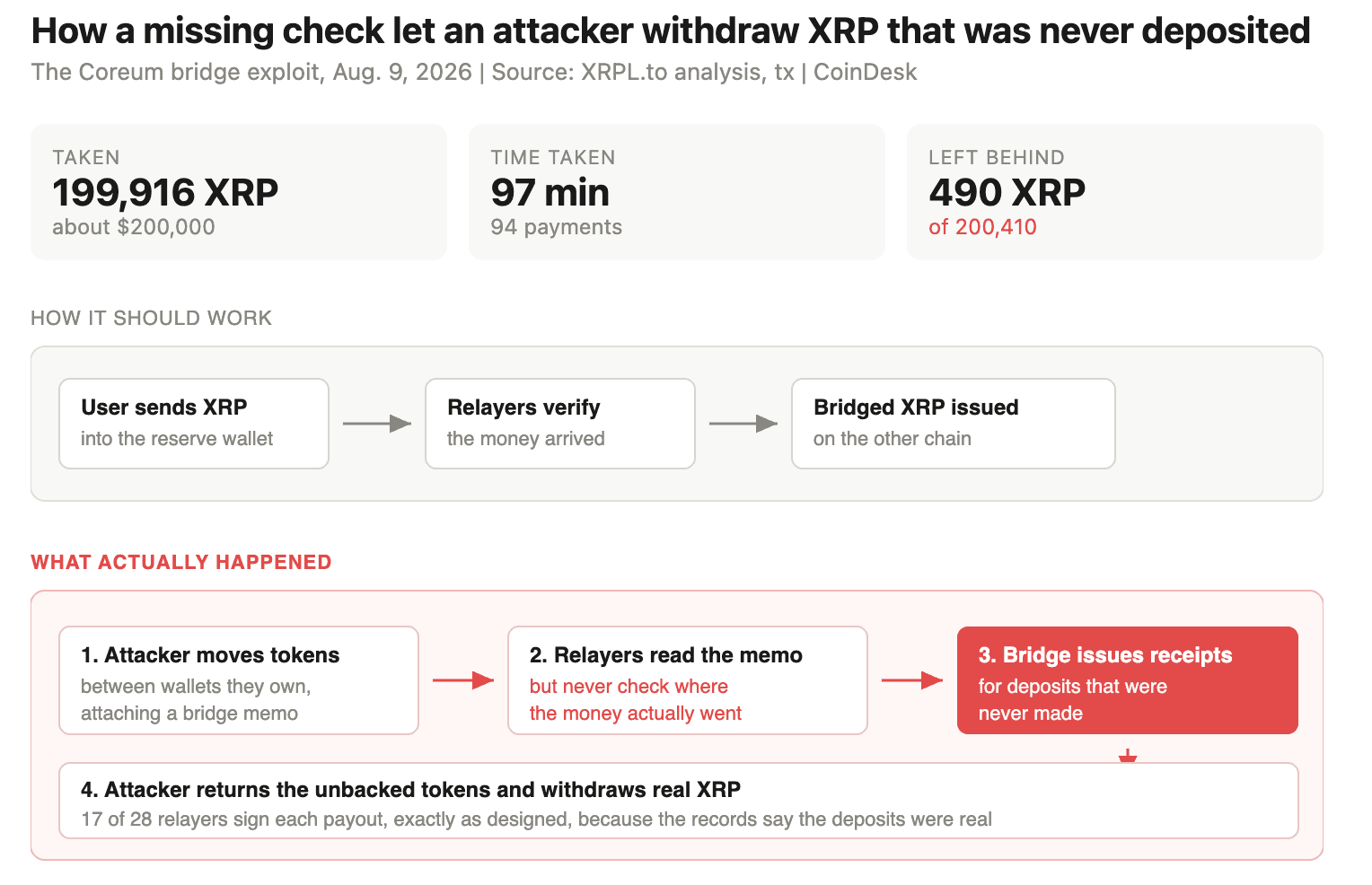
    According to tx, the bridge’s software registered transactions as deposits even though they never delivered $XRP to the bridge. That gave the attacker bridged $XRP on the tx chain without the real $XRP that was supposed to back it. Those unbacked tokens then went back through the bridge, and the attacker withdrew real $XRP from the reserve.

    How a missing check let an attacker withdraw $XRP that was never deposited. (Shaurya Malwa/CoinDesk)

    The drain began at 19:16 UTC. Each payout was authorized by 17 of the bridge’s 28 relayers, a majority signing off exactly as designed, because the bridge’s own records told them the deposits were real.

    Relayers are programs that watch both blockchains and approve transfers when the bridge’s records say a withdrawal is owed.

    The specific failure sat one layer down, however, as the relayer code processed payments carrying the bridge’s memo without first verifying the destination address.

    tx confirmed the deposit-detection flaw in an update, saying the attacker exploited software that incorrectly recognized transactions that delivered no $XRP to the reserve.

    An update on the XRPL bridge incident.

    On August 9, the tx XRPL bridge was exploited and $XRP was drained from the bridge’s reserve wallet on the $XRP Ledger. The bridge has been halted, the vulnerability has been identified, and all potential remedies are being evaluated. This…

    — tx (@txEcosystem) August 11, 2026

    The project added it has identified and fixed the vulnerable code, engaged blockchain forensics specialists and filed a complaint with the FBI’s Internet Crime Complaint Center. It has not said how affected holders will be made whole.

    Meanwhile, the stolen $XRP did not stay put. Onchain tracking shows most of it moved onward within hours through several other addresses.

  • Trump says secret plane switch ‘up to the Secret Service’

    Trump says secret plane switch ‘up to the Secret Service’

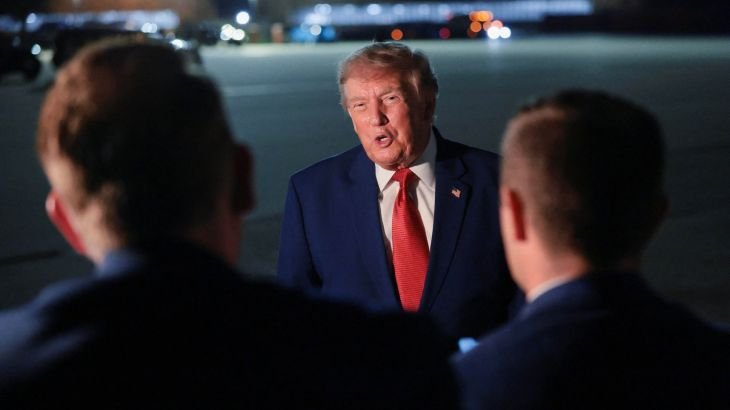
    US President Donald Trump says the decision to make a plane switch in Turkiye after the NATO summit was made by the Secret Service. The Washington Post revealed Trump boarded Air Force One, but used a catering truck to move to another aircraft due to an alleged Iranian threat.

  • A Super Clean Deal: This Dreame Robot Vacuum and Mop Is Almost 30% Off

    A Super Clean Deal: This Dreame Robot Vacuum and Mop Is Almost 30% Off

    Eliminate your cleaning duties with this deal. Walmart has the Dreame C30 Plus robot vacuum and mop on sale for $239.99, down from its regular $329.99 list price. This limited-time promotion saves 27% on a value-packed cleaning system featuring 19,000Pa maximum suction, a dual anti-tangle system, 360-degree navigation with multifloor mapping, and a 40-liter auto-empty dock. Mop it up while the deal lasts!

    Securing a two-in-one robotic vacuum and mop equipped with 360-degree navigation, app-based custom room control, and 120 days of autonomous dust collection for under $250 is an incredible value. It makes this flash promotion the ideal window to fully automate daily floor care.

    This major price markdown gives busy parents and pet owners a rare opportunity to capture deep carpet cleaning and edge-to-corner mopping without the standard retail cost strain. Add to your cart now!

    WALMART DEAL ALERT

    Dreame C30 Plus Robot Vacuum and Mop

    19,000pa suction, dual anti-tangle, LDS 360° mapping, smart carpet boost, 4L 120-day auto-empty


    $239.99
    at Walmart

    $329.99
    Save $90.00


    Get Deal

    The Dreame C30 Plus takes care of your daily floor maintenance with 19,000Pa suction power and a dual anti-tangle brush design. It uses 360-degree LiDAR mapping and multi-floor route support, smart carpet detection with automatic suction boosting, edge-to-corner coverage, and a 4-liter self-emptying dock that provides 120 days of hands-free upkeep for easy home floor care. But if you need something else, check out PCMag expert Andrew Gebhart’s list of the best robot vacuum and mops for 2026.

    The Dreame C30 Plus sets a new standard for budget-friendly robotic floor care, combining 19,000Pa suction power with 120 days of self-emptying dock convenience. At over 25% off, you can add dual anti-tangle protection, smart carpet boosting, and LDS laser mapping straight into your household routine. Don’t let this deal gather dust.

    Recommended by Our Editors

    However, if you’re looking for a more compact alternative, this iRobot Roomba 105 robot vacuum deal is currently available at almost half off.

    More Deals on Robot Mops

    *Deals are selected by our commerce team

    About Our Expert

  • ‘The Diplomat’ Showrunner on Why Season Three Finale Was “Terrifying” to Write

    ‘The Diplomat’ Showrunner on Why Season Three Finale Was “Terrifying” to Write

    Debora Cahn received her first Emmy nomination 20 years ago as a producer on The West Wing. Now, the TV vet is up for best drama for her own show, the political thriller The Diplomat, for the second straight year — while also receiving her first-ever writing nod.

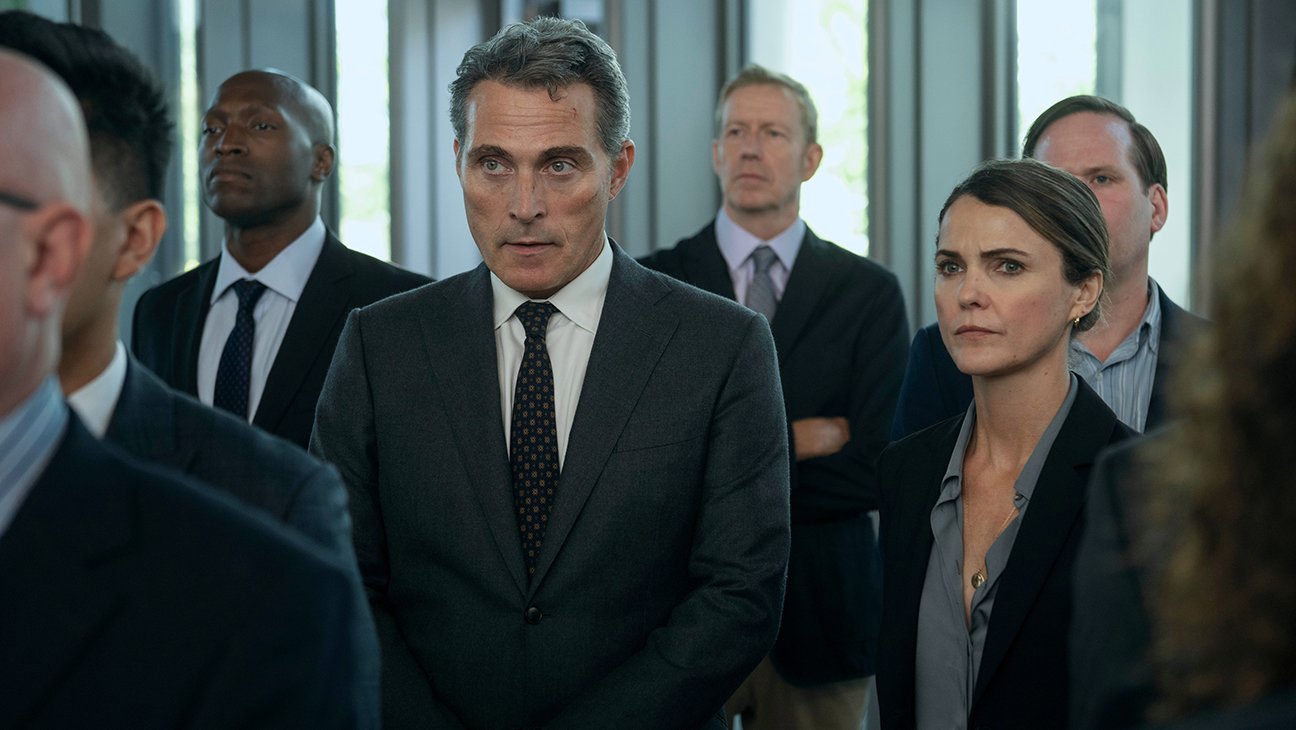
    Cahn discusses with THR her partnership with star Rufus Sewell and writing the “terrifying” finale.

    The show has grown in Emmy nominations over each of its three seasons. What do you make of that from your own creative perspective of evolving the show?

    There’s always the hope that a show can continue to thrive past all of your first-grade ideas, which you lay out in the first season. All of the low-hanging fruit storywise goes into those first few episodes. Then it turns into this new thing that is partly a show that I had in my mind and partly the product of a bunch of people working on this thing together — the relationship that Keri [Russell] and Rufus built out of Kate and Hal and turned into this marriage that has really drawn people in and served as the spine of the series. The hope is always that you haven’t used up all your good tricks and that you have a deeper well than you knew yourself going in. That’s a little bit of a leap of faith. It’s really great when it feels like your audience is responding to that reach.

    Rufus got his first nomination for the show, and it feels appropriate since Hal takes more center stage this season opposite Kate. What is it like writing for him?

    He has been, from the beginning, this stellar dance partner who is in so many ways responsible for everything that that relationship is. There are a lot of people who really connect with Kate as a character, and see themselves in that character, and there is a tremendous amount of love for Hal and connection with Hal. I sense from the audience that Hal is just giving them a unique ride. He’s fucking great.

    You end the season with Kate realizing Hal’s subtle, brutal betrayal. How did you get there?

    When you’ve achieved a finale by blowing a bunch of people up and then you’ve achieved a finale by having a president killed, having an interesting shift in one character’s attitude toward another character … is the most terrifying finale to write. (Laughs.) It was intimidating to try and figure out how you make a finale out of a really subtle shift in perspective that you’re not sure is real. It was a relief that people were willing to watch.

    You’re nominated for writing the episode “Amagansett” with Peter Ackerman, which pits the relationship between Kate and Hal against that of the president and first gentleman, Grace (Allison Janney) and Todd (Bradley Whitford). How did that parallel develop?

    It certainly was an experiment in turning the Grace character into a piece of another marriage where the marriage itself was going to be a character in the way that Kate and Hal’s was. We didn’t know that it was actually going to work, but was there a ton of suspense? No: It’s Allison and Brad. We were excited to see them build a different kind of way to work together after they had decades ago. We were all a little bit nervous that we were writing into a piece of the past, but they so elegantly and joyfully have created this whole new thing with two new characters that are just such a blast to watch. Every time that epic foursome is onstage together, the whole crew leans in. It’s just without question a career highlight for me, seeing the four of them work together. Boy, does game recognize game.

    This story first appeared in an August stand-alone issue of The Hollywood Reporter magazine. To receive the magazine, click here to subscribe.

  • ‘The Office’ U.K. Actress Lucy Davis Reveals “Incurable” Breast Cancer Diagnosis

    ‘The Office’ U.K. Actress Lucy Davis Reveals “Incurable” Breast Cancer Diagnosis

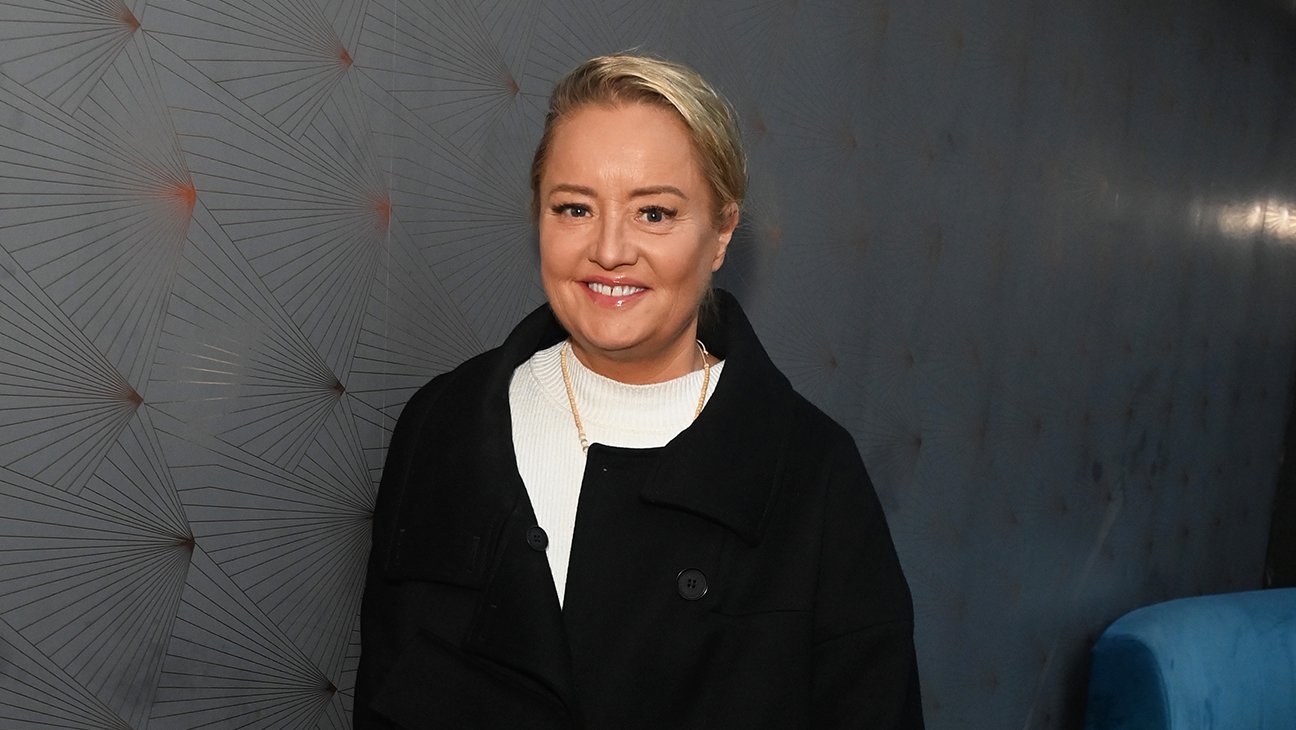
    Lucy Davis, the actress who starred in the original British version of The Office, has revealed she was diagnosed with stage 4 breast cancer.

    The actress shared a post on Instagram explaining that she initially felt a lump that “wasn’t a ‘lump’ as such; rather a kind of hard spot. Really tiny. I almost didn’t bother getting it checked,” urging others to attend regular checkups. Davis also said that her cancer is “incurable.”

    “A year and a half ago I was diagnosed with Stage 4 Breast Cancer, which has metastasized to my bones,” she wrote. “Specifically to my spine, right hip, and my ribs. The cancer is incurable, and too late for chemo.”

    Related Stories

    Davis shared the extent of her pain, noting that it “can really be something else.” She added, “Standing and walking for too long a time can be hard, and I need to use a wheelchair sometimes (so if you see me toddling around in one, feel free to give me a push!).”

    Davis starred in the original Office throughout its three-season run as Dawn Tinsley, a receptionist at the Wernham Hogg paper merchant company. Her character formed a romance with Martin Freeman’s Tim Canterbury; Davis’ Dawn was the model for Jenna Fischer’s Pam Beesly.

    “As of now, I’m trying to live out whatever might be left of my life in as fun a way as I possibly can,” Davis wrote. “I always like to find the teachable moments in anything negative that happens. And cancer has not disappointed in that regard; there’s a lot I have learned from it, and I’m grateful for that.”

  • ‘The Daily Show’ Releases Audition Tapes for John Oliver, Michael Che, Current Hosts and More

    ‘The Daily Show’ Releases Audition Tapes for John Oliver, Michael Che, Current Hosts and More

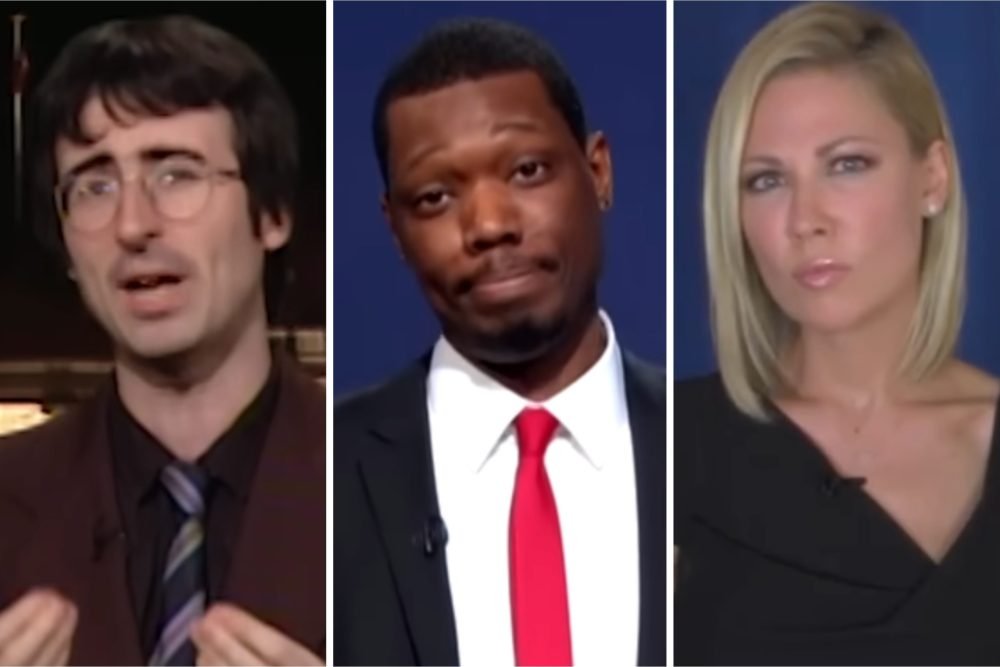
    “The Daily Show” released a slew of never-before-seen audition tapes from past and present correspondents in a 10-minute compilation posted to YouTube.

    The video, honoring the satirical news program’s 30th anniversary, features audition tapes from all five current rotating hosts, many of whom are seen in the footage bantering with either Jon Stewart or Trevor Noah, depending on when they first joined the show.

    Some of the auditions are presented like correspondent segments, with Jordan Klepper, for example, wearing a suit and riffing with Stewart in front of a green screen showing Washington, D.C. Others are more casual, with Desi Lydic seemingly talking to a producer reading a script off-screen.

    A fresh-faced John Oliver, who joined “The Daily Show” in 2006, is seen joking around with Stewart before the audition starts. “Now, if you do come work for us, you know you can’t use the name John,” Stewart tells Oliver, who quips back, “That’s fine. I’m prepared for that. I was going to take ‘Rico.’”

    The auditions also include Samantha Bee, who served as a correspondent from 2003 to 2015 before leaving to host her own show, “Full Frontal,” and Michael Che, who was on “The Daily Show” for three months before departing for “Saturday Night Live.”

    Jessica Williams, Roy Wood Jr., Rob Riggle, Jason Jones and Wyatt Cenac are also featured. And, in 2002, Ed Helms and Rob Corddry are seen performing the same bit, about changes being made to Winter Olympic sports.

    Watch the audition tape compilation below.

  • Jonas Brothers on Today’s New Generation of Disney Stars: “Don’t Envy Anybody That’s Doing This Now”

    Jonas Brothers on Today’s New Generation of Disney Stars: “Don’t Envy Anybody That’s Doing This Now”

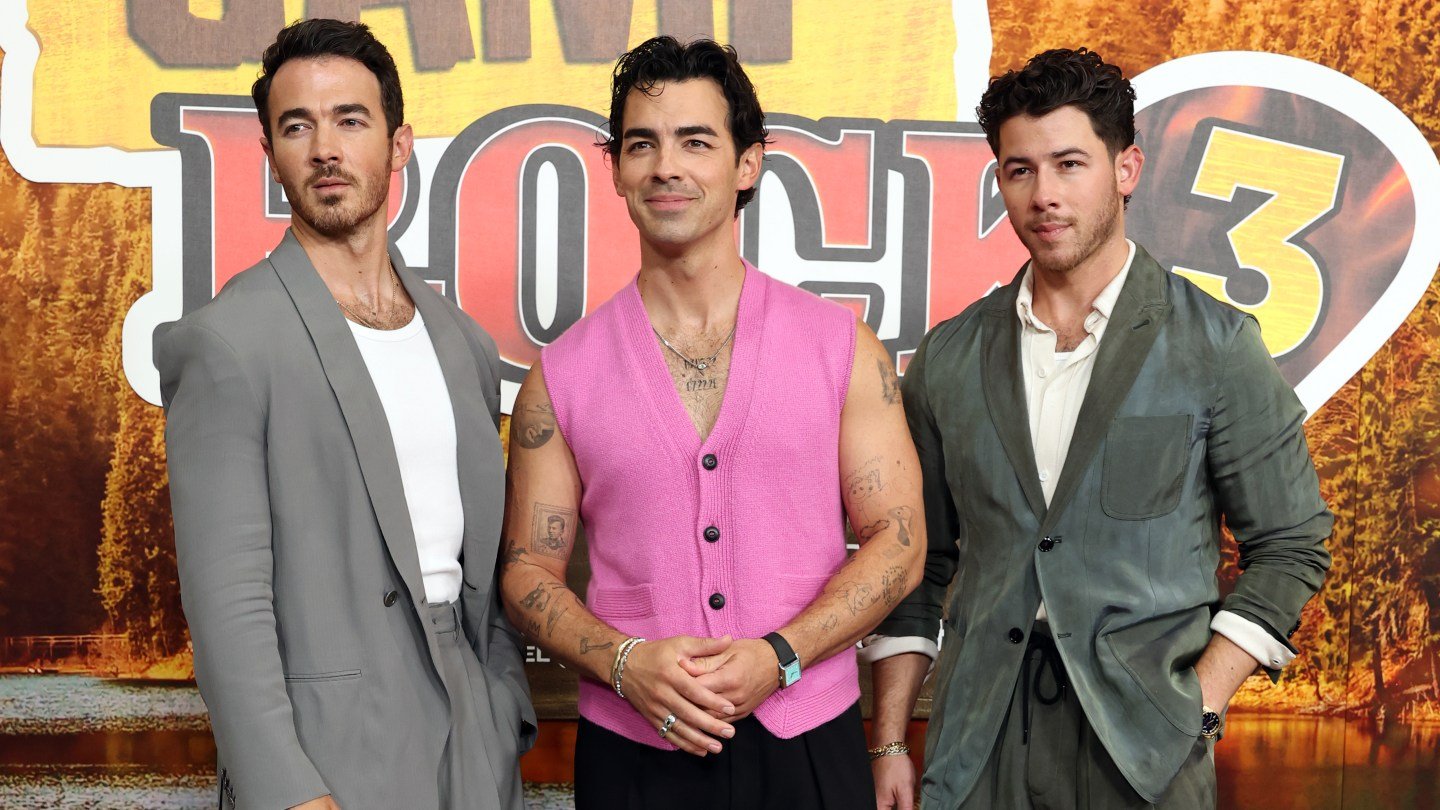
    The Jonas Brothers are going back to their Disney roots, both executive producing and reprising their Camp Rock roles in the franchise’s third film.

    Camp Rock 3 sees the brothers’ band Connect 3 returning to the camp to look for a new opening act for their tour. This means a whole new cast of campers — led by Malachi Barton and Liamani Segura — are introduced, along with a cameo appearance from fellow O.G. star Demi Lovato (who also serves as an EP).

    Speaking to The Hollywood Reporter at the film’s L.A. premiere on Monday, Joe Jonas said that in shooting scenes with Lovato, they “both were looking at these new campers kind of pinching ourselves like wow, this is a pretty wild full circle moment. We’ve all lived so much life and to be where we are today and to create something like this, Camp Rock 3, as producers, wearing the producer hat, I think we were like, ‘This is kind of wild.’”

    Walking the carpet alongside Nick Jonas and Kevin Jonas, Joe also weighed in on getting to know the next generation of Disney stars, and how different it is now than when the brothers were first getting famous.

    “I don’t envy anybody that’s doing this now, there’s probably a lot more scrutiny,” Joe noted. “Things happen a lot faster, and with that you also have an opportunity to kind of explain yourself quicker; when we were starting, we didn’t have a lot of options — just kind of hope that the article isn’t about you. Now you can at least go on your TikTok and say, ‘Hey guys, I didn’t say that’ or whatever it is.”

    Joe Jonas also emphasized that there are more resources now to speak to professionals and get support from the studio, and “we also wanted to make sure that we were running a safe space on set. That was one of our priorities when we signed up to do this, we were like, ‘We want these kids to feel comfortable,’ because ultimately we remember what it was like and it can be a lot of pressure. They’re about to be shot out of a cannon into stardom, so we wish them the best and we hope they’re surrounded by love and care.”

    Lovato said she also offered the new stars plenty of advice, telling them that “this is going to be a whirlwind and make sure to take breaks if you need them; it’s so important to protect your mental health, and to soak it up and to have fun. That’s the most important part.”

    The pop star explained that returning to Camp Rock almost two decades after the sequel was “really healing for me,” as “Camp Rock has meant so much to so many people and it’s meant so much to me; this was the beginning of my journey in this industry and [my character] Mitchie will always have a huge, special place in my heart.”

    Camp Rock 3 premieres Thursday on Disney Channel and the next day on Disney+. 

    Tiffany Taylor contributed to this report.