APC Studios’boutique distributor About Premium Content (APC) has signed a number of key international broadcast deals ahead of this year’s Unifrance Rendez-Vous in Le Havre on French-language scripted and unscripted series “Blue Gold,” “Seasons” and “An Artful Imbrolio.”
The eight-part crime drama and family saga “Blue Gold” has been licensed to Walter Presents for the U.K. and Ireland, RTP in Portugal and Blue Play in Switzerland, joining U.S. streamer MHz Choice.
Produced by Authentic Prod (“Sam,” “Montmartre”) for France Télévisions the series is written by Marie-Anne Le Pezennec (“Dolmen”) and Ludovix Lacroix and directed by Hippolyte Dard.
Barbara Probst stars in ‘Blue Gold’
Courtesy of About Premium Content
Set in the 1980s in Provence, “Blue Gold” chronicles the saga of three women from three generations, Marie, Alice and Flore, and one decades-old buried secret. When a body is found and murders start piling up, Flore will have to solve the family puzzle by revealing the truth. Barbara Probst, Sylvie Granotier and Déborah Krey star.
The four-part “Seasons,” a French-language drama series produced by Windy Production for Arte, has been picked up by RTP in Portugal and RTBF Auvio for French-speaking Belgium. It previously sold to Radio Canada’s Ici Tou.TV Extra for French-speaking Canada.
‘Seasons’
Courtesy of About Premium Content
Beginning in August 1991 at the seaside resort of Les-Sables-d’Olonne, it follows Camille, 15, as she first meets the two best friends Martin and Alexandre on the beach and crashes into their lives like a comet. Perpetually torn between the two men, Camille will live a crazy love story with them over more than 30 years.
Nicolas Maury (“Call My Agent”) directed, co-wrote and stars in the show, co-written by Hélène Duchateau (“The Forest,” “Unfaithful,” “The Eclipse”). The series’ stellar cast includes Stéphane Caillard (“Flo,” “Marseille”), Lucas Bravo (“Emily in Paris,” “Ticket to Paradise”), Abraham Wapler (“Andor,” “Colours of Time”), Géraldine Pailhas, Martine Chevallie and Marysole Fertard.
APC Stories’ three-part art investigation documentary “An Artful Imbroglio” went to Filmin in Spain and RTP in Portugal. Produced for Arte, the unscripted series, which is set in Paris, Rome, London and New York, sheds light on one of the art world’s greatest mysteries.
In the spring of 2014, a mysterious, anonymous letter triggered one of the biggest scandals in the art world: the alleged trafficking of fake old master paintings on an unprecedented scale. At the heart of this imbroglio unfolds a gallery of colorful characters, all revolving around an ultra-charismatic art dealer.
Andrew Garfield‘s character may be rebelling against a king in The Uprising, but he says billionaires are the ones who should also be “scared shitless” by the film.
During a recent Q&A, alongside director Paul Greengrass, Garfield explained why he hopes the film serves as a warning to the world’s richest. The Uprising, based on the uprising that inspired the legend of Robin Hood, sees Garfield’s character Ploughman form an army against the tyranny of King Richard II in a fight for justice.
“First, I hope they come and see it, for first thing,” the Artificial actor said when asked what he hopes audiences take away from the movie. “But secondly, I hope it’s galvanizing. I hope there’s some awakening that people feel, that they feel that their own, that we all feel like our own struggles are being reflected in the struggles of these characters from a distant time and place, and that it could be directive. And I hope that if any billionaires watch it, they’re scared shitless.”
The moderator later quoted one line from the film: “There will be no peace until we are healed.” In response, Greengrass noted the phrase is “true of today as it [was] 600 years ago, for sure.”
Garfield chimed in, adding, “I’m going to include the billionaires in that as well, because they’re the ones that might be the most soul sick. They’re the ones that might need the healing the most in a way.”
Though The Uprising is set in 14th-century England, the film’s themes about the abuse of power and dehumanization of the underclass seemed to resonate with Garfield.
“The truth of that period of time,” the two-time Oscar nominee told Esquire last month, “was that there were brutal conditions for working-class people, brutal taxation post-plague, incompetence in government, abusive practices, with the underclass being seen as sub-human creatures from the perspective of those in power.”
When asked whether those conditions could pertain to today’s world, Garfield said, “Yeah, here and in the United States, and all around the world.”
“One of the things that’s cool about this film is that it’s a bit of a Rorschach Test,” he continued. “A lot of differently politically aligned people will go, ‘Oh, it’s me!’ We get into really dicey territory — and to not see the [British far-right activist] Tommy Robinson stuff as anything but despicable is just ignorant — but I’m sure a bunch of people will look at this film and go, ‘England first! What about us?’ It’ll be very interesting in that regard.”
He later added, “What was inspiring and exciting in the making of [the film] was this possibility of justice, this possibility of healing.”
Indian filmmaker Anuparna Roy has been carrying Ameena’s story since childhood.
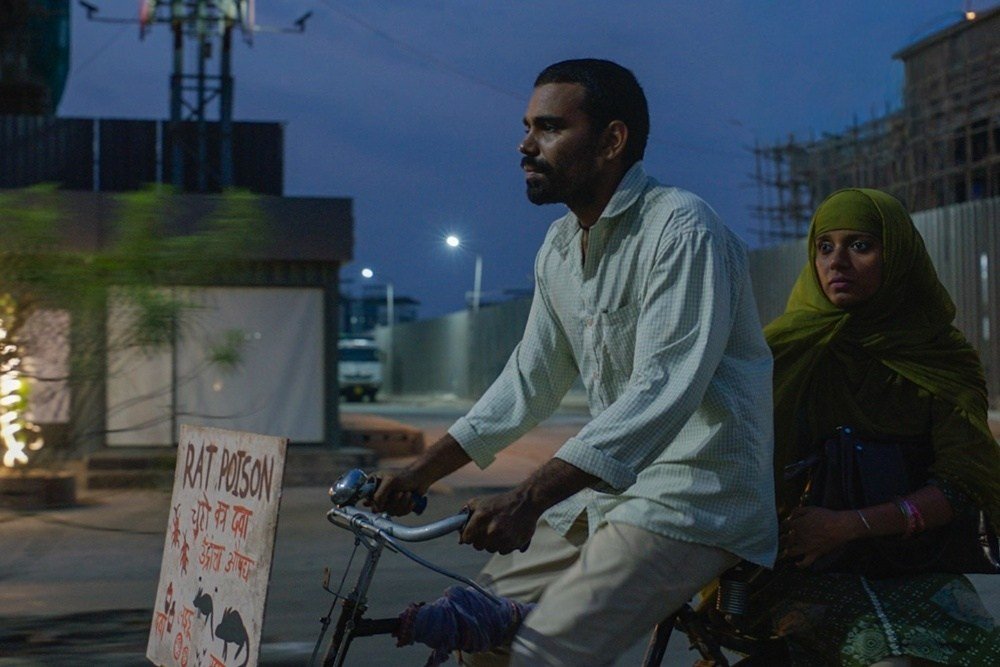
Ameena was a bonded laborer in Roy’s hometown, and something she once said about her marriage stayed with the director long after she grew up and moved away. That memory became the seed for “Lovers in the Blue Night,” which premieres in the Horizons competition at the Venice Film Festival a year after Roy’s debut feature, “Songs of Forgotten Trees,” made her the first Indian filmmaker to win the section’s best director prize.
International sales on the new film are being handled by Parallax.
Roy says “Songs of Forgotten Trees” was a personal story made under difficult funding conditions, built around two women who barely leave a single house. “Lovers in the Blue Night” widens that frame to four migrants moving through Mumbai; she also describes the production itself as far more professional this time, with deadlines and limitations she is still learning to work inside.
Asked whether she expected the new film to move into Venice’s main competition rather in Horizons, Roy says she dreamed of it rather than expected it, and that landing in the section again is no disappointment. She still considers herself a new director learning her craft alongside filmmakers she admires.
Ameena’s arc did not stay fixed to the facts that Roy remembered. She says her early instinct was rebellious, imagining the character finding real love and leaving her marriage behind. But that path stopped looking like simple freedom as the script developed. “That is also another loop — another loop of patriarchy,” Roy says, describing what looks from the outside like an escape into a happy ending.
That refusal to let escape read as simple freedom extends to how Roy treats her characters’ circumstances more broadly. She wanted the migrants’ hardship to shape them without defining them entirely, resisting the idea that displacement should crowd out their ordinary desires for intimacy, jealousy or tenderness. Karim, a closeted gay man married to Ameena, and his lover Sukka, a man trying to break free of caste, sit at the center of that approach. Roy says she wanted a neutral, empathetic language for both men rather than exaggerating poverty or turning their struggle into ideology.
Roy frames love itself as a form of resistance for characters, who are punished for wanting things. “When you are lonely or displaced, even a small gesture of intimacy can begin to feel enormous,” she says, describing what she calls the illusion of love: a space where affection, longing, isolation, need and fantasy start to blur together, so that people fall for the possibility of a person as much as the person themselves.
One choice stands out. Karim produces rat poison and kills rats in wealthy Mumbai housing societies, a job Roy based on someone she saw doing the same work in the city’s Andheri East suburb. She calls the image of him coming home from that job to kiss another man “no less than revolutionary,” and says placing the two things side by side felt deeply political to her.
Displacement links this film to Roy’s debut. Both stories draw on floods Roy experienced growing up in a coastal region near the Bangladesh border, close to the Bay of Bengal, and both send their characters into exile from a destroyed home. Where her first film explored two women, this one turns to two men and the duality of bisexuality.
Upcoming stories include “In the Shadow in the Light,” a romantic feature about a dysfunctional marriage modeled partly on her parents, and an untitled project about a woman’s sexual transit.
Bitcoin’s BTC$78,564.82 golden cross is live, confirming a widely-tracked bullish signal on the price chart. However, its record as a standalone indicator is mixed.
A golden cross occurs when an assets average price over 50 days, the so-called 50-day simple moving average, moves above its 200-day average. The crossover shows that short‑term momentum is finally overtaking the long‑term trend, setting the stage for a potential sustained rally.
This signal has previously triggered 12 times in bitcoin’s history, yielding a mixed long-term track record, as CoinDesk discussed in detail last week.
Only three out of the 12 historical crosses remained valid for a full year, generating a massive average return of 250% over those 12 months. Across the remaining nine measurable instances where three-month data was available, the signal produced a far more modest three-month average gain of 24.9%.
The latest golden cross, therefore, is far from a guarantee of long-term bullishness, as historical data shows the signal has triggered premature bull traps three times as often as it has sustained multi-year rallies.
As of this writing, bitcoin changed hands at $78,650, down 0.6% since midnight UTC, according to CoinDesk data.
Bitcoin’s golden cross history. (TradingView, CoinDesk)
South Korea-based cryptocurrency exchange Bithumb has listed CP, the native token of Cluster Protocol. According to the exchange’s announcement, CP trading began today at 09:30.
The listing is significant in terms of increasing accessibility for the CP token to investors in South Korea, as well as trading volume and liquidity. Bithumb users can now trade CP through the platform following the listing.
Upbit, one of South Korea’s leading cryptocurrency exchanges, has also started offering trading support for Cluster Protocol (CP). The exchange launched CP trading with KRW, $BTC, and $USDT trading pairs today at 08:30.
Upbit’s offering of three different trading pairs expands access to the CP token for different investor groups. The KRW pair allows direct trading via the South Korean won, while the $BTC and $USDT pairs facilitate access to the token for cryptocurrency investors.
The simultaneous listing of CP on Bithumb and Upbit is a noteworthy development in terms of the token’s visibility and liquidity in the South Korean market. CP’s trading volume and price performance will be closely monitored in the coming period.
The assertions come Friday despite Bartiromo’s Hollywood attorney Bryan Freedman insisting the veteran Wall Street anchor is still “an employee” of Fox and threatening legal action. Adding to the burgeoning media mess surrounding the so-called “Money Honey,” Donald Trump had thrown serious shade on Fox for taking good pal Bartiromo off the air.
That shade could set the stage for yet another showdown between Trump and his once favorite media buddies at the Murdoch-ruled Fox.
“I can’t believe Maria Bartiromo is no longer going to have her great show(s) on FoxNews/Business,” Trump, a frequent Bartiromo guest, posted Thursday night, about 12 hours after Fox announced “effective today” that the Mornings With Maria host was out. “Three different shows, always number one. Maria is a total professional, and a true warrior. Her fans, of which there are many, will not be happy. God bless you, Maria!”
Bartiromo hadn’t been on the air for almost a month, with Deadline confirming that Fox brass had enough of the MAGA-friendly Bartiromo after they learned she passed corporate-guidance missives to the White House in recent months. However, carving her own way at Fox Business and Fox News for more than a decade, those communications were just the latest minefield that Fox execs feared could blow up in everyone’s faces.
“Her indiscretion was just the latest in a series of self-inflicted wounds,” a cable news insider says of Bartiromo and her close ties with Trump. “This has been a concern for a while, Maria being too cozy with the White House. She crossed a line, and she’s suffered the consequences.”
Weary of addressing allegations of similar conduct over the years by Sean Hannity and other Fox hosts, or Bartiromo’s contract specifics, the source added: “She’s no longer with Fox. Take that for what it is.”
Deadline hears that while there may be “technical truth” to Freedman’s remarks today that Bartiromo still works at Fox because of contracts and other paperwork, she is not returning to her Fox Business or Fox News roles — full stop.
Long a passionate defender of POTUS and offering him a platform over the years, Bartiromo’s apparent sharing of internal edicts with Trump administration officials, first reported by Status, made her pink-slipping inevitable.
Digging a little deeper and a few years back, the seeds of Bartiromo’s downfall were evident if you connect the red string.
In April 2023, Fox agreed to pay $787 million to settle a lawsuit filed by Dominion Voting Systems, one of the technology firms singled out in Fox’s coverage of the 2020 election results. Citied in volumes of court filings and the high-stakes trial that had just begun when Fox settled, Bartiromo was one of the main hosts on Fox promoting the false claims of irregularities with the election Trump lost and Joe Biden won. At the time, the top-rated Tucker Carlson was pulled off the air at Fox in a move that resulted in a Freedman-handled legal dust-up between Carlson and the media company.
No word from ex-Apprentice host Trump if Bartiromo is in the running to be the new White House Press Secretary, but sharp-elbowed lawyer Freedman says his client actually isn’t looking for a new job because she still has her old one.
“For many years, Maria Bartiromo hosted three number one rated television shows on Fox channels,” Freedman said Friday, as my colleague Dade Hayes noted earlier. “She has been, without question, one of the hardest working journalists throughout her award winning career.”
The lawyer for the likes of Carlson and Megyn Kelly, as well as Don Lemon, then unsheathed the knife that may lead to a bloody affair down the line.
“The irresponsible reports that have been published stating that Maria Bartiromo was fired or is no longer an employee of Fox are absolutely and unequivocally false,” Freedman said. “Make no mistake, we have the receipts and witnesses and they will come out whether through the courthouse or otherwise. Those reporting her firing or the incredulous facts supporting that fiction have exhibited a complete and utter reckless disregard for the truth.”
When Deadline asked Fox for a response to Freedman’s statement about his client’s employment situation, the company said: “the release speaks for itself.” The White House did not respond to Deadline’s request for comment.
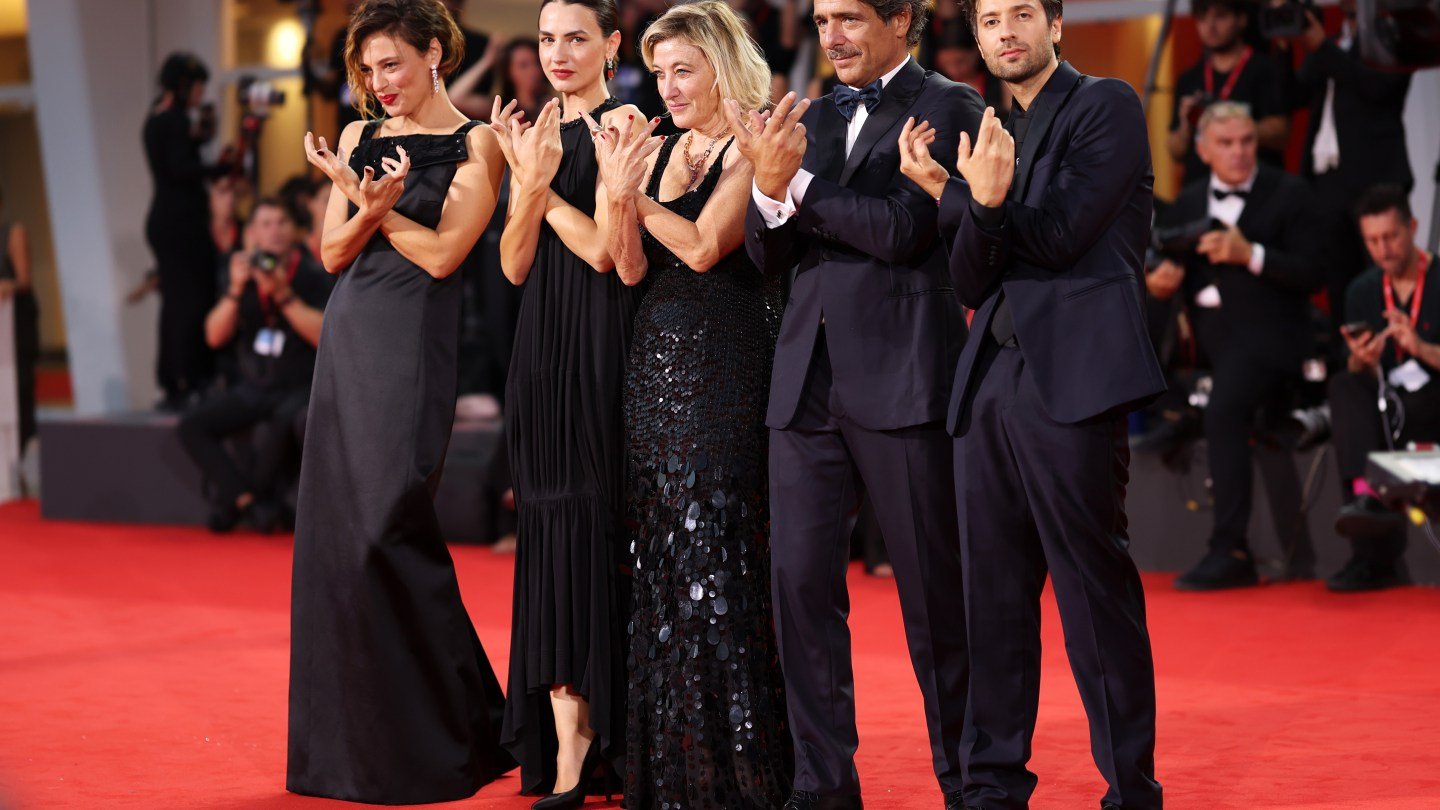
The hometown crowd went wild Monday night for the world premiere of The Spiral, a campy, fun Italian horror thriller from director Paolo Strippoli (The Holy Boy, A Classic Horror Story).
Jasmine Trinca (Saint Laurent, The Caiman) stars as Anna, a controlling mother who makes a deal with the devil, in the form of a trench coat-wearing, chain-smoking Valeria Bruni Tedeschi, to save her daughter Alice (Romana Maggiora Vergano) after a gruesome accident. But the agreement sets off a, you guessed it, spiral of macabre events that will end up tearing the family apart. Adriano Giannini plays Anna’s wealthy alpha-male businessman husband, Walter. Andrea Genovese plays their son Tobia.
The twisty genre film, which dips into Grand Guignol territory, with plenty of OTT performances — led by Tedeschi’s glorious turn — may be an outsider for the Golden Lion, but it definitely played for the Venice audience, which gave it a warm and enthusiastic standing ovation, with the director and cast coaxing the crowd to keep clapping past the 9-minute mark.
Whether that will be enough to convince the Venice jury, headed by The Bride! director Maggie Gyllenhaal, remains to be seen. But at a Venice where fun has been in short supply, The Sprial, came as a welcome palate cleanser.
The Spiral next heads to Toronto, where it’s screening in the popular Midnight Madness section. Le Pacte, which is handling international sales for the film, will be hopeful for its prospects. Given the film’s high-concept premise, remake rights could also be in play.
The film hits Italian theaters Oct. 8, released by 01 Distribution.
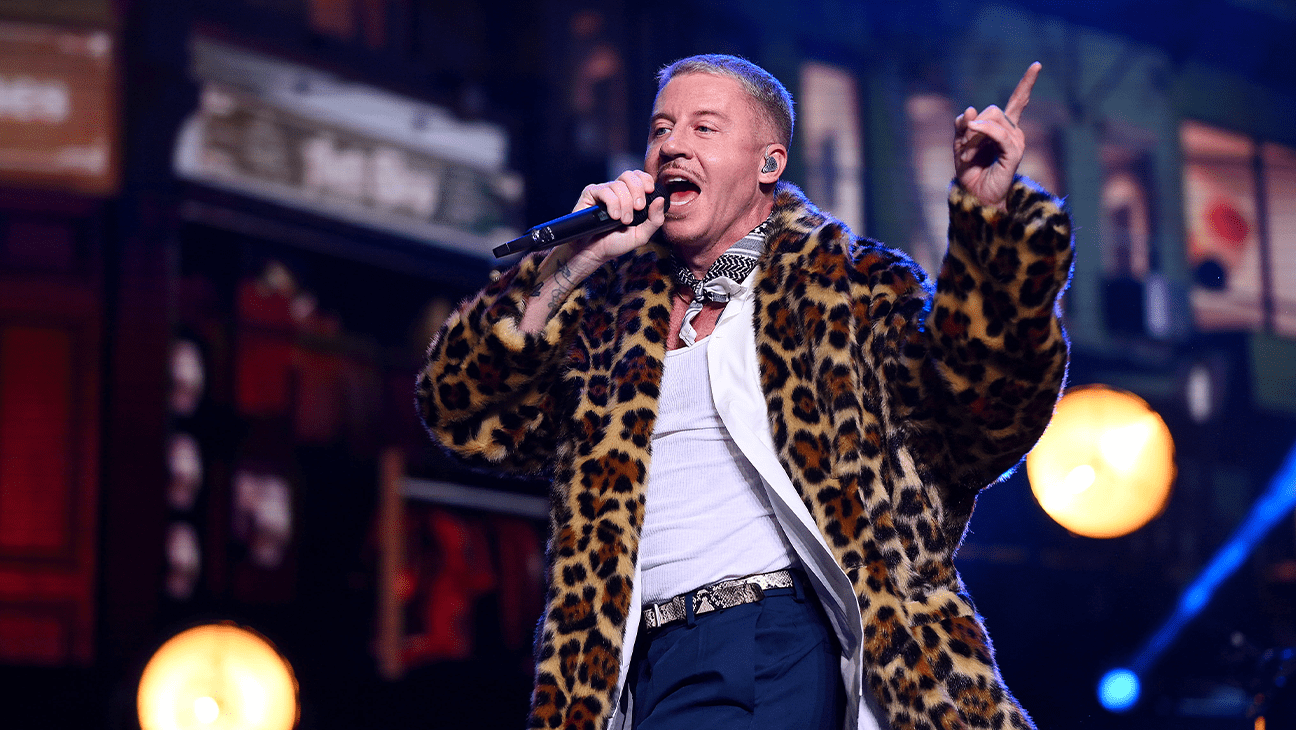
On Monday, the rapper wrote on social media, “Wanting all humans to be treated equal should never be controversial.” His post also included his speech from Saturday, the second night of back-to-back shows at New Jersey’s MetLife Stadium.
After stating “Free Palestine” again onstage Saturday night, Macklemore later clarified to the audience, “To all of my Jewish brothers and sisters: criticism of Israel, criticism of apartheid, being against genocide in no way is a criticism of you. My message is for peace; love for all human beings to be treated with dignity, respect, and equality.”
“So I say Free Palestine, I say Free Lebanon, I say Free Cuba, I say Free Congo, Free Sudan, I say Free all people in America living in fear of this terrorist organization, ICE. None of us will be free until we are all free,” he added.
This came a day after Macklemore’s opening set on Friday drew criticism for the rapper’s performance of his protest song “Hind’s Hall” and telling the audience, “A big part of the reason why I wanted to do this tour in the first place is so I could stand up in stadiums like this and say two words that are very near and dear to my heart: Free Palestine.”
The Israeli-American Council (IAC) launched a petition in response, calling for Macklemore’s removal for the remaining tour dates.
“This was an Ed Sheeran concert – not a political rally, not a protest, and not an activist event,” the petition read in part. “The issue is not whether Macklemore has the right to hold political views. The question is where the line should be drawn when an opening act uses a global concert platform to advance a one-sided political agenda.”
The Hollywood Reporter has reached out to Sheeran’s rep for comment, but did not hear back at the time of publication.
R3E Network has resolved all 11 findings from a systematic audit of neox-rs, the Rust-based Neo X full-node client, including four classified at P1 severity. Separately, R3E shipped a security-focused release for the Neo Decompiler, hardening its parsing, output sanitisation, and release pipeline.
Both releases reflect a security-first development approach across R3E’s Neo tooling, with neox-rs v2.5.2 targeting consensus and cryptographic correctness while the decompiler update addresses input handling and supply-chain integrity.
neox-rs v2.5.2: audit remediation
The v2.5.2 release closes all findings from a Sept. 5 audit review, with fixes spanning consensus, Anti-MEV transaction handling, and cryptographic operations. The client, built on Paradigm’s Reth framework, was first released in July as the first alternative full-node client for Neo X and reached its first stable release shortly after.
Among the P1-severity fixes, the dBFT ChangeView tally has been aligned with the nspcc-dbft v0.3.2 reference implementation. The previous tally logic contained a duplicate detection issue that could affect view-change progression. The fix introduces cumulative per-request tallying and restores the recovery path for future views with cumulative contribution rules.
A second P1 fix addresses Anti-MEV reconstruction pool admission. The pool now uses parent-state per-sender tracking for nonce and cost validation, matching the behavior of the Geth reference client. This ensures that enveloped transactions entering the reconstruction pool are validated against consistent state rather than potentially stale sender data.
The third P1 finding concerns PKCS#7 decryption handling. neox-rs now implements a Pkcs7Strict hardfork with an optional neoXPkcs7StrictBlock genesis field for versioned activation. The release introduces dual-mode decryption: strict mode enforces RFC 5652 compliance, while legacy mode preserves pre-fork replay compatibility. A corresponding Geth patch is included in the release with SHA-256 verification.
Validator safety and test coverage
Beyond the audit findings, the release introduces a durable validator signing-duty journal stored in neox-dbft-duties.jsonl. The journal is fsync-backed and restart-safe, providing equivocation protection by refusing to sign a different payload for the same duty after a restart. Torn crash recovery uses hash-shape validation to ensure journal integrity.
The release also adds reconstruction retry with exponential backoff and an offline envelope census scanner for historical PKCS#7 validation.
All 418 tests in the Neo X Rust suite pass with zero failures. Five cross-implementation test suites validate compatibility against Geth reference client vectors covering threshold encryption, decryption, padding, reshare, and ciphertext admission. The release maintains strict clippy compliance and nightly rustfmt formatting.
Binaries are available for Linux x86_64, Linux aarch64, and macOS Apple Silicon. The client supports Neo X MainNet (chain ID 47763) and T4 TestNet (chain ID 12227332).
Neo Decompiler v0.14.0
The Neo Decompiler, which converts NEF bytecode and manifest metadata into readable C# source, received a security-audited release across three separately versioned deliverables: the Rust crate at v0.14.0, the JavaScript package at v2.1.0, and the web package at v0.14.0.
Jimmy Liao, R3E Network founder, described the update:
“NEF + manifest -> readable C#. This update fixes Rust branch/loop analysis, preserves JS call order & side effects, and hardens parsing. 103/103 pinned devpack contracts compile with Roslyn.”
CALLT and method-token hardening
The release caps NEF method-token arity at the Neo VM stack limit of 2048, preventing oversize inputs from causing unexpected behavior. Unresolved method-token calls now receive deterministic index-derived labels, and same-named method tokens are resolved by token index rather than method name. Restricted or hostile token names are no longer used as executable identifiers in decompiled output.
Argument rendering for CALLT expressions has been corrected to preserve evaluation order and side effects. High-level and C# rendering paths no longer substitute placeholders for missing values.
Output sanitisation and pipeline hardening
All generated source and CLI output now escapes control characters, bidirectional formatting characters, and line separators. Schema input, diagnostics, and error counts are capped, and oversize files are rejected before buffer allocation.
The release pipeline itself has been hardened. GitHub Actions revisions are pinned, packaging and publishing jobs are separated with SHA-256 verification between stages, and npm archive creation uses fail-closed scripts. Ambiguous tar encodings and unsafe archive layouts are rejected during packaging.
Additional improvements include corrected immediate dominator computation for deep merge cases in SSA construction, aligned WebAssembly report shapes with the TypeScript API, and a new Criterion benchmark suite for deterministic performance tracking.
The release notes can be found at the links below: https://github.com/r3e-network/neox-rs/releases/tag/neox-v2.5.2 https://github.com/r3e-network/neo-decompiler/releases/tag/v0.14.0
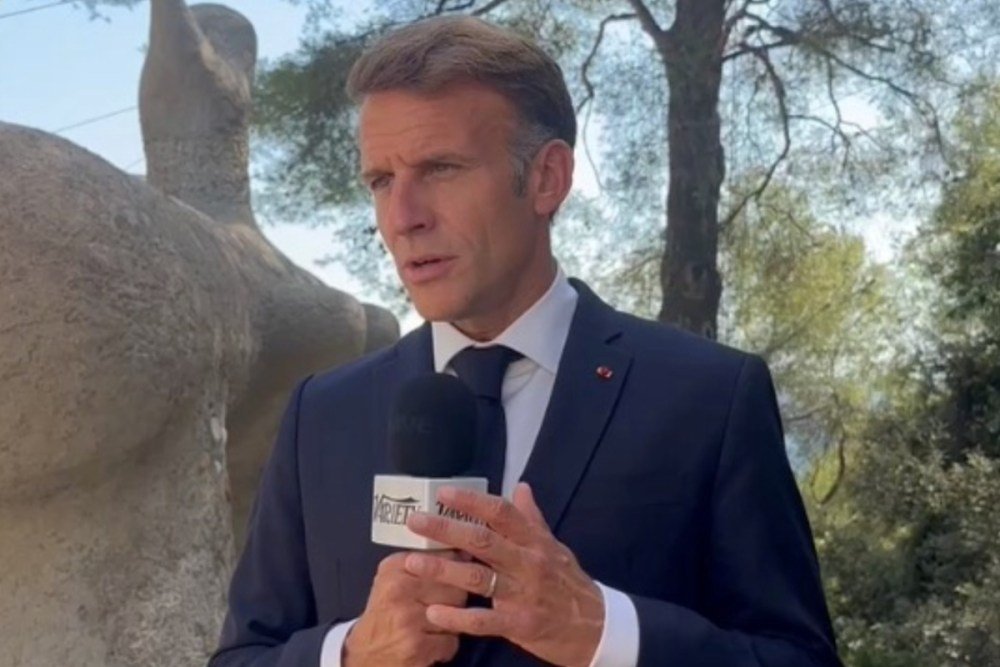
French President Emmanuel Macron said the Lumière Summit in Saint-Paul-de-Vence, which he co-chaired with South Korean President Lee Jae Myung on Monday, was deliberately held at a moment of dramatic upheaval for the entertainment business, from the growing dominance of YouTube and TikTok to AI and media consolidation.
Speaking to Variety at the event, he pointed to the growing power of YouTube, TikTok and other social platforms as one of the reasons the timing was right for the landmark gathering devoted to the future of cinema and the moving image.
“YouTube is very efficient. It’s de facto the default platform in a lot of countries for a lot of people. And it’s quite clear that today they divert a lot of people from these platforms or the big channels where a lot of money is invested in creation,” said Macron at the Fondation Maeght, a French art foundation showcasing works of art from Georges Braque to Joan Miró, nestled amid a luxuriant forest.
He argued that YouTube, which is currently outtalking Netflix in over 20 international markets, should increasingly be brought into the same ecosystem as other global platforms such as Netflix, Amazon and Disney, that have been required to invest in local production.
France and other countries need to “engage with them” in a multilateral way, he said, to try to change the platform’s approach so that it helps finance “local content,” while supporting “more creativity, more creations, more respect of the authors.”
Macron, who’s been a driving force behind the rise of French AI companies, including Mistral, as well as the creation of the EU’s AI Act and the international summit on AI that was held last year, also said France wanted to compete aggressively in AI by expanding computing capacity, data centers and European models. But he insisted that technological ambition must be accompanied by protections for intellectual property and much greater transparency.
Asked about his discussions about EU regulations with companies such as Google or OpenAI, Macron said that while France is eager to compete in the AI race, it’s also pushing for greater transparency and protections for creators in Europe.
“When you have content produced by AI, you just have to know it. So transparency for us is key,” he said. “We want to flag when the content is produced with AI. Because we think it’s fair.”
Without that, Macron warned, AI could “totally transform the relationship to truth,” feeding distrust not only in creative content but in science and democracy.
Macron also addressed the increasing consolidation of the entertainment business and his discussions surrounding the greenlighting of the Paramount-Warner Bros. deal by the EU regulators. He said he didn’t have an active role in lobbying for the merger, but admitted that he supported “the commitments made to invest more in Europe and to create more content and to provide guarantees and commitments vis-à-vis our theaters.” Paramount Skydance boss David Ellison traveled to Paris (as well as London and Germany) in January and met with Macron, among other high-level political and industry figures.
The French President described the merger case as fundamentally “a U.S. M&A story,” saying his priority was ensuring that a major company like Paramount Skydance maintained a strong footprint in France and Europe. While Ellison wasn’t present at the Lumiere Summit, Paramount Skydance’s Andy Gordon was there and sat at Macron’s table at lunch, alongside The Walt Disney Company’s Dana Walden, Netflix’s Ted Sarandos, NBCUniversal Entertainment’s Donna Langley, Mediawan’s Pierre-Antoine Capton and Sony’s Tom Rothman, among others.
“What is important to us is to make sure that you will still finance creation, that you will still work with us, that you will still make more movies in France and in Europe,” he said.
The Summit is also being held on the last stretch of his second mandate as he is due to leave office in May. With the far-right and far-left parties dominating polls ahead of the next presidential election, the French film and TV industry has shared deep concerns over the future of France’s prized cultural model that could come under threat.
Asked what would survive beyond 2027, Macron pointed first to France’s international tax credit for international movies and TV series, which was recently strengthened with the inclusion of above-the-line costs and has helped draw a growing number of major U.S. and international productions to the country.
“We improved tax credits, international tax credits. If somebody wants to withdraw this tax credit, it will just kill the industry and a lot of opportunities,” said Macron, who had told Variety in a cover interview in 2024 that he would fight for “Emily in Paris” Season 5 to remain in the French capital, prompting a comedic feud with the Rome mayor. Besides the sixth and final season of “Emily in Paris,” “The White Lotus” season 4 is also currently shooting in France.
He also pointed to the investment made during his presidency in studios and production infrastructure as part of his France 2030 plan, which he said has turned France into a leading international shooting destination.
“We want more of them to make new movies in our country. Why? Because it’s good for our ecosystem,” he said. “It will hire a lot of technicians and actors and so on. It will show our landscapes, and it will create jobs during the movie is made and it will attract a lot of people in our landscapes and our cities and so on.”
Yet, Macron suggested the bigger battle after his departure could be over the foundations of France’s cultural policy itself.
“Some extremes are fighting very hard against the CNC (National Film Board) and what we call this exception culturelle and the DNA of the French model,” Macron said. France’s system, developed over decades, uses levies on cinema admissions that are collected by the National Film Board and re-injected into local production, alongside other schemes supporting independent producers, filmmakers and theaters.
“We have to be ready to resist because this model has been created during decades by a lot of artists, by the state and the different governments and it’s extremely important,” he said.
Ultimately, Macron tied the defense of the French model not only to jobs and filmmaking but also to the country’s soft power.
“Culture and art is part of what France is, but it’s part as well of our soft power outside,” he said. “Recognizing that art is an exception which requires specific investment of the government, diversity of people, players, authors, protection of their rights and a specific effort in terms of multilateralism is crucial.”