Cryptocurrency payments company MoonPay is set to acquire private-markets investment platform North Capital to support its tokenization efforts, according to an emailed announcement Wednesday.
Salt Lake City, Utah-based North Capital, whose platform boasts around $9 billion in primary and secondary transaction volume, will become a wholly owned subsidiary of MoonPay after the transaction closes, subject to regulatory approval.
The all-stock deal is worth over $60 million, sources familiar with the matter told CoinDesk.
The acquisition will support MoonPay’s aim of “building the regulatory foundation to support mass adoption of tokenized real-world assets,” according to CEO and founder Ivan Soto-Wright.
“We believe bringing those capabilities into the MoonPay ecosystem can help connect different parts of the financial system through modern, programmable infrastructure,” Soto-Wright added.
North Capital provides the tech infrastructure for tokenizing securities for private securities issuers and fund managers, supporting capital raising, asset management, clearing, custody, and secondary trading.
North Capital’s affiliates hold relevant broker-dealer, trading, transfer and investment advisory registrations with the U.S. Securities and Exchange Commission (SEC).
MoonPay has expanded beyond its core business of crypto payments in recent months, establishing its Trade platform to connect banks and fintechs to tokenized assets, DeFi protocols and stablecoin liquidity.
Qatar’s foreign ministry spokesman Majed al-Ansari has told Al Jazeera his country is determined to make diplomacy work to end the US-Iran conflict. On Tuesday Qatar oversaw the first meeting between the US and Iran in months, on the sidelines of the UN General Assembly.
Think of it as paying a $100 premium to reserve the right to buy a $1,000 laptop anytime in the next four weeks. If the laptop’s price jumps to $1,200, you exercise your right and effectively save $200 (minus your $100 token). If the price stays at or below $1,000, you let the reservation lapse and lose only the $100.
Traders use call options to profit from an impending surge in the underlying asset, in this case, $BTC or $ETH. Put options do the opposite by protecting the buyer from a potential sell-off in the underlying asset.
The crypto options market has expanded multifold since 2020, with traders combining call and put options alongside spot and futures positions to express views on price direction, volatility, and time decay. That surge has turned quarterly options settlements into must-watch events for crypto traders.
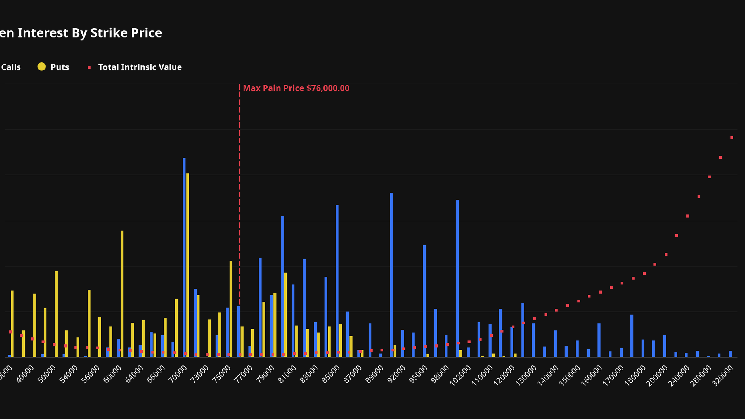
One thing traders widely track is max pain for expiries: the spot price level at which option buyers stand to lose the most on the day of expiry. The theory, though widely debated and challenged, is that options sellers seek to drive the spot price to the maximum pain point to inflict maximum pain on buyers.
The maximum pain for bitcoin is $75,000, well below the spot price of $85,500. Deribit described the level where option buyers collectively suffer the greatest losses as a “soft magnet for price into expiry.”
A video shared on social media in September 2026 by the conservative pundit Rob Smith featured an interview with a woman who claimed to live on the South side of Chicago and said that immigrants who entered the United States without authorization (“illegals”) were receiving $20,000 in benefits from the Democratic-led governments of Chicago and Illinois.
Snopes found that the interview was originally conducted by Brooke Shirley (the mother of the conservative social media personality Nick Shirley, who is herself a conservative social media personality) in August 2024, while the Democratic National Convention was happening in Chicago.
The woman interviewed in the video made several claims that closely resembled major Republican talking points at the time. Some of those claims referenced policies that have become outdated, while others were misleading or exaggerated. As a result, we have not rated the claim.
We contacted Smith for comment on the fact that his posts sharing the video never mentioned that the interview took place in 2024, and will update this story if we learn more. We also reached out to the Illinois Housing Development Authority to confirm that a program that provided up to 6 months or $15,000 in renter’s assistance for asylum seekers was no longer active; it said that program stopped processing applications in June 2024.
In September 2026, a video posted by the conservative pundit Rob Smith appearedonline claiming that Democrats were giving $20,000 in benefits to “illegals” in Chicago.
Snopes readers asked us to verify or disprove the claims made in the video, the latest in a long stretch of Republican-promoted rumors suggesting Democrats give large amounts of money or other benefits to immigrants living in the country without authorization. (Snopes fact-checked a version of that claim from the White House here).
Oftentimes, as is the case here, such claims are accompanied by the idea that these payments are the first step in a Democratic-led plot to permanently control the federal government.
The video presents its narrative without providing any additional evidence to support any of its claims, which are as follows:
Immigrants living in the country illegally receive $15,000 in food stamps from the government;
These immigrants receive $5,000 in cash from the government;
These immigrants receive free, government subsidized Wi-Fi;
The government covers these immigrants’ rent for two years;
Democrats give immigrants living in the country illegally these benefits as a sort of “bribe,” with the later goal of granting them the right to vote. The immigrants would then repay the favor by voting for Democrats in large numbers, effectively diluting the voting power of non-immigrant Americans and giving the party long-term control.
We have refrained from rating this article because of the complexity of the claims in the video. Our research indicated that the first two claims were unfounded at best, while the third and fourth are exaggerated, though the fourth might have been the source behind the $15,000 figure. (The fifth claim is also unfounded, since it depends on the other four being true.)
We also noted that much of the rhetoric resembled common claims made during the last two years of President Joe Biden’s administration, when Texas Gov. Greg Abbott made a show of busing migrants entering the U.S. to cities like Chicago. Much of the reporting around these issues also came from that time, leading us to suspect that the interview took place in the lead-up to the 2024 election, rather than in 2026.
We were able to confirm the theory using a reverse image search. The original video first appeared on the Instagram (archived) and TikTok accounts of conservative social media personality Brooke Shirley in late August 2024. Shirley, the mother of conservative social media personality Nick Shirley, originally posted the video in the days following the 2024 Democratic National Convention, which was held in Chicago. She has reposted the video at leasttwice since then.
As part of reporting this story, we contacted the Illinois Housing Development Authority, which ran a program that paid some rent costs for immigrants legally seeking asylum, though not to the extent suggested in the video. Our research suggested that program ended in late 2023. Snopes contacted IHDA to confirm that the program was no longer active. Andrew Field, an agency spokesperson, told us it processed its final applications in June 2024.
We also contacted Smith seeking clarification on the time discrepancy, since his September 2026 video never mentioned that the interview originally took place two years prior. We also asked whether Smith believed the policies described in the interview were active in 2026, but had not heard back.
Wealso attempted to confirm that the interview featured in the video, conducted with a woman who said she lived on Chicago’s south side, was real — if it was instead generated using AI tools, for instance, the person who generated it could make the woman say anything, and therefore the video would not be a reliable source of information. We were able to geolocate the interview’s location to Chicago’s Grant Park using the word “Roosevelt” on the building to the left. That fact, combined with the posting date of Brooke Shirley’s original video, strongly suggested that the video was not an AI fake or otherwise misleadingly edited.
SNAP eligibility is extended to some non-citizens, but there are strict requirements, which were made even more strict after the passage of the Trump administration’s much-touted “One Big Beautiful Bill” budget act in July 2025.
The principal requirement is that an immigrant must have a permanent residency card and have lived in the U.S. for at least five years, or be under the age of 18. Prior to July 2025, however, there were exceptions for refugees and individuals granted asylum. Even before these exceptions were eliminated, however, the claim would still have been untrue. SNAP benefits are calculated using the number of individuals in a household (in 2024, for instance, a family of four could receive a maximum of $973 each month, or just over $11,500 per year, with money subtracted based on an individual’s household income. Immigration status does not factor into the calculation at all.
Immigrants are not getting $5,000 in cash
This claim also spread significantly around the time the video was originally shared.. It, too, is not based on any evidence. Snopes disproved a claim that immigrants got roughly $3,800 in 2017, and many prominentfact-checkingorganizations have disproved the claim that immigrants are getting $5,000 in cash or gift cards.
Furthermore, although exposing and cutting alleged wasteful government spending has been a major policy platform of the second Trump administration, there was no evidence the administration has identified or targeted programs matching the claims in the video.
Chicago has a free WiFi program … for families of students
It’s worth noting that many libraries in America, including the Chicago Public Library, offer on-site free WiFi and computer access to all patrons, regardless of immigration status.
However, we found that the city does offer a free home internet program that immigrants can access. The program is eligible for families of students enrolled in Chicago Public Schools who receive free or reduced meals, and there are no eligibility requirements based on immigration status.
According to a city fact-sheet about the program, the internet access is valued at $10 per month — a drop in the bucket compared to the alleged $20,000 in benefits each immigrant allegedly receives.
Chicago did pay some immigrants’ rent … for up to 6 months, or $15,000
Snopes found that in the fall of 2022, months after Greg Abbott’s busing program began, the state of Illinois did implement a program through the Illinois Housing Development Authority to cover the housing costs for the influx of migrants seeking asylum entering Chicago. (It should be noted that migrants are legally entitled to claim asylum, and therefore the description of these individuals as “illegal immigrants” is suspect at best). The latest references to program online suggested that it expired in 2023. The IHDA confirmed that the program finished processing applications in June 2024 and is no longer operating.
However, contrary to the claim, this program did not cover rent for two years. Several outlets haveseparately investigated a similar claim about the government of Michigan, too.
Instead, it covered a security deposit and rent for three months, with an optional extension for another three months, making six months in total. Applicants could receive a maximum of $15,000, which we suspect may have been the source of the food stamps figure.
According to an IHDA document detailing the program’s accomplishments, it gave $3.7 million in grants to 681 families by the beginning of 2023, and another $1.4 million went toward additional three-month extensions. The authority claimed households received an average of $6,369, which is significant, but still below the fictitious $15,000 in food stamps described previously.
The program provided $53 million in rental assistance to 6,623 asylum seekers and families over the course of its lifespan, meaning that each successfully applicant received an average of just over $8,000.
One last note on this program: the IDHA’s program paid landlords directly wherever possible — the money for rental assistance offered through the program was not given to immigrants.
Conclusion
In sum, the claims were a combination of unfounded, outdated and exaggerated.
It is true that immigrants were eligible for some welfare programs in Chicago during the later years of Joe Biden’s presidency. However, the emergency housing program ended in 2024, while the additional restrictions on SNAP implemented by the Trump administration specifically bars refugees and asylum seekers — the individuals generally being incorrectly described as “illegal immigrants.”
Chicago Connected FAQ. https://www.cps.edu/strategic-initiatives/chicago-connected/chicago-connected-faq/. Accessed 18 Sept. 2026.
“Democratic National Convention, 2024.” Ballotpedia, https://ballotpedia.org/Democratic_National_Convention,_2024. Accessed 21 Sept. 2026.
Deng, Rae. “Democrats Didn’t Shut down Government to Fund Health Care for ‘illegal Aliens.’ Here’s Context.” Snopes, 3 Oct. 2025, https://www.snopes.com//fact-check/government-shutdown-health-care/.
Esposito, Joey. “Unpacking Claim Massachusetts Governor Gave $100M in Taxpayer Money to Noncitizens.” Snopes, 11 July 2026, https://www.snopes.com//news/2026/07/11/maura-healey-100-million-noncitizens/.
First Home Alliance Helping Asylum Seekers | First Home Alliance. https://firsthomealliance.org/first-home-alliance-helping-asylum-seekers/. Accessed 18 Sept. 2026.
Food Stamps or SNAP Benefits for Immigrants (FAQ). https://www.illinoislegalaid.org/legal-information/food-stamps-immigrants-or-snap-benefits. Accessed 18 Sept. 2026.
Gore, D’Angelo. “Unsupported Claim About Biden Paying Rent for ‘Illegal Immigrants.’” FactCheck.Org, 15 May 2024, https://www.factcheck.org/2024/05/unsupported-claim-about-biden-paying-rent-for-illegal-immigrants/.
Izzo, Jack. “Biden’s ‘Executive Order 9066’ Gives Migrants Who Illegally Enter US $5K Visa Gift Cards?” Snopes, 21 Feb. 2024, https://www.snopes.com//fact-check/biden-executive-order-9066/.
———. “Does California Provide ‘sex-Change Procedures’ to Immigrants without Legal Status? Claim Omits Key Context.” Snopes, 27 Apr. 2026, https://www.snopes.com//news/2026/04/27/california-sex-changes-immigrants/.
Kasprak, Alex. “Are 43 Percent of All Food Stamps ‘Given to Illegals’?” Snopes, 5 July 2018, https://www.snopes.com//fact-check/43-percent-food-stamps-illegal/.
MacGuill, Dan. “FACT CHECK: Do ‘Illegal’ Refugees Receive $3,874 Per Month from the Government?” Snopes, 15 Nov. 2017, https://www.snopes.com//fact-check/monthly-refugee-benefits/.
“Migrants Get up to Two Years Free Rent for New Apartments.” Newsweek, 10 Jan. 2024, https://www.newsweek.com/migrants-get-two-years-free-rent-new-apartments-1859556.
S, et al. “Texas Has Spent over $148 Million Busing Migrants to Other Parts of the Country.” NPR, 20 Feb. 2024. National. NPR, https://www.npr.org/2024/02/20/1232651088/texas-has-spent-over-148-million-busing-migrants-to-other-parts-of-the-country.
“Summary of Immigrant Eligibility Restrictions Under Current Law.” ASPE, 24 Feb. 2009, http://aspe.hhs.gov/reports/summary-immigrant-eligibility-restrictions-under-current-law.
Supplemental Nutrition Assistance Program (SNAP) Implementation of the One Big Beautiful Bill Act of 2025 – Alien SNAP Eligibility | Food and Nutrition Administration. https://www.fna.usda.gov/snap/obbb-alien-eligibility. Accessed 18 Sept. 2026.
Tribune (TNS), Lizzie Kane, Laura Rodríguez Presa-Chicago. “Migrants Are Leaving Chicago Shelters with the Help of Rental Assistance.” Greater Milwaukee Today, 23 July 2023, https://www.gmtoday.com/news/illinois/migrants-are-leaving-chicago-shelters-with-the-help-of-rental-assistance/article_359b89ac-27d7-11ee-b623-c3fdf74f4dfd.html.
Uribe, Maria Ramirez. Joe Biden Isn’t Paying Rent for Immigrants Illegally in US. 9 May 2024, https://politifact.com/factchecks/2024/may/09/maga-inc/no-the-biden-administration-isnt-paying-rent-for-i/.
———. U.S. Government Doesn’t Give Migrants $5,000 Gift Cards. 19 Dec. 2023, https://politifact.com/factchecks/2023/dec/19/mark-lamb/no-the-us-government-is-not-giving-people-who-cros/.
Valdez, Jonah. “Right-Wing YouTuber Behind Viral Minnesota Fraud Video Has Long Anti-Immigrant History.” The Intercept, 31 Dec. 2025, https://theintercept.com/2025/12/31/nick-shirley-videos-minnesota-somali-day-cares-fraud-claims/.
UPDATED: Coming right up against a deadline set by a federal judge, the Justice Department tonight defended Donald Trump‘s ban on CNN, Politico and MS NOW from the White House grounds. The response comes despite an outcry across media outlets that the restriction is a flagrant violation of the First Amendment.
Leaning onto a Wednesday hearing on a temporary restraining order, the administration argued for Trump and top White House aides in its opposition filing that the “President’s actions are lawful under the First Amendment.”
Adding to that, and sidestepping Trump’s previous quip that there was no particular reason for the ban the Department of Justice is now claiming that CNN, MS Now and Politico have “engaged in a number of reporting incidents that have threatened national security” over stories on the construction of Trump’s much criticized ballroom. Swiping at past rulings on White House access, the DOJ is also maintaining that “While the D.C. Circuit has held that some areas of the White House grounds constitute a nonpublic that decision is wrong and should be overruled.”
After Trump banned the three outlets on Friday, CNN, Politico and MS NOW jointly sued the president and top staffers, claiming violations of the First and Fifth amendments.
“This ban could not be a more direct assault on the First Amendment nor a more blatant violation of our most fundamental constitutional principles,” their lawsuit stated.
Late Tuesday, the DOJ laid out POTUS’ POV.
“The White House is the home and workplace for the Nation’s Commander-in-Chief,” the 19-page document from Assistant Attorney General Brett Shumate and others at the DOJ states. “Plaintiffs CNN, MSNOW, and Politico have long been granted privileged access to White House grounds. But the President concluded that they have failed to maintain basic minimum “standards of professionalism and decorum expected of those given access to the White House Complex, including” by ‘publishing sensitive or classified information.’”
The DOJ also claimed that the revocation of credentials was “preliminary” and that notices were sent to the networks on Tuesday. The letters, filed with the court and featuring no letterhead, gave them until Friday to contest the decision.
The letter to CNN stated, “No President has been as transparent to the public or as accessible to the press as President Trump. Nevertheless, your organization has exhibited behavior in violation of the standards of professionalism and decorum expected of those given access to the White House Complex, including by trafficking in verifiable falsehoods about national security and other issues, and publishing sensitive or classified information.” The letter to MS NOW cited, among other things, a report from a source that Trump had underestimated the “willingness of Iran to resume” the conflict. The letter to Politico pointed to a report on the funding of the ballroom and how the Secret Service would invest in security improvements.
Some of the stories cited had nothing to do with national security.
“In September 2026, Politico Playbook relied on unnamed sources to paint the Republican midterm convention in Dallas as a disaster. Media reporting showed that the convention had over 100 million live stream views,” the letter to the outlet stated.
Among the stories cited was a CNN piece on construction details of the White House ballroom, which the Trump team contended revealed “top secret” information. Other stories cited were reports on munition supplies in the war in Iran, and that the military had exhausted nearly 80% of its interceptors.
Snapping at UN credentialed CNN reporters while in NYC on Monday, Trump has found himself out of the usual spotlight.
Shortly after the filing on Monday, the five major TV networks that make up the White House TV pool said that they were suspending coverage in solidarity, leaving a void in video of Trump at the White House and other events. The pool is made up of CNN, NBC News, ABC News., CBS News and Fox News. Other outlets, like The New York Times, have protested the ban in other ways, like withholding their use of images from the White House.
U.S. District Judge Timothy Kelly has scheduled a hearing for Wednesday afternoon on the outlets’ motion for the TRO. Trump has already signaled that he expects the judge to rule in the networks’ favor and plans an appeal. Even though he appointed the judge in his first term, Kelly sided with then-CNN correspondent Jim Acosta after the network sued the Trump administration for revoking his hard pass in 2018.
The three outlets’ legal team, led by Theodore Boutrous Jr., bolstered their case earlier on Tuesday when they noted a new D.C. Circuit decision on access to the steps of the Capitol. The judges ruled that the eastern steps of the Capitol were a “nonpublic forum” but speech regulations had to be “viewpoint neutral.”
Trump has complained about the three outlets’ coverage of him, telling reporters, “There’s something wrong with a country that can allow people to write purposely negative stories.”
Boutrous’ team also filed one of Trump’s Truth Social posts in which he said that he “sadly” appointed Kelly to the federal bench. They also filed a report on Trump’s outburst at CNN’s Kaitlan Collins, when she was among the reporters at the United Nations, asking questions of the president on Tuesday. Surprised at her appearance there, as she was credentialed via the UN, Trump told her, “You shouldn’t be here.”
Shortly after the DOJ filing, the president against attacked Collins, as well as the judge.
He wrote on Truth Social at 11:53 p.m. ET, “All of the SLEAZEBAGS, like Third Rate ‘Reporter,’ Kaitlan Collins, of Fake News CNN, a truly unhappy person, said they weren’t going to be covering me. Then why were they ranting and raving like Lunatics, in the Press Area, at the United Nations? Why was she there? She’s got a ‘TRUMP’ addiction, and so does CNN and MSDNC. They’re all sick, treasonous, and demented! The ‘good news’ is that they have a great, for them, and totally disloyal Judge.”
905K Views · 15K Reactions | President Trump Tells Reporters That He Will Get Gas Prices down to below $2 a Gallon, but Only after the Midterms. | NBC News. www.facebook.com, https://www.facebook.com/reel/1590584736196205/. Accessed 21 Sept. 2026.
AAA Fuel Prices. https://gasprices.aaa.com/memorial-day-weekend-gas-prices-reach-four-year-highs/. Accessed 21 May 2026.
Daniller, Andrew, et al. “Americans’ Evaluations of the Economy Remain Negative.” Pew Research Center, 23 July 2026, https://www.pewresearch.org/politics/2026/07/23/americans-evaluations-of-the-economy-remain-negative/.
Peoples, Steve, et al. “Rising Gas Prices Frustrate Voters. Trump Says It’s an ‘Inexpensive Price to Pay’ for the Iran War.” Associated Press, 20 Sept. 2026, https://apnews.com/article/gas-prices-trump-midterms-affordability-iran-war-d2f5d5aa7ecc1f6d55d8f5759db03150.
“Trump Says Rising Gas Prices Are ‘A Very Small Price to Pay’ for the Iran War.” C-SPAN, 5 May 2026, https://www.c-span.org/clip/white-house-event/trump-says-rising-gas-prices-are-a-very-small-price-to-pay-for-the-iran-war/5199900.
WHAS11. “Trump Says High Gas Prices Are Small Price to Pay in Iran War.” YouTube, 19 Sept. 2026, https://www.youtube.com/watch?si=Sht7avONtoFxNddu&t=70&v=y67YN25DdA0&feature=youtu.be.
Jesse Eisenberg regaled a room of journalists with brilliant — but slightly tragic — tidbits from his childhood and career while discussing his latest feature, The Debut.
Julianne Moore, Paul Giamatti, Halle Bailey, Havana Rose Liu, Bernadette Peters, Colton Ryan, Lilli Cooper, Maulik Pancholy and Bonnie Milligan join Eisenberg in The Debut, following a shy woman (Moore) who is unexpectedly cast in a local production of an original musical. Under the spell of the strong-willed and enigmatic director (Giamatti), she loses herself in the role and the high-stakes world of this community theatre production.
The film is premiering at the San Sebastian Film Festival, where an extremely polite Eisenberg (“thank you so much,” he said after each question) appeared for a press conference on Wednesday.
The actor-writer-director, whose last film A Real Pain was nominated for multiple Oscars, said The Debut is partially autobiographical as it pulls on his own experience joining community theater. “The movie takes place in 1990 in central New Jersey, and when I was in central New Jersey in 1990, I was like [Moore’s character] Mona Friedman. I was so shy. I was depressed, and I didn’t have friends. And then I walked into this community theater when I was seven years old, and suddenly everybody was so nice, and they hugged me,” he said, prompting giggles from the room. “Going from a kid who was made fun of in school because I have the same hair as you, curly hair, and the kids were saying mean things to me. And then I walked into the community theater, and everybody said, ‘Wow, your hair is so amazing! Come this way, you should play with me!’”
Jesse Eisenberg is asked why he chose not to reprise his role as Mark Zuckerberg for Aaron Sorkin’s #TheSocialReckoning at the San Sebastian Film Festival:
“It just didn’t feel like something I wanted to act in again. But that’s nothing to do with how great the movie is… Jeremy… pic.twitter.com/frYHOls2BF
The experience was, to say the least, transformative. “Suddenly it was like I walked into an alien planet where everybody was nice, and then just like Julianne Moore’s character, I took it too far and became crazy. So really, the movie is charting my life when I was a child. But I just thought it would be so much better to make it about an older woman because Julianne’s amazing, and it’s more emotionally impactful to see a woman.”
Such is his admiration for Moore — who starred in Eisenberg’s first directorial feature, 2022’s When You Finish Saving the World — that she changed his long-held view of acting. “I used to have this negative opinion about acting because I was an actor and I just thought, ‘This is just such a ridiculous job. They pay us too much. We’re vain,’” said Eisenberg. “We want to look pretty in the morning, we want to stay in the nicest places, and we want to not ever lift anything on movie sets, and then we want all the credit for the movie! I was always like, ‘This is a weird job, and it’s not fair.’ And then on my first movie, I saw Julianne Moore rehearsing for a scene.”
He saw her on the monitor, preparing for an office scene. “She was going through a real, deep emotional process to get ready for the scene. I remember looking at it, and I go, ‘Oh, wait a second, that’s really hard.’ Like we’re all out here joking, and I’m having a donut, and she’s in there suffering. I realized, ‘Oh, maybe acting is actually a really valuable thing. Maybe difficult. Maybe it’s challenging. Maybe it takes a lot. And suddenly, in [one] moment, my entire opinion on acting changed because I saw somebody else doing it, and it wasn’t just about me.”
Moore and Giamatti, he said, are two of his favorite actors. “And the movie has this element of a romance, which was not in the script at all,” revealed Eisenberg about Giamatti’s onscreen magnetism. “His character is not supposed to be romantically charming. He’s more supposed to be scary and mysterious. But he just brought this warmth to it, and it plays great in the movie.”
Naturally, the filmmaker was also asked about his refusal to return to the role of Mark Zuckerberg in Aaron Sorkin’s hotly anticipated Social Network (2010) follow-up, The Social Reckoning, which will instead see Succession alum Jeremy Strong in the role. “It’s ironic because people associate me with this website, but they know way more about the website than I do, and I like to keep it that way,” replied Eisenberg about the Facebook founder.
“I’ve talked about it a lot, and Aaron Sorkin’s talked about it a lot. I loved his script, and he’s a genius,” continued the star. “And the movie, I’m sure, is incredible. But for me, it just didn’t feel like something I wanted to act in again. But that has nothing to do with how great the movie is. The movie will be a great movie, and Jeremy Strong will be amazing in the movie. I’m sure. I just didn’t feel like it’s something I wanted to do again.”
The 2026 San Sebastian International Film Festival runs Sept. 18-26.
Cineplex has put itself up for sale while unveiling former Landmark Cinemas head Bill Walker as its new CEO, replacing a retiring Ellis Jacob.
“As part of the strategic review, the board will consider a range of alternatives, including, but not limited to, a potential sale of the company. The board has engaged Goldman Sachs and TD Securities as co-financial advisors in connection with the strategic review,” Cineplex, the Canadian exhibition giant, said in a statement via its board of directors.
Cineplex operates around 1,606 movie screens at 156 locations across Canada, and is a major launchpad for Hollywood tentpoles and other films screening north of the border. Putting up a for sale sign gets Cineplex back to where it was the last time Jacob sought an exit from the exhibition giant in 2019.
At that point, U.K. exhibition giant Cineworld Group unveiled a deal to acquire Cineplex for $2.1 billion to create a company with more than 11,200 movie screens globally. But a year later, as the pandemic took hold on the exhibition industry, Cineworld abandoned the movie theater deal to create one of the world’s largest cinema companies.
Cineplex was subsequently awarded damages of $1.236 billion in lost synergies from the abandoned takeover deal, but was unable to collect those funds after Cineworld went through a Chapter 11 bankruptcy process in the U.S.
That left Jacob and his executive team at Cineplex having to manage their balance sheet and greatly disrupted business in Canada during the pandemic. The latest attempt to possibly sell Cineplex comes amid better times for the Canadian exhibitor as it rides a Hollywood box office rebound.
Jacob, a Canadian exhibition industry pioneer, in mid-2025 announced he will stay on at the movie theater chain until the end of 2016 to assist a transition to new leadership. That includes Walker being named as the new CEO. Walker previously served as CEO of Landmark Cinemas, Canada’s second-largest theatre exhibitor, which operates as part of Kinepolis Group NV, a publicly traded cinema company based in Belgium.
Walker helped seal Landmark’s sale to Kinepolis in 2017, while continuing to run the company under Kinepolis’ public ownership. Jacob will become a special advisor to the Cineplex board as it looked to strategic alternatives to maximize returns to shareholders.
“Bill brings a unique combination of industry expertise, operational leadership, transaction experience and strategic perspective. Given his deep understanding of the theatrical exhibition industry and proven leadership experience, the board is confident that Bill is exceptionally well positioned to lead Cineplex. At the same time, the board believes it is appropriate to conduct a comprehensive review of strategic alternatives available to the company,” Cineplex board chair Phyllis Yaffe said in a statement.
Cineplex added no timetable for its strategic review process has been set as the company added “there can be no assurance” that a transaction will follow as the company continues to operate as usual.
“Having spent much of my career in the exhibition industry, I have great respect for what the Cineplex team has built. I believe the company possesses an exceptional platform for growth, a powerful brand and meaningful opportunities to create value. I fully support the Board’s commitment to evaluating strategic alternatives and look forward to working closely with the board, management team and other stakeholders as the strategic review progresses,” Walker added in his own statement.
No surprise here: “Patient Zero,” the song Taylor Swift announced Tuesday, is not an orphan. The pop superstar followed news od the single a day later with a Wednesday morning reveal for a project that includes four new tracks —”The Life of a Showgirl: The Encore.”
On social media, Swift wrote, “About a year ago, you guys did a truly unfathomable thing. Something that completely blew my mind… You gave ‘The Life of a Showgirl’ the biggest first week for an album in history. I took a trip to Sweden to celebrate with Max and Shellback, my two collaborators on this album. Really we just wanted to reflect and take in how grateful we were for the moment we were in, but there was a studio there and we did what we do when we feel anything at all: We wrote more songs. I hope you love them, because they were born out of pure gratitude for your exuberance for and celebration of the album we made. ‘The Life of a Showgirl: The Encore’ including four new songs is out on Friday and available to pre-order and save now.”
Prior to “Showgirl,” she hadn’t worked with that dynamic duo since 2018’s “Reputation,” but apparently the reunion went so well, she couldn’t resist an extension.
For now, it puts to bed the previous widespread conjecture that Swift was certain to put out “Taylor Swift (Taylor’s Version)” this fall to celebrate the 20th anniversary of her debut album. But setting that aside for an all-new collection is a tradeoff most fans will be happy with. So, “Our Song (Middle Aged Version)” can wait. A
The 21st century has not been terribly kind to broadcast TV. The DVR, a spike in cable original programming and, most recently and seriously, the rise of streaming to become the primary way people consume TV, have battered the network model for the past couple of decades.
The stats don’t lie: Over the past year, broadcast networks have averaged only about 21 percent of all TV use in the United States, based on Nielsen’s Gauge measurement. The Oscars are moving to a streaming platform, and the Emmy Awards may follow. Late night shows are suffering deaths by a thousand cuts (or, in CBS‘ case, one big one).
Obviously, there’s a “but” coming, and here it is: Despite the structural forces weighing on the network business, there’s also a good deal of optimism among those who work there. Network shows don’t draw the on-air ratings they once did, but they make up a lot of the difference when they hit streaming platforms. The media giants that own both networks and streaming services seem to have figured out that the two platforms can support one another. And among the people who actually make the shows, there’s a growing sense that the network model of producing shows on a set schedule is a good way to do business.
UTA partner and TV literary agent Mickey Berman, who represents several writers and showrunners, puts things pretty succinctly: “When you look at the combined package, the shows are working and people are watching them.”
Part of the appeal of network TV, both for audiences and creatives, is its consistency: The expectation is that they’ll be on the air every year, usually with 12 to 22 episodes per season. The early years of the streaming boom promised a reprieve from the admittedly grueling schedule of a full network season — but as that model has moved from still fairly regular (if shorter) seasons to eight or 10 episodes every couple of years, the network model has come back into vogue (see also: The Pitt and HBO Max’s recently ordered How to Survive Without Me and FX and Hulu’s The Bear, among other streaming series that have approximated the network model).
“I think for a while, people were a bit seduced by streaming and enjoyed some of the creative freedom and other things about it,” Lisa Katz, president scripted content for NBC and Peacock, tells The Hollywood Reporter. “But over time, broadcast shows have continued to show they’re consistent, and I think that they continue to be high in quality and bring in fans. There’s something about it — maybe the new thing felt great, but NBC is celebrating its 100th anniversary, and there’s a reason it’s had the staying power and the legacy that it has.”
Berman also notes the “tremendous amount of stability” in working on a network series. For writers, actors, directors and other crew members, “They know that if a show works, they’re going to be shooting or writing for a certain period of time with more episodes and hopefully more seasons.”
Michelle and Robert King, the creators and showrunners of The Good Wife, The Good Fight and CBS’ freshman drama Cupertino (among other shows), have moved back and forth between broadcast and streaming. The network business has its pluses, they say.
“Selfishly, one thing about doing broadcast shows is they don’t get lost,” Michelle King says. “There are a few streaming shows that one hears about, but there are so very many that seem to just get lost that no one has heard of. Broadcast shows tend to get marketed. People have heard of them, and people get to see them. We’re super proud of Cupertino, so we’re thrilled that people are going to get to see it.”
Robert King adds that he’s found — somewhat counterintuitively — that they have more control over a network show than they might on a streaming series.
“You don’t have a lot of non-writing producers looking over your shoulder because of the speed with which everything needs to be done,” he says. “I mean, they talk about streaming doesn’t know how to do 20 episodes a year anymore. Writers do. It’s just the non-writing producers want to [sweat] everything. … I like doing 20 episodes because you can be intuitive in the writing and the stories you tell.”
Amy Reisenbach, the president of CBS Entertainment who greenlit Cupertino, says she has fielded calls from creators and showrunners looking to return to a broadcaster after making streaming shows.
“There is nothing like waking up the next day, from a writer’s perspective and executive’s perspective, in my mind, to getting the ratings and getting a [glimpse] into what you did last night,” she says. “And when you’re waking up to 8 million-ish viewers for Tracker and Marshals the next day … I don’t think you can underestimate the power in that and knowing how many people tuned in for your show the night before.”
The stability of network TV extends to the number of scripted series at the networks as well: 56 shows are due to air on the big four broadcasters in the 2026-27 season, up from 50 (plus one limited series, Fox‘s The Faithful) last season. ABC, CBS, Fox and NBC combined canceled only six scripted series (ABC kept all 10 of its shows), while adding a dozen to their rosters.
“There’s been a renewed interest from the talent base in broadcast because of the stability, because of the quicker turnaround, because of the opportunity for more episodes and more seasons, and that’s not just financial,” Berman says. “It’s also about building a relationship with the audience, where they fall in love with characters and can see them on a schedule that they expect. Grey’s Anatomy has been on the air for so long. People love those characters. But even [for shows that haven’t been on for as long], people want to grow with those characters.”
NBC’s Katz also led the charge for a mini-revival of pilot season in the spring, making eight of them and picking up four (dramas Line of Fire and The Rockford Files and comedies Newlyweds and Sunset P.I.). Networks continue to develop shows year-round and using various methods to develop shows, from smaller pre-pickup writers rooms to straight-to-series orders. But the pilot process has a lot of upside, from Katz’s perspective.
“It benefits the show and gives us the opportunity to launch it in the most successful way possible, and to make some adjustments, whether it be in casting or a storyline, when we still have time to do it,” she says. “That’s one of the things I’ve loved about broadcast that’s really challenging in streaming. In streaming, the way that we’re doing it, you have maybe three weeks left of shooting when you’re seeing the first cut. It’s very hard to make adjustments.”
One other key factor fueling the optimism around network shows is that in the past few years, media giants have recognized that broadcast and streaming can be complementary rather than mutually exclusive. That network shows bring in sizable audiences when they reach streaming is hardly new information, but better Nielsen measurement of streaming — and the public release of more data — has helped bring the point home.
For the 2025-26 season, about half of the top 25 shows in cross-platform ratings originated on broadcast networks. Nine network series (not including sports and news programs) averaged 10 million or more cross-platform viewers, and four others came in just below that threshold. With ABC, CBS and NBC’s parent companies each owning a big streaming service (Hulu/Disney+, Paramount+ and Peacock, respectively), the broadcast-streaming symbiosis is good for both aspects of the business. (Fox has a next-day streaming deal with Hulu for its shows, and some are also available on its own platforms, free streamer Tubi and the year-old Fox One subscription platform.)
“We have always considered Paramount+ and CBS parts of a larger ecosystem that includes Pluto as well,” Reisenbach says. “We have a great partnership with Cindy [Holland] and Jane [Wiseman]. They’re obviously working on their shows, which are very different than our shows, but we’re conscious of wanting to be complementary. I’m so appreciative of how grateful they have been for the next-day programming from CBS. They totally get what we do and the kind of shows that we make, and they have created this lane for us.”
The network-streaming relationship and the uptick in series orders has Berman feeling good about the next couple of years for his clients, and for network TV.
“I think in the next couple years, there’s going to be tremendous opportunity to capitalize on that [momentum], and hopefully new models come from that about how our clients participate,” Berman says. “I’m really optimistic. I feel like the worst is definitely behind us, and I’m glad we have a four-year [labor] deal so that we can really build some momentum toward the future.”