
According to on-chain data, Shiba Inu experienced one of its biggest exchange outflow events recently, with a net exchange flow of about -281 billion $SHIB over the previous day. As $SHIB continues to struggle with a persistent bearish trend and waning market sentiment, traders have taken notice of the movement. When more tokens depart from exchanges than enter them, there is a negative exchange netflow.
Theoretically, this is frequently seen as a positive signal since assets moved off exchanges are typically harder to sell right away. To lessen short-term selling pressure, investors regularly transfer tokens into private wallets for long-term holding, staking, or self-custody. Context, however, matters. The price of $SHIB has been declining despite the substantial withdrawal. The token is still well below all major moving averages after breaking out of a minor consolidation pattern recently.
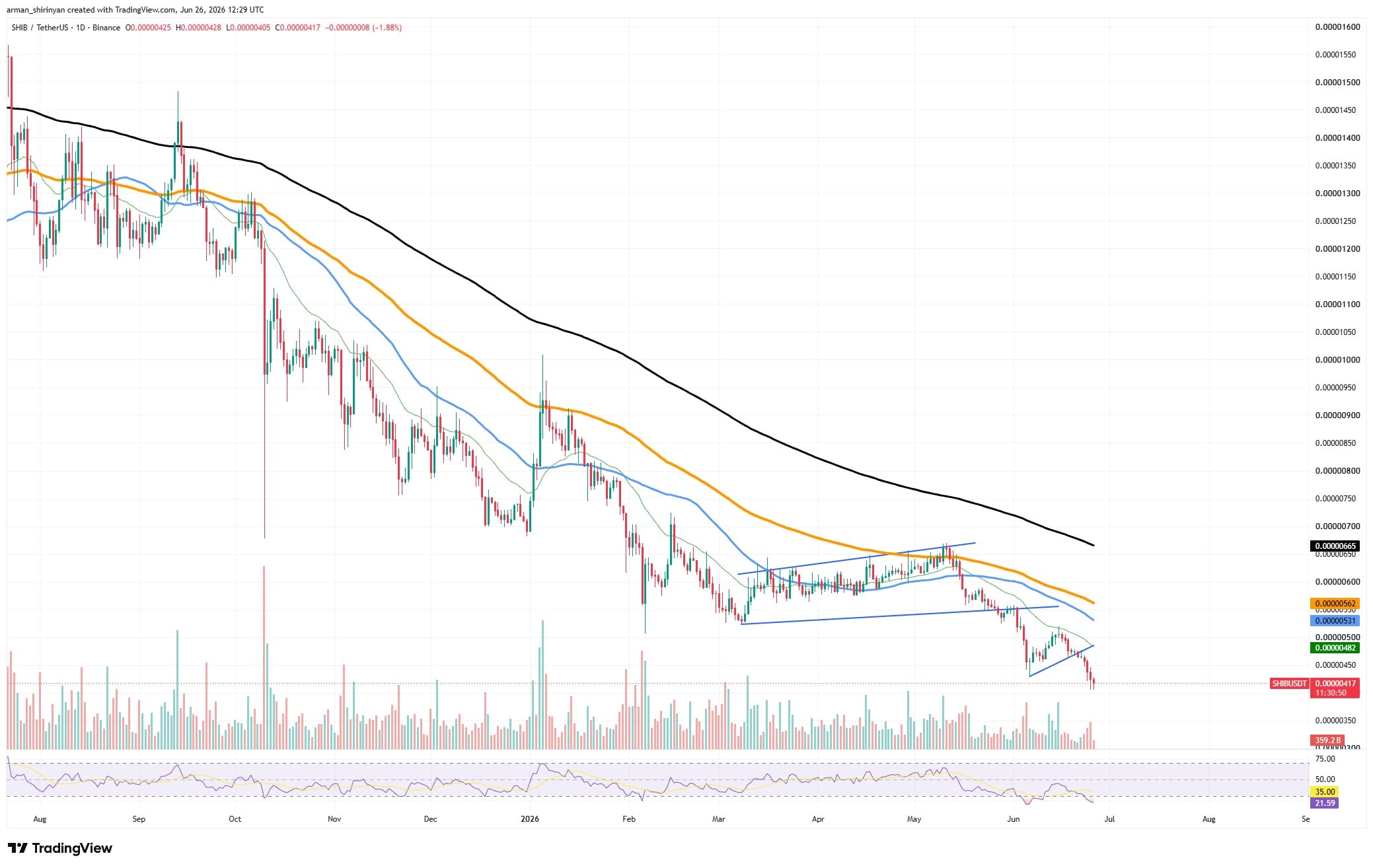
A sequence of lower highs and lower lows is still visible in the larger technical structure, suggesting that sellers are still in charge of the market. The gap between price action and exchange flows indicates that the outflow is insufficient on its own to buck the current trend. Although fewer tokens on exchanges may eventually improve supply dynamics, market players seem to be more concerned with weak momentum and dwindling speculative interest at the moment. It is interesting to note that other on-chain metrics present a somewhat contradictory picture.
Netflows decline
Over the previous 24 hours, there have been slight increases in the number of transactions, active addresses, and active sending addresses. This shows that despite the price decline, network activity has not entirely vanished. Rising network usage during a protracted decline can frequently indicate that an asset is about to enter an accumulation phase, though verifying this requires consistent improvement over a longer time frame.
The market still has access to a sizable amount of potential liquidity because exchange reserves are still high at more than 80 trillion $SHIB. Even if a single day’s outflows are measured in hundreds of billions of tokens, the overall supply landscape is not significantly changed. The most important lesson for investors is that the -281 billion $SHIB netflow should not be viewed in a vacuum.
Although the metric is somewhat bullish in terms of supply, it is currently overshadowed by weak market structure and bearish price action. Exchange outflows by themselves are unlikely to signal an asset’s final bottom until $SHIB can recover significant resistance levels and establish a higher-low pattern.
Leave a Reply