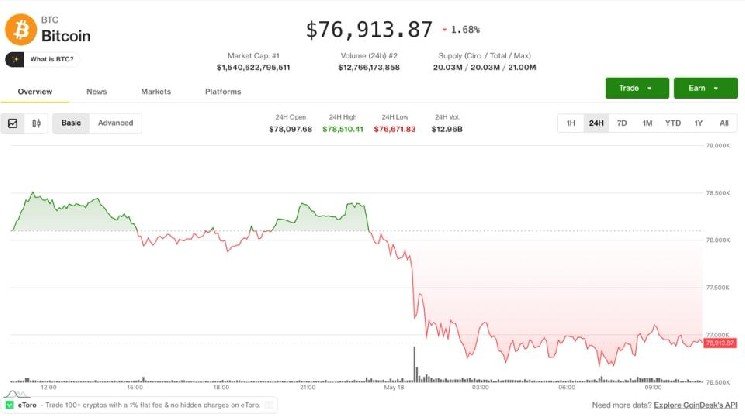
Bitcoin succumbed to selling pressure during the open of CME futures at 23:00 UTC on Sunday, falling by around 2.4% to $76,500, the lowest since April 30.
The selloff was triggered by comments from U.S. President Donald Trump, who said on social media that the “clock is ticking” for Iran, warning that “they better get moving, fast, or there won’t be anything left of them.”
Brent crude oil briefly topped $112 per barrel following his comments, while risk assets moved lower.
Ether (ETH) fell by around 3.5% following Sunday’s open, and was recently trading near $2,116, having erased April’s rally following a wave of liquidations.
U.S. equities ticked lower, too. S&P 500 index futures and Nasdaq 100 index futures fell 0.3% and 0.25%, respectively.
Derivatives positioning
- Market-wide futures notional volume surged 65% to $159 billion in 24 hours as selling pressure took hold. Open interest (OI) slipped 1.48% to $125 billion and liquidations spiked 500% to $677 million. Together, the three signal forced deleveraging rather than fresh directional positioning.
- open interest jumped 13% to 1.47 million coins, the most since April 6, even as annualized perpetual funding rates plunged to minus 72%, the most negative among major cryptocurrencies. The 24-hour cumulative volume delta also ranked most negative, reflecting aggressive selling at market prices. The combination of rising OI, deeply negative funding and negative CVD points to a heavily crowded short trade that could snap back violently if sentiment shifts.
- Zcash ($ZEC) tells the opposite story. OI rose for a third straight day, topping 2 million tokens and 24-hour CVD is the most positive among majors, driven by aggressive buying at market prices rather than passive limit orders. At 4%, the annualized funding rate remains well below overheated territory. The token is up 111% this quarter despite a recent pullback. The positioning structure suggests bulls remain in control, and further upside is possible if the broader market stabilizes.
- Other notable OI gainers include $HYPE, CRO, and $TON, while bitcoin and ether OIs held largely steady over 24 hours.
- Excluding $ZEC, $TON, and $HYPE, all other top 25 tokens posted negative 24-hour CVDs, confirming that the broader market decline is being driven by aggressive selling rather than passive distribution.
- Bitcoin’s 30-day implied volatility index, BVIV, has edged up to 42% from 40% since May 9, maintaining its inverse relationship with spot price. The MOVE index, which tracks volatility in U.S. Treasury notes and serves as a barometer for global financial stress, jumped 14% on Friday, the largest single-day rise since March 26. A further spike in Treasury market volatility could push BVIV meaningfully higher, signaling rising fear and uncertainty in crypto.
- On Deribit, large block trades showed a clear bias toward BTC straddles, bets on a sharp move in either direction, regardless of which way prices go. This suggests some traders view current implied volatility as cheap and are positioning for a potential volatility breakout. The 24-hour volume ranking across calls and puts otherwise presents a mixed directional picture.
Token talk
- Altcoins underperformed bitcoin and crypto majors on Monday, with tokens including and losing 10% and 4.5% since midnight UTC.
- Dogecoin’s poor performance led the CoinDesk Memecoin Select Index (CDMEME), which fell 2.2%, making it the worst-performing CoinDesk benchmark.
- The DeFi Select Index (DFX) lost around 1.1% while the bitcoin-dominant CoinDesk 20 (CD20) shed around 0.6%.
- A handful of altcoins performed well on Monday despite broader market pressure: Thorchain (RUNE) rose by 3.8% as it began to recover from last week’s exploit, while layer-1 blockchain token KAIA continued its rich vein of form, rising by 1.6% since midnight and 3.5% over the past 24 hours while daily trading volume almost tripled to $53 million.
Leave a Reply