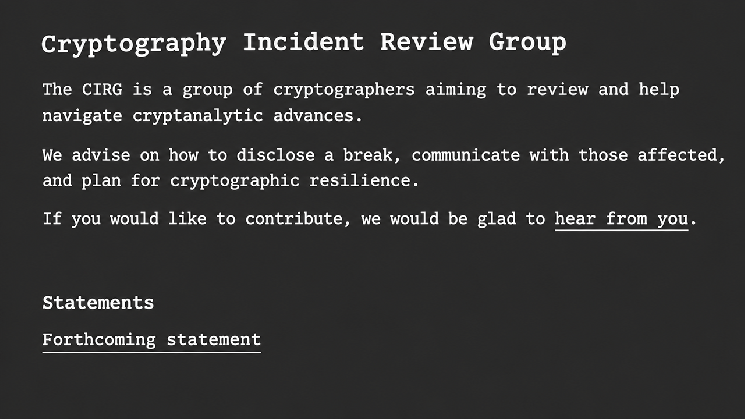
Anthropic cryptography engineer Steve Weis publicly introduced the initiative on X, attracting attention from researchers and technology executives. The organization has indicated that a statement is forthcoming, although it has not identified a specific cryptographic incident or announced a confirmed vulnerability.
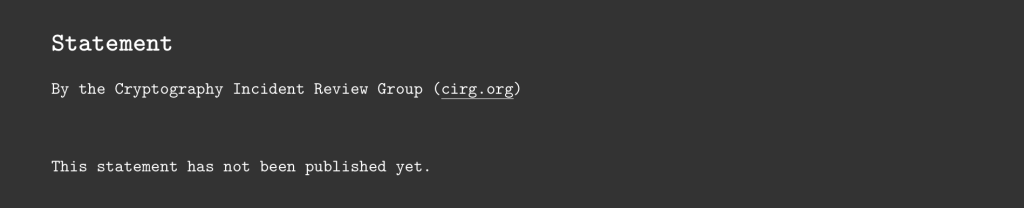
The timing, however, has attracted considerable scrutiny. Joi Ito, former director of the MIT Media Lab, urged his 138,000 followers on X to pay close attention to the group’s forthcoming statement. “Keep an eye on the new Cryptography Incident Review Group, a group of well-known cryptographers, for a statement on recent crypto advances,” Ito wrote.
What Has Scott Aaronson Revealed About AI Cryptanalysis?
Much of the speculation stems from comments published by Scott Aaronson, a theoretical computer scientist at the University of Texas at Austin, who has discussed potentially significant unpublished research from frontier AI laboratories on his Shtetl-Optimized blog. Bitcoin.com News reported on Aaronson’s statements amid speculation that RSA (Rivest–Shamir–Adleman), an asymmetric public-key cryptosystem widely employed to secure data transmission, had been cracked.
To date, no such cryptographic breakthrough against RSA has been independently verified. Still, Aaronson said in his editorial that he was “virtually certain, from multiple reliable sources, that the AI labs are now sitting on one or more bombshells” involving cryptography-related algorithms. However, the computer scientist expressed considerably less confidence about the precise nature of those discoveries.
Among the more consequential rumors is that researchers at OpenAI or Anthropic might possess an algorithm capable of factoring large integers in polynomial time, a discovery that could undermine the mathematical foundation of RSA encryption. Aaronson’s blog post subsequently clarified that the information he considered reliable fell well short of establishing such a breakthrough.
Nevertheless, speculation has proliferated across social media, with increasingly dramatic interpretations extending to Bitcoin’s digital signatures and the possibility of AI solving one of computer science’s greatest mysteries. The speculation comes against a backdrop of extraordinary mathematical developments. Both Anthropic and OpenAI have announced claimed proofs establishing VP ≠ VNP, an algebraic analogue of the famous P versus NP problem.
Other advances concern matrix multiplication and Fourier-transform complexity. None of these developments, however, establishes that modern cryptography has been compromised. Green, a CIRG member, previously estimated a roughly 15% probability of effectively losing confidence in existing public-key algorithms. He assigned a considerably smaller 1% probability to a theoretical environment known as “Minicrypt,” in which public-key encryption is impossible.
Coinbase Addresses Concerns Over Bitcoin’s Cryptographic Security
On Saturday, Nov. 28, cryptocurrency exchange Coinbase published a statement addressing the speculation and reassuring customers about the security of their digital assets. The centralized crypto exchange acknowledged recent AI-assisted improvements to integer factoring but distinguished those developments from attacks against elliptic-curve cryptography, which provides the mathematical foundation for transaction signatures across major blockchain networks.
The Coinbase blog post published this weekend states:
“Despite all the rumors over the last week, we have deep connectivity across AI and cryptography and we do not currently believe that there is an AI breakthrough that poses an immediate and practical threat to the cryptography that modern systems rely on today”
RSA relies on the difficulty of factoring large composite integers into their constituent prime numbers. Bitcoin and Ethereum, by contrast, rely on the difficulty of solving the elliptic-curve discrete logarithm problem for their conventional transaction signatures. Consequently, a breakthrough against RSA would not automatically invalidate Bitcoin’s signature schemes.
Although both systems rely on mathematical problems believed to be computationally difficult, the underlying problems are distinct. Coinbase’s cryptography team, led by Yehuda Lindell, continues to assess emerging research while preparing for post-quantum cryptography (PQC). Such preparations are designed to facilitate the replacement of vulnerable cryptographic algorithms without requiring an entire technological infrastructure to be rebuilt from scratch.
A sufficiently powerful quantum computer presents a separate threat because Shor’s algorithm can theoretically solve both integer factoring and discrete logarithm problems efficiently.
What Would Happen to Bitcoin if P Equals NP?
At the heart of much of the discussion lies P versus NP, a mathematical problem formally introduced in 1971 that carries a $1 million prize from the Clay Mathematics Institute. The question is deceptively simple: If a computer can quickly verify that an answer is correct, can it also quickly discover that answer?
Consider a difficult Sudoku puzzle. Finding the solution might take hours, yet verifying that a completed puzzle satisfies every rule takes considerably less time. Computer scientists want to know whether that disparity necessarily exists for certain computational problems.
The traveling salesman problem provides another illustration. Assuming symmetric travel distances, a salesman visiting 10 cities has 181,440 distinct possible routes to consider. Increase that number to 20 cities, and the possibilities balloon to approximately 60.82 quadrillion. If today’s mathematicians discover a polynomial-time algorithm for an NP-complete problem, they would establish that P equals NP, demonstrating that an entire class of computational problems possesses efficient solutions in the formal mathematical sense.
The ramifications could extend far beyond cryptocurrency. Pharmaceutical research, industrial manufacturing, logistics, mathematical proof discovery, and artificial intelligence (AI) could benefit enormously from sufficiently practical algorithms. For cryptography, however, the consequences could be considerably less welcoming.
Bitcoin relies on the mathematical asymmetry between generating valid digital signatures and deriving the private keys necessary to produce them. The network also employs SHA-256 hashing, which makes verifying proof-of-work straightforward while making its production computationally expensive. A sufficiently practical P = NP breakthrough could threaten these foundations, as well as conventional banking infrastructure, encrypted communications, and even cryptographic systems developed to withstand quantum computing.
Yet polynomial time does not necessarily translate into practical speed. An algorithm requiring a number of computational steps proportional to the input size raised to the 100th power technically qualifies as polynomial time, despite potentially being useless on contemporary hardware. Conversely, proving P ≠ NP would establish that certain efficiently verifiable problems cannot be solved in polynomial time. It would not, however, independently establish the security of Bitcoin’s particular cryptographic algorithms.
Bitcoin Proponents Push Back
Cryptography expert and Blockstream CEO Adam Back weighed in with P!=NP or galactic parameters, punctuating his assessment with a shrug emoji. He added that “almost certainly P!=NP, but neither outcome is likely to impact SHA-256, nor Elliptic Curve. and EC has a ready replacement, Lamport-Signatures (aka SHRINCS in Bitcoin context). And there are bigger, newer hashes. So give it up, fellas. The cryptography sky is not falling,” Back remarked on X.
Jan3 founder and CEO Samson Mow explained that even if P = NP were proven, Bitcoin could remain secure, as researchers would still need to devise a computationally efficient algorithm capable of solving the difficult problems underpinning its cryptographic primitives, such as ECDSA and SHA-256, at practical scales.
Mow’s X post argued:
“Just knowing that such an algorithm exists is not enough. Even if algorithms that work in polynomial time on the cryptography Bitcoin uses were somehow found, there are still ways Bitcoin can continue on, though it would look radically different.”
Cryptography Community Awaits CIRG’s Forthcoming Statement
As of Sunday, Nov. 29, no practical break of a major blockchain’s signature scheme has been publicly demonstrated. Neither has a definitive solution to P versus NP been announced. The formation of CIRG nevertheless reflects a growing recognition that AI-assisted mathematical research may advance faster than institutions can evaluate discoveries, coordinate disclosures and implement technological replacements.
For now, the most tangible development is the emergence of an organization dedicated to navigating precisely these circumstances. Its forthcoming statement could provide greater clarity about what researchers are confronting and whether the cryptographic community faces an immediate challenge or a longer-term preparation exercise. The distinction between mathematical possibility and computational practicality remains the dividing line between today’s speculation and tomorrow’s security reality.
Leave a Reply