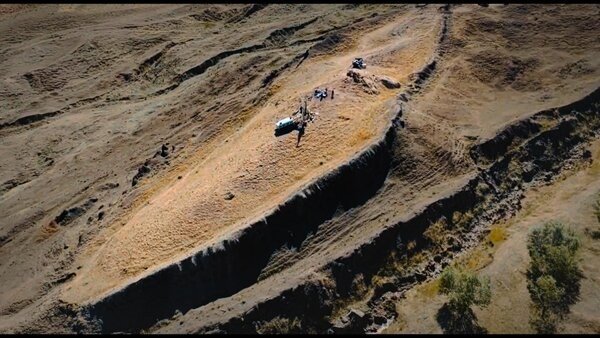

The mystery of Noah’s Ark could be one step closer to being solved.
Researchers investigating a site in Turkey long believed to be the Biblical vessel’s final resting place have dated wood found there to around 4,300 years old.
This is an exciting development as it matches up with the estimated dates of when Noah would have built the Ark.
Prof Cenker Atilla, of Sivas Cumhuriyet University carried out laboratory tests carried out in the United States to determine the age of the wood.
The research team is awaiting further results from laboratories in Switzerland and Türkiye to compare with the initial findings.

The Durupınar Formation, near the village of Üzengili in the Doğubayazıt district of Ağrı Province, has attracted attention for decades because of its distinctive boat-shaped appearance and alleged links to the biblical vessel.
In late summer, researchers collected samples described as wood and carbonised material.
On Sunday, Prof Atilla confirmed that the team had received its first results from a US laboratory, according to Turkey’s İhlas News Agency (İHA).
The analysis indicated that the samples dated to between 2400 and 2200 BC, placing them in the third millennium BC.
Andrew Jones, deputy leader of the research team, also said two wood samples had produced dates suggesting an age of about 4,300 years.

He noted that the estimated dates corresponded with some proposed chronologies of the biblical flood, but acknowledged that the findings alone did not establish that the Durupınar Formation was Noah’s Ark.
Researchers intend to compare the American results with independent analyses being carried out in Switzerland and at laboratories associated with TÜBİTAK, Türkiye’s Scientific and Technological Research Council.
Radiocarbon dating measures the amount of carbon-14 remaining in organic material to estimate how old it is.
However, establishing the age of a piece of wood does not determine how it was used, whether it was shaped by humans or how it came to be buried at the site.

Those questions will require further examination of the samples’ physical characteristics and the geological deposits from which they were recovered.
Earlier geological studies have concluded that the boat-shaped Durupınar Formation was created through natural processes.
The newly announced dates do not, in themselves, overturn those findings or demonstrate a connection between the wood and an ancient vessel.
Speaking about the discovery, Jones, founder of Noah’s Ark Scans, said: ‘Prof. Dr. Cenker Atila, President of our Noah’s Ark Research Project, has discovered what appears to be blackened, charred wood deep inside the Durupınar site—a thrilling development in our research at the Noah’s Ark site.
‘Charred wood survives at ancient archaeological sites, preserving valuable clues to the past.’
MORE: Hoard of 2,000-year-old Celtic silver coins found on site of electricity substation
MORE: Noah’s Ark ‘evidence’ may have been found where biblical vessel came to rest
MORE: Man who refused operation on religious grounds died days before rules were changed
Leave a Reply