
People who vape are inflicting ‘similar detrimental effects’ on their pulmonary system as smokers, a sobering new study suggests.
Although experts insist that e-cigarettes are the lesser of these two evils, it appears both of these bad habits wreak similar havoc on our lungs in the long-term.
Researchers at the Florida International University have warned that there is ‘credible evidence’ that vaping causes significant damage to our breathing apparatus over time.
As vaping is still a fairly new phenomenon, scientists aren’t entirely sure of the impact it will have on people later in life.
And that’s why boffins in Miami set out to find what sort of effect ‘prolonged e-cigarette use’ has on the pulmonary functions of young adults.

Future generations might be fighting a lot of respiratory problems as they age, the research suggest (Getty Stock Image)
Experts took a look at how different the lungs of 22 participants performed after seven months of persistently vaping – and it’s not good news, lads.
The subjects, who were aged between 21 and 35, each took part in two pulmonary function tests (PFTs) at the start and end of the study.
This allowed the experts to measure how much air they were able to expel from their lungs in one second.
Each person abstained from vaping for 12 hours prior to taking the tests, which are also known as spirometry breath tests, to ensure recent usage didn’t muddy the results.
And overall, there was a ‘statistically significant reduction’ of their ability to blow out air by the end of the study.
What changes occurred over seven months?
The average PFT score fell to 3.75 litres from 3.85 after the seven month period, the research published in the Tobacco Control journal explains.
Researchers reckon that this is proof that regular vaping ‘induces persistent changes in respiratory function’.
As well as this, the study found that those who vaped more often were speeding up the downfall of their respiratory system, as their results declined faster.
This is the ‘hallmark of COPD risk’, according to the Florida International University researchers.
COPD, or chronic obstructive pulmonary disease, is caused by damage to your airways and lungs.
It causes coughing, shortness of breath, frequent chest infections and relentless mucus – and unfortunately there is no cure.

Vaping has ‘similar detrimental effects’ as smoking, the study found, and puts people at risk of COPD (Getty Stock Image)
It’s a condition that commonly impacts smokers, and it seems that future generations could also be struck down with COPD in droves thanks to the prevalence of vaping.
The authors of the study described their findings as ‘credible evidence of the effect of prolonged exposure to e-cigarette use on the pulmonary functions of young adults’.
Although further research with ‘more lengthy’ observation periods and tobacco-free control groups is warranted, the experts said the study is the ‘first indicator of the potential of prolonged e-cigarette use posing a COPD risk’.
“Furthermore, this result mirrors the outcomes of previous research on pulmonary function in cigarette smokers, reinforcing the evidence of similar detrimental effects,” it continues.
“This study provides the preliminary evidence of the potential of chronic e-cigarette use to induce persistent changes in respiratory functions.”
What other experts have said
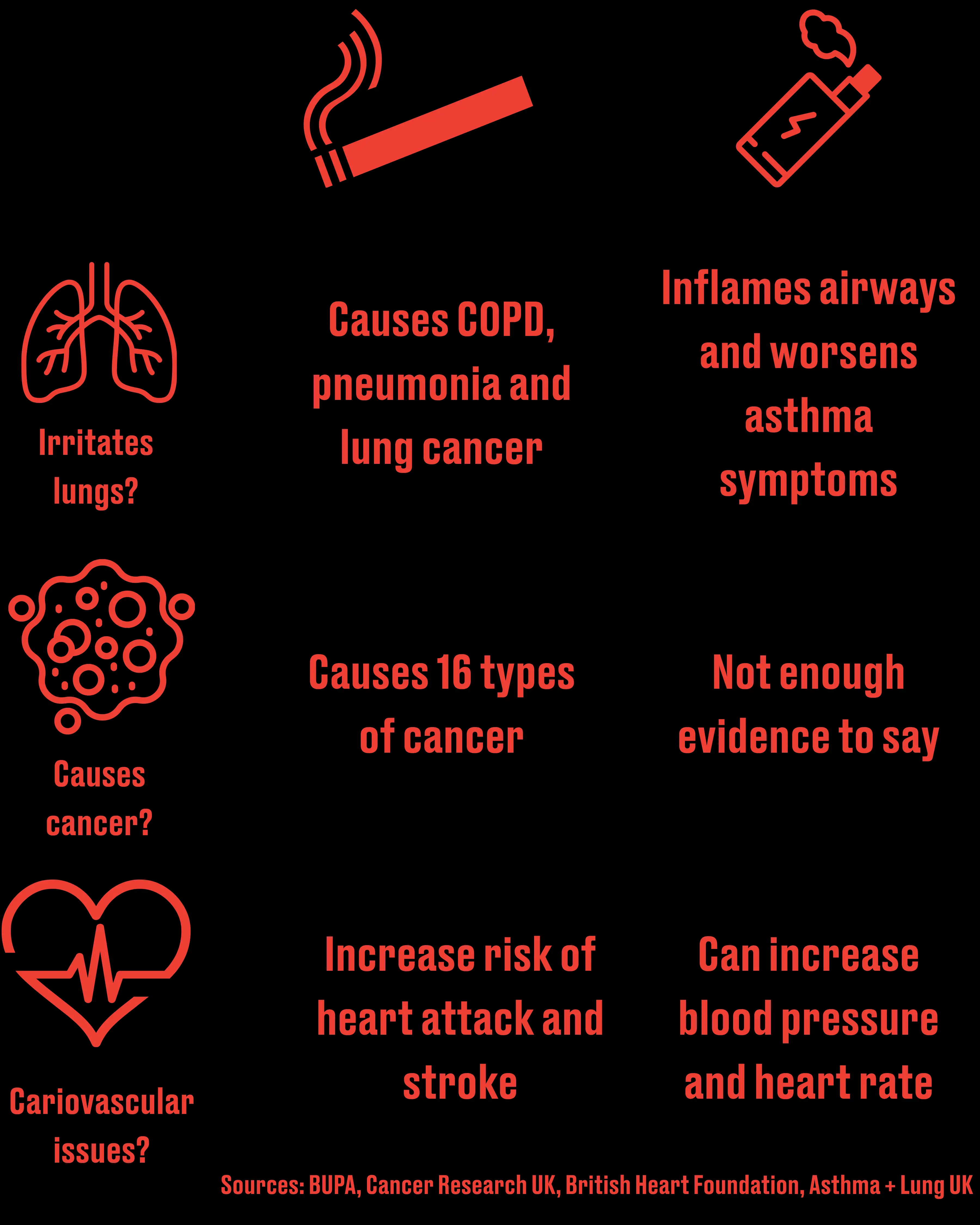
(LADbible)
Other experts have shared their reaction to the results, such as Dr Katie East, who described the study as an ‘important’ area of research.
However, the Associate Professor in Public Health, Brighton and Sussex Medical School (BSMS) pointed out that the findings are ‘preliminary’ and there were some limitations.
“Replication is required with larger studies, appropriate control groups, and longer follow-up before reliable and meaningful conclusions can be drawn,” she said.
Professor Lion Shahab, Professor of Health Psychology and Co-Director of the UCL Tobacco and Alcohol Research Group, University College London (UCL), had a similar opinion.
He suggested that it is ‘hard to draw firm conclusions about the impact of vaping on lung health‘ due to the shortcomings of the study.
Leave a Reply