
A scientist studies bed bugs by sleeping with thousands of them in a laboratory at the bottom of his garden.
Entomologist Dr Richard Naylor, 45, breeds the insects to test pest control products from all over the world.
During a ‘feeding day’ twice a week, he straps some of his 60,000 bugs to his arm and works while they suck his blood.
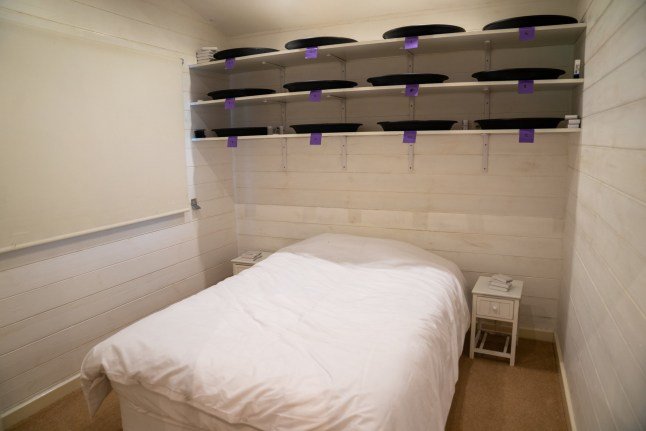
He then sleeps with them on nights when he needs to test out new devices or repellents – in a self-contained two-bedroom suite in his garden.
Dr Naylor has been bitten ‘millions and millions’ of times – and says he is now immune, but gets anaemia symptoms every now and again.

Dr Naylor. who lives in the Forest of Dean in Gloucestershire, runs a not-for-profit business called the Bed Bug Foundation.
And he says his wife doesn’t get jealous of his bed mates – as she is a former biology teacher who works in the business too.
He said: ‘I don’t react to the bites anymore. Apparently it takes something like 40,000 bites to stop reacting to bed bugs.
”And that for me was more than a decade ago. So I haven’t reacted for a long time. Over time, your immune system just stops reacting to it.
‘For most people, it’s something like an angry mosquito bite, a bit more severe than a mosquito bite. But gradually it gets less and less, and I don’t get any swelling or inflammation anymore now.’
Dr Naylor, who has worked on bed bugs since 2001, has set up a lab in his garden with his wife Alexia.
They produce research into insects and conduct product trials for the pest management industry.
He breeds the bugs and sends them all over the world, often to canine detection teams who help hotels spot infestations.
He said when he tells people what his job his ‘everyone starts scratching and seem a bit horrified.’
‘I’ve talked to people in South America in malarial zones, and they’re far more horrified by bedbugs than the mosquitoes that have the potential to make them very sick or kill them,’ he said.
Dr Naylor explained that he needed to sleep with the bugs to test if new sprays and repellents worked.
He said: ‘I can’t really test products on bed bugs without there being a host in the room because their behaviour completely changes. If there’s no one around, bed bugs just sleep, they don’t move around, or they’re triggered by carbon dioxide from our breath and by our body heat – their behaviour is very tied to ours.
‘I can’t test traps and sprays in a room without a person because the bed bugs don’t do anything. Humans have been carrying bedbugs around for as long as humans have been in civilisation.’
Dr Naylor feeds the insects twice a week by strapping pots containing hungry bedbugs to his arms with elastic bands while carrying on with his web admin.
He said: ‘The bugs live in pots and the pots have metal lids, and I just elastic band them to my forearms or sometimes legs if I need more space, and they feed for a few minutes and I can’t really feel anything.
‘After about ten minutes, when it looks like they’re all crawling back up the paper full of blood, then I swap them over, and I can feed thousands of bugs like that in not very long.’
He says his wife is fully on board – and has been working in the business for the past 15 years.
He said: ‘I have kept tarantulas, scorpions, reptiles and other unusual pets since I was a child, so Alexia knew, at least to some extent, what she was letting herself in for! We have been together since I was 16, and back then my bedroom was filled with animals.
‘So by now Alexia is quite accustomed to living with me. I don’t recall if she was even particularly surprised when I floated the idea of building a bedbug testing facility in the garden. She shares some of my interest in bed bugs and the natural world generally, although she doesn’t sleep in the test rooms.
‘I have infested the family home four times in about 25 years. I think that’s not too bad going, given that we work with them almost every day.’
Get in touch with our news team by emailing us at webnews@metro.co.uk.
For more stories like this, check our news page.
MORE: New evidence of volcanic activity on Mars suggests possible life on the red planet
MORE: This is what you dream about right before you die, according to scientists
MORE: Humans are exploring the ‘Zeptoverse’ – a world 100billion times smaller than an atom
Leave a Reply