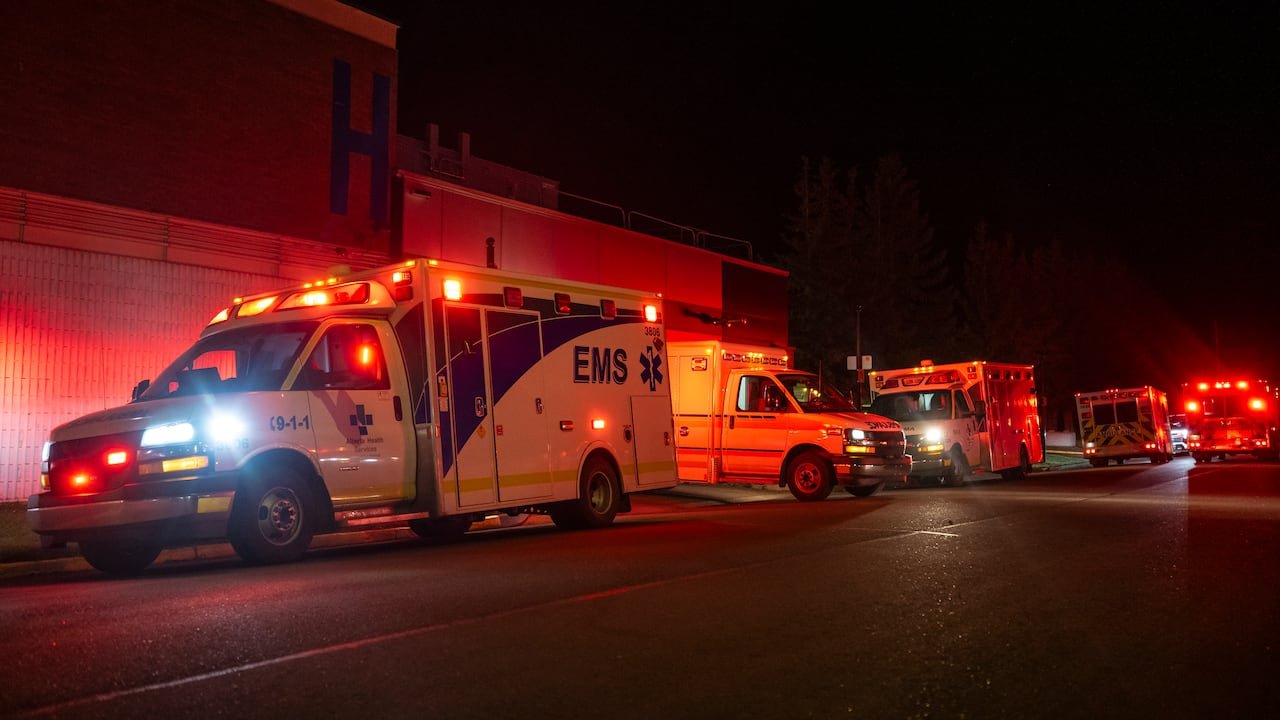
Soldiers badly burned when fire engulfed a military training field face a prolonged and fragile recovery that will test the strength of Alberta’s health-care system, warn doctors on the frontline.
On Saturday afternoon, a dramatic change in winds at Canadian Forces Base Wainwright sent a low-burning grass fire racing toward soldiers doing live-fire training exercises, killing four and sending 39 to hospital, many of them with serious burns.
Doctors who specialize in treating severe burn injuries say the wounded soldiers face long, painful recoveries fraught with threats of infection, complicated wound care, respiratory issues and organ failure.
“Patients with large burn injuries will have hospital stays that will be counted not in days or weeks, but in months,” said Dr. Vincent Gabriel, medical director of the Calgary Firefighters Burn Treatment Centre at Foothills Hospital.
Scarce resources, few beds
It’s one of two centres in Alberta that specialize in critical burn care, along with the Edmonton Firefighters Burn Treatment Unit at the University of Alberta Hospital. Each has just eight beds.
Gabriel did not speak specifically about the patients from CFB Wainwright, 200 kilometres southeast of Edmonton.
However, he said such mass burn casualty events can quickly overwhelm resources, raising critical concerns about capacity and care.
While Alberta’s burn centres can expand into other areas of the hospital — intensive care units, for example — staffing can only stretch so far, Gabriel said.
“Everyone in the burn community comes into this space extremely dedicated to the patient to a fault. But there is an upper limit really to the number of hours per day and how many people we have,” he said.

A lethal fire broke out at CFB Wainwright in Alberta on Saturday. Authorities say four members of the Canadian Armed Forces were killed and dozens more injured. Dr. Cheyanne Vetter, Wainwright Health Centre director, says the rollout plan that night was ‘extremely smooth’ while working with multiple nearby hospitals.
Treatment of severe burn victims is complex. Along with severe inflammation that strains internal organs, the threat of infection is considered the greatest danger, because the patient’s compromised skin has lost its protective ability.
Once patients are intubated to maintain their airways and stabilized with fluids and oxygen, only then can the work of repairing their wounds begin.
Treatment of multiple burn victims at once can quickly deplete inventories of specialized equipment and medical supplies, such as surgical instruments, dressings and skin substitutes, Gabriel said.
“In a mass casualty incident, you may use all of that you have.”
Managing and sourcing these scarce resources often becomes a national and international effort, he added.
Multiple surgeries over many months
Treatment for patients like Cpl. Sean Hiatt, who suffered burns to around half of his body, will extend far beyond the acute, 24-hour response phase, experts say. It may require months of inpatient treatment, continuous surgical reconstructions and long-term physical therapy.
Hiatt managed to call his mother before he was taken to hospital in Edmonton, and remains in critical condition.
Those who suffer severe burns must endure multiple surgeries over weeks or even months, first to remove the burned tissue, then later to graft skin from other, unburned areas of their bodies.

Teresa Hiatt, the sister of one of the critically injured soldiers from the fatal CFB Wainwright fire, shares an update on her brother’s health and his time in the military.
Grafting with the patient’s own skin is the “surgical gold standard,” Gabriel said.
Donor skin is also a critical tool, though it is in high demand even on normal days, he added.
After they leave the hospital, burn patients often require extensive ongoing support as they learn to navigate a “new normal,” Gabriel said.
“Hospital discharge is by no means the finale in their need for care.”

Emergency crews and military personnel at the Wainwright Health Centre as injured military members are treated after a fire at CFB Wainwright, outside of Wainwright, Alta., on Saturday, Oct. 17, 2026. (John Ulan/The Canadian Press)
Danielle Fuchko, a burn disaster preparedness expert and clinical nurse educator, said the disaster at Wainwright will strain Alberta’s hospital and surgical capacity for months.
Her previous research on the triage and treatment of burn injuries has served as a case study of Alberta’s ability to respond to a mass casualty like this one.
As the only province in Canada with two burn centres verified by the American Burn Association for their specialized care, Alberta is in a strong position, she said.
However, there are gaps, such as the limited capacity of those units when faced with a large influx of patients.
“A burn injury is a lifelong injury for these patients,” she said. “This is a really prolonged incident and will require significant resources for months to years to come.”

Firefighters work along a firewall next to CFB Wainwright, south of the town of Wainwright, Alta, on Monday, Oct. 19, 2026. (Christopher Katsarov/The Canadian Press)
Burn specialists in Toronto and Hamilton say they are ready to support their Alberta colleagues.
Dr. Alan Rogers, a surgeon at the Ross Tilley Burn Centre at Toronto’s Sunnybrook Health Sciences Centre, has said the hospital is ready to take patients if needed, and could send temporary skin from its frozen tissue bank.
Dr. Marc Jeschke, director of the burn program for Hamilton Health Sciences, said the devastating fire at Wainwright shows the need for more capacity in the system.
Burn care medical experts from across Canada ran a mass casualty exercise just weeks ago, he said, and discovered there are only 46 burn beds in hospitals nationwide.
“This is a tragedy … but this will not be the last time.”
Leave a Reply