Tag: News – Al Jazeera

  • Will the US-Israeli attacks impact Iran’s participation in World Cup 2026?

    Will the US-Israeli attacks impact Iran’s participation in World Cup 2026?

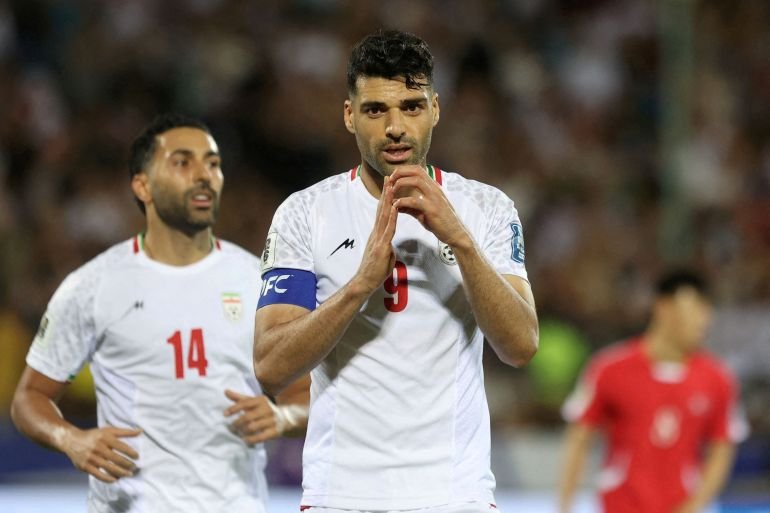
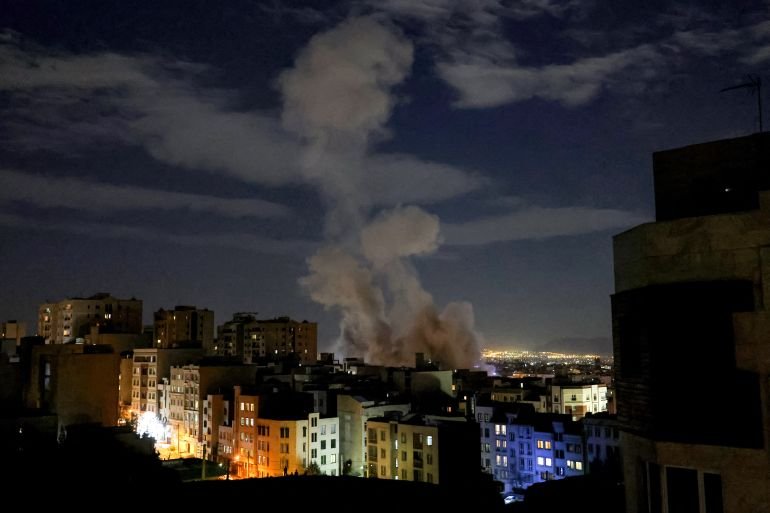
    United States and Israeli attacks on Iran have cast doubt over the Iranian football team’s participation in the upcoming FIFA World Cup.

    Iran has responded to the attacks, which began on Saturday, by striking Israeli and US military bases in the Middle East with missiles and drones.

    Recommended Stories

    list of 3 itemsend of list

    As of Monday morning, at least 555 people had been killed across Iran and 10 in Israel. Three US soldiers had been killed in action while 38 people had been killed in other nations across the region.

    The World Cup will be cohosted by Canada, Mexico and the US – where Iran is scheduled to play all its group games. But if there is no letup in the conflict, the tournament’s logistics and Iran’s role in it have come under question.

    Here’s what we know so far:

    When is the FIFA World Cup, and what’s Iran’s schedule in the tournament?

    The World Cup will begin on June 11 in Mexico while Canada and the US will host their first match the following day. The final will be played on July 19 in East Rutherford, New Jersey, near New York.

    Iran is in Group G of the tournament with Belgium, Egypt and New Zealand and is scheduled to play all of its games on the US West Coast.

    Here’s Team Melli’s group-stage schedule:

    • June 15: Iran vs New Zealand at 9pm (05:00 GMT on June 16) at Los Angeles Stadium
    • June 21: Belgium vs Iran at 3pm (23:00 GMT) at Los Angeles Stadium
    • June 26: Egypt vs Iran at 11pm (07:00 GMT on June 27) at Seattle Stadium

    Will Iran play in the FIFA World Cup?

    While Iran has not officially pulled out of the tournament, a top Iranian football official has admitted the team’s participation has been thrown into question.

    “What is certain is that after this attack, we cannot be expected to look forward to the World Cup with hope,” Mehdi Taj, president of the Football Federation of the Islamic Republic of Iran (FFIRI), told local sports portal Varzesh3 on Sunday.

    “It’s not possible to say exactly, but there will certainly be a response,” Taj added when asked whether the FFIRI or the Iranian government would reconsider the country’s participation in the tournament.

    “This will surely be studied by the country’s high-ranking sports officials, and there will be a decision on what’s going to happen.”

    FIFA Secretary-General Mattias Grafstrom has said the world football governing body is monitoring the conflict and the situation emerging from it.

    “I read the news [about Iran] this morning the same way you did,” Grafstrom said at the International Football Association Board’s annual general meeting in Wales on Saturday, according to a report by ESPN.

    “We had a meeting today, and it is premature to comment in detail, but we will monitor developments around all issues around the world.”

    With the tournament a little more than three months away, FIFA said it will “continue to communicate with the host governments”.

    Will the Iranian team and fans be allowed in the US for the World Cup?

    While Iran’s games are scheduled at venues on the US West Coast, which is home to a sizeable Iranian community, Team Melli’s fans hoping to travel to the tournament from Iran and support their team will find it difficult.

    Iran was among the 12 countries that were included in US President Donald Trump’s travel ban imposed in June.

    The ban was met with criticism from Iran, which called it “racist” and a sign of deep-rooted hostility towards Iranians and Muslims.

    What happens if Iran does not participate in the World Cup?

    There is no precedent for a team withdrawing from the FIFA World Cup, which is deemed the biggest sporting event in the world.

    Teams that have been sanctioned and banned by global and regional football bodies have been excluded from the tournament with Russia’s ban the most recent.

    Should Iran pull out of the tournament, it would likely be replaced by another nation to ensure the smooth operation of the tournament.

    Because Iran is part of the Asian Football Confederation and qualified for one of the region’s berths for the World Cup, the replacement would likely come from Asia although organisers have not confirmed whether that would be the case.

    Based on their position at the end of the qualifying process, the United Arab Emirates could be the nation next in line. However, if Iraq, who are aiming to qualify via an intercontinental playoff, fail to book a place, they could pip the UAE as Iran’s replacement.

    What’s Iran’s record at the FIFA World Cup?

    Iran are currently ranked 20th in the world and second in Asia.

    They have appeared in the World Cup on seven occasions with consecutive appearances in the past three editions but have failed to move past the group stage.
  • Ayatollah Ali Khamenei’s assassination will likely backfire. Here is why

    Ayatollah Ali Khamenei’s assassination will likely backfire. Here is why

    A favourite tactic of war is to try to decapitate the enemy leadership. While such strategies might work in certain contexts, in the Middle East, they have proven to be a disastrous choice.

    For sure, the assassination of an enemy leader might give a quick boost of popularity amid war. Certainly, United States President Donald Trump and Israeli Prime Minister Benjamin Netanyahu are basking in the limelight of their perceived “success” in assassinating Iranian Supreme Leader Ali Khamenei.

    But killing an 86-year-old man who had already been planning his succession due to his ill health is not that much of a feat considering the overwhelming firepower that the US and Israel together possess. More importantly, eliminating him does not necessarily mean that what follows would be a leadership or a regime that would accommodate Israeli and US interests.

    That is because leadership assassinations do not lead to peaceful outcomes in the Middle East. They can open the door for much more radical successors or for chaos that leads to violence and upheaval.

    A brief glance at recent history shows that whenever Israel and the US have tried the idea of leadership “decapitation” in various conflicts in the region, the results have been disastrous. In the case of Iraq, its leader Saddam Hussein was captured by US forces and handed over to allied Iraqi forces who executed him. This ended a regime that was openly antagonistic to Israel, but it also opened the doors for pro-Iranian forces to take power.

    As a result, in the following two decades, Iraq served as a launching pad for Iran’s regional proxy strategy, which saw it build a powerful network of nonstate actors that threatened US and Israeli interests.

    The security vacuum created by the US invasion triggered various insurgencies, the most devastating of which was the rise of ISIL (ISIS), which swept through the Middle East, killing thousands of innocent people, including US citizens, and triggering a massive refugee wave towards US and Israeli allies in Europe.

    Another case in point is Hamas. Since the early 2000s, Israel has repeatedly tried to assassinate its leaders. In 2004, it succeeded in killing its founder Sheikh Ahmed Yassin and then his successor Abdel Aziz Rantisi, who was considered a moderate. A few assassinations later, Yahya Sinwar was elected head of Hamas in Gaza and went on to plan the October 7, 2023, attack.

    Hezbollah has a similar history. Its late leader Hassan Nasrallah, who successfully led the expansion of the group to a formidable nonstate power, ascended to its leadership after Israel assassinated his predecessor Abbas al-Musawi.

    Two and half years of war and mass killing of leadership may now have devastated both armed groups, but Israel has failed to assassinate the idea behind them: resistance to occupation. The current lull in fighting may be the quiet before another storm.

    In the Iranian case, it is highly unlikely that whoever replaces Khamenei would be as open to negotiations as he was. The statements by the Omani interlocutors during the talks in Muscat and Geneva pointed to major concessions on the nuclear issue that Iran under Khamenei was prepared to make. It is unlikely that his replacement would have the political space to follow suit.

    If Israel and the US continue their campaign and really push for state collapse in Iran, what comes out of that ensuing chaos could be anyone’s guess. But if we are to go by recent experiences in Iraq and Libya, a security vacuum in Iran would have devastating consequences for US allies in the region and in Europe.

    That raises the pertinent question of what Israel and the US stand to gain from their “decapitation” strategy in Iran.

    For Netanyahu, the assassination of Khamenei is a major success. Facing crucial elections that could mean the possible end of his political life and maybe his imprisonment over four corruption charges, the short-term gain in popularity and votes is worth it. Israeli leaders do little thinking and planning on the mid- to long term and do not have to bear the consequences of military adventurism abroad. After all, Israeli society is very much in favour of it.

    But for Trump, the gains are not as apparent. He gets to brag about killing an 86-year-old ailing leader of a faraway country to a public that has no appetite for war. At a time of a continuing cost-of-living crisis in the US, he is spending billions of taxpayer dollars to fight a war against a country that posed no imminent threat, a war that many Americans are increasingly identifying as “Israel’s war”.

    Instead of projecting power, Trump risks showing weakness and being seen as a US president fooled into starting a costly war to ensure the political survival of the prime minister of a foreign country.

    It is clear for now that the US president has drawn a line at putting US boots on the ground. At some point, he will have to end the bombardment campaign and pull US troops. He will leave behind a disaster that US allies in the region will have to bear the brunt of. US regional alliances are sure to suffer. Domestic audiences are sure to ask questions.

    This will be yet another US military adventure in the region that will cost US taxpayers’ money, US soldiers’ lives and foreign policy clout and offer no return. The hope is that Washington may finally learn its lesson that assassinations and decapitation strategies don’t work.

    The views expressed in this article are the author’s own and do not necessarily reflect Al Jazeera’s editorial stance.

  • Iran death toll reaches 555 as US, Israel escalate attacks

    Iran death toll reaches 555 as US, Israel escalate attacks

    Civilian deaths are growing as more attacks are reported in the capital and other parts of the country.

    At least 555 people have been killed in US-Israeli strikes across 131 counties in Iran, the Iranian Red Crescent Society says, amid another wave of intensive attacks and Iranian counterstrikes on Israel and US assets in the Middle East region.

    At least 35 people were killed on Monday morning in southern Iran’s Fars province, according to the Mehr news agency. The outlet also reported more than 20 people killed in an attack on Niloofar Square in Tehran.

    Recommended Stories

    list of 3 itemsend of list

    The Fars news agency said at least two people were killed in the central city of Sanandaj as several residential buildings next to the city’s police station were destroyed. The Tasnim news agency said US and Israeli forces dropped six missiles on different parts of the city, including densely populated neighbourhoods.

    Reza Najafi, Iran’s ambassador to the International Atomic Energy Agency (IAEA), the United Nations nuclear watchdog, told reporters that US-Israeli air strikes had targeted Iran’s Natanz nuclear enrichment site on Sunday.

    “Their justification that Iran wants to develop nuclear weapons is simply a big lie,” Najafi said, describing the facility as “peaceful”.

    Israel and the US have not issued any statements confirming strikes at the site, which the United States bombed during the 12-day war between Iran and Israel in June.

    Al Jazeera’s Tohid Asadi, reporting from the Iranian capital, said the latest strikes were indicative.

    “This shows the scope of the attacks on Iran, with raids targeting not just political centres and military headquarters,” he said. “We are witnessing damage to civilian buildings, with some of them fully demolished in some cases. And this is concerning because the civilian fatalities are growing.”

    Videos verified by Al Jazeera also showed huge clouds of smoke billowing behind buildings near the international airport in the central Iranian city of Kermanshah.

    Iranian authorities reported that the death toll from an Israeli attack on a girls’ school in Minab on Saturday rose to 180.

    Hossein Kermanpour, the head of public relations at Iran’s Ministry of Health, added that the “same type” of missile was used to attack the Gandhi Hospital in Tehran on Sunday. The hospital was badly damaged, and patients were evacuated.

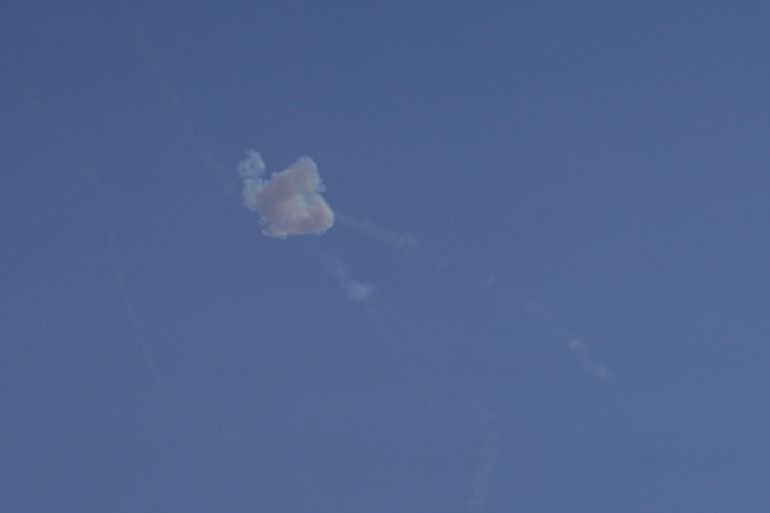
    The Israeli military on Monday said Iran had launched more missiles and that air defences were operating to intercept the projectiles. It called on residents to take shelter and remain in protected spaces until informed.

    Israeli police said nine people were killed after an Iranian missile attack on the central city of Beit Shemesh. Eleven people were reported missing as rescuers searched for survivors.

    Iran continued with its retaliatory strikes on Qatar, Bahrain, Jordan, Oman, Kuwait, Saudi Arabia and the United Arab Emirates, with attacks reported on airports, residential buildings and hotels.

    Countries in the Gulf have pledged to defend themselves against Iranian attacks, including by “responding to the aggression”.

    Iranian Foreign Minister Abbas Araghchi stressed that Tehran was not seeking confrontation with its Gulf neighbours but aimed to attack US assets in the region.

  • Poll suggests only a quarter of Americans support attacks on Iran

    Poll suggests only a quarter of Americans support attacks on Iran

    A poll conducted in the hours after the United States and Israel launched a major military operation against Iran, sparking regional retaliation, shows dismal approval for the strikes from the US public.

    The Reuters Ipsos poll was conducted beginning on Saturday and closing on Sunday, before the administration of President Donald Trump announced that the first US troops had been killed in the conflict. Only one in four respondents approved of the US-Israeli attacks.

    Recommended Stories

    list of 3 itemsend of list

    The early findings could have a significant effect on how the Trump administration moves forward in the days ahead and on how lawmakers respond to the attacks, particularly as they look to a punishing midterm election season.

    Trump on Sunday promised to continue what he described as a “righteous mission” until “all objectives are achieved”. Referencing the three US military members announced killed on Sunday, Trump said that “there will likely be more before it ends”.

    After a US-Israeli strike killed Iranian Supreme Leader Ayatollah Ali Khamenei, Trump again framed Iran as an existential threat to the US, claiming that the country’s leaders “have waged war against civilization itself”.

    The Reuters-Ipsos poll suggested that the US public does not share that view, with 43 percent of respondents saying they disapproved of the war and another 29 percent saying they were unsure.

    Approval among Republicans was stronger, but not resounding, with 55 percent saying they approved of the strikes, 13 percent disapproving and 32 percent unsure.

    Perhaps most significantly, about 42 percent of Republicans said they would be less likely to support the operation if it led to “US troops in the Middle East being killed or injured”.

    About 74 percent of Democrats disapproved of the strike, with 7 percent approving and 19 percent unsure.

    Midterms loom

    The poll released on Sunday comes as Republican lawmakers have largely coalesced around Trump’s message on Iran, even as its contradiction to Trump’s campaign promises risks alienating his Make America Great Again (MAGA) base.

    Trump had run on a pledge to cease “endless wars” and halt US interventionism abroad in an “America First” pivot.

    While Trump has shown a unique ability to shape the views of his staunchest supporters in his likeness, some conservative commentators have warned that he is playing with fire.

    “If this war is a swift, easy, and decisive victory, most of them will get over it,” Blake Neff, a former producer for late conservative activist Charlie Kirk, wrote on X on Saturday.

    “But if the war is anything else, there will be a lot of anger.”

    He added that “success can override bad explanations. So we must pray for success.”

    Speaking to Al Jazeera, Doug Bandow, a senior fellow at the Cato Institute, a libertarian think tank, said the confirmation that US soldiers had been killed “brings home the cost of the war”.

    “Americans, by a very large margin, don’t want to be tied up in an ongoing conflict in the Middle East,” he said during a television interview. “The fact that Americans have died suddenly shows this is not just a video game from the standpoint of America.”

    Beyond the three US military personnel killed, at least 201 people have been killed in Iran, nine in Israel, two in Iraq, three in the United Arab Emirates and one in Kuwait.

    Meanwhile, 45 percent of respondents to the Reuters-Ipsos poll, including 34 percent of Republicans and 44 percent of independents, said they would be less likely to support the campaign against Iran if gas or oil prices increased in the US.

    The conflict has threatened arterial trade routes, with several companies suspending shipments in the area.

    Democrats will also be keeping a close eye on public sentiment on the war, which will surely hang over the campaign season ahead of the midterm elections in November.

    The party has made affordability a key issue, with incumbents and upstart challengers alike portraying Trump’s military adventurism, which has also included the US abduction of Venezuelan leader Nicolas Maduro, as out of touch with his messaging.

    Elected Democrats, meanwhile, have given a range of responses to the US operation against Iran, with at least one Democratic senator praising Trump’s strikes. Others celebrated Khamenei’s killing, but remained more circumspect on Trump’s justification for the attacks, while several others were forthright in condemning the strikes.

    Several Democrats on Sunday said the killing of US soldiers underscored the urgency of passing a war powers resolution, which would require approval from Congress before further military action is taken.

    “I’m thinking of the brave American soldiers killed today,” Senator Chris Van Hollen, a proponent of the resolution, posted on X on Sunday. “They should still be with us.”

    “Trump said he would keep us out of war. This is his war of choice.”

    A vote on the resolution is expected early this week.

  • At least three US service members killed during Iran operation: CENTCOM

    At least three US service members killed during Iran operation: CENTCOM

    US Central Command (CENTCOM) said in a statement that five others have been ‘seriously wounded’ in the operation.

    The United States military has announced that three service members have been killed in its operation against Iran, the first US casualties in the continuing attacks on Iran.

    The announcement on Sunday comes on the second day of strikes by the US and Israel that have killed the Iranian Supreme Leader Ayatollah Ali Khamenei and drawn retaliatory fire from Iran towards targets across the Middle East.

    US Central Command (CENTCOM) confirmed in a statement that three US service members were killed and five others have been “seriously wounded” in the operation.

    “Several others sustained minor shrapnel injuries and concussions — and are in the process of being returned to duty. Major combat operations continue and our response effort is ongoing,” it added.

    “The situation is fluid, so out of respect for the families, we will withhold additional information, including the identities of our fallen warriors, until 24 hours after next of kin have been notified,” it added.

    The United States and Israel continued to launch attacks across Iran on Sunday, the second day of a campaign that US President Donald Trump says is aimed at removing Iran’s government from power. Iran has responded to the assault with attacks targeting US assets across the Middle East, raising fears of a wider regional war.

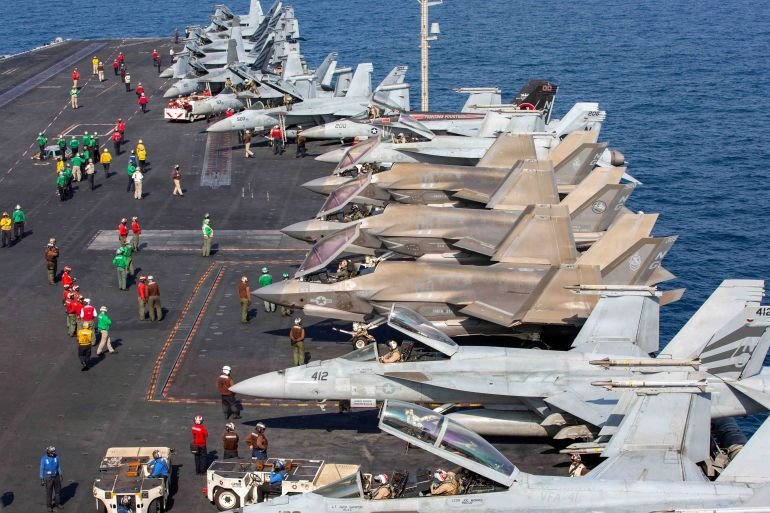
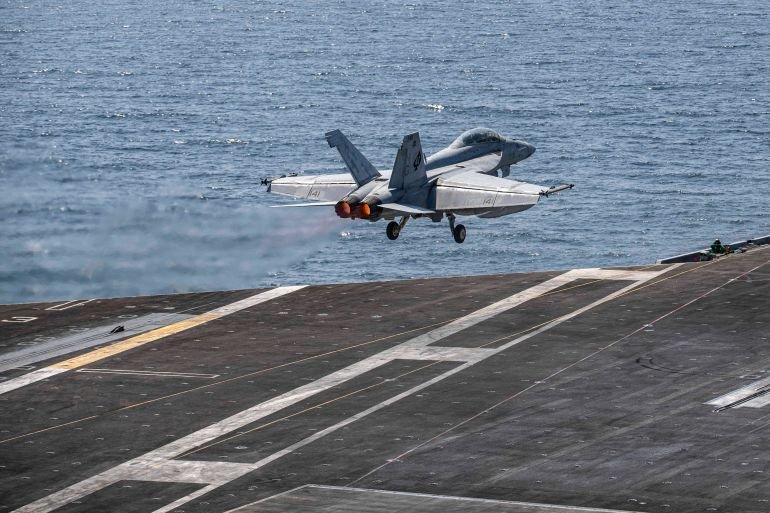
    Iran’s Revolutionary Guards reported on Sunday that they had targeted the USS Abraham Lincoln aircraft carrier with four ballistic missiles.

    A US official told Al Jazeera that the Iranian attack did not cause any damage.

    CENTCOM said on X that the aircraft carrier, “continues to launch aircraft in support of CENTCOM’s relentless campaign to defend the American people by eliminating threats from the Iranian regime.”

    Reporting from Washington DC, Al Jazeera’s Alan Fisher, said that the deaths of US troops would “change a lot of things for the United States”.

    “Donald Trump, of course, campaigned on the idea of being a president who wasn’t going to take the US into wars. He said that [former US Vice President] Kamala Harris, if she were elected, would start a fight with Iran that would lead to World War III,” Fisher said.

    “There are many on the Democratic side who now want an emergency debate in Congress about this [the US operation in Iran] because they want to know what is the administration’s plans? Where does this go? How long is thing going to last?,” he said.

    “And the big question of course, how many more service personnel will be put at risk,” he added.

    Still, Trump told Fox News on Sunday that things were “moving quickly” during its operation on Iran following the killings of Iranian Supreme Leader Ali Khamenei and other members of the political top brass. 

    “I’m not worried about anything, and things are going well,” he said.

    “Iran would have had a nuclear weapon within two weeks if it weren’t for our strikes against its nuclear facilities, and then this type of attack wouldn’t have been possible,” he added.

    Iran has vowed retaliation for the killing of Khamenei and the ongoing US-Israeli attacks on the country, as Foreign Minister Abbas Argachi told Al Jazeera that there were no “limits to our self-defence”.

  • The US-Israeli war on Iran could rewrite Gulf security calculations

    The US-Israeli war on Iran could rewrite Gulf security calculations

    The United States-Israeli war on Iran is just one day old, and it is already clear it will have a profound impact on the Middle East and the Gulf in particular. The US-Israeli bombardment of Iran has killed a number of high-ranking officials as well as Supreme Leader Ali Khamenei. Tehran has responded by attacking not just Israel but also various countries in the region.

    Saudi Arabia, Qatar, the United Arab Emirates, Bahrain, Kuwait and Oman were all struck by Iranian missiles or drones, even though none of these countries had launched attacks on Iran from their territory. Various sites across these states were targeted, including US military bases, airports, ports and even commercial areas.

    If the conflict drags on, it could become a real turning point for the Gulf – one that reshapes how states think about security, alliances and even their long-term economic futures.

    For years, Gulf stability has leaned on a familiar set of assumptions: The United States remained the dominant security guarantor; rivalry with Iran was managed, contained and kept below the threshold of full confrontation; and the Gulf Cooperation Council (GCC) – despite its disagreements – provided enough coordination to prevent regional politics from unravelling entirely. A sustained conflict involving the US, Israel and Iran would strain all of that at once. It would push Gulf capitals to revisit not only their defence planning but also the deeper logic of their regional strategy.

    In recent years, Gulf diplomacy had already been shifting – carefully, quietly and with a strong preference for hedging rather than choosing sides. The Saudi-Iran thaw brokered by China in 2023, the UAE’s pragmatic channels with Tehran and Oman’s steady mediation role all point to the same idea: Stability requires dialogue, even when mistrust runs deep. Qatar has also kept doors open, betting on diplomacy and de-escalation as a way to reduce risk.

    But a prolonged war would make that balancing act much harder to sustain. Pressure would rise from Washington to show clearer alignment. Domestic opinion would demand firmer answers about where national interests truly stand. Regional polarisation would intensify. In that kind of environment, strategic ambiguity stops looking like smart flexibility and starts looking like vulnerability because everyone wants you to pick a side.

    The economic shockwaves could be just as significant. Any extended conflict tied to Iran immediately puts maritime chokepoints back at the centre of global attention, especially the Strait of Hormuz, one of the most sensitive arteries in the world economy. Even limited disruptions could trigger sharp energy price increases, higher insurance and shipping costs, and renewed investor anxiety.

    Yes, higher oil prices could boost revenues in the short term, but sustained volatility carries a different cost. It could scare away long-term capital, complicate megaproject financing and raise borrowing costs at exactly the moment many Gulf states are trying to accelerate diversification.

    There is also a longer-term strategic risk. Major consumers, especially in Asia, may decide that repeated instability is reason enough to speed up diversification away from Gulf energy resources. Over time, that would quietly reduce the region’s leverage, even if it remains a major energy supplier.

    Inside the GCC, the war could either push states closer together or expose the cracks. The bloc has always moved between unity and rivalry, and a crisis doesn’t automatically produce cohesion. Different members have different threat perceptions and different comfort levels with risk. Oman and Qatar have typically valued mediation and communication channels with Tehran. Saudi Arabia and the UAE have leaned more heavily towards deterrence, even if both have recently invested in de-escalation. Kuwait tends to balance carefully and avoid hard positioning.

    If the conflict escalates unpredictably, those differences could resurface and strain coordination. But the opposite outcome is also possible. The crisis could drive deeper cooperation on missile defence, intelligence sharing and maritime security. Which direction the GCC takes will depend less on outside pressure and more on whether member states see this as a moment to compete or a moment to close ranks.

    Zooming out, a prolonged war would also accelerate larger geopolitical realignments. China and Russia would not remain passive. Beijing, deeply invested in Gulf energy flows and regional connectivity, may expand its diplomatic footprint and present itself as a stabilising intermediary. Moscow could exploit the turmoil to increase arms sales and leverage regional divisions.

    Meanwhile, if US military engagement deepens but Washington’s political bandwidth narrows, Gulf states may find themselves in a complicated position – more dependent on American security support yet more cautious about relying on a single patron. That dynamic could produce a new pattern, something like conditional alignment, where Gulf capitals cooperate militarily with the US but widen their economic and diplomatic options to avoid overdependence.

    The deepest change, though, may not be military or economic. It may be cultural, in strategic terms. The Gulf states have spent decades prioritising stability, modernisation and careful geopolitical manoeuvring. A sustained regional war could disrupt that model. It could force painful trade-offs between security imperatives and development ambitions, between diplomatic flexibility and alliance discipline, between the desire to avoid escalation and the reality of living next door to it.

    That is why the Gulf now feels like it is standing at a crossroads. It could become the front line of a prolonged, great power-inflected confrontation – or it could leverage the diplomatic capital it has built to push for de-escalation while strengthening its defensive resilience. Either way, the outcome won’t just shape Gulf security thinking. It could influence the region’s entire political architecture for years – possibly decades – to come.

    The views expressed in this article are the author’s own and do not necessarily reflect Al Jazeera’s editorial stance.

  • How US-Israel attacks on Iran threaten the Strait of Hormuz, oil markets

    How US-Israel attacks on Iran threaten the Strait of Hormuz, oil markets

    The US-Israeli attacks on Iran have triggered swift retaliatory attacks from Tehran, targeting their assets in multiple Middle East countries, including Israel, Qatar, the United Arab Emirates, Kuwait, Bahrain, Jordan, Saudi Arabia, Iraq and Oman.

    Analysts are warning of a spike in global oil prices after Iranian officials hinted at shutting down the Strait of Hormuz, one of the most important maritime routes in the world.

    Recommended Stories

    list of 3 itemsend of list

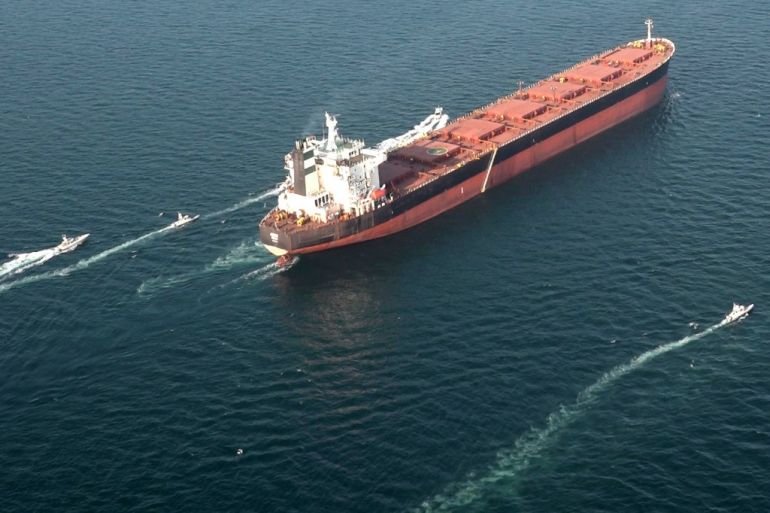
    On Saturday, an official from the European Union told the Reuters news agency that vessels crossing the strait have been receiving very high frequency (VHF) transmissions from Iran’s elite Islamic Revolutionary Guard Corps (IRGC), saying “no ship is allowed to pass the Strait of Hormuz”.

    However, the EU official added, Iran has not officially closed the strait. Instead, several tanker owners have suspended oil and gas shipments through the strait amid the ongoing conflict in the region.

    “Our ships will stay put for several days,” a top executive at a major trading desk told Reuters on condition of anonymity. Countries like Greece have also advised their vessels to avoid transiting through the waterway.

    Any instability in this important maritime route could rattle economic stability worldwide.

    So what is the Strait of Hormuz, and how will its closure impact oil prices?

    Where is the Strait of Hormuz?

    The Strait of Hormuz is located between Oman and the UAE on one side and Iran on the other. It links the Arabian/Persian Gulf, or just the Gulf, with the Gulf of Oman and the Arabian Sea beyond.

    It is 33km (21 miles) wide at its narrowest point, with the shipping lane just 3km (2 miles) wide in either direction, making it vulnerable to attack.

    Despite its narrow width, the channel accommodates the world’s largest crude carriers. Major oil and gas exporters in the Middle East rely on it to move supplies to international markets, while importing nations depend on its uninterrupted operation.

    INTERACTIVE - Strait of Hormuz - FEB24, 2026-1772104775

    How much oil and gas pass through the strait?

    According to the US Energy Information Administration (EIA), about 20 million barrels of oil, worth about $500bn in annual global energy trade, transited through the Strait of Hormuz each day in 2024.

    The crude oil passing through the strait originates from Iran, Iraq, Kuwait, Qatar, Saudi Arabia and the UAE.

    The strait also plays a critical role in the liquefied natural gas (LNG) trade. According to the EIA, in 2024, roughly a fifth of global LNG shipments moved through the corridor, with Qatar accounting for the vast majority of those volumes.

    Where does it all go?

    The strait handles both oil and gas exports and imports.

    Kuwait and the UAE import supplies sourced outside the Gulf, including shipments from the United States and West Africa.

    The EIA estimated that in 2024, 84 percent of crude oil and condensate shipments transiting the strait headed to Asian markets. A similar pattern appears in the gas trade, with 83 percent of LNG volumes moving through the Strait of Hormuz destined for Asian destinations.

    China, India, Japan and South Korea accounted for a combined 69 percent intake of all crude oil and condensate flows through the strait last year. Their factories, transport networks and power grids depend on uninterrupted Gulf energy.

    A spike in oil prices will impact countries such as China, India and several Southeast Asian nations.

    How would the Strait’s closure impact oil prices?

    According to Iranian state media, the country’s Supreme National Security Council must make the final decision to close the strait, and it has to be ratified by the government.

    But energy traders have been on high alert in recent weeks amid escalating tensions in the region – home to one of the largest reserves of oil and gas in the world. Muyu Xu, senior crude oil analyst at Kpler, told Al Jazeera that since the war began on Saturday, there has been a sharp drop in vessel traffic through the strait.

    “At the same time, the number of vessels idling on either side – in the Gulf of Oman and the Gulf – has surged, as shipowners grow increasingly concerned about maritime security risks following Tehran’s warning of a potential navigation closure,” he said.

    “The Strait of Hormuz is critical to the global energy market, as roughly 30 percent of the world’s seaborne crude oil transits the waterway. In addition, nearly 20 percent of global jet fuel and about 16 percent of gasoline and naphtha flows also pass through the Strait,” Muyu said.

    “On Sunday, an oil tanker was struck off the coast of Oman just hours ago, signalling a clear escalation of the conflict and a shift in targets from purely military facilities to energy assets.”

    Shipping data showed that at least 150 tankers, including crude oil and liquefied natural gas vessels, have dropped anchor in open Gulf waters beyond the Strait of Hormuz.

    The tankers were clustered in open waters off the coasts of major Gulf oil producers, including Iraq and Saudi Arabia, as well as LNG giant Qatar, according to the Reuters news agency estimates based on ship-tracking data from the MarineTraffic platform.

    Moreover, on Sunday, the United Kingdom Maritime Trade Operations (UKMTO) said it is aware of “significant military activity” in the Strait and said it has ⁠received a report of an ⁠incident two nautical miles north of Oman’s Kumzar, located in the ‌Strait of Hormuz.

    Muyu from Kpler said a broad range of energy infrastructure is now under threat. “This is expected to sharply intensify the oil price rally and could keep prices elevated for a sustained period, potentially longer than during last June’s conflict.”

    Ali Vaez, director of the Iran project at the International Crisis Group, told Al Jazeera, “Closure of the Strait of Hormuz would disrupt roughly a fifth of globally traded oil overnight – and prices wouldn’t just spike, they would gap violently upward on fear alone.”

    “The shock would reverberate far beyond energy markets, tightening financial conditions, fuelling inflation, and pushing fragile economies closer to recession in a matter of weeks,” he added.

    When the US and Israel bombed Iran last June, there was no direct disruption to maritime activity in the region.

    What does it mean for the global economy?

    Any disruption to energy flows through Hormuz will also impact the global economy, driving up fuel and factory costs.

    Hamad Hussain, a climate and commodities economist at the United Kingdom-based firm Capital Economics, said that for the global economy, a sustained rise in oil prices would add upward pressure to inflation.

    “If crude oil prices were to rise to $100 per barrel and remain at those levels for a while, that could add 0.6-0.7 percent to global inflation,” he said, noting that this would also lead to an increase in natural gas prices.

    “This could slow the pace of monetary easing by major central banks, particularly in emerging markets, where policymakers tend to be more sensitive to swings in commodity prices,” he added.

  • US strikes on Iran lead to renewed demands for war powers legislation

    US strikes on Iran lead to renewed demands for war powers legislation

    Democratic lawmakers have largely condemned the strikes on Iran, emphasizing the lack of congressional approval.

    Lawmakers from the Democratic Party have condemned the US attacks on Iran as a “dangerous” and “unnecessary” escalation, and called on the Senate to immediately vote on legislation that would block the president’s ability to take further military action without congressional approval.

    Senator Tim Kaine, a member of the Senate Armed Services and Foreign Relations Committees and the primary author of the war powers resolution, called President Donald Trump’s order to attack Iran a “colossal mistake”.

    Recommended Stories

    list of 3 itemsend of list

    “The Senate should immediately return to session and vote on my War Powers Resolution to block the use of US forces in hostilities against Iran,” Kaine said in a statement on Saturday. “Every single Senator needs to go on the record about this dangerous, unnecessary, and idiotic action.”

    House of Representatives Minority Leader Hakeem Jeffries echoed Kaine, saying that House Democrats are committed to forcing a floor vote on a measure to restrict Trump’s war powers regarding Iran.

    “Donald Trump failed to seek Congressional authorisation prior to striking Iran. Instead, the President’s decision to abandon diplomacy and launch a massive military attack has left American troops vulnerable to Iran’s retaliatory actions,” he said in a statement. “The Trump administration must explain itself to the American people and Congress immediately.”

    The push for a legislative check on Trump’s executive power has gained significant bipartisan momentum in the Senate, of which the Republican Party maintains a slim majority.

    Senate Minority Leader Chuck Schumer demanded on Saturday that Congress be briefed immediately about the Iran attacks, including an all-senators classified session and public testimony, criticising the administration for not providing details on the threat’s scope and immediacy.

    “The administration has not provided Congress and the American people with critical details about the scope and immediacy of the threat,” he said in a statement.

    Senator Mark Warner, vice chairman of the Senate Select Committee on Intelligence, described the strikes in a statement posted on X as “a deeply consequential decision that risks pulling the United States into another broad conflict in the Middle East”.

    He questioned the urgency and intelligence behind the attack, warning of repeating “mistakes of the past”, like the Iraq war.

    “The American people have seen this playbook before – claims of urgency, misrepresented intelligence, and military action that pulls the United States into regime change and prolonged, costly nation-building,” he said.

    Not just Democrats

    While the push to curb executive military authority is largely driven by the Democratic caucus, a growing contingent of Republican lawmakers has signalled a rare break from the White House to join the effort.

    Republican representative Thomas Massie, one of the most outspoken critics, described the strikes as “acts of war unauthorised by Congress”.

    “I am opposed to this War. This is not America First,” he wrote on X.

    In the Senate, Republican Senator Rand Paul, who also co-sponsored the war powers resolution, said his opposition to the war is based on constitutional principles.

    “My oath of office is to the Constitution, so with studied care, I must oppose another Presidential war,” he said on X.

  • Netanyahu’s war? Analysts say Trump’s Iran strikes benefit Israel, not US

    Netanyahu’s war? Analysts say Trump’s Iran strikes benefit Israel, not US

    President Donald Trump stood in front of regional leaders during a visit to the Middle East in May and declared a new era of US foreign policy in the region, one that is not guided by trying to reshape it or change its governing systems.

    “In the end, the so-called nation-builders wrecked far more nations than they built, and the interventionists were intervening in complex societies that they did not even understand themselves,” the US president said in rebuke of his hawkish predecessors.

    Recommended Stories

    list of 3 itemsend of list

    Less than a year later, Trump ordered an all-out assault on Iran with the stated goal of bringing “freedom” to the country, borrowing language from the playbook of interventionist neoconservatives, like former President George W Bush, whom he spent his political career criticising.

    Analysts say the war with Iran does not fit with Trump’s stated political ideology, policy goals or campaign promises.

    Instead, several Iran experts told Al Jazeera that Trump is waging a war, together with Israel, that only benefits Israel and its prime minister, Benjamin Netanyahu.

    “This is, once again, a war of choice launched by the US with [a] push from Israel,” said Negar Mortazavi, a senior fellow at the Center for International Policy in Washington, DC.

    “This is another Israeli war that the US is launching. Israel has pushed the US to attack Iran for two decades, and they finally got it.”

    Mortazavi highlighted Trump’s criticism of his predecessors, who had waged regime-change wars in the region.

    “It is ironic, because this is a president who called himself the ‘president of peace‘,” she told Al Jazeera.

    History of warnings of the Iranian ‘threat’

    Netanyahu, who promoted the 2003 US invasion of Iraq, has been warning for more than two decades that Iran is on the cusp of acquiring nuclear weapons.

    Iran denies seeking a nuclear bomb, and even Trump administration officials have acknowledged that Washington has no evidence that Tehran is weaponising its uranium enrichment programme.

    After the US bombed Iran’s main enrichment facilities in the 12-day war in June last year – an attack that Trump says “obliterated” the country’s nuclear programme – Netanyahu pivoted to a new supposed Iranian threat: Tehran’s ballistic missiles.

    “Iran can blackmail any American city,” Netanyahu told pro-Israel podcaster Ben Shapiro in October.

    “People don’t believe it. Iran is developing intercontinental missiles with a range of 8,000km [5,000 miles], add another 3,000 [1,800 miles], and they can get to the East Coast of the US.”

    Trump repeated that claim, which Tehran has vehemently denied and has not been backed by any public evidence or testing, in his State of the Union address earlier this week.

    “They’ve already developed missiles that can threaten Europe and our bases overseas, and they’re working to build missiles that will soon reach the United States of America,” he said of the Iranians.

    Trump has been building the case for a wider war with Iran since the June conflict, repeatedly threatening to bomb the country again.

    But the US president’s own National Security Strategy last year called for de-prioritising the Middle East in Washington’s foreign policy and focusing on the Western Hemisphere.

    Meanwhile, the US public, wary of global conflict after the wars in Iraq and Afghanistan, has also been largely opposed to new strikes against Iran, public opinion polls show.

    Only 21 percent of respondents in a recent University of Maryland survey said they favoured a war with Iran.

    The first day of the war saw Iran fire missiles against bases and cities that host US troops and assets across the Middle East in retaliation for the joint US-Israeli strikes, plunging the region into chaos.

    Trump acknowledged that US troops may suffer casualties in the conflict. “That often happens in war,” he said on Saturday. “But we’re doing this not for now. We’re doing this for the future. And it is a noble mission.”

    ‘Ignoring the vast majority of Americans’

    The Trump administration had appeared to step back from the brink of conflict earlier this month by engaging in diplomacy with Tehran.

    US and Iranian negotiators held three rounds of talks over the past week, with Tehran stressing that it is willing to agree to rigorous inspections of its nuclear programme.

    Omani mediators and Iranian officials had described the last round of negotiations, which took place on Thursday, as positive, saying that it yielded significant progress.

    The June 2025 war, initiated by Israel without provocation, also came in the middle of US-Iran talks.

    “Netanyahu’s agenda has always been to prevent a diplomatic solution, and he feared Trump was actually serious about getting a deal, so the start of this war in the middle of negotiations is a success for him, just like it was last June,” Jamal Abdi, the president of the National Iranian American Council (NIAC), told Al Jazeera.

    “Trump’s embrace of regime change rhetoric is a further victory for Netanyahu, and loss for the American people, as it suggests the US may be committed to a long and unpredictable military boondoggle.”

    While announcing the strikes on Saturday, Trump said his aim is to prevent Iran from “threatening America and our core national security interests”.

    But US critics, including some proponents of Trump’s “America first” movement, have argued that Iran – more than 10,000km (6,000 miles) away – does not pose a threat to the US.

    Earlier this month, US Ambassador to Israel Mike Huckabee told conservative commentator Tucker Carlson that “if it were not for Iran, there wouldn’t be Hezbollah; we wouldn’t have the problem on the border with Lebanon”.

    Carlson said, “What problem on the border with Lebanon? I’m an American. I’m not having any problems on the border with Lebanon right now. I live in Maine.”

    On Saturday, Congresswoman Rashida Tlaib stressed that the US public does not want war with Iran.

    “Trump is acting on the violent fantasies of the American political elite and the Israeli apartheid government, ignoring the vast majority of Americans who say loud and clear: No More Wars,” Tlaib said in a statement.

  • World reacts to US, Israel attack on Iran, Tehran retaliation

    World reacts to US, Israel attack on Iran, Tehran retaliation

    The outbreak of conflict between Israel and the United States against Iran, triggered by joint US-Israeli strikes across Iran, has drawn frantic calls for calm as deep consternation spreads across globe.

    Criticism has mounted against Washington for taking part in the attacks while still engaged in nuclear negotiations with Tehran. Anger has also surfaced in Gulf states caught up in the conflict, as Iran launches retaliatory missile strikes against US military assets hosted on their soil.

    Recommended Stories

    list of 3 itemsend of list

    Here is a breakdown of how countries and institutions are responding:

    United States

    President Donald Trump announced that the US was engaged in a “major combat operation” aimed at “eliminating threats from the Iranian regime” on Saturday morning, as missiles hit numerous areas in Tehran and across the country. Trump pledged to raze Iran’s missile industry and destroy its navy, while urging the Iranian people to overthrow the government.

    Israel

    A senior Israeli defence official told the Reuters news agency the joint US-Israeli attacks had been planned for months, with a specific date set weeks ago. Prime Minister Benjamin Netanyahu claimed the attacks aimed to remove an “existential threat” posed by Iran. He said the attacks would “create the conditions for the brave Iranian people to take their fate into their own hands”.

    Iran

    Iran’s Ministry of Foreign Affairs accused Israel and the US of violating the United Nations charter with their attacks and pledged a harsh response, as the country waged retaliatory attacks on Israel as well as in several Gulf states that host US military assets, including Qatar, the United Arab Emirates, Bahrain and Kuwait. “All American and Israeli assets and interests in the Middle East have become a legitimate target,” a senior Iranian official told Al Jazeera. “There are no red lines after this aggression.”

    European Union

    European ⁠Commission President ⁠Ursula von der Leyen and European Council ⁠President Antonio Costa called the conflict “greatly concerning” and urged all parties “to exercise maximum restraint, to protect civilians, ‌and to fully respect international law”.

    Red Cross

    Mirjana Spoljaric, president of the International Committee of the Red Cross, called on countries to respect the rules of war and urged them to find the political will to prevent “further death and destruction”. She warned that “a dangerous chain reaction” of military escalation was under way across the Middle East, “with potentially devastating consequences for civilians”.

    Oman

    The main mediator in ongoing US-Iran negotiations, Oman expressed dismay at the outbreak of violence. Foreign Minister Badr Albusaidi said the conflict would not serve US interests, nor the interests of global peace, and urged Washington “not to get sucked in” further.

    The country’s Ministry of Foreign Affairs called on “all parties to immediately cease military operations” and for “the United Nations Security Council to convene an emergency meeting to impose a ceasefire”.

    Germany, France, the UK

    In a joint statement, the prime ministers of the three countries said they “condemn Iranian attacks on countries in the region in the strongest terms” and remain committed “to regional stability and to the protection of civilian ⁠life.” They also said they ‌want a resumption of US-Iran negotiations.

    Separately, French President Emmanuel Macron ⁠called for an urgent meeting of the UN Security Council, ⁠saying the conflict carries “serious consequences” for international peace and security. “The current escalation is dangerous for everyone. It must stop,” he said.

    Qatar

    The Ministry of Foreign Affairs strongly condemned Iran for firing missiles at Qatari territory, which is home to the Al Udeid Air Base that hosts US troops. The ministry called the attacks a flagrant violation of Qatar’s national sovereignty and a direct assault on its security. It added that Qatar reserves the right to respond, as per international law.

    United Arab Emirates

    The Ministry of Defence condemned in the “strongest terms” Iran’s attacks on its territory, several of which it said its air defences intercepted. It called the attack “a dangerous escalation and a cowardly act that threatens the security and safety of civilians”, stressing that the UAE has the “full right” to respond.

    Bahrain

    Bahrain confirmed that an Iranian missile attack targeted the headquarters of the US Navy’s 5th Fleet that it hosts, and called the attack “treacherous”.

    Kuwait

    The Ministry of Foreign Affairs denounced the Iranian attack on its soil as a “flagrant violation” of international law and said it had the right to respond. It warned that any additional escalation would only deepen regional instability.

    Saudi Arabia

    Saudi Arabia condemned in the “strongest terms” the Iranian attacks on Gulf Arab states and warned of “dire consequences”.

    Turkiye

    The Ministry of Foreign Affairs called on “all parties” to end the spiral of violence, which it stressed started with US-Israeli attacks on Iran. “The events that began with Israel and the US attacking Iran, and continued with Iran targeting third countries, are of a nature that risks the future of our region and global stability,” said the ministry.

    Pakistan

    Foreign Minister Ishaq Dar “strongly condemned the unwarranted attacks against Iran and called for an immediate halt to escalation through urgent resumption of diplomacy to achieve a peaceful, negotiated resolution to the crisis”.

    Russia

    Dmitry Medvedev, deputy chairman of Russia’s Security Council, accused the US of having used its nuclear talks with Iran as a cover-up before military operations. The country’s Ministry of Foreign Affairs urged the international community to swiftly deliver an objective assessment of what it called irresponsible ⁠actions that risk ⁠further destabilising the region.

    China

    The Ministry of Foreign Affairs urged “an immediate halt to military actions” and appealed for “the resumption of dialogue and negotiations” to maintain regional peace and stability. It stressed that “Iran’s national sovereignty, security and territorial integrity should be respected.”

    India

    The Ministry of External Affairs called on all parties to “exercise restraint” and “avoid escalation”. It said “dialogue and diplomacy should be pursued” and that “sovereignty and territorial integrity of all states must be respected.” The statement came several days after the country’s Prime Minister Narendra Modi travelled to Israel and hailed their “vital” partnership.

    Ukraine

    The ⁠Ministry of Foreign Affairs accused Iran of being responsible for the chain of events leading to the conflict, including its crackdown on protests earlier this year. “The cause of the current ⁠events is precisely ⁠the violence and impunity of the Iranian regime, ⁠in particular the killings and ⁠repression of ⁠peaceful protesters, which have become particularly widespread in recent ‌months,” said the Foreign Ministry.

    Norway

    Foreign Minister Espen Barth said the initial attack on Iran by Israel breached standards of international law. “The attack is ⁠described by Israel as a preventive strike, but ⁠it is not in line with international law,” said Barth. “Preventive attacks require an immediately imminent threat.”

    Belgium 

    Foreign Minister Maxime Prevot said the Iranian people “must not pay the price for their government’s choices. We deeply regret that diplomatic efforts could not lead earlier to a negotiated solution.”