Tag: NBA

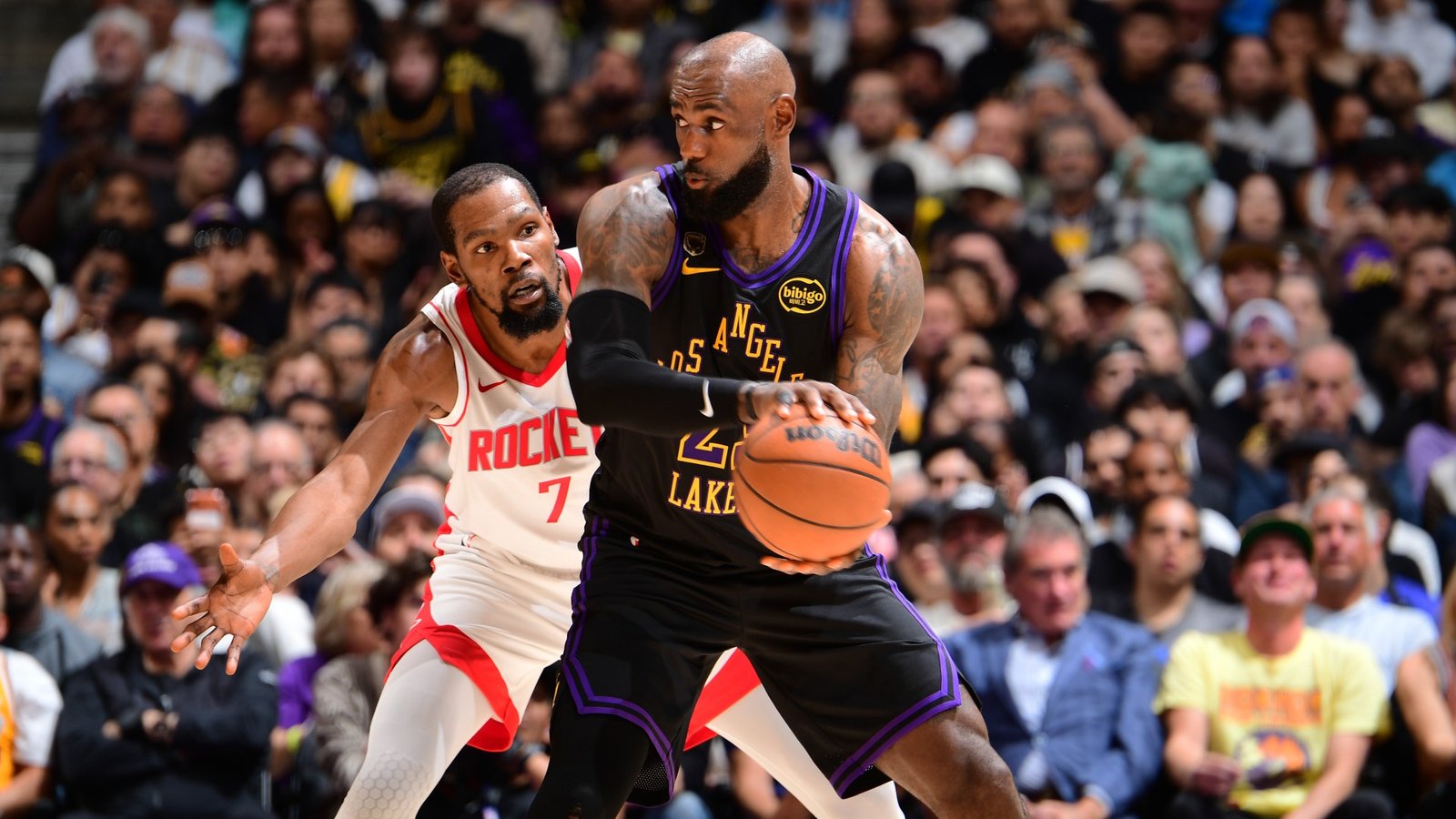
  • 4 takeaways: LeBron James defies age as Lakers limit Kevin Durant to take 2-0 lead

    Game Recap: Lakers 101, Rockets 94

    • Download the NBA App

    Kevin Durant returned to the Houston Rockets’ starting lineup in Game 2 against the Los Angeles Lakers after missing Game 1 with a bruised right knee.

    His presence was welcomed by the Rockets, but it still wasn’t enough to defeat the shorthanded Lakers.

    Playing without Luka Dončić and Austin Reaves – both sidelined by injuries – the Lakers took a 2-0 series lead with a 101-94 victory against Houston on Tuesday in a first-round Western Conference playoff game.

    Game 3 is Friday in Houston (8 p.m. ET, Prime Video).

    Here are four takeaways from Game 2:


    1. Is James 41 … or 21?

    LeBron James continues to defy the effects of aging on professional athletes.

    In a playoff game in 2026, the 41-year-old James led all scorers with 28 points and added eight rebounds and seven assists in 39 minutes.

    He scored nine points in the fourth quarter – two on a soaring two-handed dunk that gave the Lakers a 99-92 lead with 55.3 seconds remaining in the fourth quarter.

    James was aggressive, getting to the free-throw line 14 times.

    “He brought a level of physicality, and he’s done it throughout his career,” Lakers coach JJ Redick said. “He’s just really comfortable playing that way whether it’s him on a back-down, getting to the basket or him drawing fouls. He forces you to match his physicality.”

    After the game, James told NBC he is “super blessed, super humbled” to play that way at his age. The Lakers need it, too, without Dončić and Reaves, and will need that kind of effort from him to win the series.

    2. Smart, Kennard rule in Lakers’ backcourt

    No Dončić, no Reaves, no big deal.

    Just add Luke Kennard and Marcus Smart to the starting lineup.

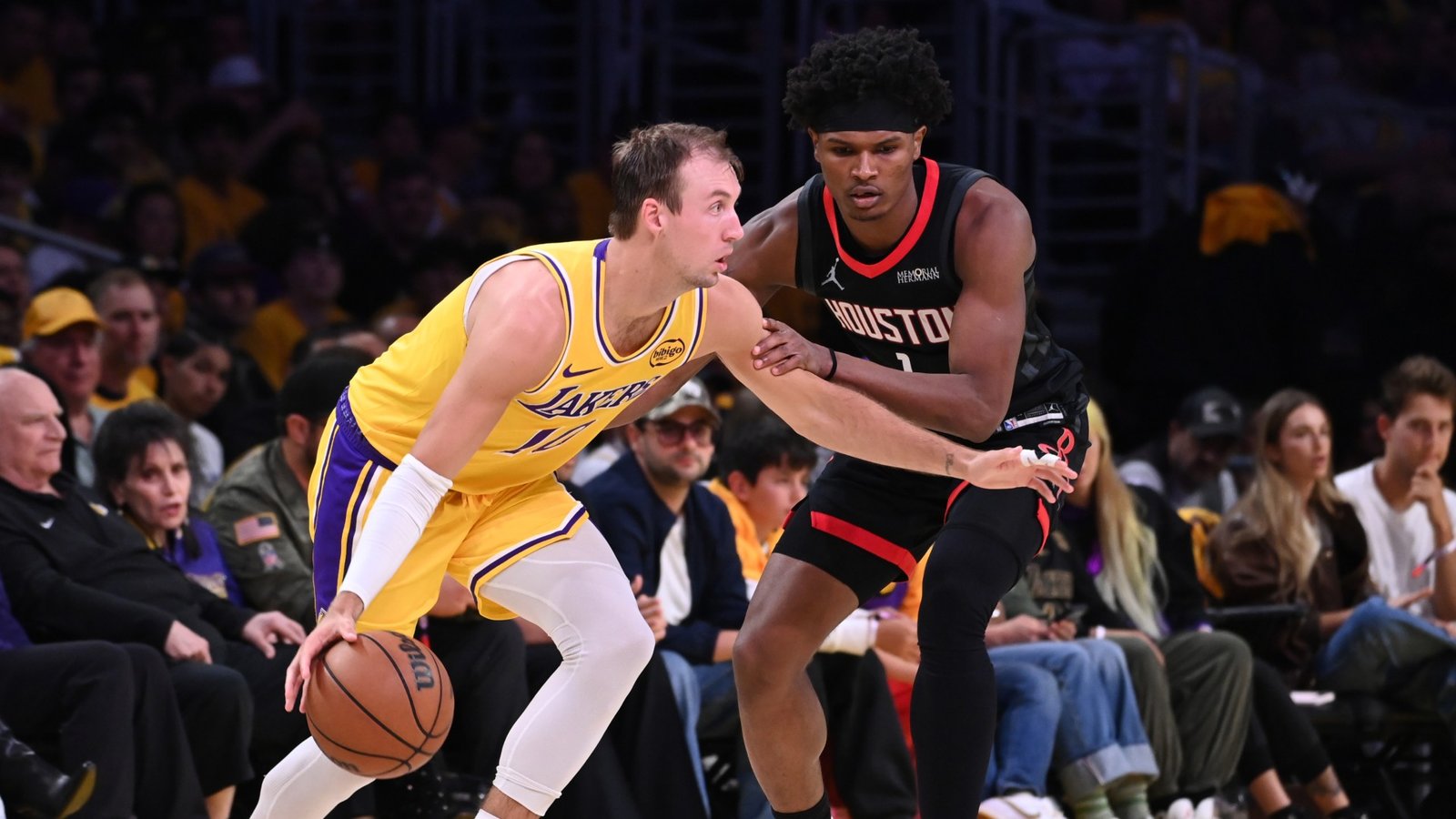
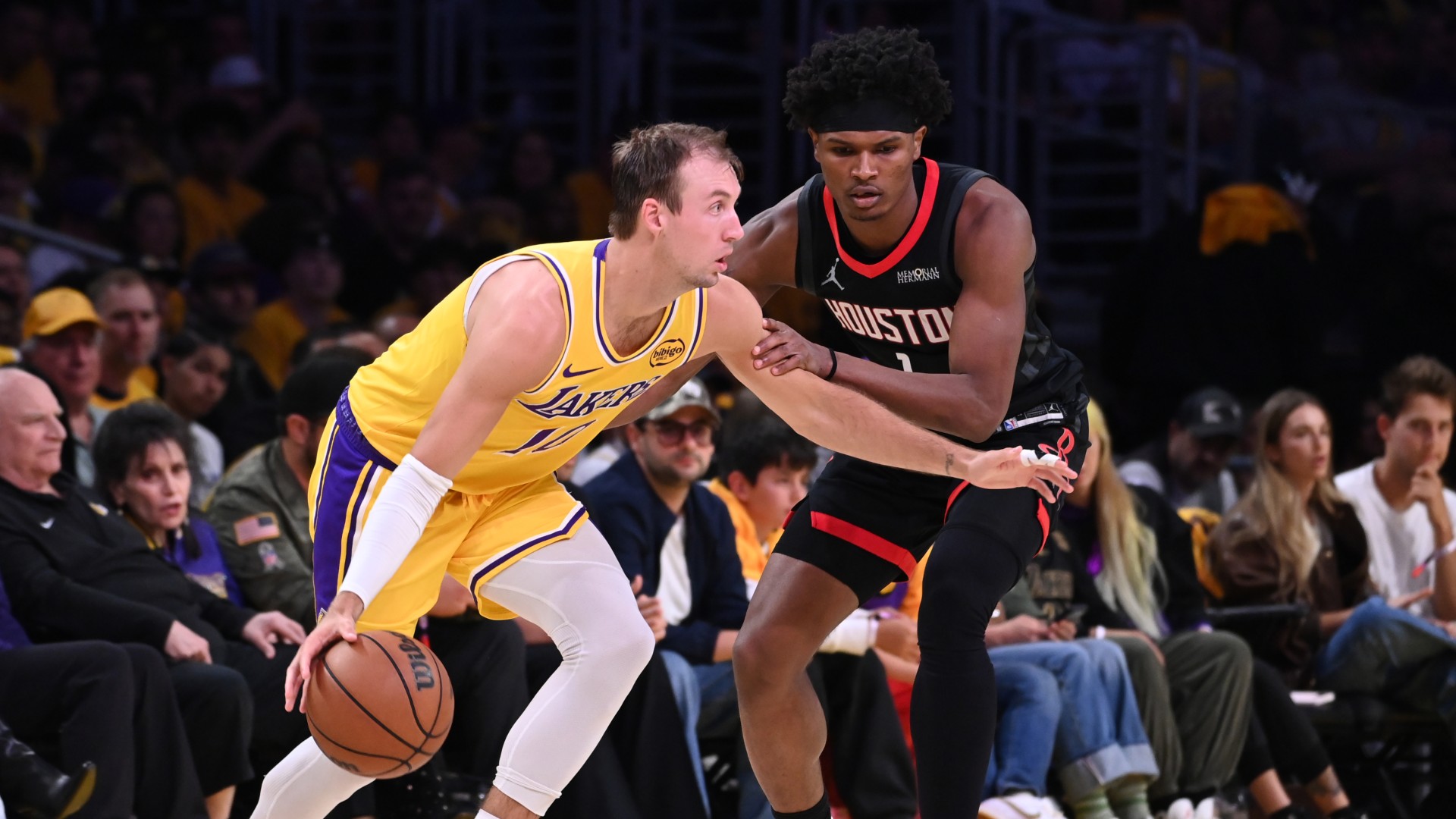
    Kennard followed up his 27-point performance in Game 1 with 23 points, six rebounds and three steals, and Smart produced 25 points, seven assists and five steals.

    Kennard, who led the league in 3-point shooting percentage (47.8%), and Smart were a combined 16-for-26 shooting from the field and 8-for-13 on 3-pointers – including five 3s from Smart.

    “He just had a killer game tonight,” Redick said of Smart.

    3. Lakers slow Durant after big first half

    Durant, who sustained a bruised knee last week in practice, was a game-time decision entering Game 2 and was cleared to play after going through pregame warmups.

    Durant looked good in the first half, scoring 20 points. However, he had just three points in the second half and committed nine turnovers.

    The Lakers often sent two defenders to Durant when he had the basketball, forcing him into a difficult shot or pass.

    “Glad to be out there, playing in high-pressure moments,” Durant said. “But bad game for me tonight.”

    Durant took just 12 shots and indicated he needs to shoot more even with the double-teams. “When two, three people are on me and I shoot, we can get an offensive rebound. …I’ve got to shoot more of those and put my teammates in better position,” he said.

    Redick and his coaching staff deserve credit for holding the Rockets to under 100 points in each of the first two games. Redick isn’t taking any credit.

    “We’re just getting this thing started,” he said. “He’s the type of player who can take over a series. We just have to continue to have great team defense and great activity.”

    4. Statistical oddities in this series

    The 3-ball is playing a role in the series. Through the first two games, the Lakers are shooting 48.9% on 3s and the Rockets are at 29%. Houston had one more made 3 in Game 1, but the Lakers had six more made 3s in Game 2.

    Also in Game 2, just two reserves scored – one from each team. Tari Eason scored 10 points for Houston, and Jaxson Hayes had six points for Los Angeles.

    * * *

    Jeff Zillgitt has covered the NBA since 2008. You can email him at jzillgitt@nba.com, find his archive here and follow him on X.

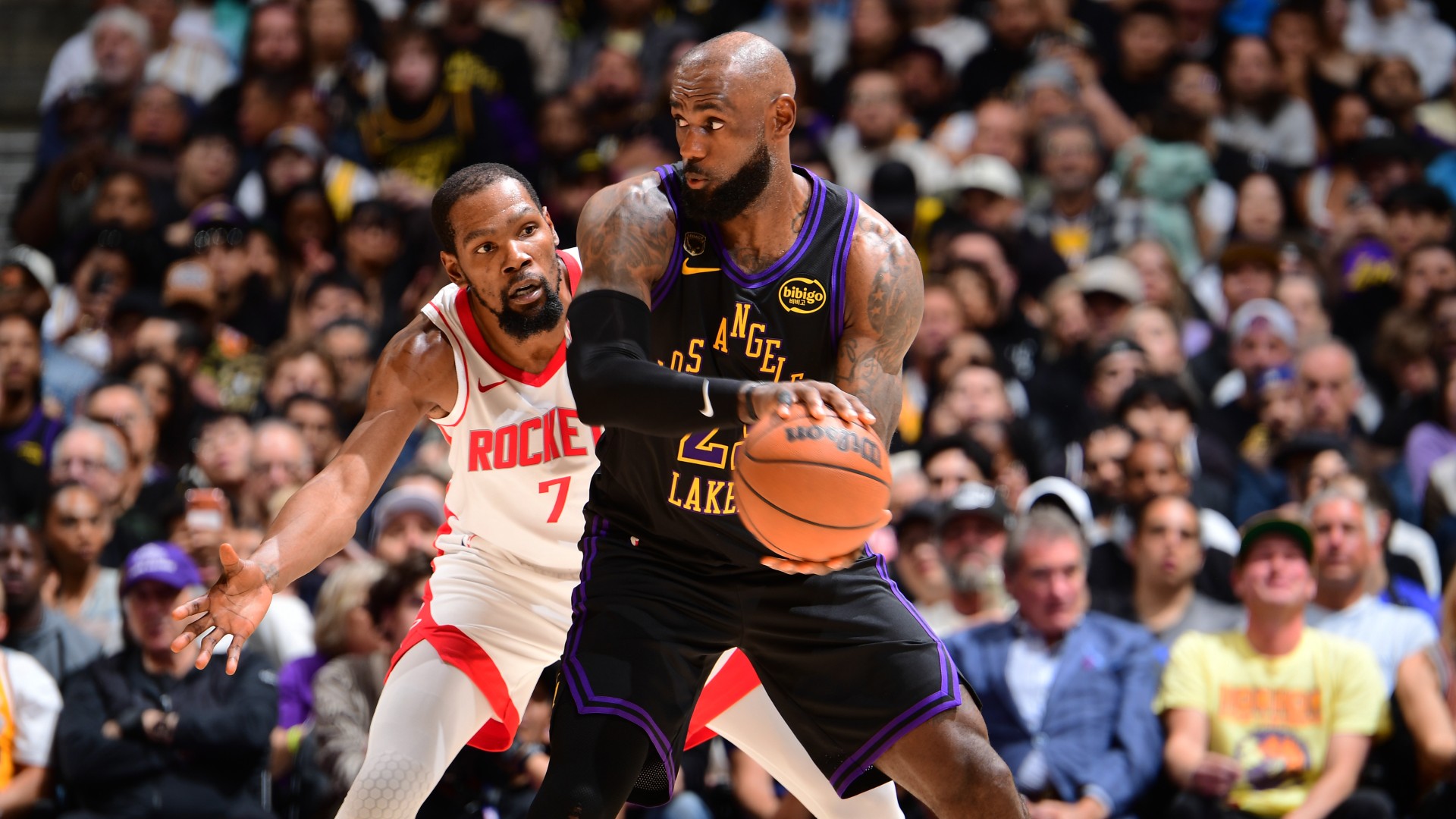
  • 4 takeaways: LeBron James defies age and Lakers limit Kevin Durant to take 2-0 lead

    4 takeaways: LeBron James defies age and Lakers limit Kevin Durant to take 2-0 lead

    In a playoff game in 2026, LeBron James led all scorers with 28 points and added eight rebounds and seven assists in 39 minutes.

    • Download the NBA App

    Kevin Durant returned to the Houston Rockets’ starting lineup in Game 2 against the Los Angeles Lakers after missing Game 1 with a bruised right knee.

    His presence was welcomed by the Rockets, but it still wasn’t enough to defeat the shorthanded Lakers.

    Playing without Luka Dončić and Austin Reaves – both sidelined by injuries – the Lakers took a 2-0 series lead with a 101-94 victory against Houston on Tuesday in a first round Western Conference playoff game.

    Game 3 is Friday in Houston (8 p.m. ET, Prime Video).

    Here are four takeaways from Game 2:


    1. Is LeBron James 41 or 21?

    LeBron James continues to defy the effects of aging on professional athletes.

    In a playoff game in 2026, the 41-year-old James led all scorers with 28 points and added eight rebounds and seven assists in 39 minutes.

    He scored nine points in the fourth quarter – two on a soaring two-handed dunk that gave the Lakers a 99-92 lead with 55.3 seconds remaining in the fourth quarter.

    James was aggressive, getting to the free-throw line 14 times.

    “He brought a level of physicality, and he’s done it throughout his career,” Lakers coach JJ Redick said. “He’s just really comfortable playing that way whether it’s him on a back-down, getting to the basket or him drawing fouls. He forces you to match his physicality.”

    After the game, James told NBC he is “super blessed, super humbled” to play that way at his age. The Lakers need it, too, without Dončić and Reaves, and will need that kind of effort from him to win the series.


    2. Smart, Kennard rule in Lakers’ backcourt

    No Dončić, no Reaves, no big deal.

    Just add Luke Kennard and Marcus Smart to the starting lineup.

    Kennard followed up his 27-point performance in Game 1 with 23 points, six rebounds and three steals, and Smart produced 25 points, seven assists and five steals.

    Kennard, who led the league in 3-point shooting percentage (47.8%), and Smart were a combined 16-for-26 shooting from the field and 8-for-13 on 3-pointers – including five 3s from Smart.

    “He just had a killer game tonight,” Redick said of Smart.


    3. Lakers slow Durant after big first half

    Durant, who sustained a bruised knee last week in practice, was a game-time decision entering Game 2 and was cleared to play after going through pregame warmups.

    Durant looked good in the first half, scoring 20 points. However, he had just three points in the second half and committed nine turnovers.

    The Lakers often sent two defenders to Durant when he had the basketball, forcing him into a difficult shot or pass.

    “Glad to be out there, playing in high-pressure moments,” Durant said. “But bad game for me tonight.”

    Durant took just 12 shots and indicated he needs to shoot more even with the double-teams. “When two, three people are on me and I shoot, we can get an offensive rebound. …I’ve got to shoot more of those and put my teammates in better position,” he said.

    Redick and his coaching staff deserve credit for holding the Rockets to under 100 points in each of the first two games. Redick isn’t taking any credit.

    “We’re just getting this thing started,” he said. “He’s the type of player who can take over a series. We just have to continue to have great team defense and great activity.”


    4. Statistical oddities in Rockets-Lakers series

    The 3-ball is playing a role in the series. Through the first two games, the Lakers are shooting 48.9% on 3s and the Rockets are at 29%. Houston had one more made 3 in Game 1, but the Lakers had six more made 3s in Game 2.

    Also in Game 2, just two reserves scored – one from each team. Tari Eason scored 10 points for Houston, and Jaxson Hayes had six points for Los Angeles.

    * * *

    Jeff Zillgitt has covered the NBA since 2008. You can email him at jzillgitt@nba.com, find his archive here and follow him on X.

  • 4 takeaways: Scoot Henderson emerges while the Spurs stumble without Victor Wembanyama

    Guided by Scoot Henderson playoff career-high 31 points, the Trail Blazers rally past the Spurs in Game 2 to even the series

    • Download the NBA App

    The glow of San Antonio Spurs star Victor Wembanyama’s first Kia Defensive Player of the Year Award didn’t last as long as the Spurs and their fans had hoped.

    Shortly after he was presented the Hakeem Olajuwon Trophy – the award was announced on Monday – Wembanyama hit his head and face on the court in a hard fall in the second quarter against the Portland Trail Blazers Tuesday.

    He left the game, did not return and entered the NBA concussion protocol.

    Then, the Blazers took advantage, overcoming a 14-point deficit in the final 8:18 for a 106-103 victory in Game 2, tying the best-of-7 first-round Western Conference series.

    Game 3 is Friday in Portland (10:30 p.m. ET, Prime Video)

    Here are four takeaways from Game 2:


    1. Henderson spearheads Portland’s victory

    Blazers guard Scoot Henderson scored a game-high 31 points, including 13 in the first quarter, six in the second, seven in the third and five in the fourth.

    He was 11-for-15 from the field and 5-for-9 on 3-pointers and was a vital part of the Trail Blazers’ strong start and finish.

    Portland took a 22-9 lead on Henderson’s 3-pointer with 5:27 left in the first quarter, and when he made his next 3-pointer, he had 13 of Portland’s 25 points. His 3-pointer with 2:43 left in the fourth quarter trimmed San Antonio’s lead to 101-100.

    Henderson is just 22 years old and in his third NBA season. He is one of the G League’s success stories of the players who bypassed college and joined the G League Ignite. He missed the first 51 games this season recovering from a left hamstring tear.

    “He’s very committed to get better, and slowly, when he recovered from the injury, you could see flashes of him,” Trail Blazers interim coach Tiago Splitter said. “He’s in a stage where now he’s a little more mature, the game is little slower for him (and) he’s shooting the ball well. He worked the whole year on his shooting … and now he’s just flourishing.”


    2. Spurs stumble without Wembanyama

    Remove Wembanyama’s production and presence, and winning becomes more difficult. He averaged 25 points, 11.5 rebounds, 3.1 blocks, 3.1 assists and shot 51.2% from the field in the regular season and set a franchise record for points in a playoff debut with 35 in Game 1 against Portland.

    Wembanyama logged 29.2 minutes per game during the regular season, so the Spurs played extensive minutes without him.

    However, the swing with Wembanyama on the court vs. him off the court was significant. When Wembanyama was in the game, the Spurs scored 120.5 points and allowed 103.6 points per 100 possessions, and when he wasn’t in the game, the Spurs were at 114.3 and 113.7 – a difference of nearly 17 points per 100 possessions.

    San Antonio was 12-6 in games where Wembanyama didn’t play at all.

    The Spurs trailed 34-32 when Wembanyama exited and headed into halftime tied at 57-57. They built a 93-79 lead in the fourth but were unable to secure the victory.

    Now, the attention is on Wembanyama’s availability. Spurs coach Mitch Johnson said Wembanyama sustained a concussion, and according to the NBA concussion policy summary, “If a player is diagnosed with a concussion, he cannot return to participation for at least 48 hours, including the date of diagnosis; and until after he completes the required return-to-participation process.”


    3. Trail Blazers bury big-time shots

    During Portland’s comeback, it made big shot after big shot, including necessary 3s that helped the Blazers get back in the game.

    Defensive ace Toumani Camara missed his first three 3-point attempts but made two in the fourth quarter that allowed Portland to dig into San Antonio’s lead.

    Camara’s two made free throws with 5.2 seconds remaining in the fourth quarter gave the Trail Blazers a 106-103 lead, ensuring at least overtime. It stood as the final score.
    Camara had 10 points, nine rebounds and three steals.

    Trail Blazers backup center Robert Williams III delivered off the bench with 11 points, nine rebounds, four assists and two blocks, and his final bucket that put Portland up 104-101 with 12 seconds to go turned out to be the winning shot.

    Savvy veteran Jrue Holiday added 16 points, nine assists, five rebounds and two blocks. His bucket with 2:02 gave Portland a 101-100 lead, and his championship experience (he won titles with Milwaukee and Boston) was on display.

    The Blazers were able to get the win with Deni Avdija (14 points) and Shaedon Sharpe (nine points) scoring nearly 10 points fewer than their season averages.


    4. Spurs lean on depth

    San Antonio general manager Brian Wright has assembled a deep roster, including two reserves with championship experience (Harrison Barnes with Golden State, Luke Kornet with Boston). The Spurs’ five reserves in Game 2 – Kornet, Barnes, Keldon Johnson, Carter Bryant and Dylan Harper – each scored at least four points, and Harper, the No. 2 pick in the 2025 NBA Draft, contributed 10 points.

    Bryant, who was selected No. 14 in the 2025 draft, had seven points, two rebounds and two assists in 12 minutes, and Johnson, a finalist for Sixth Man of the Year, had seven points, four rebounds and two steals.

    Kornet received a lot of Wembanyama’s minutes, finishing with 10 points, nine rebounds, two steals and two assists.

    That depth, depending on Wembanyama’s availability, could take on greater significance as the series advances.

    * * *

    Jeff Zillgitt has covered the NBA since 2008. You can email him at jzillgitt@nba.com, find his archive here and follow him on X.

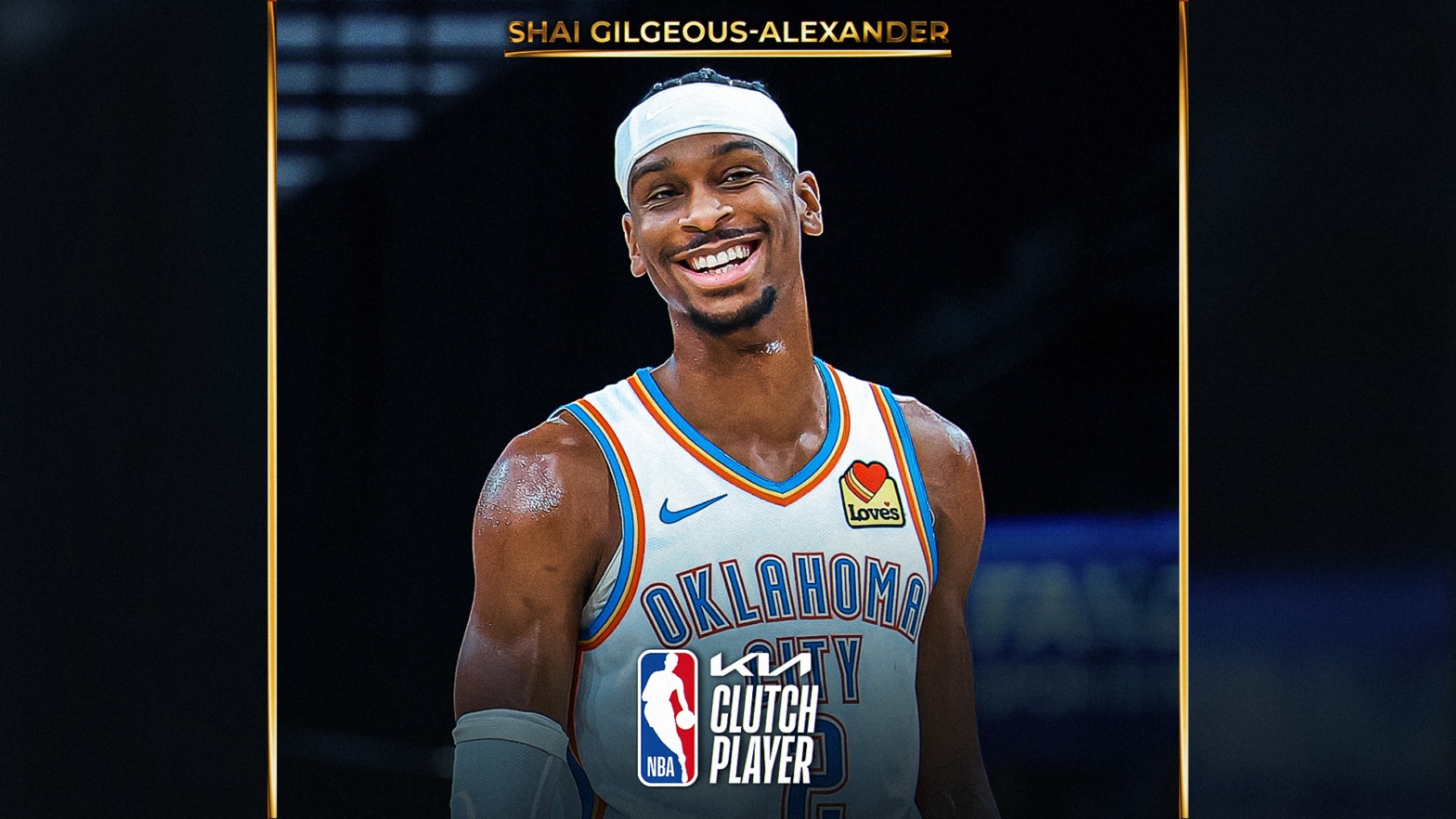
  • Shai Gilgeous-Alexander named 2025-26 Kia NBA Clutch Player of the Year

    • 2025-26 NBA Awards: Complete coverage
    • Kia Clutch Player of the Year: All-Time Winners


    (AP) — Shai Gilgeous-Alexander’s trophy haul keeps growing.

    Gilgeous-Alexander, the Oklahoma City guard who is the reigning MVP and NBA Finals MVP, is the Clutch Player of the Year award winner for this season, the NBA announced Tuesday.

    It’s the first of what could be several awards for Gilgeous-Alexander in the coming weeks. He’s a finalist to win a second straight MVP trophy — and because he’s a finalist there, he’s also a lock to make the All-NBA team for a fourth straight year.

    “This award means a lot,” Gilgeous-Alexander said on NBC Sports, which aired the award announcement. “To get this award, you have to help your team win games late and what I’m about more than anything is winning games.”

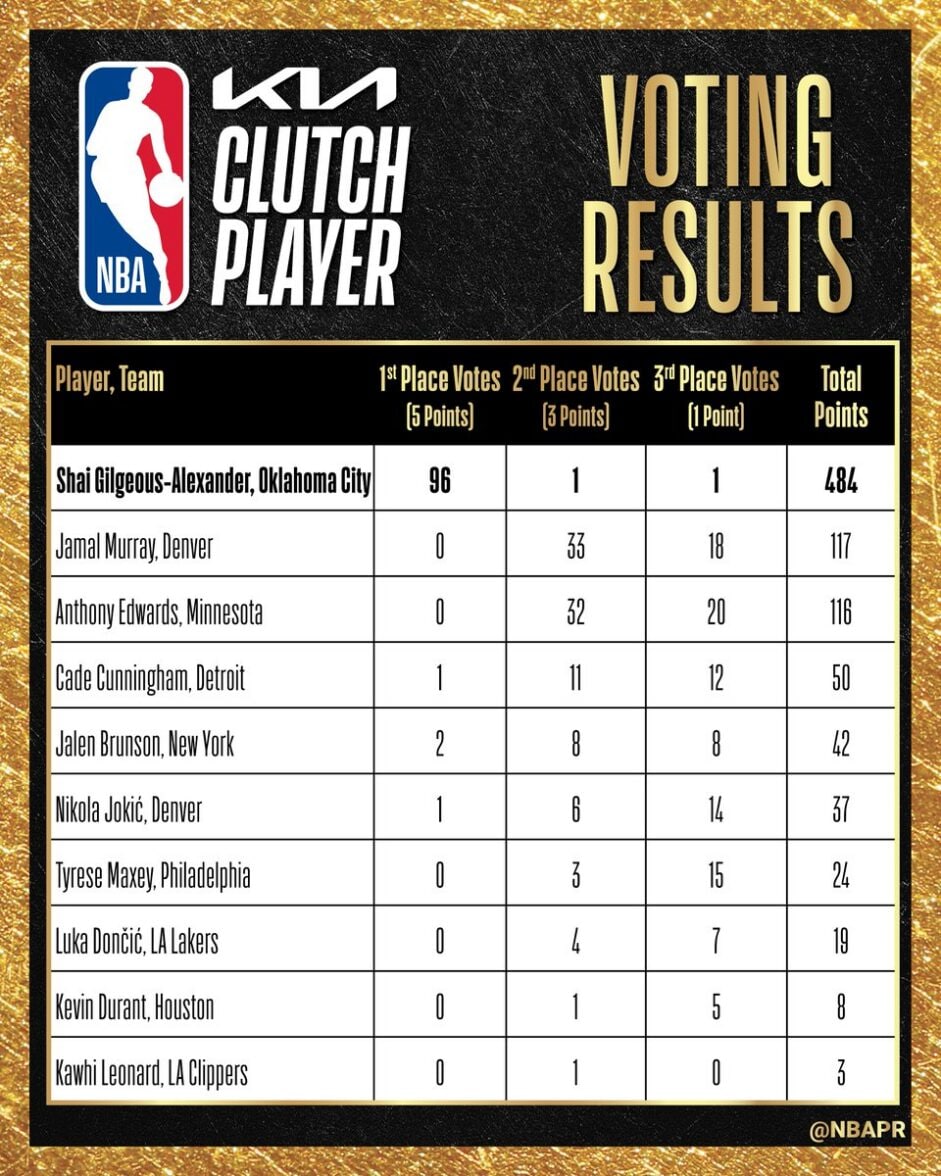
    Gilgeous-Alexander topped Minnesota’s Anthony Edwards and Denver’s Jamal Murray to win the clutch award.

    Edwards didn’t reach the 65-game eligibility standard for most league awards like MVP and the All-NBA team — and unsuccessfully appealed for a waiver that would have put him on those ballots — but his candidacy for the clutch award wasn’t affected by that rule.

    Instead, the finalists for the clutch award were decided by a survey of the league’s coaches. That whittled the group down to 14 names, which were then placed onto the ballot that a panel of 100 reporters and broadcasters who cover the league filled out last week to decide the various awards.

    Voting Results

    Gilgeous-Alexander has been a contender for the clutch award since it was added to the league’s slate of trophies; he was third last season, eighth in 2024 and seventh in 2023.

    And now, it’s his.

    “I’m proud I get to hoist it,” Gilgeous-Alexander said. “It means I’m effective out there.”

    Gilgeous-Alexander becomes the fourth player to win the clutch award, which was added in tribute to Jerry West — the inspiration for the NBA’s logo and the player long known as “Mr. Clutch” as a nod to his exploits when the outcome of games was on the line.

    De’Aaron Fox (then of Sacramento, now of San Antonio) was the first clutch award recipient in 2023, followed by Golden State’s Stephen Curry in 2024 and New York’s Jalen Brunson last season. Brunson was a nominee again this year.

    For a play to be considered clutch, by the NBA’s definition, these are the criteria: The score differential has to be five points or less, and the game has to be in either the final five minutes of the fourth quarter or in overtime.

    All three of the leading vote-getters had compelling statistical arguments for the award:

    • Gilgeous-Alexander led the league with 175 points in clutch times, plus was ninth with 21 assists in those situations. The Thunder went 20-7 in the 27 clutch games in which he played, and outscored opponents by 93 points in those clutch situations with him on the floor.

    • Edwards shot 56.5% from the field in clutch moments, the best of any of the league’s 19 players that had at least 85 clutch-time points this season.

    • Murray was second in clutch points with 166 plus led the league with 30 clutch-time assists.

    The clutch award was the second to be handed out this season. San Antonio’s Victor Wembanyama was the unanimous winner of Defensive Player of the Year, which was announced Monday.

    “It’s just very meaningful to me,” Wembanyama said Tuesday about being the first unanimous winner of the DPOY trophy. “It means that there’s no place for debate. It means that everybody agrees upon something.”

    On Wednesday, the Sixth Man of the Year winner — either the Spurs’ Keldon Johnson, the Nuggets’ Tim Hardaway Jr. or Miami’s Jaime Jaquez Jr. — will be revealed. The league’s Sportsmanship Award winner will be announced Thursday, followed by Most Improved Player on Friday.

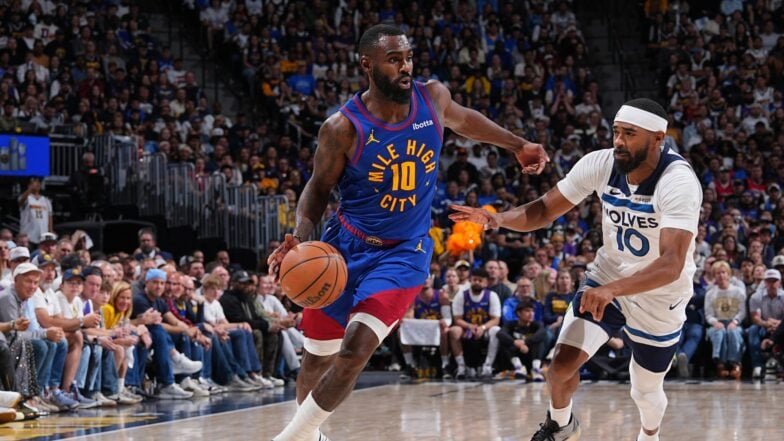
  • The Athletic: Before Hardaway Jr. found the ‘perfect fit’ he had to embrace his mistakes

    The Athletic: Before Hardaway Jr. found the ‘perfect fit’ he had to embrace his mistakes

    “I’ve embraced that role,” Hardaway says of coming off the bench.

    Editor’s Note: Read more NBA coverage from The Athletic here. The views on this page do not necessarily reflect the views of the NBA or its teams. 

    ***

    DENVER — The two words that may have changed the Denver Nuggets’ season were spoken in the summer, during a phone call between head coach David Adelman and free agent Tim Hardaway Jr.

    In search of a catch-and-shoot weapon, some scoring off the bench and a heady veteran as a target for plays after timeouts, Adelman told Hardaway what every shooter dreams of hearing:

    Green light.

    “I just said I was gonna let him be exactly what he is,” Adelman said. “The green light is the green light: If he feels like there’s an inch of him being open, he should shoot the ball.”

    Throughout his 13-year NBA career, Hardaway has to come to realize words matter. Early in his career, then-Atlanta coach Mike Budenholzer bluntly stated he would not play him. In New York, jeers from the Madison Square Garden crowd echoed in his head. And in Dallas, the silence from coach Jason Kidd amid a late-season benching cut so deep that he cried.

    To Hardaway, Adelman’s words felt like more than just a sales pitch from the Nuggets. He felt like he was seen. Appreciated. Valued. His recruitment was over.

    “Him reaching out and saying that, that’s all I really needed,” said Hardaway, who played for the Detroit Pistons last season.

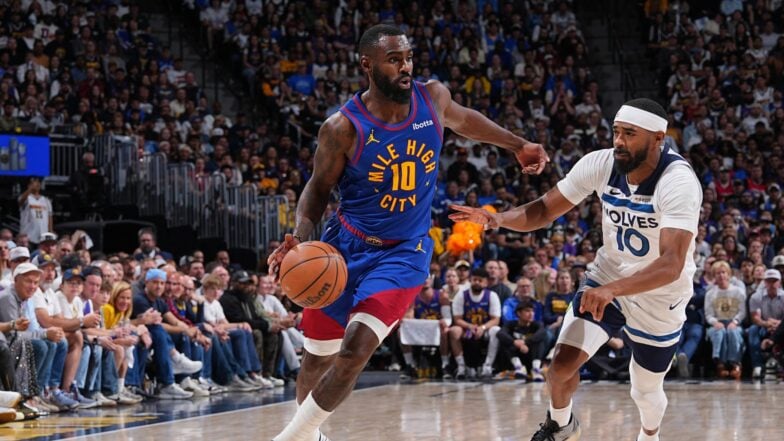
    Nine months later, Hardaway is a finalist for the NBA’s Sixth Man of the Year award, which will be announced Wednesday, and is being regarded as a lifesaver for a Nuggets season that could have easily gone off the rails because of injuries. On Monday, Hardaway was a first-half spark plug against Minnesota in the teams’ first-round series. Adelman said everything he imagined Denver was getting with Hardaway has been exceeded.

    “Beyond what I expected,” Adelman said. “He is one of the main, main reasons why we survived this season. The guy won us games. Flat out. Just really, really impactful.”

    Added Jon Wallace, the Nuggets’ executive vice president of player personnel: “He’s had immense value for us.”

    Adelman and Wallace call Hardaway the “perfect fit” — a description Hardaway revels in because it reminds him of the imperfect path he has taken to Denver. Now here he is at age 34, not only surviving but flourishing on a team with championship aspirations. He sees himself as a testament to humility, perseverance and vulnerability.

    “It’s learning from my mistakes,” Hardaway said. “Embracing those mistakes.”

    Before his career-best 40.7 percent shooting from 3-point range this season, and before he led the NBA with 205 3-pointers off the bench, and before he tied an NBA record with five games of at least seven 3-pointers off the bench, there was Atlanta.

    “Rock bottom?” Hardaway repeated before a long pause. “It was Atlanta. One-thousand percent.”

    It was his third NBA season, in the summer of 2015 after he had been traded to the Hawks from New York, which moved on after taking him with the 24th pick in 2013. After averaging a little more than 23 minutes a game in New York, Hardaway thought he was headed for a bigger role with the Hawks.

    Instead, he found himself sitting in Budenholzer’s office, getting a lecture.

    “Bud was like, ‘You’re not gonna play the first 25 games. I don’t care if people are injured or not. Like, you won’t see the floor. We’re trying to make you into the player we want you to become,’” Hardaway remembered.

    He sensed this was the beginning of the end. He wondered if he was destined for the leagues in Europe. He said he called his agent daily, as well as his Hall of Famer father, point guard Tim Hardaway Sr., fretting about his future.

    “It was my lowest point; I didn’t know if I was going to be sticking around,” Hardaway said.

    Budenholzer’s office sermon played on repeat in his mind. Today, Hardaway remembers the entire conversation as if it was yesterday. Budenholzer wanted him to be in better shape so he could not only shoot, but also defend. He wanted him to be on time. He wanted him to work on his game outside of team practices and shootarounds. He wanted him to start eating better and taking care of his body.

    “He really gave me the blueprint of how to stay in the league,” Hardaway said.

    Budenholzer’s 25-game threat didn’t quite materialize — Hardaway played in the season’s 16th game — but of the first 35 games, he appeared in only four. In the meantime, he had tours in the then-NBA Development League for the Canton Charge and Austin Spurs.

    When he returned to Atlanta, Hardaway had changed. He was arriving at the arena four hours before games and getting in extra work. If he wasn’t on the court, he was on a treadmill or stair climber.

    In the vacant arenas, and amid the rhythmic pounding on the treadmill, he gained a deeper appreciation of the men from his childhood, who worked out and played with his father.

    The younger Hardaway began to understand the league wasn’t just about skill. It was about dedication and work ethic.

    “It made me appreciate the grind and appreciate the people who came before me,” he said.

    Rock bottom morphed into a trampoline. He says his second season in Atlanta is his favorite of his 13 seasons. What used to be a grind — the workouts, the discipline, the punctuality — became his comfort. His scoring vaulted from 6.4 to 14.5 points, and his games played went from 51 to 79, including 30 starts.

    He had become a pro.

    Today, Hardaway says any time he sees Budenholzer, he makes sure he approaches him.

    “Every single time I see him, I thank him,” Hardaway said. “Yes, what he said was harsh. But it’s what made me the player I am today. He wanted me to be the best basketball player I could be. And he wanted me to work and see how hard it is to stay in this league.”

    Ten years later, at the Nuggets’ training camp in San Diego, Hardaway would pay it forward. In September, on the first day of Denver’s training camp, Wallace and Ben Tenzer, the team’s executive vice president of basketball operations, took an Uber to the team’s first practice. When they opened the gym, they froze.

    Practice wasn’t scheduled to start for another 45 minutes. Coaches hadn’t even arrived at the gym. But there was Hardaway, leading shooting drills with Peyton Watson and Bruce Brown.

    “That was the moment where we said, ‘All right, this dude is a cornerstone,’” Wallace said.

    Added Tenzer: “It was really inspiring and exciting to see that.”

    It was a tone-setting moment, borne in part from Hardaway’s Atlanta days, in part from idolizing videos of Ray Allen, who touted the need to get to the arena early, and in part from his youth, when he would attend offseason workouts of his legendary father. Every summer, he would wake up at 6 a.m. and join his dad’s workouts with trainer Tim Grover in Chicago, which included Chicago royalty like Michael Jordan, Michael Finley and Juwan Howard.

    “My dad always said you have to work on your game when no one is watching,” Hardaway said.

    Adelman said subtle touches, like Hardaway showing up early on the first day, how he speaks up in huddles and his overall perspective, has been a major element to the team’s chemistry.

    “It’s so nice to get people who have had success in their career … but who have also failed,” Adelman said. “He’s been a starter, been a sixth man, been the ninth man. Guys like that who have survived all those years and still have an impact yearly, it shows why he’s been around so long. It’s why he has fit so well. It’s just been a perfect fit.”

    In a locker room with matted, business-like personalities like Nikola Jokić, Jamal Murray and Aaron Gordon, Hardaway has been a dash of color. He is loud, often smiling and unafraid to speak his mind.

    “He’s a likable, compatible person, but he’s not afraid to say what he’s thinking … to anybody,” Adelman said. “Conversations I’ve had with him, where he’s frustrated, it’s refreshing to have somebody be emotionally accepting of who they are. A lot of these guys try to hide their emotions nowadays. It’s 2026. Everybody’s on their phone. Everybody’s inside of themselves. But Tim lives life and plays basketball expressively, and I love that about him.”

    Added starter Christian Braun: “He’s a good voice, a good personality. He’s been somebody we’ve kind of rallied around. He’s been one of the most important additions, I think, around the league this year.”

    Hardaway said the end of his 5 1/2-year tenure in Dallas helped shape his outlook on what it means to be a teammate. In 2024, as the Mavericks began their march to the NBA Finals, Hardaway slipped out of Kidd’s rotation after 11-of-44 shooting from 3 in April.

    The demotion staggered him. For weeks, he said he “tried to be a man about it” by internalizing his feelings. But as the playoffs neared, his father visited him, and while the two were at the son’s home, the younger Hardaway could no longer contain his emotions.

    “I just started asking, like … Why? Why? Why?” he said.

    He broke down and cried. And for the first time in his life, he said he felt the presence not of Hall of Famer Tim Hardaway Sr., but rather the connection of Tim Hardaway Sr., the dad.

    “What set me over the top and made me emotional was my dad just being there for me,” Hardaway said. “I mean, you have the father, the pro basketball player, but at that moment, he was dad. He was what I wanted when I was a kid.”

    He told his dad he needed help. He didn’t know how to handle his emotions. His dad told him he couldn’t let his disappointment and anger bring down the team.

    “He put his arm around me. We gave each other a hug, and we talked for hours and hours and hours,” Hardaway said of his father. “He did what I feel a dad should do for his son. It was tremendous. He helped me understand how I can, like, give my energy to others. And it helped me understand that it doesn’t hurt to ask for help.”

    In the playoffs, Kidd didn’t play Hardaway in the final four games of the first-round series against the LA Clippers. In the Western Conference finals, he played 15 minutes combined in the first two games, then was benched for the final three games. In the NBA Finals against Boston, he was an afterthought.

    Even though the elder Hardaway would later criticize Kidd for having no communication with his son about the benching, the younger Hardaway said it became a learning experience. He learned that the team is bigger than a person.

    “I always say this: The decision was made,” Hardaway said. “I could either be a person who sulks and not work, or I could be the person who works and be a great teammate to the guys who are in front of me. If they needed help or have any questions, I was there to help them out.

    “And listen, we went to the finals. So, what can I say, you know?”

    Before the Nuggets’ April 4 game against San Antonio at Ball Arena, the Denver public relations staff circulated a promotional flier touting Hardaway’s accomplishments this season, a campaign to trumpet his case for Sixth Man of the Year. The next day, Hardaway was shown the sheet, and he grinned as he studied the bullet points:

    • Most 3-pointers off the bench in the NBA this season
    • Career-high and best 3-point field goal percentage among reserves
    • Tied for the most games in NBA history with seven or more 3s off the bench
    • A total of 17 games with 20 or more points
    • Career turnover rate the best in NBA history.

    “Crazy,” he said going down the list, his smile still wide, eyes twinkling. “Oh … wow … in history …”

    What is he most proud of on the list?

    “What sticks out is all of these have to do with coming off the bench,” Hardaway said. “It means I’ve embraced that role. I’ve been a star in this league for numerous years, but to go to the bench … first, you gotta embrace it and accept the fact that this is your role; then, you have to be effective. I feel like I’ve done that, and it shows … right here.”

    He flicked the paper with his fingers for emphasis. In his 13 years, no team had promoted him like this. He is a finalist for the award along with Miami’s Jaime Jaquez Jr. and San Antonio’s Keldon Johnson, and there’s something about being in the mix, at this time of his career while working on a veteran’s minimum contract ($3.6 million), that hits differently.

    “Whoever wins that is going to be very deserving,” Hardaway said of the award. “The field is very good this year. We all know what the bigger picture is: Everybody wants to win a championship. But to even be in the conversation for the Sixth Man award, I mean, it’s amazing. I’m happy about it.”

    The next night, he went out and hit three 3-pointers against the Memphis Grizzlies to move past Michael Porter Jr. and into second on Denver’s all-time list for 3-pointers in a season with 224 (Murray holds the record with 245, set this season). Murray after the game proclaimed Hardaway the winner of the Sixth Man award.

    Meanwhile, Adelman says Hardaway’s confidence is as high as any player he has coached, no doubt influenced by the summer conversation on the phone.

    “I’ve said this all season: His green light is as bright as it can be,” Adelman said. “That’s his role on this team … and it’s what he has been doing all year. Like clockwork.”

    ***

    Jason Quick is a senior writer for The Athletic. Based in Portland, he writes about personalties and trends of the NBA, with a focus on human connections. He has been named Oregon sportswriter of the year four times and has won awards from APSE, SPJ, and Pro Basketball Writers Association.
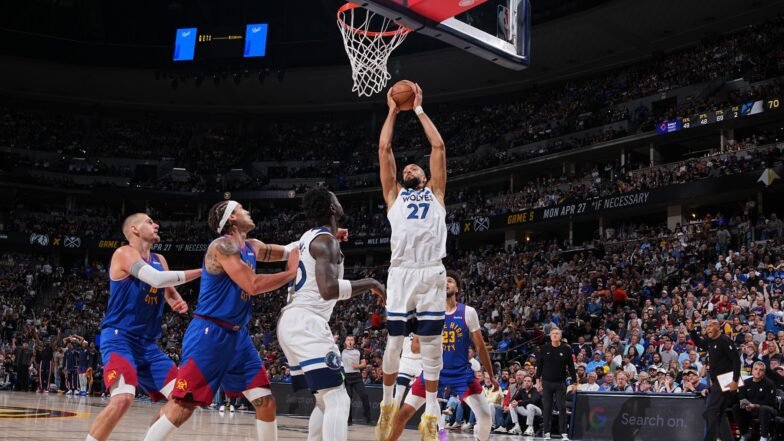
  • The Athletic: Rudy Gobert stands taller than ever in Game 2 showdown

    The Athletic: Rudy Gobert stands taller than ever in Game 2 showdown

    Rudy Gobert was up to the challenge of defending Nikola Jokić one-on-one on Monday night.

    Editor’s Note: Read more NBA coverage from The Athletic here. The views on this page do not necessarily reflect the views of the NBA or its teams. 

    ***

    DENVER — Rudy Gobert knows you don’t believe in him.

    He knows that nothing delights you more than opening your phone to see video of that one time a guard caught him in an ISO and hit a step-back 3 over him. He knows you chortle so loudly that the Cheetos dust sprays from your mouth as you repost the clip and comment in all caps, “THIS Y’ALL’S DPOY?!?”

    He knows because he hears you. Some NBA players mute the volume on social media. They couldn’t care less about what anyone says about them because the money and the stats and the wins do all the talking. Gobert is not one of those players. He is keenly aware of his place in the NBA discourse. His pride won’t let him look the other way as the disrespect flows in.

    Rudy Gobert knows you do not appreciate him.

    The Minnesota Timberwolves big man knows that no matter how overwhelming his on/off splits are, it will never be enough for many of you to look past the missed layups or the fumbled passes to see him for who he is — one of the greatest defensive players to ever play the game.

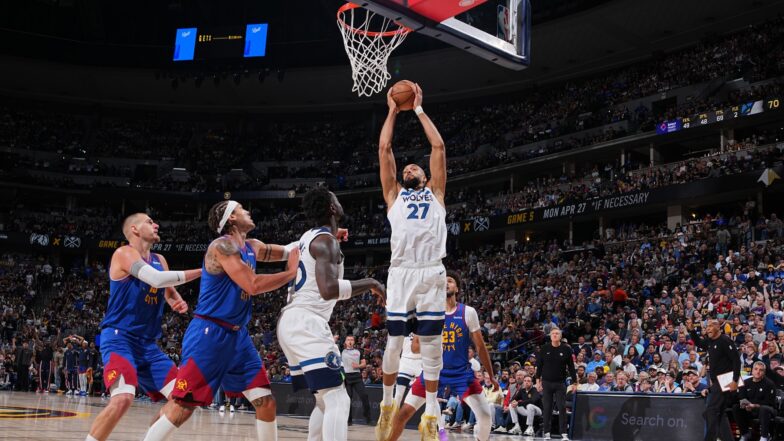
    He knows because he sees you. He examined the vote tallies for the Defensive Player of the Year award, which were released on Monday. That Victor Wembanyama won it unanimously was not a surprise to anyone, including Gobert. That Gobert finished a distant fourth, 19 points behind the Detroit Pistons’ Ausar Thompson for third place, rippled through the Timberwolves’ locker room before, during and after one of the best quarters of defense he has ever played in Monday’s 119-114 victory over the Denver Nuggets in Game 2 of their first-round playoff series.

    Gobert — in Year 13, with a record-tying four DPOYs on his resume and more than $250 million in salary earned — is finally starting to realize that you don’t matter. Not when he has almost single-handedly turned a franchise long known for defensive ineptitude into one of the stingiest groups in the league. Not when he has been a primary figure in the golden age of Timberwolves basketball, which includes playoff appearances in all four of his seasons in Minnesota and back-to-back runs to the Western Conference finals.

    Not when Anthony Edwards pulls him aside before the start of Monday’s fourth quarter, knowing the Timberwolves’ season essentially hinged on the next 12 minutes, and looks to Gobert to be the one to save them. In that moment, the Wolves were down 93-90 in the game and 1-0 in the series. Falling behind 2-0 in a best-of-seven against the high-octane Nuggets would have meant almost certain death. In that moment, Edwards craned his neck up to stare the 7-foot-1 Gobert in the eyes and deliver a challenge that bordered on the impossible.

    Nikola Jokić, the three-time MVP who averaged a triple-double and became the first player since Wilt Chamberlain in 1968 to lead the league in rebounds and assists in the same season, was on the other sideline. He may be the most unstoppable offensive player the game has ever seen. He has made mincemeat of every big put in front of him, including Wembanyama, and including Gobert on many a night. But unlike you, Edwards knew Gobert was up to the task.

    “We ain’t bringing no double team,” Edwards told him. “You gonna guard him one-on-one all night.”

    That would seem to be as close to basketball heresy as a team could get. Jokić put up 56 points, 16 rebounds and 15 assists against the Wolves in a Christmas Day win. Last season, Joker went for 61 points, 10 rebounds and 10 assists in a loss to Minnesota.

    But Edwards, and the rest of the Timberwolves, know more than you. Truth be told, some of them get as frustrated as you do when Gobert turns the ball over or flubs a layup. They also see the impact he has made in Minnesota since he was acquired from Utah in 2022 in what many of you, at the time, called the worst trade in NBA history. They have watched him turn the Wolves into a top-five defense. They have seen how opposing drivers don’t even think about going to the rim with Gobert in the vicinity.

    So they didn’t hesitate to put a generational defensive player on a generational offensive player and tell him to go to work. Gobert responded with one of the best performances of his life. After being mired in foul trouble for much of the first three quarters, Gobert held Jokić to 1-of-7 shooting in the fourth. Jokić missed both of his 3-pointers, including one airball, didn’t get to the free-throw line and had one assist. The Timberwolves outscored the Nuggets by 10 points in Jokić’s eight fourth-quarter minutes, outscored the best offense in the league 29-21 in the quarter and completed a comeback from 19 points down early in the second quarter to even the series at 1-1.

    “I think Rudy’s probably the most misunderstood player in the history of the game,” said Wolves point guard Mike Conley, who has played 7 1/2 seasons with Gobert in Minnesota and Utah. “The way that he impacts winning, just because it doesn’t look pretty all the time or is not the sexiest thing, people bypass the other 95 things he does for our team.”

    Gobert said the fourth-place finish in DPOY didn’t give him any extra juice. But he wasn’t very convincing.

    “I know who I am,” he said. “Not the first time I get disrespected, probably not the last. I’m going to keep being myself. If they want to disrespect greatness, you can just take it for granted, whatever. Sooner or later, they realize the impact.”

    The Nuggets have seen it first-hand in this series. Jokić had 25 points, 13 rebounds and 11 assists in the Game 1 win, but he also turned the ball over five times and was 2 of 7 on 3s. On Monday, he finished with 24 points, 15 rebounds and eight assists, but he turned it over three times and scored just four points on 1-of-8 shooting with zero offensive rebounds in 21 minutes with Gobert on the floor.

    As absurd as it sounds, Gobert may have had Jokić shook. In the closing seconds, with the Nuggets down 115-113, Jokić finally got a little bit of space. As he lumbered down the lane, he had a clear look at the kind of short floater that he makes in his sleep, which would have tied the game. Instead, he hesitated and dumped the ball to Christian Braun, who was fouled. Braun only made one of the two free throws.

    That’s like striking out Barry Bonds four times with the bases loaded. That’s stuffing Earl Campbell at the goal line on three straight runs. That’s knocking Taylor Swift off the top of the charts a week after she released her latest album.

    “He’s making me make tough shots,” Jokić said. “He’s big, long, he can reach the ball from any kind of angle or position. He’s a really good defensive player.”

    The 30th meeting between these two rivals in the last four years was as unhinged as so many of the ones that have preceded it. The Timberwolves opened the game with a 12-minute brain fart in the first quarter. They shot 33 percent from the field, refused to drive against Denver’s non-existent rim protection and allowed the Nuggets to shoot 67 percent from the field, 67 percent from 3 and 90 percent from the line. At one point, they fouled Denver shooters on three straight 3-pointers, and the Nuggets turned all of them into four-point plays.

    Less than one minute into the second quarter, the Wolves were down 19 points. Bones Hyland committed three fouls in four minutes, including an inexplicable decision on a three-on-one when he declined to give the ball up to either Randle or Reid and instead plowed into Tim Hardaway Jr. for an offensive foul.

    But the Wolves have been here before, in this building, against the devastating two-man game of Jokić and Jamal Murray, down big. Just like in Game 7 of the 2024 West semifinals, they never succumbed. When they finally started attacking the basket, turning Jokić into a turnstile and blowing by any perimeter defenders the Nuggets put out there, the game turned in their favor.

    “Go at Jokić, Jamal, all the bad defenders,” said Jaden McDaniels, who scored 14 points. “Tim Hardaway, Cam Johnson, Aaron Gordon, the whole team. Like, just go at them.”

    There was more spice where that came from. Edwards and Jokić got into a brief shoving match in the fourth quarter. Braun barked at the Wolves bench after hitting a 3.

    Julius Randle bounced back from an awful Game 1 with a bully ball Game 2, hammering the Nuggets around the rim and scoring 24 points with nine rebounds and six assists. Playing on one leg, Edwards put up 30 points, 10 rebounds and two blocks, and Donte DiVincenzo had 16 points, seven rebounds and six assists. Hyland overcame the foul trouble for 13 points in 10 minutes, and Naz Reid had 11 points and nine boards.

    After trailing 44-25 early in the second, the Wolves outscored Denver 94-70 over the final 35 minutes.

    “We was on one cord, I feel like, on the defensive end tonight,” Edwards said. “Especially once they went on those runs.”

    After the game, the Timberwolves couldn’t stop talking about Gobert’s performance against Jokić. They know how much criticism he takes from players and league observers. Even if they might utter some similar annoyances under their breath every once in a while, Gobert is one of their brothers. It is OK for them to go at him in private. But any time someone outside the family starts insulting him, they fight for their brother.

    “Everybody’s gonna say this about Rudy. He’s this. He’s that,” Edwards said. “They don’t understand what he means to us when he’s on the floor. People don’t want to lay the ball up around him. People just don’t want to go at Rudy. Regardless of what they say about him on the offensive end of the floor, he’s a four-time Defensive Player of the Year for a reason. He’s been doing it at a high level for a long time, and we need him on the floor.”

    When the rest of the league was laughing at president of basketball operations Tim Connelly for trading all those draft picks and players for Gobert in 2022, the Wolves paid them no mind. They knew what they were getting and what they needed, a culture changer on defense and one of the hardest workers in the league to ensure that the young core of Edwards, McDaniels, Reid and, at the time, Karl-Anthony Towns, could get some real playoff experience.

    Gobert has been all that and more for Minnesota. There have been times when he has struggled, when it looked like this experiment wasn’t going to work. But in aggregate, over the course of four years, with all of the playoff games he has helped deliver, he has been worth every pick, every player, every joke made at their expense along the way.

    “He’s an outstanding defender, he’s an outstanding professional, he’s an outstanding human,” Minnesota coach Chris Finch said. “He’s about the right things, and it’s just laughable, small-minded and petty all the crap that people decide to give Rudy.”

    Gobert has opened this rubber match with two excellent games, including a 17-point, 10-rebound effort in the Game 1 that slipped away from the Wolves in the final five minutes.

    “He knows, in his mind, he’s the best defensive player in the world,” Conley said. “He approaches every game that way. He wants every matchup. He wants to guard the best, regardless if that means some nights they score a lot on him, he’s taking that challenge. A lot of people run from that. He’s somebody that doesn’t run.”

    Game 3 is Thursday night in Minnesota. Gobert knows that Jokić will probably get the better of him sooner or later. He is far too talented not to have an explosion at some point. But he will keep throwing everything he has at the best player in the world.

    You may have given up on him a long time ago, but Gobert knows his teammates and his coaches stand shoulder to shoulder in his corner. And that is all that matters to him anymore.

    ***

    Jon Krawczynski is a senior writer for The Athletic covering the Minnesota Timberwolves, the NBA and the Minnesota Vikings. Jon joined The Athletic after 16 years at The Associated Press, where he covered three Olympics, three NBA Finals, two Ryder Cups and the 2009 NFC Championship Game.

  • Timberwolves-Nuggets Game 2: Wolves claw back on the road

    Anthony Edwards posts 30 points and 10 rebounds as the Timberwolves win a thriller over the Nuggets to even up the series.

    • Download the NBA App

    A reality for the Denver Nuggets for most of Nikola Jokić’s tenure has been the challenging underbelly of the three-time Most Valuable Player’s magnificence. Namely, the stretches of games when he sits down, a.k.a., “non-Jokić” minutes.

    The Minnesota Timberwolves have their own on/off issues at times with their center, Rudy Gobert. Their “non-Gobert” minutes can mean one thing to the Wolves’ offense but something altogether different to their defense.

    For the two teams’ fans and lovers of intense, entertaining NBA playoff basketball, though, a more pressing concern now is the “non-Wolves and Nuggets minutes” they’ll have to endure between the final horn of Game 2 and tipoff of Game 3.

    This crazy-close first-round series shifts to Target Center in Minneapolis Thursday (9:30 ET, Prime Video). That means approximately 4,110 minutes to fill, some of which can be covered by finding a replay to watch of Minnesota’s 119-114 Monday at Ball Arena.

    Oh, and burning a few more here by reading about four takeaways from the Wolves’ recovery Monday to even the series at 1-1:


    1. Your quarter, our quarter

    Things looked bleak for the Wolves when Denver scored 17 unanswered points early, stacked no fewer than three 3-pointer-plus-the-foul plays to bump its lead to 14, then used assorted saves, charges and hustle plays to lead at the end of the first quarter, 39-25.

    Things looked bleak for the Nuggets, though, when Minnesota finally stopped settling for perimeter shots, put stress on defense by attacking the paint, unveiled a little “small ball” when foul trouble sent Gobert to the bench, and outscored the home team in the second quarter, 39-25.

    Mirror image scores across two action-packed periods, dialed to full chaos when Denver’s Jamal Murray beat the halftime buzzer with a heave from the far side of the logo – 51 feet – to tie it, 64-64. The Wolves’ initial doldrums got buoyed in those second 12 minutes, Denver let go of the proverbial rope a bit, and then Murray’s circus shot hit the reset button for the subsequent 24 minutes.

    Jokić focused on finding teammates early, scoring just six of his eventual 24 points in the half. Minnesota’s Anthony Edwards went the other way, amassing 20 of his 30 before halftime once he felt secure that his achy right knee wouldn’t betray him. And teammate Julius Randle, eager to do better than in the opener Saturday, followed Edwards’ lead with 18 of his 24 by the break.

    “I feel like I can’t let him down,” the veteran power forward said of Edwards. “If he’s out there battling, there’s no excuse where I can’t give my best and make the extra-effort plays. It energizes me and makes me want to be on my best game.”

    Coaches being who they are, neither Chris Finch nor David Adelman was pleased with two quarters that wound up precisely half-full and half-empty.

    “We had a great first quarter, they had a great second quarter, the game basically restarted from there,” Adelman said.

    Anthony Edwards and Jamal Murray combined for 60 points in the Game 2 duel.

    2. Second chances saved the Wolves

    Eight of the game’s 15 lead changes came after halftime, as did three of the night’s seven ties. There were lots of similar stats, from shooting numbers and free throws earned to turnovers and scoring margins (neither team led or trailed by more than six the rest of the way).

    But one big disparity came from Minnesota’s ability to keep possessions alive, grabbing offensive rebounds and making the Nuggets pay for their eagerness to hurry upcourt. In their five-point victory, the Wolves built a 20-3 advantage in second-chance points.

    “In a hard-fought game like that when you work so hard to get a stop,” Adelman said, “and then just give up second-chance points … it kept them in the game. Every time we made a run, it felt like that’s what stopped the run. That’s something we have to clean up as a team.”

    3. A little respect for Rudy

    Gobert’s early fouls gave Minnesota a chance to run offense without him on the floor and, frankly, it freed up the Wolves in the second quarter. The paint was more open without their big man lurking, and with Jokić on the side, there wasn’t much to discourage Edwards, Randle, or the rest from working their way closer to the rim.

    Down the stretch, however, Gobert was back. And playing an active, conscientious level of defense much as he had in Game 1. He and his four Defensive Player of the Year awards called Jokić’s three MVP trophies, and won the hand.

    He contested a three by Jokić that was an air ball. He defended the Denver center on drives and various short shots from the lane. He banged back when Jokić posted up. The Wolves’ often-criticized big man did come up short when Jokić drove and dunked to get Denver within 115-113 with 49 seconds left. But Gobert already had stood strong.

    “I want to give a shoutout to Big Ru, man,” said Randle. “It’s not going to show up in the box score but what he did, especially in that fourth quarter … Ant challenged him, he said ‘I need you to stop fouling.’ He came in and how he guarded Jokić, it was super-inspiring to the team. It lifted the team. Him getting stop after stop at the end of the game was huge to us.”

    Said Edwards: “I told him ‘Brother, we’re half the team when you’re on the bench. Everybody gonna say this about Rudy, he’s this, he’s that. They don’t understand want he means to us when he’s on the floor. People don’t want to lay the ball up, people just don’t want to go at Rudy.”

    4. Two late Nuggets second-guesses

    It was 115-113 when Jokić got the ball near the foul line and, as he is known to do, worked his way closer. Rather than unleashing one of his finesse hooks, floaters or jumpers from 12 feet to tie, he saw teammate Christian Braun closer still. His pass brushed against a Minnesota defender, slowing enough for more Wolves help to come and hammer Braun.

    Braun, who isn’t a three-time MVP, missed on the first of his two free throws. Denver trailed by one with just 19.1 seconds left.

    “I should have definitely took that floater,” Jokić said.

    Randle hit two foul shots moments later for a 117-114 lead. When Murray pushed the ball up, he got within 21 feet of the basket before launching a jumper. Had he made it, Denver still would have been down by one point, with 11 seconds left. He missed.

    The Nuggets might have played the foul game from there. But a three by Murray could have set up overtime. Either way, “I needed to make the shot for it to go well,” Murray said. “I didn’t make it.”

    * * *

    Steve Aschburner has written about the NBA since 1980. You can e-mail him here, find his archive here and follow him on X.  

  • Hawks-Knicks Game 2: Atlanta steals one at MSG

    The Atlanta Hawks overcome a 12-point 4th quarter deficit to defeat the New York Knicks, 107-106, to tie up the series at 1-1. CJ McCollum leads the Hawks with 32 points.

    • Download the NBA App

    The New York Knicks were cruising to a 2-0 lead in their first round series with the Atlanta Hawks. They were up 12 entering the fourth quarter and were the best fourth-quarter team in the league this season.

    After their win in Game 1 two nights earlier, they were 39-0 when leading by at least 12 points in the final period.

    But Game 2 was another story, and the Atlanta Hawks found a way to erase that 12-point deficit and escape with a a 107-106 victory at Madison Square Garden on Monday.

    CJ McCollum led Atlanta with 32 points, including the go-ahead bucket with 34 seconds left. The Hawks also got a big performance (19 points and a key block) from Jonathan Kuminga off the bench and some huge defensive plays from Nickeil Alexander-Walker.

    “It’s a long game,” McCollum said of his team’s comeback after the Knicks were seemingly in control. “You got to play to zero. The way the game is played now, it’s so fast, there’s so many 3s, so many possessions, you always have a chance. You just have to stay within one or two possessions, stay a punch away, and then we’ll throw the last punch.”

    Here are some notes, quotes, numbers and film as the Hawks evened the series at one game apiece…


    1. Attacking Brunson bears fruit

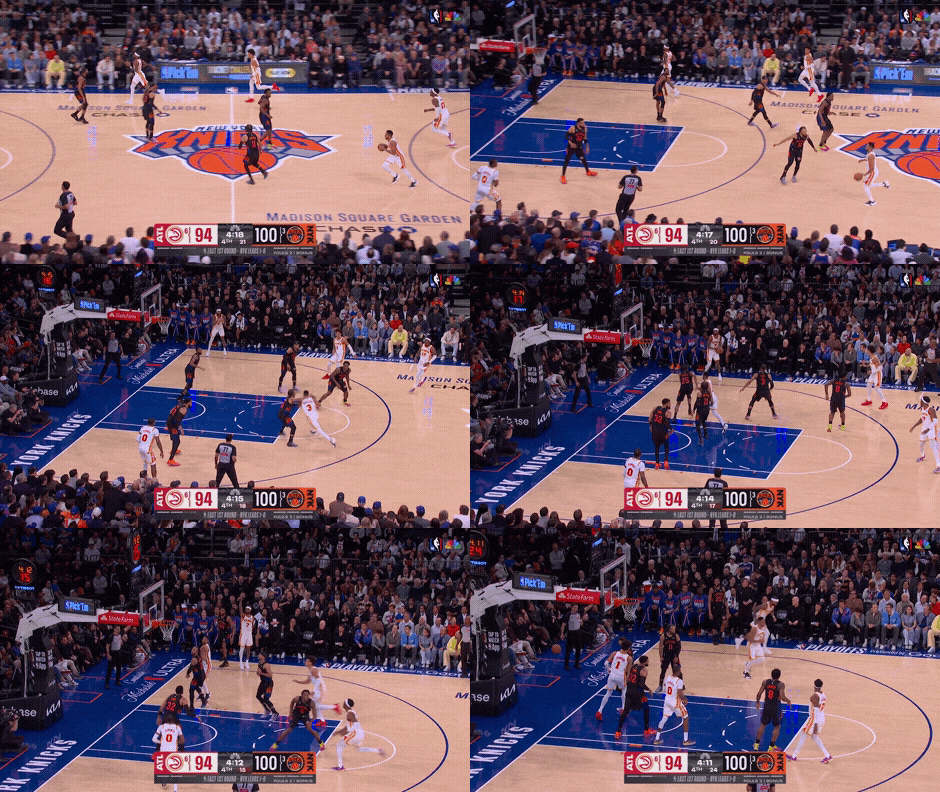
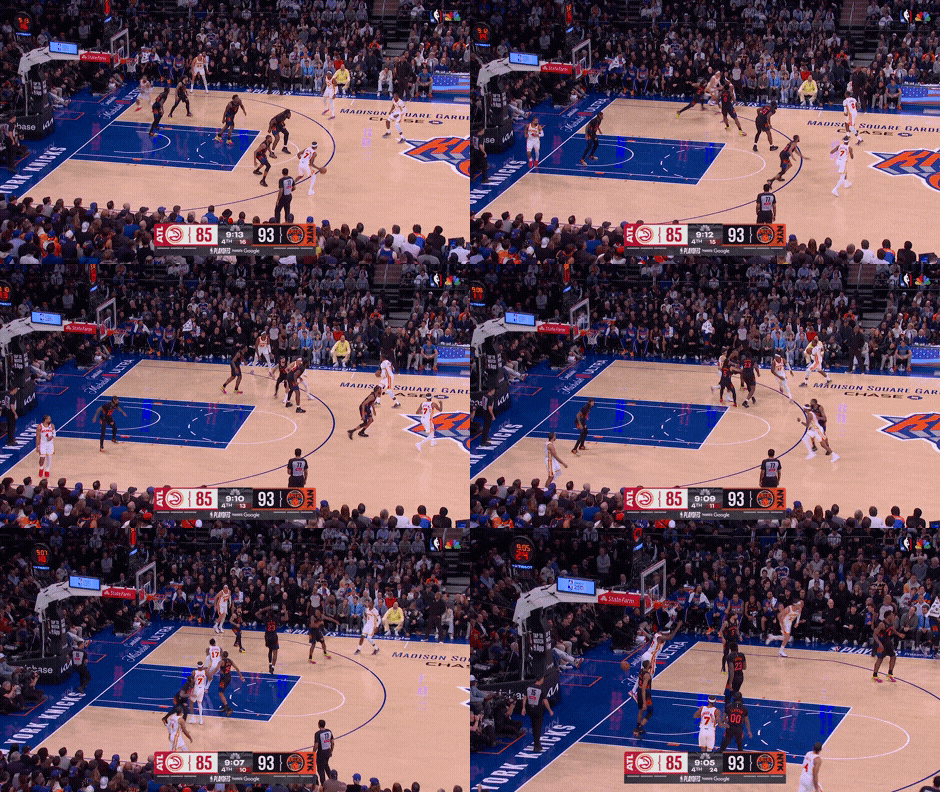
    The Hawks had kind of let Jalen Brunson off the hook in the first game of this series, not targeting him as much as they could or should have. But they had some success attacking him throughout Game 2, and they went at him for four key buckets down the stretch on Monday.

    With the Hawks down six and a little less than five minutes left, Kuminga found himself matched up with Brunson in transition. He didn’t hesitate and used an in-and-out dribble to get past Brunson for a layup.

    On the next possession, McCollum had Brunson in front of him in transition. He crossed him over, drew help from Mikal Bridges and found Alexander-Walker in the corner for a 3-pointer that got the Hawks within three.

    CJ McCollum assist on Nickeil-Alexander Walker 3-pointer

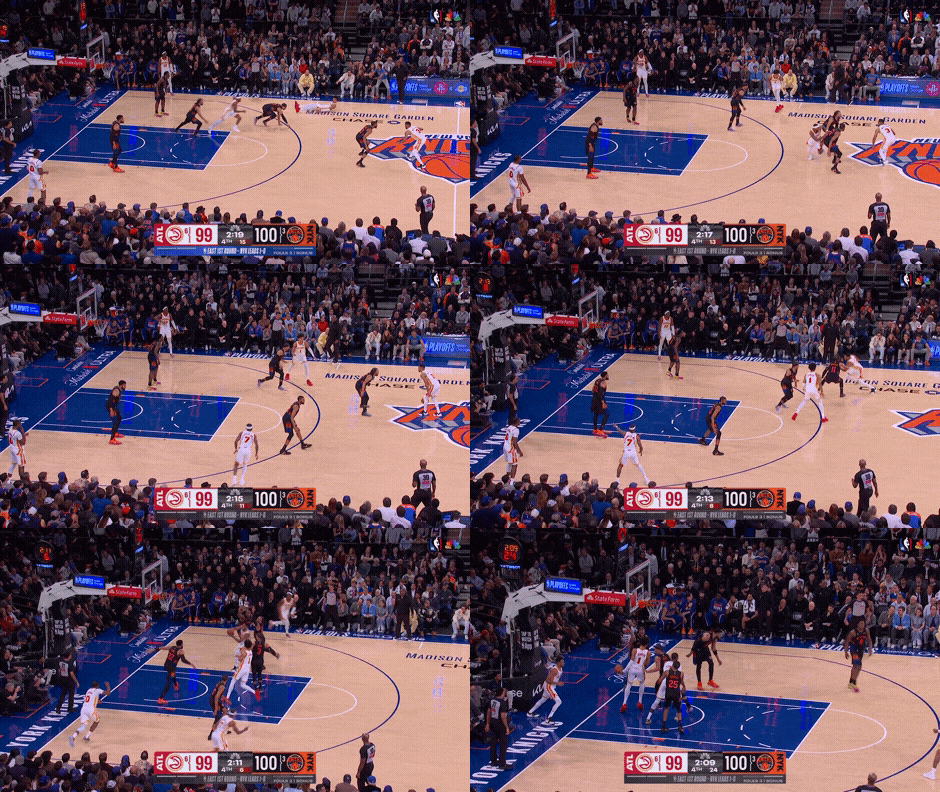
    A few possessions later, Alexander-Walker set a screen for McCollum to get Brunson switched onto the ball. A double-crossover had Brunson flailing and McCollum putting the Hawks ahead by one…

    CJ McCollum isolation against Jalen Brunson

    Next possession, same thing, except McCollum blew by Brunson going left. And a runner over Karl-Anthony Towns put the Hawks up three with a minute and a half left.

    Brunson has been the primary defender on McCollum for much of these two games. The Knicks tried to change the assignments down the stretch on Monday, but the Hawks were still able to get the matchup they wanted, and it could be a critical cat-and-mouse game going forward.

    2. Knicks need to clean up pick-and-roll defense

    Brunson’s one-on-one defense isn’t the only defensive issue the Knicks have had in this series. Too often, the Hawks have gotten clean rolls to the basket with insufficient help from the weak side.

    The pick-and-roll got the Hawks a couple of key buckets early in their fourth-quarter comeback.

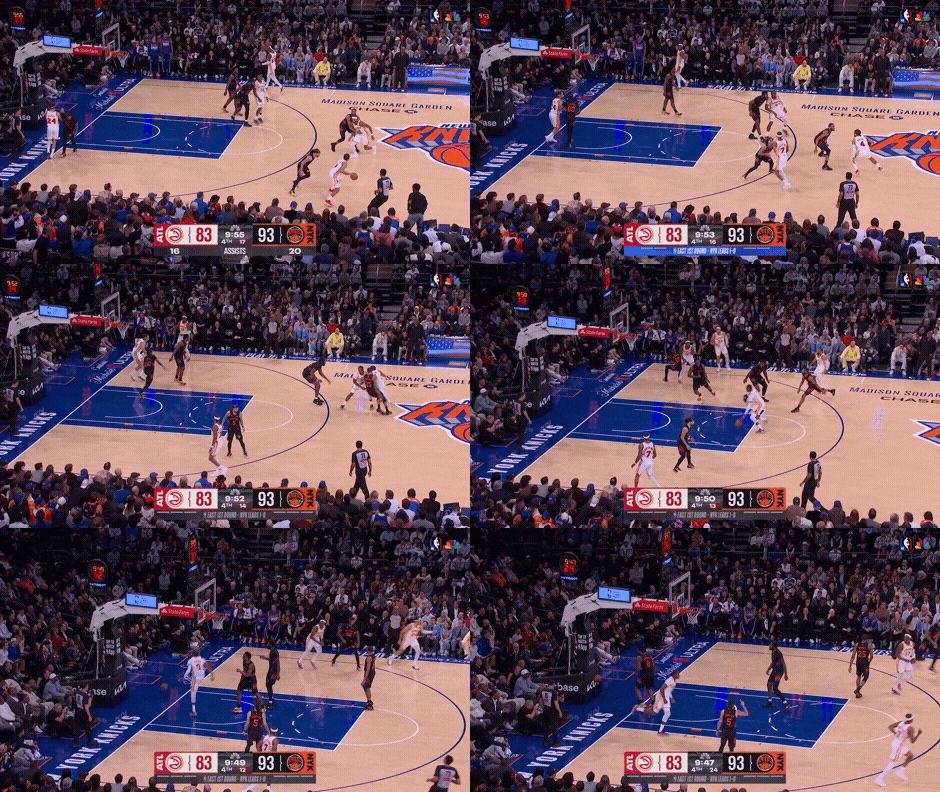
    First, Kuminga set a screen for Gabe Vincent, and with Corey Kispert curling off an Onyeka Okongwu off-ball screen in the right corner, Jordan Clarkson was scrambling out of the lane. With Alexander-Walker as the lone spacer on the left side of the floor, there was no help when Kuminga got a pocket pass from Vincent…

    Gabe Vincent assist to Jonathan Kuminga

    On the next possession, OG Anunoby switched an Okongwu handoff to Kuminga, but Mitchell Robinson stayed with the ball. And with the weak-side defenders unaware of the breakdown, Okongwu rolled to the rim untouched…

    Jonathan Kuminga assist to Onyeka Okongwu

    The Knicks have played some good defense in these two games. The Hawks could not generate good shots in their half-court offense in the first quarter on Monday. But New York also has some things to clean up as the series moves to Atlanta.

    3. Knicks dominate the glass

    The Hawks ranked ninth in defensive rebounding percentage (70.2%) in the regular season, and they kept the Knicks off the offensive glass in Game 1. But Game 2 was their third-worst defensive rebounding game of the season, with the Knicks retaining 42.6% of available offensive boards and registering 24 second chance points.

    Robinson had four offensive boards, Towns had three, and Jordan Clarkson somehow had five in just 11 minutes off the bench, including a pair on consecutive possessions midway through the second quarter. He beat Alexander-Walker to the glass for the first and then tipped in a Brunson miss less than 45 seconds later.

    The Hawks out-shot the Knicks in this game, and New York was also just 17-for-27 (63%) from the free throw line, with Robinson accounting for only one of those 10 misses. But New York is aggressive on the glass, and Atlanta is both short and shorthanded on the frontline. And rebounding will be a storyline throughout this series.

    “We had a hard time on the defensive glass,” Hawks coach Quin Snyder said afterward. “Those plays can really be deflating, but I thought we responded to those. We never quite figured it out, but we dug in in other aspects of the game.”

    4. Knicks’ bench struggles this time

    When you have two All-Stars, one benefit can be the ability to have at least one of the two on the floor for all 48 minutes. But if you fully stagger their minutes so that’s the case, you minimize the time that they’re on the floor together.

    Brunson and Towns can be one of the most lethal pick-and-roll combinations in the league, and the Knicks have scored efficiently in this series (1.20 points per chance) when a Brunson-Towns screen has led directly to a shot, turnover or trip to the line.

    So Knicks coach Mike Brown has chosen not to stagger their minutes, and the Knicks have had some stretches with both All-Stars on the bench. Their bench was great in Game 1 on Saturday, when the Knicks outscored the Hawks by a point in a little less than nine minutes with both Brunson and Towns off the floor.

    It was a different story in Game 2, when the score was Hawks 23, Knicks 16 when both Brunson and Towns were on the bench. New York shot 6-for-17 (1-for-6 from 3-point range) and had five turnovers in that time.

    In a one-point game, Brunson, Towns and Josh Hart all played fewer than 36 minutes, something you’d have a hard time imagining a year ago. The Knicks’ bench has generally been terrific this season, but Miles McBride, Landry Shamet and Jose Alvarado combined to shoot 0-for-7 on Monday.

    It will be interesting to see of Brown rests his two All-Stars at the same time again in Game 3 in Atlanta on Thursday (7 p.m. ET, Prime Video).

    * * *

    John Schuhmann has covered the NBA for more than 20 years. You can e-mail him here, find his archive here and follow him on Bluesky.

  • Cavaliers-Raptors Game 2: Cleveland takes control of the series

    Donovan Mitchell and James Harden prove to be a formidable combination as the Cavaliers defeat the Raptors, 115-105, and take a 2-0 series lead.

    LeBron James is long gone from Cleveland and has been for years, yet there’s something he left behind that the Cavaliers are flexing to their advantage in this first round playoff series.

    Their postseason dominance over the Raptors continues, even if the “LeBronto” nickname left town with LeBron.

    There could be a cry for a new moniker, now that Donovan Mitchell and James Harden have assumed the role of making life in the spring miserable for the Raptors. The Cavs have now beaten Toronto 12 straight times, and the latest victory was accomplished Monday when Mitchell and Harden couldn’t be contained and Evan Mobley chipped in as well.

    “Your superstars step up. This was a superstar’s game,” said Cavs coach Kenny Atkinson.

    Harden and Mitchell, especially. They combined for 58 points and took turns distancing the Cavaliers from the Raptors, enough to assume a 2-0 lead in the series and send the Raptors back home and scrambling for answers.


    Here are the takeaways from the Cavs’ 10-point Game 2 win:

    1. Mitchell and Harden are two much for the Raptors (so far)

    Donovan Mitchell (30 points), James Harden (27 points) and Evan Mobley (25 points) combine for 82 to give the Cavs a 2-0 series lead.

    Given the stakes and the situation, this served as the high-water mark for the Mitchell-Harden backcourt tandem which was formed at the trade deadline a few months ago. They were fluid and forceful and a handful Monday for the Raptors and really through both games.

    This was precisely what the Cavaliers hoped for when they fused these two stars together and now they’re reaping the benefits of that decision. Both players are capable of going downhill and attacking the rim for layups or fouls, or shooting from 15 feet and beyond. It’s a combination that’s tough to defend, even for a decent group of Toronto defenders.

    Not only did they score, but did so efficiently: 22-for-35 combined shooting, along with 12 rebounds and nine assists. They’re both very good isolation scorers off the dribble. And not only did they get buckets but each bring a tendency to take — and make — tough shots, while double teamed or in traffic.

    There was a stretch where Mitchell had 17 points in 20 minutes and Harden 19 in 19, an impactful 1-2 punch.

    “That’s why they’re stars,” said Atkinson.

    Another key moment, and a curious one at that, was when Harden “gently” pushed off on Scottie Barnes, who fell to the floor. While Raptors coach Darko Rajakovic jumped from his seat and screamed for a foul, Harden shot a cold look at his fallen defender for about a second, then shot a 3-pointer that needed two bounces before falling in.

    The chemistry between Harden and Mitchell seems surprisingly solid given how little time they’ve spent together, but each seems determined to make it work, which it has in this series. It helps that there’s a mutual respect; Harden willingly yields to Mitchell, and Mitchell surrenders the ball-handling to Harden, who’s the superior passer.

    2. Mobley brought the Cavs a Big 3

    Unwilling to let his teammates have all the fun, Mobley delivered solidly by shooting 11-for-13 for 25 points. And in the process he showed how tough the Cavs are to beat if they can get someone to play on the level of Harden and Mitchell.

    Mobley comes into the playoffs following a season that was solid but partly because of injuries, not exactly a step up from 2024-25 when he was an All-Star and Defensive Player of the Year. Big things were expected in the follow-up, and it waited until Game 2 of the first round.

    “He’s in a phenomenal place physically, and mentally he’s in a great flow,” said Atkinson.

    When Mobley is this active on the offensive end, the Cavs aren’t as predictable and opposing defenses are punished if they pay too much respect to Harden and Mitchell. Also, Harden’s passing should not only benefit Mobley, but Jarrett Allen.

    3. Brandon Ingram has some ‘splaining to do

    He was mainly a ghost down the stretch of Game 1 and complained about the lack of touches. Then his Game 2 response was rather tame, putting it mildly. The Raptors aren’t trailing 0-2 in this series all because of Ingram, but his lack of an impact offensively is a serious factor.

    If you combined the second half of Game 1 with the first half of Game 2, Ingram shot a combined 0-for-7 with four points.

    Overall, in the last six quarters of this series he’s 3-for-16 shooting (11 points), a glaring lack of production from the Raptors’ leading scorer. And his five turnovers Monday didn’t help, either.

    He’s having a forgettable series so far, and this was inflamed when he insisted that “me shooting nine shots is not going to win basketball games” after Game 1.

    Well: Ingram shooting 15 times in Game 2 didn’t win a basketball game, either. Ingram has been humbled for sure, mainly by Dean Wade, but also by his own problems. He’s a rhythm scorer who thrives in the mid-range yet never established any flow Monday, even with more touches.

    4. Raptors still missing Quickley

    Immanuel Quickley missed his second straight playoff game with hamstring issues and the absence of the Toronto starting point guard was an obvious setback for the club.

    There was no indication Tuesday about his status for Game 3; in the meantime, the Raptors went searching for additional scoring and playmaking and leaned on Scottie Barnes and RJ Barrett with good results. They combined for 48 points and 10 assists but also a minus-23 combined.

    Without Quickley, backup Jamal Shead had to play 38 minutes; he averaged 22 during the season. He had three turnovers and made one shot.

    The Raptors also made the telling decision to reduce Jakob Poeltl’s playing time. The starting center saw just 10 minutes, his lowest in the playoffs for the Raptors.

    Clearly, Toronto is grasping to find solutions and a workable rotation against the Cavaliers. Good thing there’s a break between games, because the Raptors will need the next few days to figure it out for Game 3.

    * * *

    Shaun Powell has covered the NBA since 1985. You can e-mail him at spowell@nba.com, find his archive here and follow him on X.

  • 3 things to watch in Rockets-Lakers Game 2

    3 things to watch in Rockets-Lakers Game 2

    Luke Kennard hopes to have another big performance to help L.A. take a 2-0 series lead over Houston.

    Whether Houston Rockets All-Star Kevin Durant is available for Game 2 against the Los Angeles Lakers doesn’t alter Houston’s mission.

    The Rockets need improved play offensively and defensively if they want to avoid a 2-0 deficit against the Lakers, who took a 1-0 series lead with a 107-98 victory on Saturday.

    And of course, it will help the Rockets if Durant can play.

    Here are three things to watch for in Game 2 of this first-round Western Conference series between the Rockets and Lakers on Tuesday night (10:30 ET, NBC/Peacock).


    1. Will Durant play in Game 2?

    Remove 26 points, 5.5 rebounds and 4.8 assists per game and nearly 50/40/90 shooting splits from a lineup, and it will have an impact. The Rockets were unable to compensate for Durant’s absence in Game 1.

    Durant injured his right knee during Wednesday’s practice when he bumped knees with a teammate.

    “It’s soreness. It’s very tender,” Rockets coach Ime Udoka said. “It’s tough to bend in certain ways. Not a lot of swelling. He hit it in a very awkward spot … It could’ve been a regular bumped knee, and he would’ve played through that. But it was right above the knee, the patellar tendon area.”

    Will Durant play?

    “Pain tolerance is one thing, but actually limited movement is more the cause,” Udoka said.

    If he plays, some of Houston’s offensive woes will evaporate. If he’s unavailable, Alperen Sengun (6-for-19 shooting in Game 1), Jabari Smith Jr. (5-for-14) and Reed Sheppard (6-for-20, 5-for-14 on 3-pointers) will need much better games.

    The injury also altered Houston’s bench minutes: just one reserve played more than 11 minutes, and starters Amen Thompson and Smith each logged more than 43 minutes. Sheppard had to play 10 more minutes (36) than his season average.

    Houston took 27 more shots, made more 3s than the Lakers and committed seven fewer turnovers – and didn’t reach 100. That’s what happens when a team shoots 37.6% from the field.

    “It’s hard to win with those numbers,” Udoka said.

    2. How much of the load can James carry at 41 years old?

    LeBron James is so old – “how old is he?” – that he played in a playoff game alongside his son, Bronny, making them the first father-son duo to appear in a postseason game. They shared just under four minutes of court time as James directed the Lakers to a victory with 19 points, 13 assists, eight rebounds, two steals and one block.

    The Lakers were also without Luka Dončić (left hamstring) and Austin Reaves (oblique strain). Before Dončić and Reaves sustained injuries in the 77th game, the Lakers had settled into a nice flow offensively with James as the third option – albeit not your average No. 3.

    Now, he has to manage more of the offense, and he produced in Game 1, dominating with his passing in nearly 40 minutes – outlet passes, lobs, drive-and-kicks, underhand deliveries, lasers. It was the type of effort that has become refined art.

    The Lakers will keep counting on him to produce like that.

    3. Who else steps up for Lakers?

    Los Angeles’ Luke Kennard, a February trade deadline acquisition, scored 27 points on 9-for-13 shooting, including 5-for-5 on 3s, in Game 1. The Rockets will try to make sure that doesn’t happen again.

    However, Deandre Ayton also had a solid game (19 points, 11 rebounds), Rui Hachimura added 14 points and savvy veteran Marcus Smart contributed 15 points and eight rebounds. It was a superior performance from the Lakers’ starters as their shortened rotation scored 13 points. Of the four reserves who played, none made more than one field goal.

    “I’m already thinking about ways that I could have been better, putting us in a position to be more successful, both offensively and defensively,” James said. “We’ve got a lot of room for improvement going into Tuesday.”

    * * *

    Jeff Zillgitt has covered the NBA since 2008. You can email him at jzillgitt@nba.com, find his archive here and follow him on X.