As the rise in Bitcoin price continues, lingering leveraged positions in the market have brought potential liquidation zones back into focus. According to Alphractal CEO and market analyst Joao Wedson, an examination of open positions over the past 30 days highlights levels particularly high at $61,000 and $57,000.
Wedson noted that numerous positions were opened when Bitcoin was trading between $65,000 and $68,000, around the $61,000 mark. It is assessed that a significant portion of leveraged positions could come under pressure if the price falls to this level.
The lower $57,000 level stands out as a stronger liquidation zone. According to Wedson, a significant portion of the positions at risk of liquidation at this level were opened when Bitcoin was trading between approximately $63,000 and $66,000.
The analyst pointed out that these areas are important not only in terms of liquidation levels but also because of investors’ stop-loss orders. Investors placing stop-loss orders around $61,000 and $57,000, believing the price is unlikely to reach these points, could further increase selling pressure in the event of a sharp decline.
On the other hand, there are also potential liquidation zones on the upside. Wedson stated that there is a significant amount of liquidation in the $85,000 to $86,000 range, but most of these stem from positions older than a month.
Jiang Zhuoer, one of China’s most prominent cryptocurrency miners and founder of $BTC.TOP, significantly strengthened his view that the market may have bottomed out, stating that his previous bear market prediction was largely wrong. Jiang said he is now 90% certain the bear market is over and that Ethereum ($ETH) could outperform Bitcoin ($BTC) in the current cycle.
Jiang Zhuoer explained that he repurchased the $ETH he had previously sold between $1,738 and $1,931, setting a stop-loss order at $2,100. He then stated that he sold 50% of his spot $ETH holdings at $2,525, attempting to predict the market peak, and set a stop-loss order at $2,550 for that trade.
The renowned miner stated that he plans to use approximately 20-30% of his reserve funds, which he has not yet released to the market, to buy Ethereum. According to Jiang, if the Bitcoin price falls to the $67,000-$72,000 range, the remaining funds will be used to purchase $ETH.
If Bitcoin does not fall to those levels, Jiang stated that he will buy Ethereum at the current market price by the end of October at the latest. This reveals his plan to allocate his remaining reserves entirely to $ETH.
Jiang Zhuoer also stated that the cryptocurrency market maintains a strong upward trend, and therefore the probability of accurately predicting the market peak is relatively low.
The launch comes from Layertwo Labs, founded and led by longtime Bitcoin developer Paul Sztorc, also known as Truthcoin. The play is not to rewrite Bitcoin itself. Instead, ECX will become a separate network that copies Bitcoin’s transaction ledger at designated snapshots and hands most bitcoin holders an equal number of coins on the new chain. Someone holding 1 $BTC in a wallet they control at the snapshot will receive 1 ECX on the new network, while the original $BTC stays exactly where it was.
That distinction is critical. A hard fork creates a separate version of a blockchain after sharing the same historical record. ECX will take Bitcoin’s existing ledger as its starting point, but it will run its own software settings, mining difficulty, nodes, and economic activity. Bitcoin users do not have to participate, and their $BTC is not converted, locked, or moved. The fork simply creates another asset attached to the same wallet addresses at the snapshot.
ECX Will Leverage a 3-Phase Launch
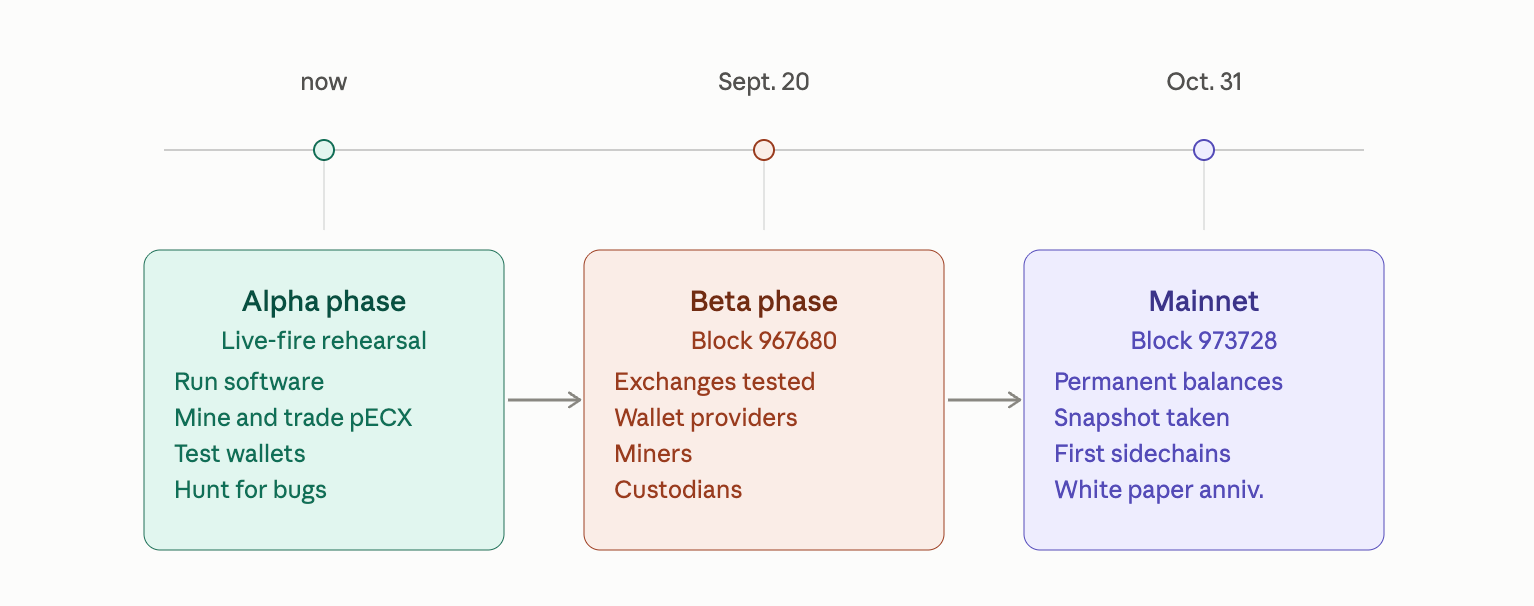
According to Sztorc, the alpha phase is designed as a live-fire rehearsal. Participants can run software, mine, trade practice coins, test wallets, and hunt for cracks in the system. The practice coins, called pECX or alpha ECX, are not permanent.
A beta phase is scheduled around Sept. 20 at Bitcoin block height 967680. That round is expected to lean harder on exchanges, wallet providers, miners, and custodians, the companies that safeguard assets for others.
A visual perspective of Paul Sztorc’s upcoming fork and its phases.
The permanent mainnet is scheduled for Oct. 31, near Bitcoin block 973728. That lands on the 18th anniversary of Satoshi’s Bitcoin white paper. At that snapshot, permanent ECX balances will be created, and the project expects its first batch of specialized sidechains to become available. The drawn-out rollout gives developers and infrastructure providers room to expose bugs, gauge mining conditions, and install safeguards before the permanent chain goes live.
Drivechains Are the Main Bet
Sztorc has spent more than a decade pushing Drivechains, a proposed way to let Bitcoin support optional sidechains without rewriting the rules for every user. A sidechain is a separate network with different features that can connect to a main blockchain. In practice, users could choose a sidechain for privacy, faster payments, or other functions while leaving the base network relatively conservative.
The proposed technology surfaced in BIP 300 and BIP 301, technical proposals Sztorc developed in 2017 and 2019. BIP 300 lays out a mechanism for moving assets between a main chain and sidechains. BIP 301 describes blind merged mining, which would let miners collect sidechain fees without running all of the software for every sidechain.
Those proposals never gathered enough support to activate on Bitcoin through a soft fork, a backward-compatible rules change. Bitcoin’s most recent major soft fork, Taproot, was activated in 2021. Layertwo Labs ultimately decided its Drivechain vision had a better shot as a separate hard fork than another campaign to win consensus from Bitcoin developers, miners, and node operators.
ECX plans to launch with seven specialized sidechains, including Thunder for high-throughput payments, Zside for shielded transactions, Bitnames for decentralized identity, Bitassets for token issuance, Photon for quantum-resistant signatures, Truthcoin for prediction markets, and Coinshift for cross-chain trading. The wager is that users can pick features without forcing every bitcoin user to swallow new base-layer rules.
Bitcoin Will Remain Unchanged
The project uses the same SHA-256d mining algorithm as Bitcoin and keeps its base layer close to Bitcoin Core, the dominant Bitcoin software. However, it will run its own network identifier and ports, keeping ECX nodes from mistakenly connecting to Bitcoin. The chain will reset mining difficulty to the minimum at launch before returning to normal adjustments, a setup likely to make early mining conditions fairly volatile.
One unique rule from the outset involves roughly 1.1 million early Bitcoin coins associated with Satoshi Nakamoto through the “Patoshi pattern,” a method researchers use to identify likely early-mined blocks. About 600,000 ECX will remain assigned to those addresses, while roughly 500,000 ECX will be redirected through special transactions to early investors and development funding. Supporters frame that as financing a new network without an initial coin offering. The move does not touch Satoshi’s $BTC on Bitcoin.
The project also stands far apart from the recent BIP-110 episode, an attempted temporary soft fork aimed at restricting some non-financial blockchain data. BIP-110 backers failed to attract meaningful miner support, node support, and infrastructure backing in any meaningful way, and the resulting minority chain stalled after a small handful of blocks. ECX is not trying to force rules onto Bitcoin. It is a separate experiment built to fight for users, miners, and capital while the Bitcoin network runs normally.
Self-Custody and Claiming Free Coins
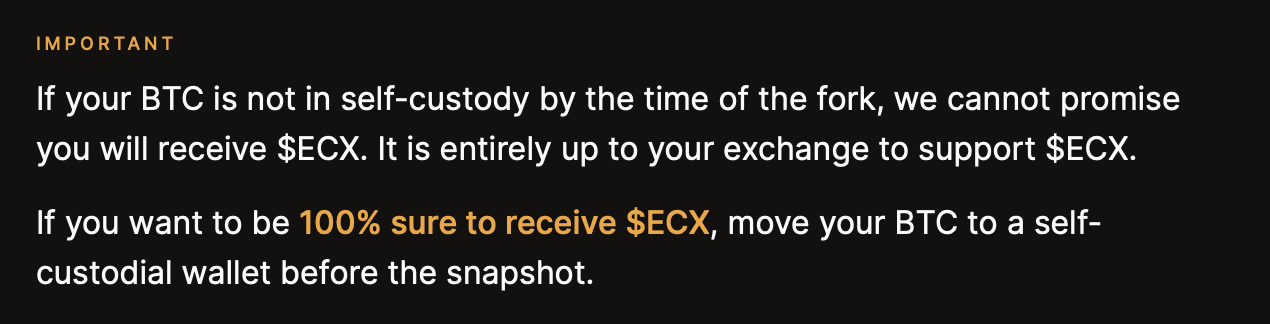
For individual holders, the crucial question is who controls the private keys at each snapshot. A private key is the secret credential proving control of a Bitcoin address. People holding $BTC in self-custody, meaning in a wallet where they control those keys, should be able to access their corresponding ECX directly. People keeping $BTC at exchanges or other custodians are stuck waiting to see whether those companies support the fork and distribute the new asset.
The ECX snapshot credits coins straight to bitcoin ($BTC) addresses, meaning whoever holds the private keys controls the matching ECX. If $BTC sits on an exchange, the exchange holds those keys and effectively controls the forked ECX, leaving customers at its mercy for distribution. Self-custody cuts out that middleman, putting the keys in the holder’s hands and giving them direct control over the corresponding ECX. Image source: ecash.com.
There is no established market price for permanent ECX because mainnet has not launched. During testing, some future-backed ECX trading could emerge, and even if exchanges list ECX, expect wildly speculative price discovery. The bigger question is whether ecash (ECX) gets warmer treatment than the recent BIP-110 fiasco. There is an ECX wallet for Apple (Testflight) and Android, while project docs also spotlight Bitwindow, an alternative Bitcoin Core frontend with native drivechain support.
The real fight starts after Oct. 31. ECX will need working sidechains, stable software, willing exchanges and enough miner participation to show that its combined fee model actually works. Bitcoin holders seeking direct access should track the snapshot heights, maintain control of their keys and stick with official guidance. They should also remember that ECX has nothing to do with XEC, the separate cryptocurrency that uses the same ecash name.
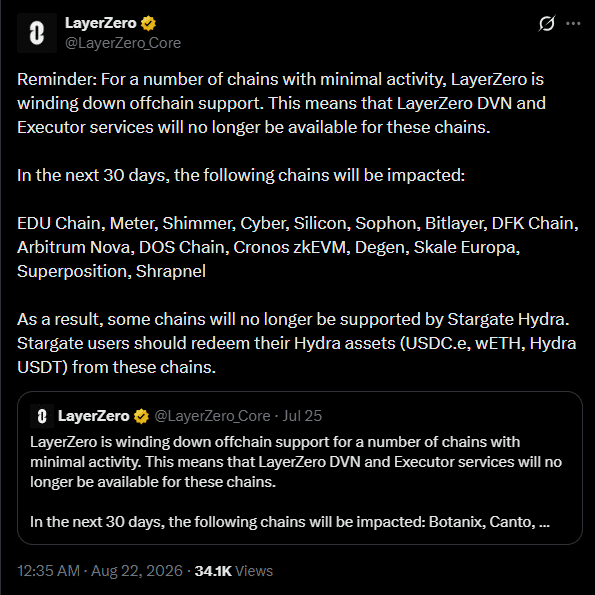
Cross-chain interoperability provider LayerZero will withdraw off-chain support for 14 low-activity chains, including Arbitrum Nova.
In its latest statement, the firm said that its DVN (decentralized verifier network) and Executors, collectively responsible for off-chain communication between different chains, will be deprecated for the 14 chains.
The affected networks include Cronos zkEVM, Degen, Skale Europa, Superposition, Shrapnel, and more. As a result, some assets, including stablecoins (USDT and USDC) across these chains, could be stranded if not moved before the full shutdown.
According to LayerZero, the off-chain support will be axed in 30 days (by September).
Source: X
Since July, LayerZero has flagged over 30 chains with low activity, including the recently shut BounceBit. Although the move is positioned as operational efficiency, security risk and competition seem to be key reasons behind the aggressive shift.
Chainlink CCIP traction threatens LayerZero
LayerZero has massive financial backing, including top-tier VC firms such as Sequoia Capital, a16z (Andreessen Horowitz), Binance Labs, and Coinbase Ventures.
And the bet was simple: bridge the fragmented liquidity across various blockchains. But the KelpDAO’s $292M hack, one of the largest DeFi exploits in 2026, triggered a massive fallout.
The exploit stemmed from LayerZero’s recommended “1-of-1” DVN setup, which doesn’t give enough verification before large minting or fund transfers are approved. Since the same loophole can be used with low-adopted reserve assets, Aave has stopped supporting most of them, including ghost chains.
In fact, several projects have since migrated from LayerZero to rival Chainlink CCIP (Cross-Chain Interoperability Protocol). Notably, the Wyoming state government, BitGo (WBTC), and Nethermind have migrated from LayerZero to CCIP.
Chainlink’s Zach Rynes estimated that a total of $15B has been migrated from LayerZero, underscoring the expensive lesson for LayerZero for the KelpDAO fallout.
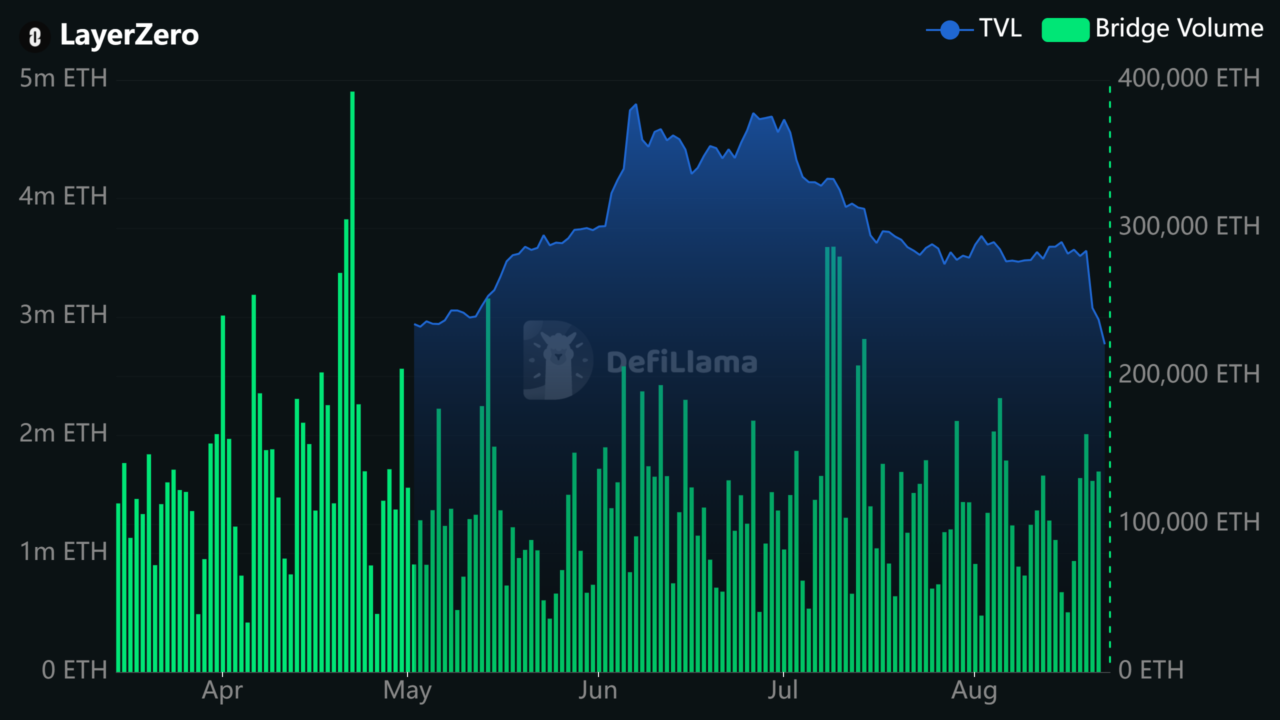
Notably, after the exploit, LayerZero bridged volume dropped 4x from nearly 400K $ETH to about 100K $ETH.
Source: DeFiLlama
As such, LayerZero’s aggressive move to wind down support for over 30 chains may be viewed as a strategic play to reduce its security risk exposure. By extension, it’s meant to counter Chainlink CCIP’s growing competition after the KelpDAO exploit.
But whether that’s enough to stop its top projects from migrating to Chainlink remains to be seen.
Final Summary
LayerZero to withdraw support for 14 chains by September.
Chainlink CCIP has attracted over $15B in assets migrating from LayerZero since the KelpDAO hack.
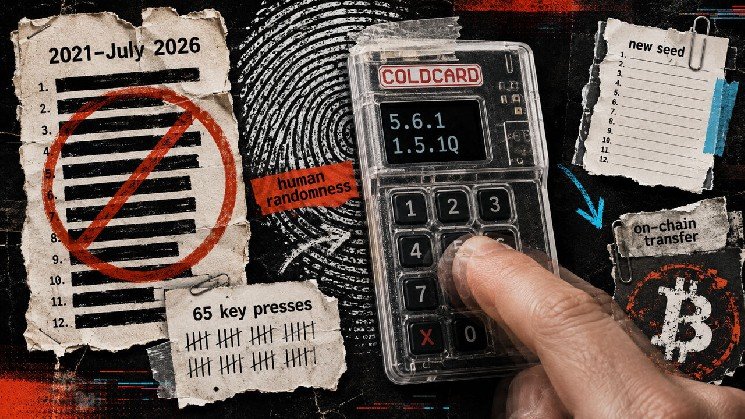
Coinkite, the maker of the Coldcard Bitcoin hardware wallet, released new standard firmware on Aug. 20 that forces users to add physical randomness whenever they generate a seed.
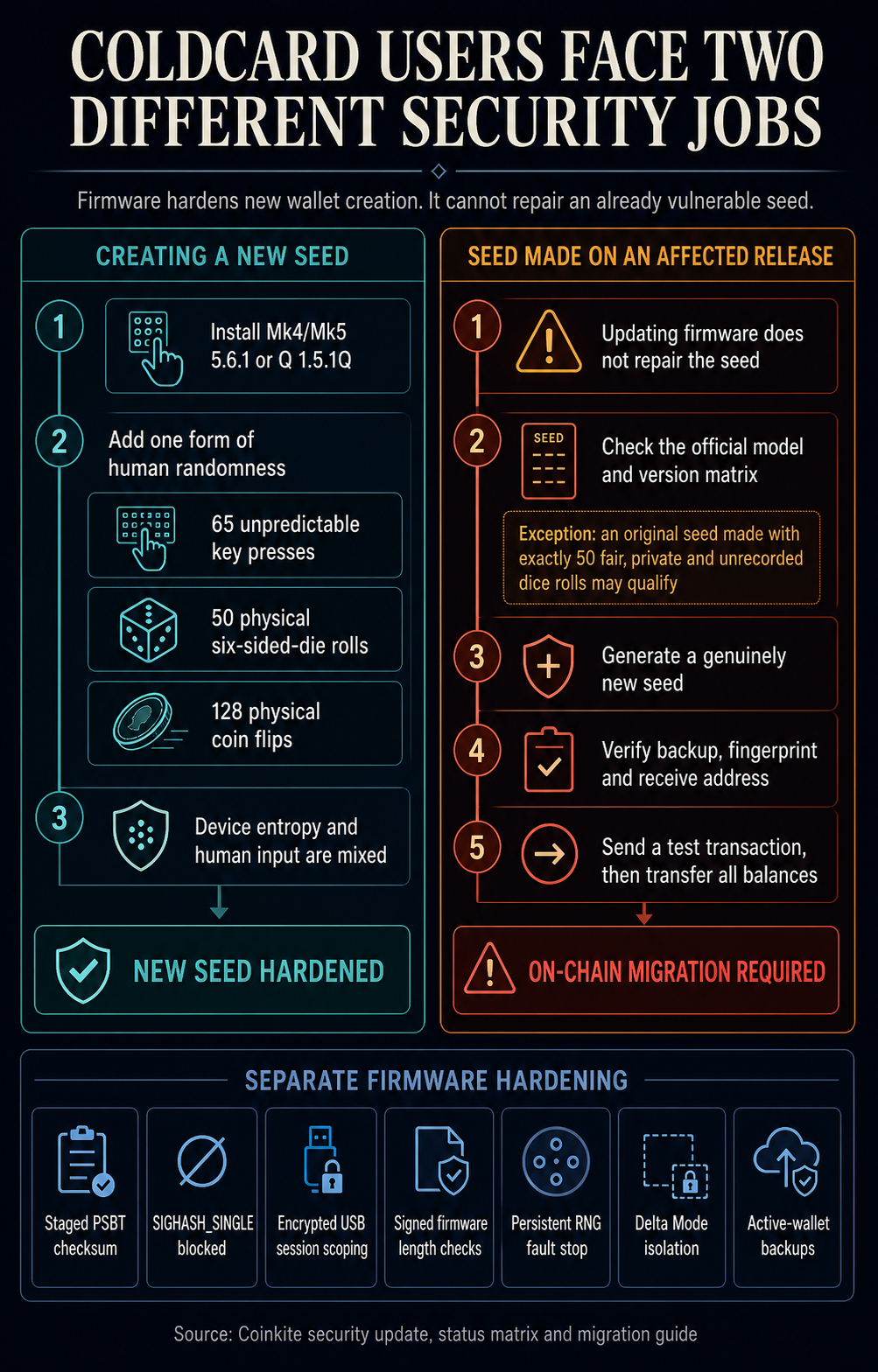
Owners who generate a seed after installing the current fixed release can use the hardened process. Owners still relying on a seed produced by affected firmware must generate another seed and transfer the funds unless that wallet meets the dice-roll exception.
During standard seed creation, every seed combines fresh device entropy with one required human input source: at least 65 key presses made at unpredictable intervals, 50 rolls of a physical six-sided die, or 128 physical coin flips. The requirement reduces reliance on the wallet’s random-number generator alone.
Coldcard’s current security status recommends version 5.6.1 for Mk4 and Mk5 devices and 1.5.1Q for Q devices. The advisory’s exposure list is wider and track-specific. Coinkite’s official migration guidance covers Mk2 and Mk3 firmware 4.0.1 through 4.1.9; Mk4 and Mk5 standard firmware before 5.6.0 and Edge firmware before 6.6.0X; and Q standard firmware before 1.5.0Q and Edge firmware before 6.6.0QX.
Block’s independent technical analysis uses a broader Mk2 and Mk3 boundary that includes version 4.0.0. Owners of that release should not treat the vendor boundary as proof of safety.
Installing fixed firmware does not change an old seed. Unless the advisory’s dice exception applies, Coinkite’s migration guide tells affected users to generate a genuinely new seed, verify its backup and wallet fingerprint, confirm a receiving address on the device, send a small test transaction, and then transfer every balance tied to the old seed. Cloning or restoring the wallet does not create a new seed.
Migration is not required for this RNG flaw when the user added at least 50 fair, independent and private physical die rolls through the affected workflow and never recorded or exposed the sequence. Fewer rolls, or uncertainty about those conditions, means the user should migrate.
Block traced the original defect to code that could route requests to a deterministic MicroPython fallback because a feature flag defined as zero was treated as present. Mandatory human input adds outside entropy to new standard seeds, limiting damage if device randomness fails again. It cannot retroactively add entropy to a seed that already exists.
Coldcard treats the mixed flow differently from the advanced Dice Rolls Only option. That mode excludes hardware randomness and requires 50 rolls for a 12-word seed or 99 for a 24-word seed.
The firmware package reaches signing and data paths too. It binds USB review to a staged PSBT checksum, rechecks transaction bytes before signing, blocks SIGHASH_SINGLE modes by default, restricts USB downloads to the current encrypted-session result, and validates firmware file length. It adds persistent RNG-fault stops, a boot-time hardware-RNG linkage check, more Delta Mode isolation, and active-wallet backup behavior.
The status page lists targeted source review, a real-device RNG-path test, and a reproducible build and dice-path trace, but Coldcard says they do not amount to a full audit of every fixed binary. Coinkite says some customers suffered severe losses and law enforcement is investigating, but it has not published a verified victim count or loss total.
Following the sudden and sharp rise in the cryptocurrency markets, Caitlin Long, Founder and CEO of Custodia Bank and a leading figure in the market, assessed the recent activity in Bitcoin and the general financial markets. Long stated that a macroeconomic reason and the actions of the US Treasury Department were behind the sharp jump in the market.
Caitlin Long, commenting on the US Treasury Department’s announcement that it will more than double its long-term bond (30-year Treasury bond) repurchases, described this as a form of “yield curve control.”
Long stated that this move directly triggered a sharp movement in interest rates and put pressure on the US dollar, weakening it. He added that a weaker dollar generally supports risk assets. This situation triggered a sharp upward movement in leading crypto assets such as Bitcoin and Ethereum.
Responding to the question “Has the 4-year cycle ended?”, which has been frequently debated in the market recently, Long argued that the charts and fundamental data indicate that the cycle is still ongoing. He stated that the basic dynamics of the mining economy have not changed; it is a natural part of the cycle for miners to lose profitability due to high electricity and computing costs and withdraw from the market.
Long, who refrained from making price predictions, stated that based on past experience, Bitcoin appears cheap at current levels.
The cryptocurrency and privacy-focused financial world is experiencing eventful times. Valor Group Founder Dev and Mert Mumtaz, a well-known figure in the crypto ecosystem, participated in The Rollup program on the crypto broadcasting platform, sharing the latest developments on the Zcash (ZEC) network and a critical roadmap for the project’s future. The discussions highlighted the network’s scalability, security updates, and measures taken against quantum threats.
The recent Ironwood update implemented on the Zcash network is considered one of the project’s most important milestones. Speaking at the event, Mert recalled that during internal red teaming and AI-powered security audits, a potential vulnerability was identified in the Orchard pool that could have allowed the creation of counterfeit notes. Through extensive work and official verification, it was proven that the code mathematically matched the specifications perfectly. With the seamless transfer of funds from the Orchard pool to the new Ironwood pool, the risk of counterfeit coin minting on the network has been completely eliminated, and community concerns have been addressed.
Dev, who shared important technical details about Zcash’s future vision, emphasized that Valor Group’s main goal is to achieve a transaction volume on the scale of a credit card for Zcash. He stated that they aim to process more than 50,000 transactions per second at sub-second speeds while maintaining a full proof-of-work mechanism, and that the main obstacle to scaling is not the nodes themselves, but the wallet scanning processes. It was noted that thanks to new wallet architectures and optimizations, synchronization delays in the user experience will become a thing of the past.
The upcoming Tachion update promises to make Zcash fully protected against quantum computing threats. The update will integrate recursive zero-knowledge proofs into the network. This is reported to reduce transaction sizes by more than five times, eliminate node processing overhead, and resolve state growth issues. With Tachion, the network is claimed to achieve not just “quantum recoverable” but a truly “quantum-proof” privacy structure.
Uniswap’s native token, $UNI, reached a new record for daily burn value. According to data, approximately $590,000 worth of $UNI was burned on August 21st (yesterday). This figure represents the highest daily $UNI burn amount ever recorded in dollar terms.
The largest portion of the burn occurred on the Ethereum network. Approximately $267,000 worth of $UNI was removed from circulation on Ethereum, $165,000 on Base, and approximately $87,000 on Robinhood Chain. Including burns on other networks, the total daily value approached $590,000.
In terms of token volume, approximately 150,000 $UNI were burned on August 21st. This amount stands out as the second highest daily burn in $UNI terms recorded on the date.
The data shows that the $UNI burning mechanism has accelerated significantly recently, with activity spreading across different networks.
$UNI’s price has risen 6.88% in the last 24 hours, but it is still trading 90.7% lower than its all-time high of approximately $45.
For much of the recent market cycle, AI was one of Wall Street’s hottest sectors. Technology stocks pulled in massive amounts of money as investors bet that heavy spending on AI would eventually lead to higher profits and better productivity.
However, the latest 50-day performance comparison shows a big shift in momentum. Bitcoin was up 31.60% and Ethereum surged 53.50%, according to recent data. In contrast, the S&P 500 gained just 2.26%, while the Nasdaq barely moved at 0.22%.
Gold and silver also had solid runs, up 14.31% and 19.26% respectively.
Why is Crypto Outperforming AI Stocks?
One possible explanation is that crypto has attracted a new wave of liquidity and institutional interest precisely when stock momentum has started to stall.
US spot Bitcoin ETFs pulled in about $1.6 billion between Monday and Thursday in the August 17-21 week, the strongest weekly inflow of 2026 so far. Thursday alone brought in around $606 million.
Ethereum is experiencing a similar trend. Spot Ether ETFs recorded approximately $221 million on August 20, marking their fourth straight day of inflows.
This is notable because it shows the rally isn’t just retail traders jumping on momentum, but that there’s also institutional money coming in through regulated products.
Has Capital Moved from AI Stocks into Crypto?
The gap in performance shows crypto is beating stocks, but it doesn’t tell us where the money is coming from. Investors could be holding Nvidia, an S&P 500 ETF, Bitcoin, and Ethereum at the same time.
In fact, the divergence we’re seeing might be powered by different factors at work, not necessarily a straight shift from one asset class to another.
Crypto’s recent run has been driven by stronger ETF demand and better liquidity. On the other hand, as reported by Reuters, the S&P 500 and Nasdaq were headed for weekly losses, and higher Treasury yields kept putting pressure on tech stocks.
Still, this doesn’t mean investors have suddenly gone cold on AI. Rather, it suggests crypto has stronger drivers at the moment.
Crypto’s Biggest Advantage Right Now May Be Momentum
Right now, the biggest difference between the two markets is momentum, and crypto leads in that regard.
Bitcoin is now approaching the $80,000 area after rising roughly 30% from its recent low near $60,000. What’s more, BTC is getting close to its strongest weekly performance in more than two years, with the price up around 22% during the week.
Crypto’s total market capitalization has also increased sharply, indicating that the rise isn’t limited to one token.
Nonetheless, it’s important to note that when a market goes from lagging badly to leading strongly in a short time, the momentum itself can become a risk. Short sellers may be compelled to cover their positions, and traders may rush to ride the uptrend. Such a dynamic can intensify gains, but it can also make any pullback much harsher.
So, the strongest bullish signal for crypto to maintain its lead would be continued ETF inflows, along with better liquidity and more involvement from assets beyond just Bitcoin.
In any case, the AI market shouldn’t be written off yet. Nvidia’s upcoming earnings report on August 26 will be a big test for whether the AI investment cycle can get its momentum back, and strong earnings could quickly pull capital back toward tech stocks.
For much of the recent market cycle, AI was one of Wall Street’s hottest sectors. Technology stocks pulled in massive amounts of money as investors bet that heavy spending on AI would eventually lead to higher profits and better productivity.
However, the latest 50-day performance comparison shows a big shift in momentum. Bitcoin was up 31.60% and Ethereum surged 53.50%, according to recent data. In contrast, the S&P 500 gained just 2.26%, while the Nasdaq barely moved at 0.22%.
Gold and silver also had solid runs, up 14.31% and 19.26% respectively.
Why is Crypto Outperforming AI Stocks?
One possible explanation is that crypto has attracted a new wave of liquidity and institutional interest precisely when stock momentum has started to stall.
US spot Bitcoin ETFs pulled in about $1.6 billion between Monday and Thursday in the August 17-21 week, the strongest weekly inflow of 2026 so far. Thursday alone brought in around $606 million.
Ethereum is experiencing a similar trend. Spot Ether ETFs recorded approximately $221 million on August 20, marking their fourth straight day of inflows.
This is notable because it shows the rally isn’t just retail traders jumping on momentum, but that there’s also institutional money coming in through regulated products.
Has Capital Moved from AI Stocks into Crypto?
The gap in performance shows crypto is beating stocks, but it doesn’t tell us where the money is coming from. Investors could be holding Nvidia, an S&P 500 ETF, Bitcoin, and Ethereum at the same time.
In fact, the divergence we’re seeing might be powered by different factors at work, not necessarily a straight shift from one asset class to another.
Crypto’s recent run has been driven by stronger ETF demand and better liquidity. On the other hand, as reported by Reuters, the S&P 500 and Nasdaq were headed for weekly losses, and higher Treasury yields kept putting pressure on tech stocks.
Still, this doesn’t mean investors have suddenly gone cold on AI. Rather, it suggests crypto has stronger drivers at the moment.
Crypto’s Biggest Advantage Right Now May Be Momentum
Right now, the biggest difference between the two markets is momentum, and crypto leads in that regard.
Bitcoin is now approaching the $80,000 area after rising roughly 30% from its recent low near $60,000. What’s more, BTC is getting close to its strongest weekly performance in more than two years, with the price up around 22% during the week.
Crypto’s total market capitalization has also increased sharply, indicating that the rise isn’t limited to one token.
Nonetheless, it’s important to note that when a market goes from lagging badly to leading strongly in a short time, the momentum itself can become a risk. Short sellers may be compelled to cover their positions, and traders may rush to ride the uptrend. Such a dynamic can intensify gains, but it can also make any pullback much harsher.
So, the strongest bullish signal for crypto to maintain its lead would be continued ETF inflows, along with better liquidity and more involvement from assets beyond just Bitcoin.
In any case, the AI market shouldn’t be written off yet. Nvidia’s upcoming earnings report on August 26 will be a big test for whether the AI investment cycle can get its momentum back, and strong earnings could quickly pull capital back toward tech stocks.