Tag: CRYPTOS FoxBusiness.

  • HSBC: “Fed Will Keep Interest Rates Unchanged for Two Years”

    HSBC: “Fed Will Keep Interest Rates Unchanged for Two Years”

    HSBC reiterated its expectation that the Fed will keep interest rates stable for the next two years.

    The bank announced that the Fed kept its policy interest rate unchanged at 3.50%-3.75% at its March meeting and indicated a “wait-and-see” approach in its decision statement.

    According to HSBC, persistent inflationary pressures and rising geopolitical risks continue to create uncertainty in the Fed’s monetary policy outlook. The sharp rise in energy prices, in particular, is cited as increasing inflation risks, while risks to the labor market have somewhat decreased.

    The bank maintains its view that, under current conditions, the Fed will not change interest rates in 2026 and 2027. HSBC also noted that volatility in energy prices and geopolitical developments could support safe-haven demand, contributing to a strong US dollar.

    On the other hand, according to CME’s FedWatch data, markets are largely pricing in a scenario where interest rates remain unchanged. Accordingly, the probability of the Fed raising interest rates by 25 basis points in April is calculated at 6.2%, while the probability of interest rates remaining at their current level is at 93.8%.

    *This is not investment advice.

  • Interest in Altcoins Has Dropped Significantly: Analyst Claims This Has a Different Meaning

    Interest in Altcoins Has Dropped Significantly: Analyst Claims This Has a Different Meaning

    New data indicating a significant decline in interest in altcoins within the cryptocurrency market points to a notable shift in investor behavior.

    An analysis published by CryptoQuant analyst Darkfost stated that altcoin trading volumes have entered a sharp downward trend, reflecting a significant decrease in investor interest.

    According to the analysis, risk appetite has significantly narrowed due to current macroeconomic uncertainties and geopolitical risks, while altcoins continue to underperform against Bitcoin. This indicates that the market is shifting towards assets considered safer havens.

    According to current data, the daily trading volume of altcoins on Binance is approximately $7.7 billion, while the total volume on other major exchanges is around $18.8 billion. These figures are significantly below the peak levels seen in October and February of 2025. During those periods, trading volume on Binance reached $40-50 billion, while on other platforms it rose to the $63-91 billion range. Furthermore, Binance’s share of the altcoin market is estimated to be around 40%.

    The analysis noted that historically, peak trading volumes have generally coincided with market cycle peaks and FOMO (fear of missing out) periods. Conversely, it was argued that the current low-volume and stagnant market conditions indicate periods of weakest investor interest, and that such periods could be times when potential opportunities arise.

    *This is not investment advice.

  • InterLink Crosses 7 Million Verified Users After Adding One Million in a Single Month

    InterLink Crosses 7 Million Verified Users After Adding One Million in a Single Month

    InterLink has crossed 7 million verified human users. The network added its most recent million users in just over a month, accelerating from the 6 million milestone rather than slowing down after it.

    🎉 INTERLINK SURPASSES 7 MILLION REAL USERS

    🚀 From 6M+ to 7M+ verified humans in just over one month – this isn’t just momentum, it’s acceleration.

    Seven million is not just a number. It represents seven million verified identities. Seven million real individuals actively… pic.twitter.com/drp9Qcf0AQ

    — InterLink Labs 👤 + 🌐 (@inter_link) March 21, 2026

    The announcement confirms that growth isn’t tapering and that the network is now preparing the next phase of activity, including new events, recognition mechanisms for verified users, and additional pathways for participation and value creation within the ecosystem.

    What Seven Million Verified Users Actually Means

    The number that matters here isn’t just the big total. It’s the verification layer underneath it. InterLink’s user count represents verified human identities, not wallets, not accounts that could be bots, not addresses spun up to farm rewards.

    Seven million real individuals who have gone through an identity verification process and are actively participating in the network.

    That distinction is genuinely hard to achieve at scale. Most crypto projects report wallet addresses or app downloads. InterLink is reporting verified humans, which is a different and significantly harder metric to inflate. Adding a million verified users in just over a month means the verification process isn’t scaring people off.

    Most identity checks add enough friction to kill momentum. InterLink’s onboarding is apparently not doing that.

    What’s Driving the Adoption

    Growing from some baseline to 6 million takes time. Adding the next million in just over a month is a different kind of momentum. Networks tend to slow as they scale because the easiest users to reach get reached first, and subsequent growth requires more effort per user. InterLink’s trajectory is running the other way, with the most recent million arriving faster than earlier cohorts.

    That kind of acceleration in a verified identity network has compounding implications. Each new verified user makes the network more valuable to the users already in it. Trust-based networks, where participants know they are interacting with real people rather than bots or anonymous wallets, become more useful as the participant pool grows.

    Seven million verified humans is large enough to support meaningful economic activity, collaborative events, and social coordination that wouldn’t work at smaller scales.

    What Comes Next for the InterLink Network

    InterLink is using the 7 million milestone as a launchpad rather than a finish line. The announcement outlines three specific directions for the next phase.

    A new wave of events will roll out for the user base. Special mechanisms are being prepared to recognize and enhance the value of verified users specifically. And new pathways will be introduced for users to participate, contribute, and unlock value within the ecosystem.

    The language around these announcements is deliberately broad, but the direction is clear. The network is moving from a growth phase focused on user acquisition into an activation phase focused on what verified users can actually do and earn within the system. Identity verification was the foundation. The question now is what gets built on top of it.

    The framing of verified identity as a prerequisite for real trust and real value is central to InterLink’s thesis. A network full of real people operates differently from one full of anonymous wallets and bots. Rewards actually mean something when they land with a human on the other side.

    Contributions carry more weight when the contributor is a verified identity. Events and coordination mechanisms work differently when participants can trust who they are interacting with.

    Why Verified Identity Networks Are Worth Watching

    The broader context for InterLink’s growth is a crypto ecosystem that has struggled persistently with Sybil attacks, bot farming, and anonymous wallet proliferation that distorts participation metrics and reward distribution. Projects that solve identity verification at scale are addressing a foundational problem that affects almost every other layer of Web3 participation.

    Reaching 7 million verified users with such huge adoption still building puts InterLink in a small group of projects that have actually demonstrated this at a meaningful scale. The next phase, activating those identities through events, recognition mechanisms, and new participation pathways, will determine whether the network converts its user base into durable economic activity.

    Conclusion

    Seven million verified humans in a single network is a number that doesn’t have many comparables in crypto. The acceleration from 6 million to 7 million in a month matters more than the total itself. InterLink is now moving from building its user base to activating it, and the mechanisms being prepared for verified users will determine whether this milestone becomes a foundation or just a headline.

  • Bitcoin drops below $69,200 as Trump gives 48-hour ultimatum on Iran power plants

    Bitcoin has given back last week’s gains in a single weekend.

    The largest cryptocurrency slid to $69,192 on Sunday morning, down 2.2% over the past 24 hours and 3.1% on the week, after U.S. president Donald Trump issued a 48-hour ultimatum to Iran late Saturday demanding the reopening of the Strait of Hormuz or face attacks on the country’s power plants.

    Trump said he would “hit and obliterate” Iran’s power plants, beginning with the largest, if the strait wasn’t opened to commercial shipping.

    The threat marks a dramatic escalation from Friday, when Trump said he was thinking about “winding down” the military operation. Going from winding down to threatening civilian infrastructure in 24 hours whipsawed a market that had spent the previous week building confidence around de-escalation.

    The liquidation data shows how one-sided the positioning was heading into the weekend. CoinGlass data shows $299 million in total liquidations over the past 24 hours across 84,239 traders, with long liquidations accounting for $254 million, roughly 85% of the total.

    Bitcoin longs took $122 million in damage. Ether longs lost $95.7 million. The largest single liquidation was a $10 million BTC-USDT swap on OKX. The lopsided ratio confirms the market was leaning heavily bullish after eight consecutive days of gains heading into the weekend, leaving it vulnerable to exactly this kind of headline shock.

    Major tokens fell in lockstep, meanwhile. Ether dropped 1.8% to $2,114, XRP lost 2.5% to $1.41, BNB slid 1.4% to $633, solana fell 2.1% to $88.55, and dogecoin lost 2.7% to $0.092. The only majors green on the week were ether at 0.8% and solana at 0.7%. Everything else is red over seven days.

    The 48-hour window means the deadline arrives Monday evening. If Iran doesn’t comply, and there’s no indication it will, the market faces the prospect of strikes on power infrastructure, which would be the first direct targeting of civilian energy systems in the conflict.

    The Strait of Hormuz remains effectively closed to most commercial traffic, with roughly 20% of the world’s oil and gas flows still disrupted.

    Last week’s rally to $75,912 now looks like it was built on ceasefire speculation that evaporated over the weekend. The Fed held rates on Wednesday with a dovish lean that should have supported risk assets, but the persistent risk of war headlines has traders holding back from making outsized directional bets.

  • ETH/BTC Holds 0.03 but the Real Test Is Whether It Can Reclaim 0.032 Level

    ETH/BTC Holds 0.03 but the Real Test Is Whether It Can Reclaim 0.032 Level

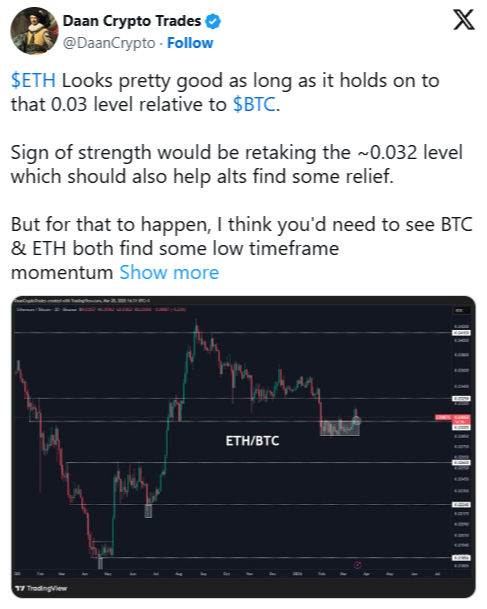
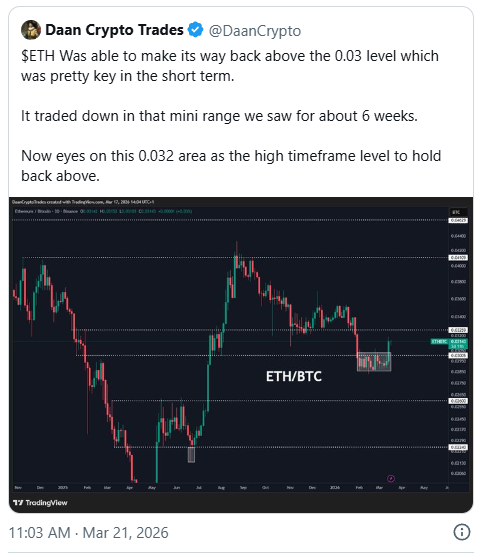
    The $ETH/$BTC pair is sitting at 0.03050 as of March 21, 2026, and analyst Daan Crypto Trades says that level needs to hold. On the two-day chart, $ETH/$BTC has been in a prolonged downtrend since peaking above 0.04100 in mid-2025. It was lower through the second half of the last year and into early 2026 before finding what looks like a short-term floor in the 0.03000 to 0.03005 range. The current price is barely above that floor, and the market context around it is firmly risk-off.

    What the Chart Shows

    The two-day $ETH/$BTC chart on Binance tells a clear story about the past year. From a low near 0.01856 in early 2025, the pair ran hard into July, hitting above 0.04100 before the trend reversed completely.

    The decline from that peak has been consistent and steep, with brief recoveries at 0.03259 and 0.03400 that both failed to hold. Each rally got sold, and each rejection pushed the pair lower until it found the current consolidation zone just above 0.03000.

    The highlighted box on the chart marks the current tight range where the pair has been compressing, roughly between 0.03005 and 0.03100. That compression after a sustained downtrend can mean accumulation or it can mean a brief pause before another leg lower. The level at 0.03000 is the line that separates those two interpretations in practical terms.

    The 0.032 Level and Why It Matters for Alts

    Daan identifies 0.03259 as the key resistance level to watch. That zone previously acted as support during the downtrend before breaking down, which means reclaiming it would represent a meaningful shift in the structure of the pair rather than just a bounce within the existing range.

    The alt market angle is the part that makes this relevant beyond just the $ETH/$BTC trade. When $ETH strengthens relative to $BTC, it typically signals that risk appetite is expanding across the broader crypto market.

    Capital flows from $BTC into $ETH first, then into smaller altcoins. A sustained move above 0.032 on the pair’s chart would be a leading signal that alts are finding the conditions they need to rally. Without it, most altcoins remain stuck in the same risk-off environment that has characterized the market since the $BTC rejections from the $72,000 area.

    What Needs to Happen in USD Terms First

    The $ETH/$BTC analysis doesn’t exist in isolation. Daan’s view is that $BTC above $72,000 and $ETH above $2,200 in USD terms are prerequisites for the ratio to reclaim 0.032.

    The logic is straightforward: the pair needs low-timeframe momentum in dollar terms before the relative strength trade can develop. A rising $ETH/$BTC driven by $ETH strength in USD is a different and more durable signal than one driven by $BTC weakness.

    $BTC has rejected from the $72,000 area multiple times recently, which is the source of the current risk-off sentiment. Each rejection has reinforced the ceiling and kept the broader market cautious. Until $BTC breaks convincingly above that level and holds, the conditions for a sustained $ETH/$BTC recovery aren’t fully in place. The chart shows what’s possible structurally. The USD price action in $BTC is what unlocks it.

    The Risk-Off Reality Right Now

    The current setup is neutral to cautious. $ETH/$BTC holding 0.03 is a prerequisite, not a signal. The floor is important to maintain but maintaining it doesn’t itself trigger anything. What the analysis describes is a market waiting for a catalyst that hasn’t arrived yet, with a clear set of conditions that would change the picture: $BTC above $72K, $ETH above $2.2K, and $ETH/$BTC reclaiming 0.032 on a sustained basis.

    Until that sequence plays out, the $ETH/$BTC pair stays in compression and the broader alt market stays under pressure.

    Conclusion

    $ETH/$BTC holding 0.03 is the floor that keeps the setup alive. Losing it likely accelerates alt market pain. Reclaiming 0.032 is the signal traders are waiting for, but that requires $BTC and $ETH to move first in USD terms. Right now the market is risk-off, the $72K $BTC rejection is fresh, and patience is the only rational position until the structure changes.

  • Bitcoin options signal extreme fear as downside protection premium hits new all-time high, says VanEck

    Bitcoin options signal extreme fear as downside protection premium hits new all-time high, says VanEck

    Bitcoin traders are paying record prices for downside protection, according to VanEck’s mid-March 2026 Bitcoin ChainCheck, a sign that investors remain defensive even as spot prices begin to stabilize.

    In the report, senior VanEck analysts said bitcoin’s 30-day average price fell 19% from the prior period, while realized volatility dropped from about 80 to just above 50.

    Futures funding rates also eased to 2.7% from 4.1%, suggesting leveraged speculation has cooled.

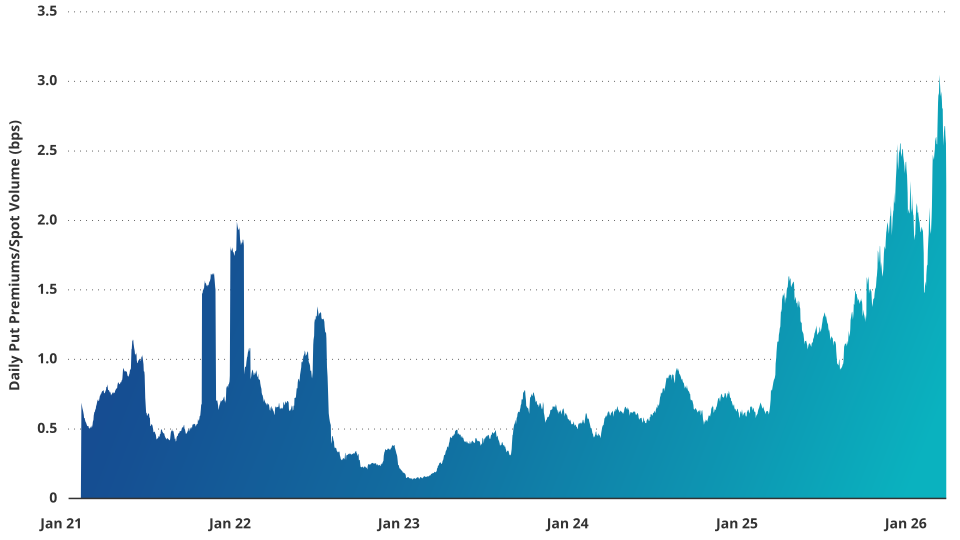
    Options markets show investors are as cautious as it gets. VanEck said the put/call open interest ratio averaged 0.77 and peaked at 0.84, the highest level since June 2021, when China cracked down on bitcoin mining.

    Traders spent about $685 million on put options over the past 30 days, while call premiums fell 12% to about $562 million, the report adds. Relative to spot volume, put premiums reached roughly 4 basis points, an all-time high in VanEck’s data.

    “Relative to spot volume, put premiums reached an all-time high of roughly 4 basis points, roughly 3x the levels seen in mid-2022 following the Terra/Luna stablecoin collapse and the Ethereum staking liquidity crisis,” the report reads.

    That means investors are paying up for insurance against further losses.

    VanEck said that kind of fear has often marked turning points rather than fresh breakdowns. The firm found that, in the past six years, similar options that skewed readings were followed by average bitcoin gains of 13% over 90 days and 133% over 360 days.

    The report also points out onchain activity has remained weak while miner selling remains contained.

  • XRP Ledger Addresses With 100,000 XRP Hit 32,054

    XRP Ledger Addresses With 100,000 XRP Hit 32,054

    $XRP Ledger adoption continues to grow in the cryptocurrency space as addresses with 100,000 $XRP and above have hit a new high. As highlighted by market intelligence platform Santiment, 32,054 wallets contain over 100,000 $XRP, which signals active utility on the ledger by institutional holders.

    Retail $XRP wallets expand to 5.66 million as institutional interest grows

    Notably, holders with over 100,000 $XRP are whales, large investors or early adopters of $XRP.

    While the 32,054 wallets might appear small, these holders likely control a huge percentage of the $XRP supply. The growth in the number of wallets with over 100,000 $XRP indicates capital concentration among whales and institutional holders.

    📈 $XRP Ledger is continuing to see its network grow. Based on wallet size, here are the amount of addresses under each tier:

    🦐🐟 Less Than 100 $XRP: 5.66M Wallets
    🐡🐬 100 to 100K $XRP: 2.01M Wallets
    🦈🐳 More Than 100K $XRP: 32,054 Wallets pic.twitter.com/QN1AWIhYBJ

    — Santiment (@santimentfeed) March 21, 2026

    Besides this category of holders, Santiment observed that retail users have expanded further from their 4.7 million wallets in early 2025. These small holders have less than 100 $XRP in their wallets. Currently, the wallet address count of retail holders has hit 5.66 million $XRP wallets.

    These comprise small-time investors in the asset, people just testing the network to understand how things work and new users. The almost 1 million addition reveals broad adoption of the coin at the grassroots level.

    These new users appear to have confidence in $XRP despite its price volatility. The growth is likely due to positive developments in the Ripple ecosystem, like strategic collaborations with traditional institutions and the firm’s legal battle with the U.S. regulatory body.

    The long legal battle between the U.S. Securities and Exchange Commission (SEC) over $XRP as a “security” or not finally ended in 2025. The SEC has now officially recognized $XRP as a non-security, categorizing it as a commodity.

    Regulatory clarity and Ripple developments boost $XRP adoption

    Ripple’s win provided legal clarity and opened the path to more adoption, both for institutional and retail holders.

    Meanwhile, wallet distribution shows that mid-tier addresses, which contain between 100 and 100,000 $XRP, now stand at 2.01 million. Although these investors hold a sizable amount of the coin, they are not classified as whales.

    Overall, the total number of wallets across all tiers indicates that the $XRP ecosystem is expanding. The massive concentration of capital within the over 32,000 wallets can influence the asset’s price direction in the crypto market.

    On the other hand, the large base of retail wallets and mid-tier holders shows increased participation among these categories. The development is largely due to the post-2025 regulatory clarity with the asset.

    In a related development, $XRP Ledger recently set a new 13-year milestone. Over 7.7 million wallets have at least one $XRP and not a zero balance. The interesting part is that the users are not leaving the coin dormant but actively trading with it.

  • How DeFi is quietly rebuilding the fixed-income stack for institutional capital

    How DeFi is quietly rebuilding the fixed-income stack for institutional capital

    For years, tokenization has been framed as crypto’s bridge to Wall Street. Put Treasuries onchain. Issue tokenized money market funds. Represent equities digitally. The assumption was simple: if assets move onchain, institutions will follow.

    But tokenization alone was never the endgame. As we recently argued in our institutional outlook, the real institutional unlock isn’t digitizing assets – it’s financializing yield.

    Following the regulatory clarity that emerged in 2025, institutional interest in digital assets has shifted from exploratory exposure to infrastructure-level participation. Surveys increasingly suggest that institutional engagement with DeFi could rise sharply over the next couple of years, while a meaningful share of allocators are exploring tokenized assets. Yet large allocators are not entering crypto solely to hold tokenized wrappers. They are entering for yield, capital efficiency, and programmable collateral. That requires a different kind of DeFi than the retail-built one in 2021.

    In traditional finance, fixed-income instruments are rarely held in isolation. They are repo’d, pledged, rehypothecated, stripped, hedged and embedded into structured products. Yield is traded independently of principal, and collateral moves fluidly across markets. The plumbing matters as much as the product.

    DeFi is now beginning to replicate those core functions.

    A tokenized Treasury or equity is only marginally useful if it behaves like a static certificate. Institutions want tokenized assets to become functioning, working financial instruments: collateral that can be deployed, financed and risk-managed; yield that can be isolated, priced and traded; and positions that can be integrated into broader strategies without breaking compliance constraints.

    That is the shift from first-order tokenization to second-order yield markets.

    Early design patterns already point in this direction. Hybrid market structures are emerging in which permissioned, regulated assets can be used as collateral while borrowing is facilitated by using permissionless stablecoins. At the same time, yield trading architectures are expanding the range of activities investors can undertake with tokenized assets by separating principal exposure from the yield stream. Once the yield component of an onchain asset can be priced, traded, and composed, tokenized instruments become usable in strategies that are much closer to what allocators already run in traditional markets.

    For institutions, this matters because it turns real-world assets (RWAs) from passive exposure into active portfolio tools. If yield can be traded independently, then hedging and duration management become more feasible, and structured exposures become possible without rebuilding the entire stack off-chain. Tokenization stops being a narrative and starts becoming market infrastructure.

    However, yield infrastructure alone will not bring institutional scale. Institutional constraints that shaped traditional markets have not disappeared; they are being translated into code.

    One of the most important constraints is confidentiality. Public blockchains expose balances, positions, and transaction flows in ways that conflict with how professional capital operates. Visible liquidation levels invite predatory strategies, public trade history reveals positioning, and treasury management becomes transparent to competitors. For institutions accustomed to controlled disclosure and information asymmetry, these are not philosophical objections – they are operational risks.

    Historically, privacy in crypto has been treated as a regulatory liability. What is emerging instead is privacy as compliance-enabling infrastructure.

    Zero-knowledge systems can prove transactions are valid without revealing sensitive details. Selective disclosure mechanisms can enable institutions to share limited visibility with auditors, regulators, or tax authorities without disclosing the entire balance sheet. Proof systems can demonstrate that funds are not linked to sanctioned or illicit sources without disclosing broader transaction history. Even approaches such as fully homomorphic encryption point toward a future in which certain kinds of computation can occur on encrypted data, widening the set of financial actions that can be performed privately while retaining verifiability where required.

    This is not ‘privacy as opacity’. It is programmable confidentiality, and it more closely resembles established market structures, such as confidential brokerage workflows or regulated dark pools, than it does anonymous shadow finance. For institutions, that distinction is the difference between a system that is unusable and one that can be deployed at scale.

    A second constraint is compliance. Regulatory clarity has reduced existential uncertainty, but it has also raised expectations. Institutional capital demands eligibility controls, identity verification, sanctions screening, auditability and clear operational regimes. If the next phase of DeFi is going to intermediate real-world value at scale, compliance cannot remain an afterthought bolted onto a permissionless system. It has to be embedded into market design.

    That is why one of the most important patterns emerging in institutional DeFi is a hybrid architecture combining permissioned collateral with permissionless liquidity. Tokenized RWAs can be restricted at the smart contract level to approved participants, while borrowing can occur via widely used stablecoins and open liquidity pools. Identity and eligibility checks can be automated. Asset provenance and valuation constraints can be enforced. Audit trails can be produced without forcing every operational detail into public view.

    This approach resolves a long-standing tension. Institutions can deploy regulated assets into DeFi without compromising core requirements around custody, investor protection and sanctions compliance, while still benefiting from the liquidity and composability that made DeFi powerful in the first place.

    Taken together, these shifts point to a broader reality where DeFi is not simply attracting institutional capital; it is, in fact, being reshaped by institutional constraints. The dominant narrative in crypto still centers on retail cycles and token volatility, but beneath that surface, protocol design is evolving toward a more familiar destination – a fixed-income stack where collateral moves, yield trades and compliance is operationalized.

    Tokenization was phase one because it proved assets could live onchain. Phase two is about making those assets behave like real financial instruments, with yield markets and risk controls that institutions recognize. When that transition matures, the conversation shifts from crypto adoption to capital markets migration.

    That shift is already underway.

  • Grayscale wants to bring the world’s hottest crypto trading frenzy to your brokerage account

    Grayscale has filed with the U.S. Securities and Exchange Commission (SEC) to launch a new exchange-traded fund for the $HYPE token, amid the surging popularity of decentralized exchange Hyperliquid.

    The Crypto asset manager’s proposed fund would hold the $HYPE token and be listed on Nasdaq under the ticker GHYP, according to the S-1 registration statement.

    Grayscale said it may stake some holdings in the future, though it cannot do so now. The filing doesn’t disclose a proposed fee. Other asset managers that have also filed for $HYPE ETFs include Bitwise and 21Shares, which already operate a $HYPE exchange-traded product in Europe with a 2.5% total expense ratio.

    $HYPE is the native token of the Hyperliquid network, which is home to the leading decentralized exchange of the same name. Its core layer handles perpetual futures and spot markets, while a second layer supports Ethereum-style smart contracts.

    Perpetual futures contracts, or “perps,” are derivative instruments without expiration dates that allow investors to place bets on an asset’s price without owning it. Their infinite duration (perpetual futures contracts never expire, unlike traditional contracts), high-leverage options, and round-the-clock access have made them extremely popular in the crypto space.

    The filing comes as Hyperliquid sees growing interest from traders betting on traditional financial assets, including oil and gold, while war rages in the Middle East. The platform has also recently added an S&P 500 perpetual contract.

    In simple terms, the platform’s value proposition is not just crypto trading, but also the ability to bet on traditional assets around the clock, even when most markets are closed.

    The trading frenzy has seen Hyperliquid’s weekly derivatives trading volume top $50 billion, with more than $6.5 billion being traded in the past 24 hours alone, according to DeFiLlama data.

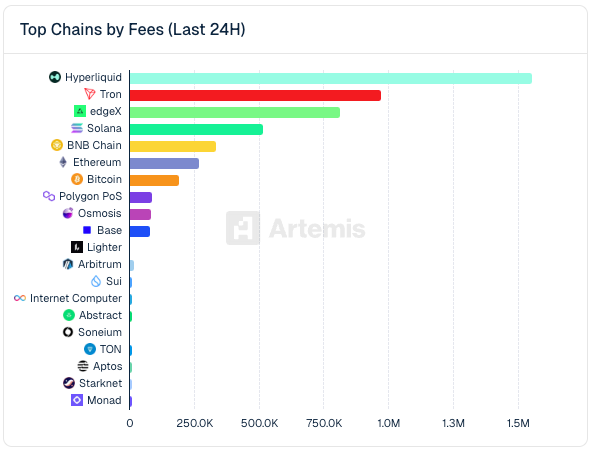
    That has helped the Hyperliquid chain dominate in revenue, which stands at $1.6 million over the last 24 hours, compared to $335,000 for BNB Chain and $192,000 for the Bitcoin blockchain, according to Artemis data.

    Hyperliquid fees in the last 24 hours (Artemis)

    This increased activity has captured many bullish takes from crypto investors and market observers. Recently, Arthur Hayes, the co-founder of BitMEX and CIO of Maelstrom, said the platform’s strong revenue, real trading activity, and disciplined token supply could take its native token, $HYPE, to $150.

    The token currently trades around $40 and has risen by 57% this year, while bitcoin fell about 20% and Ethereum’s native token, ether, fell about 28%.