Tag: CRYPTOS FoxBusiness

  • QuickSwap Goes All-In on Orbs for Perpetual Futures Trading

    QuickSwap Goes All-In on Orbs for Perpetual Futures Trading

    QuickSwap, one of the oldest names in decentralized exchange trading, has officially rolled out Orbs’ Perpetual Hub Ultra 2.0 as the default engine powering perpetual futures across every chain it operates on. The decision wasn’t made behind closed doors. It came after a community vote, “Full Shift of Decentralized Perpetuals to Orbs Network,” which cleared with a decisive 81.8% approval from QUICK token holders.

    The shift effectively retires the Orderly-based Falkor setup that had been running on Polygon PoS, replacing it with the same Orbs-driven architecture that QuickSwap already introduced on Base back in the fourth quarter of 2025. It’s not a cold start, either. QuickSwap and Orbs have been working together for years at this point, with tools like dTWAP, dLIMIT, and Liquidity Hub already live in production on both Polygon PoS and Base.

    Ran Hammer, VP of Business Development at Orbs, framed the announcement as something bigger than a routine infrastructure swap. “This is what the next phase of DeFi looks like: a top-tier DEX running a complete perps stack natively on Layer-3, with liquidity from day one and execution quality that rivals centralized venues,” he said. He also pointed to the vote itself as a signal of where the industry is heading, adding, “An 81.8% community vote says it all – decentralized markets are ready to compete with traditional finance on its own terms.”

    Full-Service Perpetual Trading Stack

    What QuickSwap gets out of the deal, in practical terms, is a full-service perpetual trading stack that doesn’t lean on outside providers. Execution, settlement, hedging, liquidation, pricing, and the trading interface itself are all handled natively through Orbs’ Layer-3 infrastructure. There’s no bootstrapping period to worry about, either; liquidity is pulled in from day one through Orbs’ integrated system, which taps into several deep liquidity sources at once rather than relying on a single pool building up over time.

    Under the hood, the platform runs on a TEE-secured execution environment, meaning trades are processed inside a trusted, hardware-isolated setting rather than out in the open. Price feeds come in cryptographically signed, and the resulting state is periodically committed on-chain through rollup settlement, giving traders a verifiable record without sacrificing speed.

    On the trading side, users get access to the usual order types, market, limit, stop-loss, take-profit, along with more advanced bracket orders. Convenience features like one-click trading, account abstraction, and gasless transactions are also part of the package, lowering the friction that’s historically kept some traders away from on-chain platforms.

    QuickSwap itself needs little introduction to anyone who’s spent time in DeFi. It’s been running since 2020 and remains the top exchange within the Polygon ecosystem, expanding over the years from Polygon PoS into Polygon zkEVM and Base while holding onto its reputation as Polygon’s flagship DEX.

    Like much of its infrastructure, the exchange is steered by its community through QUICK token governance, which is exactly the mechanism that greenlit this latest move. Orbs, for its part, operates as a decentralized Layer-3 network built specifically to handle the kind of complex trading logic that standard smart contracts struggle with.

    Its validator network runs on delegated Proof-of-Stake, backed by more than 1.12 billion ORBS tokens staked across the system. Both teams are pitching this integration as a step toward closing the gap between decentralized and centralized trading venues, not just in terms of speed and cost, but in the overall experience, while still keeping self-custody and on-chain transparency intact for users.

  • CZ’s 1.1B memecoin burn sparks buzz – Can it revive fading demand?

    CZ’s 1.1B memecoin burn sparks buzz – Can it revive fading demand?

    Memecoins often thrive on hype, yet they can lose relevance just as quickly when attention fades.

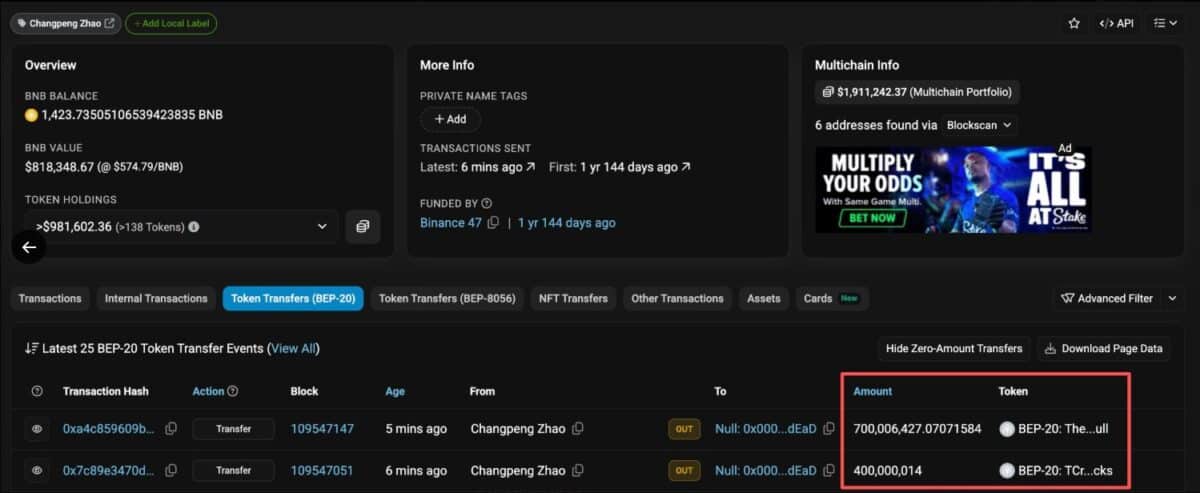
    Binance founder Changpeng Zhao’s (CZ) recent wallet activity initially fueled speculation across the memecoin market. He later clarified the transfers were routine, not valuation‑related.

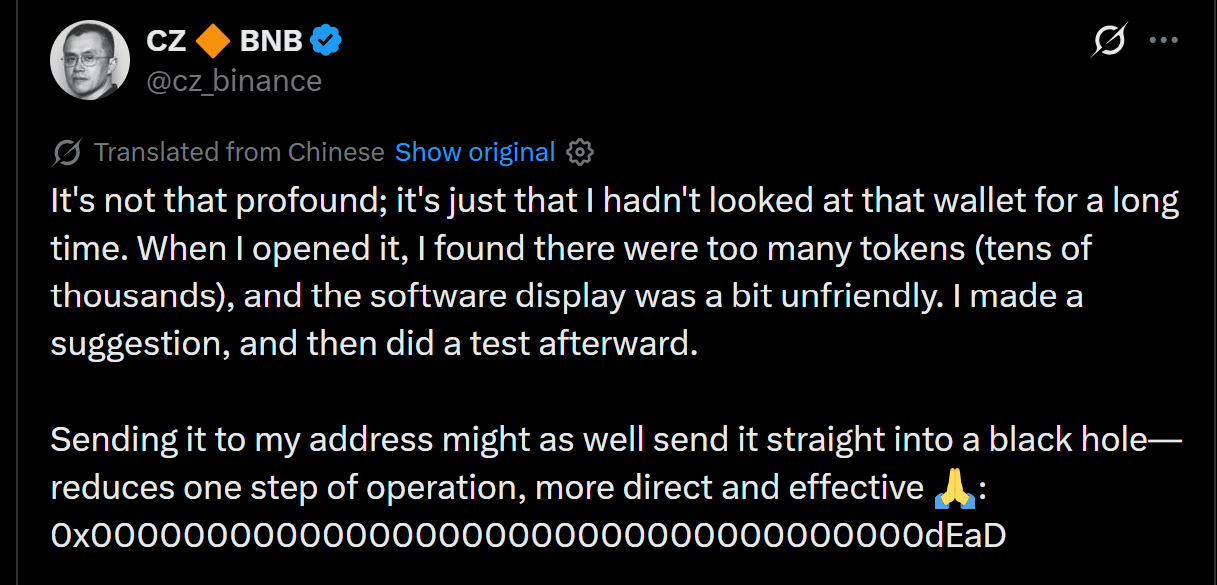
    Rather than making a statement about token valuations, he simply cleared thousands of unsolicited donations by sending them directly to the burn address.

    In a post on X, CZ noted,

    Source: X

    This move permanently removed roughly 1.1 billion donated memecoins from circulation, including transfers of 700 million and 400 million tokens shown in the wallet activity. However, the broader market impact remains limited because these assets already had little utility or liquidity.

    Source: X

    Instead, the transaction underscores how speculative narratives can quickly overshadow routine wallet management. Ultimately, sustainable valuations will continue to depend on genuine demand rather than symbolic token burns.

    Memecoin demand remains fragile

    CZ’s decision to burn unsolicited memecoins also reflects the broader challenges facing the memecoin sector. While new narratives occasionally attract speculative inflows, sustained demand has remained weak since Bitcoin’s October 2025 peak.

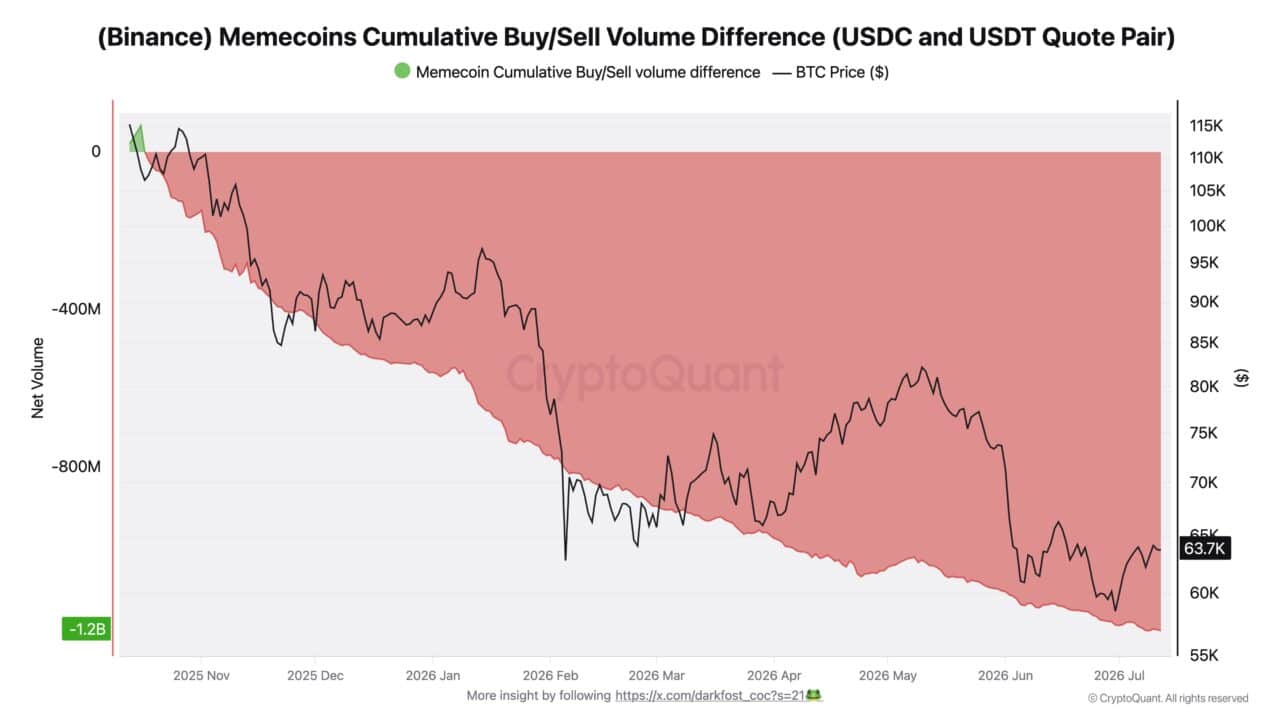
    As Bitcoin [$BTC] plummeted, investors began reducing their exposure to riskier assets. This led to cumulative Binance memecoin net volume declining to -$1.21 billion.

    This suggests that rather than accumulate for long-term growth, traders increasingly view memecoins as assets to exit during uncertainty. Unless risk appetite improves, capital will likely continue concentrating in stronger cryptocurrencies.

    Source: Dakforst on X

    As a result, this leaves memecoins vulnerable to lower liquidity, sharper volatility, and shorter-lived recoveries.

    Rather than signaling isolated selling, the persistent outflows point to a prolonged risk-off environment across the sector. Although Robinhood Chain briefly revived interest in newer tokens, that momentum failed to reverse broader capital rotation.

    Without consistent buying, memecoins will stay driven by short‑lived narratives rather than durable demand.


    Final Summary

    • Memecoins remain driven by speculation, with CZ’s burn carrying limited market impact.
    • Bitcoin [$BTC] weakness continues weighing on memecoins, as persistent capital outflows keep the sector in a prolonged risk-off environment.
  • World’s first operation performed by robot surgeons has been carried out

    World’s first operation performed by robot surgeons has been carried out

    Two teleoperated robots work as a team to perform a laparoscopic gallbladder removal during a pre-clinical trial
    Two teleoperated robots work as a team to perform a laparoscopic gallbladder removal during a pre-clinical trial (Picture: University of California San Diego (UCSD)/Cover Images)

    It’s like the plot of a science fiction film.

    The world’s first operation performed by robot surgeons has been successfully carried out.

    Researchers say the breakthrough could one day allow specialists to carry out life-saving procedures from hundreds of miles away, helping patients in remote communities, disaster zones and military field hospitals.

    The human-shaped robots completed two gallbladder removal operations during a preclinical trial on large animal models.

    One procedure saw a robot operate alongside a human surgeon acting as an assistant. In the second, two humanoid robots worked together as the surgical team.

    The research, published in the journal Nature, was carried out by engineers and surgeons at the University of California San Diego.

    Nicknamed ‘Surgie’, the robots stand around 5ft tall, weigh just 27kg and use standard surgical instruments, meaning they could work in existing operating theatres without the specialist facilities needed for conventional robotic surgery systems.

    A human-robot team made up of a humanoid robot and a human surgeon acting as an assistant successfully performed a gallbladder removal (Picture: University of California San Diego (UCSD)/Cover Images)

    Professor Michael Yip, one of the study’s senior authors, said the technology could help tackle a growing global shortage of surgeons.

    He said: ‘There is a shortage of surgeons alongside growing patient needs, which leads to longer wait times, reduced access and greater healthcare disparities.

    ‘Remotely operated and autonomous humanoid robots have real potential for expanding access to critical surgeries that patients would otherwise not receive.’

    Conventional robotic surgery systems can weigh almost 1,800lb and require specialist operating theatres and large support teams.

    The researchers say humanoid robots are far cheaper, more compact and could be deployed in under-resourced hospitals or temporary medical facilities.

    Dr Shanglei Liu, who remotely controlled one of the robots during the trial, said: ‘It’s a fraction of the cost and it takes a fraction of the space in an operating room. So it’s easy to deploy anywhere from rural areas to the battlefield, and even to space.’

    Ryan Broderick, MD, controls a robot during a gallbladder removal procedure (Picture: University of California San Diego (UCSD)/Cover Images)

    The robots mirror a surgeon’s hand movements using a teleoperation system, allowing procedures to be performed remotely.

    The team says the technology is still in its early stages. The robots needed several recalibrations during surgery and the operations took much longer than those carried out using existing robotic systems.

    But the researchers believe the technology will improve rapidly, pointing out that early robotic keyhole surgery once took six hours but can now be completed in around 30 minutes.

    They hope humanoid robots will eventually work alongside surgeons, helping deliver specialist care to patients wherever it is needed.

  • Analyzing Ether.fi’s slip amid $8.6B market crash: What’s next for ETHFI?

    Analyzing Ether.fi’s slip amid $8.6B market crash: What’s next for ETHFI?

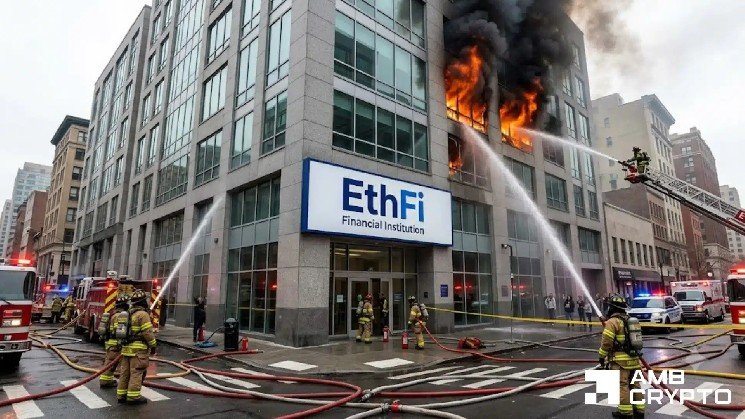
    Ether.fi [$ETHFI] has posted a sharp decline as capital outflows across the broader market drive much of the fall.

    The asset recorded a double-digit loss in the early hours of Tuesday, extending its price to a low of $0.384 on the chart. Outflows continue to dominate, yet the market is already flashing early signs of a possible recovery and leaves room for a rally to still stretch higher.

    Capital exits $ETHFI’s on-chain economy

    The steepest hurdle facing $ETHFI’s price over the past day has been the on-chain capital exit.

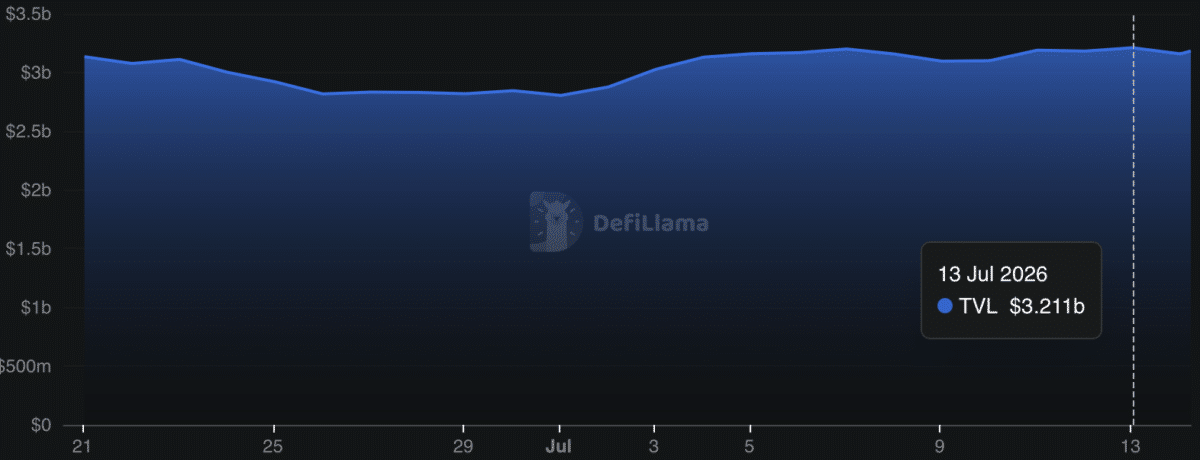
    Total value locked (TVL), which gauges the strength of on-chain capital through the deposits and withdrawals moving through the protocol, shows that roughly $54 million has left the market.

    The metric slid from $3.212 billion to roughly $3.153 billion, signalling that retail holders are exiting the market, likely on concerns over rising volatility.

    Source: DeFiLlama

    On a protocol level, the asset has held up decently, with earnings—the profit that remains once incentives are stripped out—reaching $1.34 million and already nearing half of the $2.79 million generated in June.

    The pattern suggests the recent sell-off reflects a reaction to market sentiment and not a structural bearish trend. That sentiment traces back to the notable decline the crypto market absorbed over the past day, when it shed around $8.61 billion in total capitalization.

    Perpetual contracts keep bears in play

    The clearest gap in the market emerges from $ETHFI’s perpetual contracts, which show that bears still hold some strength after an 11% decline dragged open interest to $62.26 million.

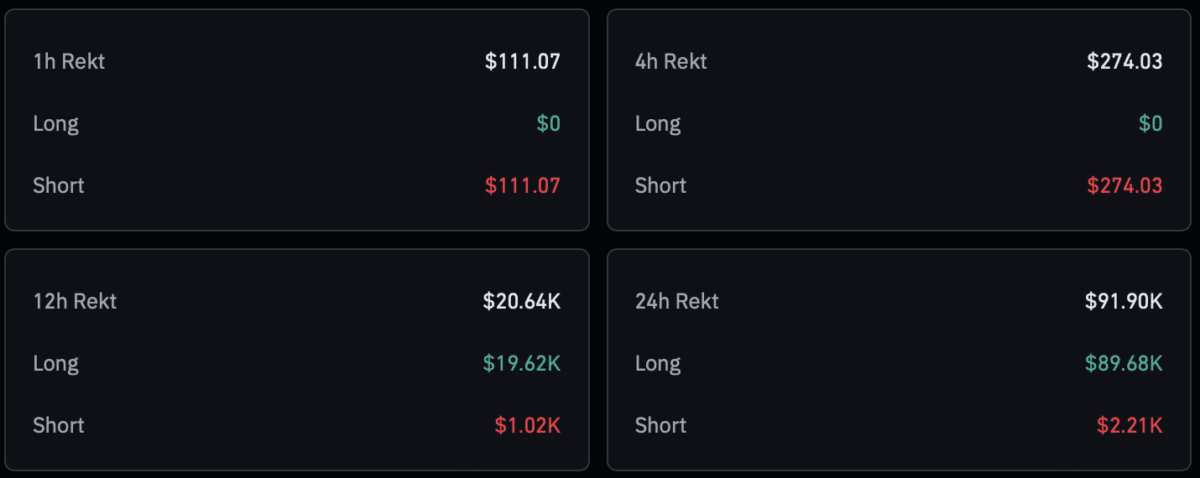
    That gap stems from an imbalance in liquidations, with market data revealing a wide disparity between long and short liquidations. Over the past 24 hours, long traders have lost roughly 40 times more than short traders.

    The liquidation data shows short traders lost just $2,210 against $89,680 for long traders across the same period, and the uneven spread points to the strength of the bears.

    Source: CoinGlass

    On lower timeframes, the liquidation disparity widens further, though the capital lost this time around remains minimal.

    The liquidation heatmap offers no clear directional bias for the asset, instead showing fairly evenly distributed clusters.

    These clusters mark areas on the chart where buy or sell orders sit, and clusters resting above the price usually act as sell zones that pull the price toward them and force selling, while clusters below reverse the dynamic and force buys once the price drops into them.

    For now, there’s no decisive direction, leaving momentum to dictate the next price move.

    Rising long volume hints at $ETHFI accumulation

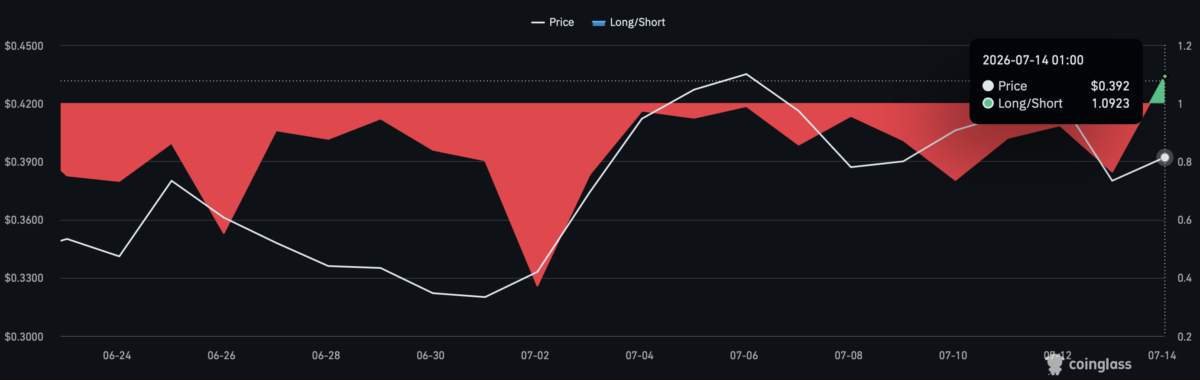
    While liquidations remain skewed in favour of the shorts, activity on the long-to-short ratio points to rising accumulation.

    At the time of writing, the long-to-short volume ratio on the chart shows more long volume in the market, pushing up to 1.02. A continued climb would imply that buy interest still lingers in the market.

    Source: CoinGlass

    Whether that offers a sufficient basis for a shift in direction remains unclear. The broader crypto market that shaped the sell-off sentiment has begun cooling, and a strong chance remains that $ETHFI benefits from the turn and recovers, flipping momentum against the sellers.


    Final Summary

    • Ether.fi’s token fell 10% after roughly $54 million left the protocol, moving in step with a broader crypto market that shed about $8.61 billion in a day.
    • Buying activity is quietly picking up and a calming market could give $ETHFI room to bounce back.
  • BREAKING! Critical US Inflation Data Released! What Was Bitcoin’s (BTC) Initial Reaction?

    BREAKING! Critical US Inflation Data Released! What Was Bitcoin’s (BTC) Initial Reaction?

    Global financial markets are focused on the US Consumer Price Index (CPI) data to be released today, while investors in the cryptocurrency market are also acting cautiously.

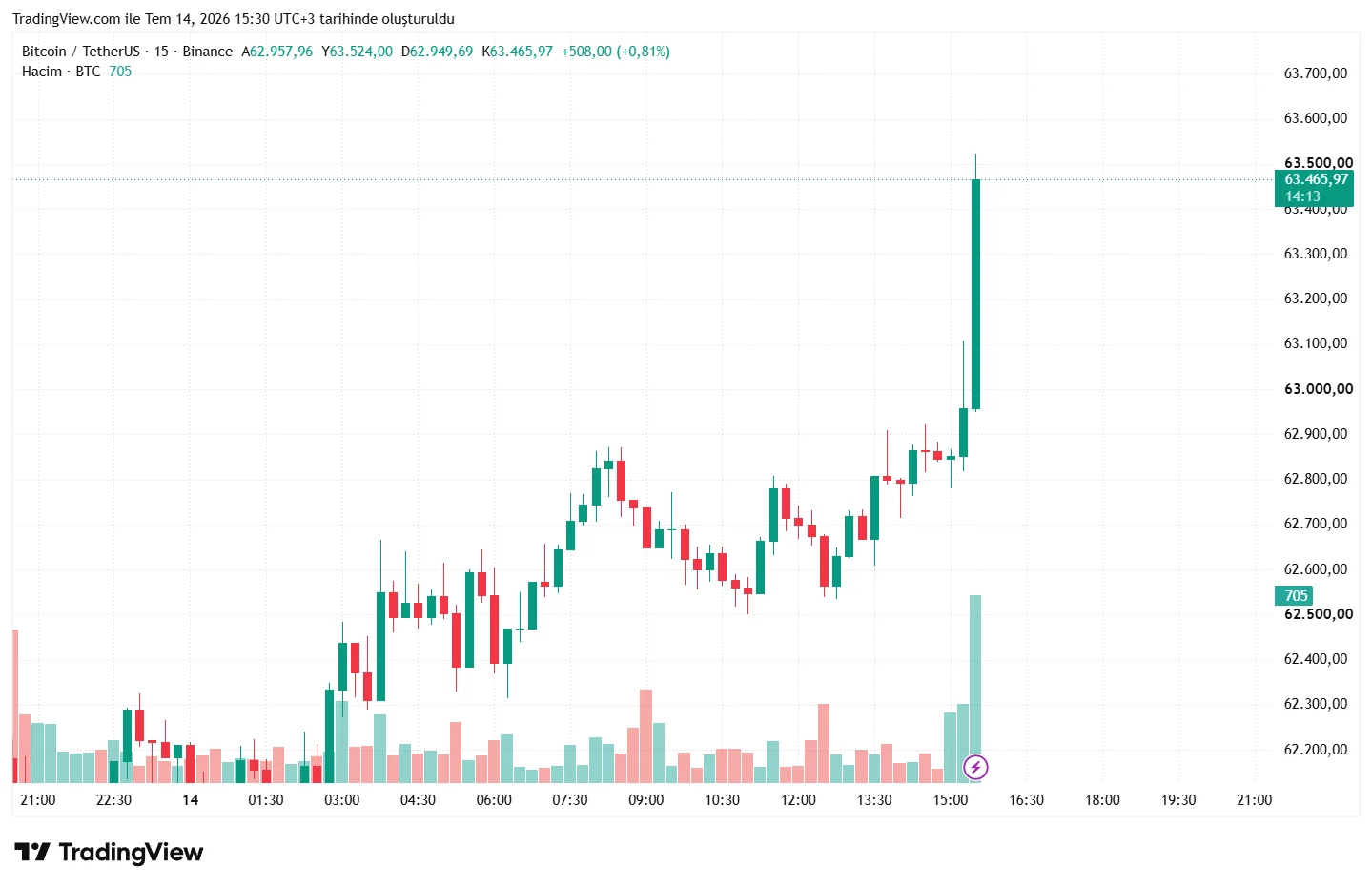
    Bitcoin, which surged above $64,000 on Friday, is maintaining its strong performance around the $62,000 level despite recent escalation in US-Iran tensions.

    However, the inflation data to be released is expected to be a determining factor in short-term price movements.

    Analysts are concerned that inflation, which the Fed has long been trying to bring down to its 2 percent target, will continue to face upward pressure due to increases in energy prices.

    At this point, while there is talk that the Fed might even raise interest rates in the face of increasing inflation risk (according to FEDWatcholl data, the probability of a rate hike in July is priced at 39%), the US June inflation data, which the Fed closely monitors when making its interest rate decisions, has been released.

    Here are the US inflation figures that have been released:

    Consumer Price Index Annual: Announced 3.5% – Expectation 3.8% – Previous 4.2%

    Consumer Price Index Monthly: Announced -0.4% – Expectation -0.1% – Previous 0.5%

    Core Consumer Price Index Annual: Announced 2.6% – Expected 2.8% – Previous 2.9%

    Core Consumer Price Index Monthly: Announced 0.0% – Expectation 0.2% – Previous 0.2%

    The consumer price index is a key variable used to measure consumer purchasing trends and changes in US inflation.

    According to The Kobeissi letter, June CPI inflation fell to 3.5%, below expectations of 3.8%. Core CPI inflation fell to 2.6%, also below expectations of 2.8%. Monthly CPI inflation fell by -0.4%, marking the largest monthly decline since May 2020. Following this data, US stock market futures rose in response to the news.

    Bitcoin’s Initial Reaction After the CPI Data!

    *This is not investment advice.

  • Hut 8 price target hiked to $165 at Benchmark as AI pivot reshapes valuation

    Hut 8 price target hiked to $165 at Benchmark as AI pivot reshapes valuation

    Companies including Hut 8, Core Scientific (CORZ), Hive Digital (HIVE) and Bit Digital (BTBT) have repositioned portions of their power and infrastructure assets to serve AI workloads, betting that long-term contracts with hyperscale customers will generate steadier, higher-margin revenue than cryptocurrency mining alone.

    Hut 8 has signed two 15-year, triple-net, take-or-pay leases covering 597 megawatts of IT capacity at its River Bend, Louisiana, and Beacon Point, Texas, campuses. According to Palmer, the agreements represent $16.8 billion in contracted base-term lease value and could rise to $42.8 billion if tenants exercise renewal options.

    Palmer said the Beacon Point agreement was the primary driver behind the higher valuation. The broker estimated that the project’s first phase alone carries $9.8 billion in base-term contract value and about $655 million in average annual net operating income.

    He also pointed to Hut 8’s financing strategy, noting the company recently completed $4.25 billion of investment-grade project financing for Beacon Point after raising $3.25 billion for River Bend. The deals validate management’s strategy of lowering its cost of capital by converting development assets into long-term contracted cash flows.

    Beyond its existing projects, the report highlighted Hut 8’s development pipeline, which totals more than 9 gigawatts across projects under exclusivity, development, construction and management, providing what it called a long runway for future growth.

  • Santiment Warns: “Bitcoin is Stable, But FOMO is at its Peak in Two Major Altcoins! Prices Could Fall!”

    Santiment Warns: “Bitcoin is Stable, But FOMO is at its Peak in Two Major Altcoins! Prices Could Fall!”

    While the leading cryptocurrency Bitcoin has been more stable in recent days, investor sentiment in the cryptocurrency market is reportedly on the rise again.

    At this point, cryptocurrency data analysis platform Santiment noted that although overall investor sentiment in the market is rising, $XRP and Ethereum have recorded their highest “FOMO” (fear of missing out) levels in the last five weeks.

    According to Santiment’s latest data, $ETH and $XRP investors have become significantly more optimistic. This has led to $ETH and $XRP reaching their highest FOMO levels in the last five weeks.

    According to the data, $XRP reached its highest FOMO level with 3.02 bullish comments for every bearish comment, while Ethereum was in the mild FOMO zone with a ratio of 2.31. In contrast, Bitcoin’s ratio of 1.40 indicated a more balanced and neutral investor sentiment.

    This shift in investor sentiment, at a time when prices are struggling to gain steady momentum, raises the possibility that the upward trend may have overtaken market performance.

    At this point, Santiment analysts note that the cryptocurrency market is moving in the opposite direction of investor expectations. They emphasize that the increasing optimism for $ETH and $XRP could be a counter-signal for the price.

    The analysis notes that historically, short-term corrections can occur during periods when investors have excessively bullish expectations, and suggests that high optimism in $XRP and Ethereum could increase downside risks or limit the pace of their rise in the short term.

    In contrast, balanced and neutral investor sentiment in Bitcoin is seen as healthier in terms of price. This is because, according to Santiment analysts, strong rallies can occur when investors are not yet fully focused on bullish expectations.

    *This is not investment advice.

  • Bitcoin exchanges Upbit and Bithumb announced they will list this altcoin on their spot trading platforms!

    Bitcoin exchanges Upbit and Bithumb announced they will list this altcoin on their spot trading platforms!

    South Korea’s leading cryptocurrency exchanges, Upbit and Bithumb, have announced they will add the $DRV token to their trading lists. According to the announcements, $DRV will be listed on Upbit against South Korean won (KRW), Bitcoin ($BTC), and Tether ($USDT), while Bithumb will only offer the token in the KRW trading pair. The simultaneous listing decision by the two major exchanges is being closely watched by the market as it is expected to increase the project’s visibility and liquidity.

    According to Upbit’s official announcement, the $DRV token will begin trading on the KRW, $BTC, and $USDT markets. Thanks to multi-pair support, users will be able to buy and sell $DRV across different assets. This is expected to increase the token’s trading volume and reach a wider investor base.

    Bithumb also announced in an official statement that it will list $DRV on the Korean won market. The exchange stated that trading is scheduled to begin at 8:00 PM local time. Thus, South Korea’s two largest cryptocurrency platforms will offer $DRV to their users on the same day.

    Listings on major exchanges in the cryptocurrency market can have a significant impact on the trading volume and visibility of the tokens in question. Listings on high-volume South Korean platforms like Upbit and Bithumb, in particular, can increase interest in the project from both local and global investors. However, experts point out that listing news can increase price volatility in the short term.

    Investors are advised to carefully evaluate the project’s technical infrastructure, token economics, and risks before trading, due to the high volatility that can occur in newly listed tokens. Market analysts note that $DRV’s performance will be shaped not only by the listing effect but also by the project’s development process, adoption rate, and overall cryptocurrency market trends.

    *This is not investment advice.

  • U.S. government moves $288 million in seized bitcoin, ether to Coinbase Prime

    U.S. government moves $288 million in seized bitcoin, ether to Coinbase Prime

    The US government just staged its seized crypto for an exchange, and it took an extra hop to get there.

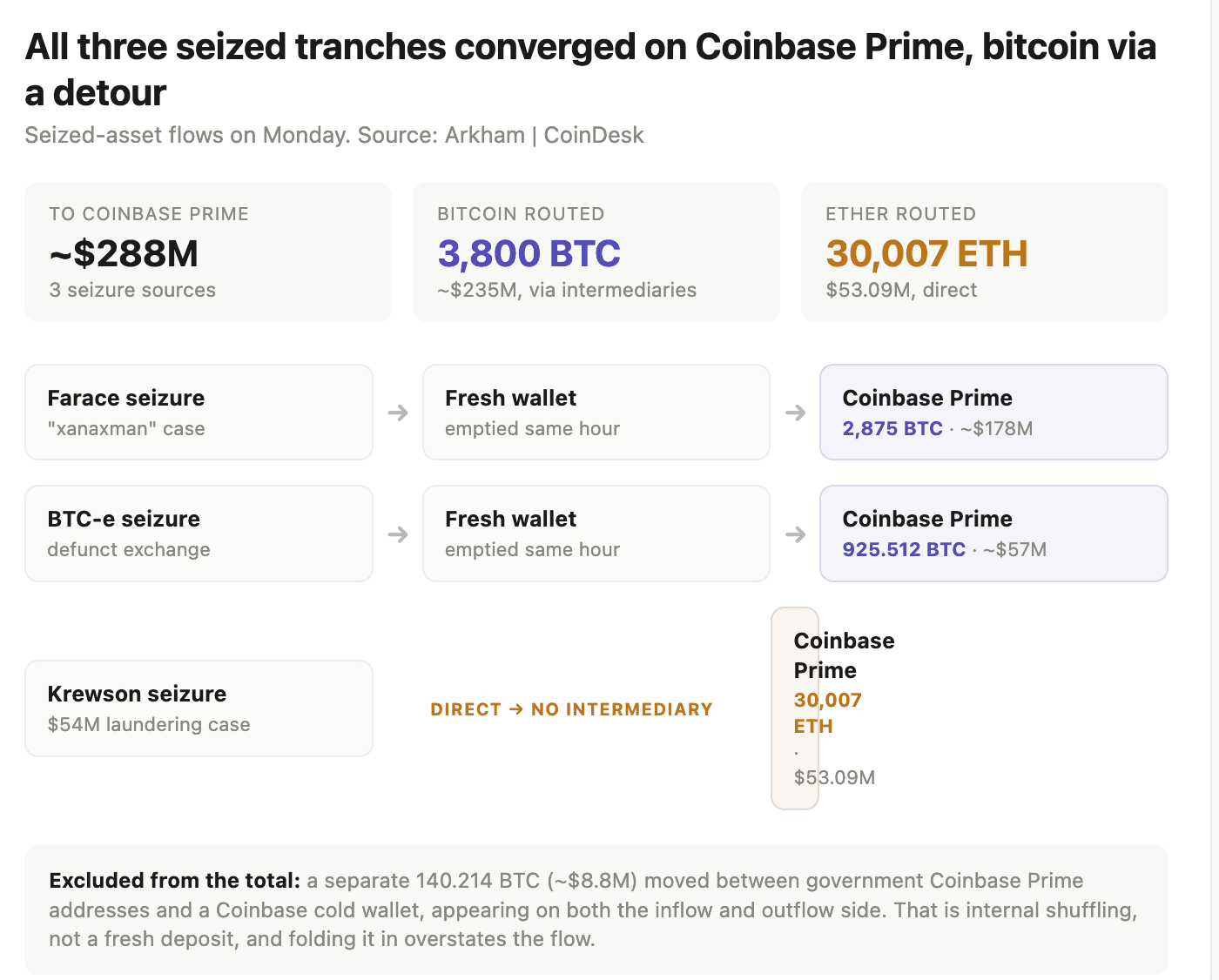
    Wallets tied to the government moved about $288 million in seized bitcoin and ether onto Coinbase Prime over roughly half a day on Monday, blockchain data from Arkham shows. The ether went direct, while the bitcoin took a detour through fresh intermediary wallets first.

    The movements are despite an executive order in March 2025 by President Donald Trump, which designated seized bitcoin for the country’s Strategic Bitcoin Reserve and said it should not be sold.

    A government wallet tied to Ryan Farace, the “xanaxman” case, sent 2,875 $BTC worth roughly $178 million to a new address, which forwarded the full 2,875 $BTC to a Coinbase Prime deposit wallet minutes later.

    A second wallet linked to defunct exchange $BTC-e sent 925.512 $BTC worth $57 million through the same pattern, in from the seizure address, straight out to Coinbase Prime. Both intermediary wallets were emptied out.

    The ether skipped the middle step, however. A wallet connected to Brian Krewson, the Oracle employee named in a $54 million laundering scheme, sent 30,007 $ETH worth $53.09 million directly to a Coinbase Prime deposit address.

  • The Sharing Volume of Bitcoin and Ethereum Keywords on X Has Dropped to Its Lowest Level in the Last 12 Months!

    The Sharing Volume of Bitcoin and Ethereum Keywords on X Has Dropped to Its Lowest Level in the Last 12 Months!

    While institutional investors continue to show interest in the cryptocurrency market, there has been a noticeable decline in individual investor engagement on social media. According to recent data, the volume of posts using the keywords “Bitcoin” and “Ethereum” on X (formerly Twitter) has fallen to its lowest level in the last 12 months.

    Daily posts about Bitcoin have dropped to around 130,000, while posts about Ethereum have fallen to around 40,000. These levels represent the lowest social media activity seen since 2020, when institutional interest was just beginning to emerge.

    Tweet volume is considered one of the key indicators measuring the level of interest of individual investors in the market. This metric reveals not the amount of capital entering the market, but how much investors are talking about specific assets. The current situation is noteworthy because, despite social media interest falling back to 2020 levels, institutional investors’ interest in cryptocurrencies is conversely accelerating.

    In 2020, Bitcoin and Ethereum hadn’t yet fully entered Wall Street’s radar, spot ETFs hadn’t been approved, and holding crypto assets on corporate balance sheets wasn’t widespread. Today, the picture has changed dramatically. Spot Bitcoin and Ethereum ETFs manage billions of dollars in funds, and asset tokenization holds a significant place on the agenda of traditional finance conferences and major financial institutions.

    Analysts believe this development could signal that institutional adoption may now be able to progress independently of individual investor interest. However, historical data shows that low levels of social media engagement often coincide with periods when prices are trading sideways or pulling back.

    According to experts, as the crypto ecosystem matures, price movements and infrastructure investments may not require as much intense individual investor interest as in past bull cycles.

    However, the renewed increase in individual investor participation remains a crucial factor in strengthening both trading volumes and market momentum. Therefore, social media data continues to be closely monitored as an indicator of market sentiment.

    *This is not investment advice.