This week gave beaten-up stock names a strange new job. They stopped acting like laggards and started leading the screen. Oracle (NYSE: ORCL), Microsoft (NASDAQ: MSFT), and AMD (NASDAQ: AMD) came into Friday on track for huge weekly gains, the kind that reset charts and force traders to stop laughing at names they had written off.
Oracle rose 27% for the week, its best run since June 1999. AMD added 14% for the week, hit an all-time high on Thursday, and kept alive a 13-session winning streak that has pushed the shares up more than 42%.
Microsoft also climbed 14% in what is its best week since April 2015 after a brutal March quarter in which the software giant lost almost a quarter of its value, its worst quarter since 2008.
Tesla (NASDAQ: TSLA) gained about 15% this week after Elon Musk said on Wednesday that the company hit a key milestone on its AI5 chip.
Broadcom (NASDAQ: AVGO), Micron (NASDAQ: MU), and ON Semiconductor are each up about 30% so far in April. Marvell is up 41% this month. The iShares Expanded Tech-Software ETF, or IGV, is up about 14% week to date, which puts it on track for its best week since its record week in October 2001.
The SPDR Info Tech Fund, known as XLK, hit an all-time high on Friday for the first time since October 2025 and closed at a record level after 13 straight days of gains. That fund also logged its best week since April 2025.
Oracle locks down power while AMD and Microsoft rip higher
Oracle on Monday had expanded an artificial intelligence data center power deal with Bloom Energy, locking in 1.2 gigawatts of capacity from Bloom.
The week before, Oracle was also issued a warrant to buy $400 million worth of Bloom shares. That added another layer to the story and gave traders more reason to chase the move.
AMD’s run looked even more dramatic on the chart. The stock rose 14% this week, but the weekly number only tells part of it. The shares have climbed more than 42% during a stretch of 13 consecutive up days. That is AMD’s longest winning streak in more than 20 years.
Microsoft, meanwhile, just finished its worst quarter since 2008 in March, when it lost almost a quarter of its market value. Now it has posted its best week since April 2015.
Since the year started, a lot of stocks have been getting sold on the fear that AI would crush old software models or force expensive catch-up spending.
But this week, hopes for a lasting peace deal between the U.S. and Iran helped fuel the rebound across the sector. Even after this rally, IGV is still down about 19% so far this year.
Tesla joins the surge as chip names and tech funds pile on
Tesla’s setup though is more complicated. Musk said Wednesday that Tesla reached a key milestone on its AI5 chip, and the stock rose about 15% for the week.
Wall Street analysts expect revenue of $22.08 billion, down 9% from a year earlier. They also expect adjusted EPS of $0.35. Adjusted EBITDA is seen at $3.217 billion, down 14.4% from the same quarter last year.
Earlier this month, Tesla said it delivered 358,023 vehicles globally in the first quarter. That missed the 364,645 analysts expected, though it was still up 6.3% year over year. There is a catch in those year-over-year numbers.
Last year’s total was unusually weak because of the changeover to the new Model Y, which means the base for comparison was already low. Tesla is also expected to give investors an update on its full self-driving effort and its robotaxi plans.
Meanwhile, Broadcom stayed in focus as Jim Cramer discussed the recent market rotation on Mad Money and said: “You may think it’s fanciable to discuss a no-name company like Broadcom, but did you even realize that it’s actually bigger in market cap size than Meta? After the stock’s 4.2% rally today, isn’t that incredible? I’m going to be sure of this because you never know with these things. But I have to tell you, this Meta is back, okay? But Broadcom is the one that I think you need to focus on.”
The Ripple-linked $XRP is now live for trading and use in DeFi on Solana.
It’s made possible due to Hex Trust’s wrapped token offering, which is 1:1 backed with native $XRP.
Around $1.2 million in wXRP has already been minted on Solana.
The prominent Ripple-linked cryptocurrency $XRP is now live for use on Solana, letting individual users and institutions alike gain access to the token on the layer-1 blockchain via a wrapped token issued by Hex Trust.
The initiative, first announced in December, will open up the utility of $XRP beyond the $XRP Ledger, expanding its use in market-making and decentralized finance (DeFi) to Solana.
More than 834,000 $XRP, or around $1.2 million worth of the token, has already been wrapped and activated on Solana.
BREAKING: $XRP is live on Solana https://t.co/pWiljVfc6m pic.twitter.com/QZbwd6qEN4
— Solana (@solana) April 17, 2026
To do so, authorized users send native $XRP to Hex Trust’s regulated custody services, and the firm then mints wXRP tokens on Solana or supported Ethereum Virtual Machine (EVM) blockchains like the Ethereum mainnet, Optimism, or HyperEVM. Institutions seeking access to the project can register to gain early access to the feature via Hex Trust.
The 1:1 backed wXRP can then be used in DeFi protocols on those chains, all of which have more robust DeFi ecosystems when compared to the native $XRP Ledger. According to data from DeFiLlama, Ethereum and Solana rank first and second in DeFi total-value-locked (TVL) with $57.2 billion and $6.08 billion, respectively.
Meanwhile, $XRP Ledger ranks 41st, with just $51.46 million in DeFi TVL.
“There’s growing demand to use $XRP across the wider crypto ecosystem and institutions, and so we are excited to see Hex Trust address this demand,” Ripple X SVP Marcus Infanger said in a statement when the initiative was launched in December.
With the wrapped token’s launch on Solana, now they can do so.
In addition to the $1.2 million in wXRP on Solana, 50 million tokens or around $74.5 million worth of wXRP has been minted on Ethereum. Almost all of those tokens have been in the same Ethereum wallet—one likely connected to the token issuer—since early November, prior to the wXRP announcement.
Less than 60 total transactions involving the wrapped token have taken place all-time, according to Ethereum block explorer, Etherscan.
A representative for Hex Trust did not immediately respond to Decrypt’s request for comment. $XRP is up around 2% in the last 24 hours, recently changing hands at $1.49. It remains 59% off its all-time high of $3.65 created last July.
The U.S. Securities and Exchange Commission (SEC) has formally approved a rule change proposal submitted by the New York Stock Exchange (NYSE) that aims to create a new trading mechanism for “tokenized securities.”
The proposal, outlined in document number 34-105260, is considered a critical step towards integrating traditional finance with blockchain technology.
According to the proposal, the NYSE plans to introduce a new regulation called “Rule 7.50,” allowing eligible securities to be traded in both traditional and blockchain-based “tokenized” forms. This structure will be implemented within the scope of the DTC pilot program under the Depository Trust & Clearing Corporation (DTCC).
Related NewsAfter the Bull Run, Michael Saylor Increased His Bitcoin Fortune: Here’s the Latest on His Portfolio
In the new system, tokenized securities will share the same trading code (CUSIP) and ownership structure as traditional shares. This will ensure full fungibility between the two forms. Furthermore, on the matching engine side, tokenized assets will be subject to the same priority rules as traditional shares and will not experience any disadvantage in trading order.
Market participants can choose to have transactions executed on the blockchain via a “tokenization flag” that they can use when placing orders. Technical and operational processes will be handled by authorized custodians.
NYSE’s proposal isn’t limited to the trading side alone. The exchange is also making changes to order queuing, routing, and clearing rules, aiming to seamlessly integrate tokenized securities into its existing market infrastructure.
Global financial giant UBS has published a noteworthy assessment of US monetary policy. The bank stated that it maintains its expectation that the Fed will cut interest rates later in the year.
A research note published by UBS emphasized that the Fed remains on a path of monetary policy easing under the current outlook. The report highlighted that Fed Chairman Jerome Powell has recently indicated that the need for tightening is limited despite the rise in energy prices. It recalled Powell’s statement that supply shocks, particularly those like rising oil prices, are generally ignored as long as inflation expectations remain under control.
Related NewsAfter the Bull Run, Michael Saylor Increased His Bitcoin Fortune: Here’s the Latest on His Portfolio
UBS analysts stated that the Fed is looking for more evidence of a sustained decline in core inflation before returning to loose monetary policy, but they still expect a total of 50 basis points of interest rate cuts by the end of the year.
On the other hand, the report also included projections for the US bond market. UBS pointed out that current US Treasury yields are significantly higher than before the geopolitical tensions, arguing that there is therefore room for downward movement in yields. The bank stated its year-end forecast for the 2-year US Treasury yield is 3.25%, and for the 10-year Treasury yield is 3.75%.
Bitcoin investors are suddenly confronting an uncomfortable math problem inside the $91.7 billion U.S. spot bitcoin ETF market.
“Coinbase Custody holds 84% of all US spot Bitcoin ETF assets,” Marc Baumann, founder of research firm fiftyonexyz, posted on X on April 14. “That’s $77 billion with a single custodian. For an industry built on decentralization, the most important product category has a single point of failure. Regulators will notice.”
The warning is landing as bitcoin trades near $77,000, having clawed back from a 40% drawdown since its late-2025 peak around $126,000. It also lands three weeks after the April 2 conditional approval of a national trust charter for Coinbase by the Office of the Comptroller of the Currency. “OCC grants Coinbase conditional approval for a National Trust Bank Charter,” Swiss law firm Goldblum & Partners posted on X on April 13, noting that “11 crypto firms now in the federal banking pipeline” and that a new rule, 12 CFR 5.20, “explicitly permits non-fiduciary crypto custody for national trust banks.” That regulatory blessing, in a twist, deepens the concentration analysts are now calling out.
The figure itself has become the new rallying cry of bitcoin’s structural skeptics. CryptoSlate first framed the dollar number on April 12 as “over 80% of Bitcoin ETF assets hit Coinbase custody choke point with $74B at risk.” Within 48 hours, the phrasing was circulating through crypto-media accounts and analyst threads.
“Over 80% of Bitcoin ETF assets now sit inside Coinbase custody. That’s roughly $74B concentrated in one infrastructure layer,” wrote crypto-media account W3BCMedia on April 13. Institutional adoption was growing, the account added, “but so is systemic custody risk.”
What the data shows
The $91.7 billion pile of U.S. spot bitcoin exchange-traded fund assets, a figure Baumann compiled from issuer prospectus filings, spans BlackRock’s IBIT, ARK 21Shares’ ARKB and Morgan Stanley’s newly launched MSBT, among others. A common thread runs through the bulk of them: Coinbase Prime is the custodian. Fidelity’s FBTC is the notable exception, self-custodying through in-house Fidelity Digital Assets.
New inflows are not diversifying that base. Blockchain intelligence firm Arkham confirmed on X on April 15 that “Morgan Stanley is buying bitcoin” via MSBT, noting the fund “has bought $83.6M of BTC” and “currently holds $64.4M in its on-chain addresses.” Those coins, too, route through Coinbase Prime.
For retail investors holding ETF shares, the arrangement has been a non-issue since spot approval in January 2024. For the handful of X accounts now amplifying the warning, it reads differently.
“Not Your Keys Not Your Coins,” wrote a pseudonymous account on April 14, citing the list of exchanges that have failed since 2014. “Makes you question Saylor or IBIT risk. Really Coinbase custody is a major key man risk.”
Why Wall Street is pushing in anyway
The paradox is that institutional appetite is accelerating, not slowing, as the concentration grows.
Fordefi, a crypto wallet infrastructure firm, tallied the last 90 days on X: Mastercard acquiring stablecoin rails provider BVNK for $1.8 billion; Citi rolling out institutional bitcoin custody; Morgan Stanley saying it will “operate as a crypto bank”; Crypto.com joining BitGo, Circle, Ripple and Paxos with OCC approval. “FDIC opened a formal crypto custody study,” the post added.
The bitcoin ETF market has “officially entered Phase Two,” Joe Consorti, a macro and bitcoin analyst, said in an April 15 video that has drawn more than 14,000 views. Phase One, Consorti argued, was basic spot access. Phase Two, he said, is about packaging bitcoin into volatility-dampened, yield-generating products for conservative investors, pointing to Goldman Sachs’s premium-income ETF filing, Morgan Stanley’s MSBT and Schwab’s advisor-channel products.
Consorti’s math: a 3% allocation from U.S. wealth advisors alone could push bitcoin to $210,000. The $144 trillion wealth-advisory market is the pool the ETF wrapper now unlocks.
The bull case leans on the same custody data that worries the skeptics. On Simply Bitcoin’s April 15 video,, the host called MicroStrategy and its ETF-wrapped peers “a synthetic miner,” buying more bitcoin in one session than the network mints in a week.
Bitwise chief investment officer Matt Hougan goes even bigger. His long-term $1 million target rests on a “sustained steady boom” of institutional flows, not the violent boom-bust cycles of earlier bitcoin eras. Every dollar landing in Coinbase Prime, on that read, is bullish collateral.
The bear case: regulators haven’t blinked yet
The bull narrative has only been tested in two calm years. One custody incident, one freeze order or one operational failure at a venue holding $77 billion would test it all at once.
Baumann’s phrase, “regulators will notice,” is the line critics keep returning to. The OCC’s April 2 trust-charter pulls Coinbase inside the federal banking perimeter. That cuts two ways: more oversight, and more exposure to the kind of supervisory actions banks periodically face. So far, neither Coinbase nor the OCC has publicly flagged any worry about the ETF concentration.
An April 13 post from fiduciary-focused account prudentmachines pushed a different fault line. “Coinbase got conditional OCC approval for a national trust bank charter, enabling them to custody federally regulated digital assets. Coinbase custodies most U.S. Bitcoin ETF assets,” the account wrote. “The question is whether that custodial function triggers fiduciary status under ERISA.”
If it does, retirement-plan sponsors eyeing spot bitcoin exposure through 401(k) menus inherit a set of duties they have not yet been asked to perform. The Department of Labor’s March 30 proposed “safe harbor” rule for alternative assets in 401(k) plans is already sharpening the question.
Nic Carter, co-founder of Castle Island Ventures, has gone further. On an April 3 Bankless interview, Carter argued the near-term quantum-computing risk to bitcoin sits inside “institutional custody and wallet infrastructure,” naming Coinbase Custody and Fidelity. He calls what is piling up on those platforms “cryptographic migration debt.”
Michael Saylor has pushed a different worry. His “paper bitcoin” warnings, broken down on Germany’s Blocktrainer channel on April 13, argue that institutional claims on coins at centralized custodians inflate what looks like real circulating supply. Host Roman Reher summarized the point bluntly: holding coins at a major custodian “doesn’t guarantee they aren’t being used as collateral.”
Coinbase’s own ETF prospectus filings say the opposite. Spot ETF assets, per the documents, are held in segregated cold storage, not lent out or rehypothecated. The SEC approved the spot bitcoin ETFs on that premise. The open question is whether it holds under stress.
What to watch
The cleanest exit is diversification. A second custodian named in any issuer’s next filing would break the math instantly. So would OCC or Securities and Exchange Commission guidance on custody concentration, or Coinbase laying out contingency arrangements for its biggest clients.
None of it has happened yet.
Bitcoin trades near $77,000. Roughly $77 billion of its U.S. institutional footprint sits in one place. “Regulators will notice,” Baumann wrote on April 14. For now, nobody at the OCC or the SEC has said otherwise.
Part 1 of this series explained what quantum computers actually are. Not just faster versions of regular computers, but a fundamentally different kind of machine that exploits the weird rules of physics that only apply at the scale of atoms and particles.
But knowing how a quantum computer works does not tell you how it can be used to steal bitcoin by a bad actor. That requires understanding what it is actually attacking, how bitcoin’s security is built, and exactly where the weakness sits.
This piece starts with bitcoin’s encryption and works through to the nine-minute window it takes to break it, as identified by Google’s recent quantum computing paper.
The one-way map
Bitcoin uses a system called elliptic curve cryptography to prove who owns what. Every wallet has two keys. A private key, which is a secret number, 256 digits long in binary, roughly as long as this sentence. A public key is derived from the private key by performing a mathematical operation on the specific curve called “secp256k1.”
Think of it as a one-way map. Start at a known location on the curve that everyone agrees on, called the generator point G (as shown in the chart below). Take a private number of steps in a pattern defined by the curve’s math. The number of steps is your private key. Where you end up on the curve is your public key (point K in the chart). Anyone can verify that you ended up at that specific location. Nobody can figure out how many steps you took to get there.
Technically, this is written as K = k × G, where k is your private key and K is your public key. The “multiplication” is not regular multiplication but a geometric operation where you repeatedly add a point to itself along the curve. The result lands on a seemingly random spot that only your specific number k would produce.
The crucial property is that going forward is easy and going backward is, for classical computers, effectively impossible. If you know k and G, calculating K takes milliseconds. If you know K and G and want to figure out k, you are solving what mathematicians call the elliptic curve discrete logarithm problem.
It is estimated that the best-known classical algorithms for a 256-bit curve would take longer than the age of the universe.
This one-way trapdoor is the entire security model. Your private key proves you own your coins. Your public key is safe to share because no classical computer can reverse the math. When you send bitcoin, your wallet uses the private key to create a digital signature, a mathematical proof that you know the secret number without revealing it.
Shor’s algorithm opens the door both ways
In 1994, a mathematician named Peter Shor discovered a quantum algorithm that breaks the trapdoor.
Shor’s algorithm solves the discrete logarithm problem efficiently. The same math that would take a classical computer longer than the universe has existed, Shor’s algorithm handles in what mathematicians call polynomial time, meaning the difficulty grows slowly as numbers get bigger rather than explosively.
The intuition for how it works comes back to the three quantum properties from Part 1 of this series.
The algorithm needs to find your private key k, given your public key K and the generator point G. It converts this into a problem of finding the period of a function. Think of a function that takes a number as input and returns a point on the elliptic curve.
As you feed it sequential numbers, 1, 2, 3, 4, the outputs eventually repeat in a cycle. The length of that cycle is called the period, and once you know how often the function repeats, the math of the discrete logarithm problem unravels in a single step. The private key falls out almost immediately.
Finding this period of a function is exactly what quantum computers are built for. The algorithm puts its input register into a superposition (or, in quantum mechanics, a particle exists in multiple locations simultaneously), representing all possible values simultaneously. It applies the function to all of them at once.
Then it applies a quantum operation called the Fourier transform, which causes the number of wrong answers to cancel out while the correct answers are reinforced.
When you measure the result, the period appears. From this period, ordinary math recovers k. That is your private key, and therefore your coins.
The attack uses all three quantum tricks from the first piece. Superposition evaluates the function on every possible input at once. Entanglement links the input and output so the results stay correlated. ‘Interference’ filters the noise until only the answer remains.
Why bitcoin still works today
Shor’s algorithm has been known for more than 30 years. The reason bitcoin still exists is that running it requires a quantum computer with a large enough number of stable qubits to maintain coherence through the entire calculation.
Building that machine has been beyond reach, but the question has always been how large is “large enough.”
Previous estimates said millions of physical qubits. Google’s paper, in early April by its Quantum AI division with contributions from Ethereum Foundation researcher Justin Drake and Stanford cryptographer Dan Boneh, reduced that to fewer than 500,000.
Or a roughly 20-fold reduction from prior estimates.
The team designed two quantum circuits that implement Shor’s algorithm against bitcoin’s specific elliptic curve. One uses approximately 1,200 logical qubits and 90 million Toffoli gates. The other uses approximately 1,450 logical qubits and 70 million Toffoli gates.
A Toffoli gate is a type of gate that acts on three qubits: two control qubits, which affect the state of a third, target qubit. Imagine this as three light switches (qubits) and a special lightbulb (the target) that only turns on if two specific switches are flipped on at the same time.
Because qubits lose their quantum state constantly, as Part 1 explained, you need hundreds of redundant qubits checking each other’s work to maintain a single reliable logical qubit. Most of a quantum computer exists just to catch the machine’s own mistakes before they ruin the calculation. The roughly 400-to-1 ratio between physical and logical qubits reflects how much of the machine exists as self-babysitting infrastructure.
The nine-minute window
Google’s paper did not just reduce qubit counts. It introduced a practical attack scenario that changes how to think about the threat.
The parts of Shor’s algorithm that depend only on the elliptic curve’s fixed parameters, which are publicly known and identical for every bitcoin wallet, can be precomputed. The quantum computer sits in a primed state, already halfway through the calculation, waiting.
The moment a target public key appears, whether broadcast in a transaction to the network’s mempool or already exposed on the blockchain from a previous transaction, the machine only needs to finish the second half.
Google estimates that the second half takes about nine minutes.
Bitcoin’s average block confirmation time is 10 minutes. That means if a user broadcasts a transaction and their public key is visible in the mempool, a quantum attacker has roughly nine minutes to derive a private key and submit a competing transaction that redirects funds.
The math gives the attacker a roughly 41% chance of finishing before your original transaction confirms.
That is the mempool attack. It is alarming but it requires a quantum computer that does not exist yet.
The bigger concern, however, is the 6.9 million bitcoin (roughly one-third of total supply) sitting in wallets where the public key has already been permanently exposed on the blockchain. Those coins are vulnerable to an “at-rest” attack that requires no race against the clock. The attacker can take as long as needed.
A quantum computer running Shor’s algorithm can turn a bitcoin public key into the private key that controls the coins. For coins transacted since Taproot (a privacy upgrade on Bitcoin that went live in November 2021), the public key is already visible. For coins in older addresses, the public key is hidden until you spend, at which point you have roughly nine minutes before the attacker catches up.
What this means in practice, which 6.9 million bitcoin are already exposed, what Taproot changed, and how fast the hardware is closing the gap, is the subject of the next and final piece in this series.
Judge Stanley Blumenfeld Jr. determined that the token does not meet the criteria of an investment contract, invalidating claims of unregistered securities.
The lead plaintiff, Lee Greenfield, reported losses exceeding $40,000 after investing in the Solana and Ethereum versions of the asset.
The ruling concludes that there was no “common enterprise” according to the Howey Test, exempting Jenner from federal securities fraud allegations.
On Friday, a district judge in California issued a landmark ruling by decreeing that Caitlyn Jenner’s JENNER cryptocurrency does not constitute a financial security. The decision follows a class-action lawsuit accusing the celebrity of promoting unregulated assets.
The court analyzed the case under the Howey Test, a legal tool that defines whether an asset is an investment contract. The judge concluded that there was no “common enterprise” or technical capital pooling mechanisms to justify the classification.
Despite the plaintiff’s argument that Jenner’s fame influenced the expectation of profits, the ruling maintains that investors did not share profits or losses collectively. This technical nuance is crucial for differentiating memecoins from traditional stocks.
The defense for Jenner and her late manager, Sophia Hutchins, always maintained that the Ethereum-based token lacked the characteristics of a security. The court finally validated this stance, pointing out deficiencies in the prosecution’s arguments.
The Impact of the Howey Test on the Memecoin Ecosystem
This verdict represents a significant precedent for the celebrity-linked cryptocurrency sector. By ruling in favor of the defense, the court limits the ability of investors to claim damages based strictly on market volatility.
Furthermore, the resolution highlights that the simple act of investing money does not guarantee the existence of a security if there is no corporate structure behind it. This distinction protects, in part, token creators against litigation over price fluctuations.
The judge rejected the idea that transaction taxes or marketing plans constituted an investment in a common enterprise. According to the record, resources were not pooled to generate capital beyond the coin itself.
Consequently, Judge Blumenfeld dismissed the federal charges, suggesting that any remaining state-level claims must be resolved in other venues. The sentence closes a tense chapter for Caitlyn Jenner’s public image in the crypto space.
U.S. justice has drawn a clear line by determining that the JENNER memecoin does not qualify as a security. The ruling underscores the lack of a common enterprise, leaving claims for economic losses outside federal securities jurisdiction.
Grinex’s shutdown is intensifying scrutiny of crypto laundering tactics, as fund movements suggest behavior inconsistent with typical enforcement actions. Chainalysis analysis highlights patterns that raise questions about whether the activity aligns with a conventional external hack or alternative explanations.
Key Takeaways:
Chainalysis flags Grinex swaps as inconsistent with typical law enforcement seizures.
Tron-based conversions show illicit actors avoiding stablecoin issuer intervention.
Grinex activity does not clearly align with patterns of a conventional external hack.
Grinex Shutdown Raises Questions About Crypto Laundering Tactics
Sanctions pressure continues to test the resilience of crypto networks tied to restricted financial activity. Blockchain intelligence firm Chainalysis on April 17 examined Grinex after the sanctioned exchange suspended operations. The review described the shutdown as a new stress point for infrastructure tied to sanctions evasion.
Grinex claimed a cyberattack cost about 1 billion rubles, or $13.7 million, and published the source and destination addresses involved. Chainalysis then assessed the transfers using on-chain data rather than relying on the exchange’s narrative. The analysis found that the stolen assets were mainly a fiat-backed stablecoin before being moved through a Tron-based decentralized exchange into TRX.
“In the case of the alleged Grinex hack, the stablecoin funds were quickly swapped for a non-freezable token, thereby avoiding the risk of having the stablecoins frozen by the issuer,” the blockchain analytics firm stated, adding:
“This frantic swapping from stablecoins to more decentralized tokens is a hallmark tactic of cybercriminals and illicit actors attempting to launder funds before a centralized freeze can be executed.”
Chainalysis argued that this behavior does not fit a typical Western law enforcement seizure because authorities can request freezes from centralized stablecoin issuers. The firm instead said the rapid conversion raises questions about whether the activity aligns with a conventional external hack.
Shadow Crypto Economy Shows Deep Interconnected Structure
Those conclusions rest on more than the attack claim alone. Chainalysis noted that the decentralized exchange used in the swap had previously served Garantex, the sanctioned predecessor to Grinex, as a liquidity source for hot wallets. That detail is notable because Chainalysis has already described Grinex as the direct successor to Garantex after international enforcement disrupted the earlier platform. The company also tied Grinex to A7A5, a ruble-backed token issued by sanctioned Kyrgyzstani company Old Vector.
According to the analysis, A7A5 was built for a narrow Russia-linked payments ecosystem aligned with cross-border settlement needs under sanctions pressure. Chainalysis added that the exfiltrated funds were still sitting in a single address at publication time, leaving a live trail for future forensic review.
The broader takeaway was less about one theft than about the financial system surrounding it. Chainalysis observed that the episode is the latest disruption inside a “shadow crypto economy.” That phrase captured the firm’s larger conclusion that Grinex, Garantex, A7A5, and related services formed an interlinked network designed to keep value moving despite sanctions. Chainalysis further disclosed that it labeled the relevant addresses in its products to help customers identify exposure as the funds move downstream. Even without final attribution, the firm made clear that Grinex’s suspension damages a key channel within that sanctioned ecosystem.
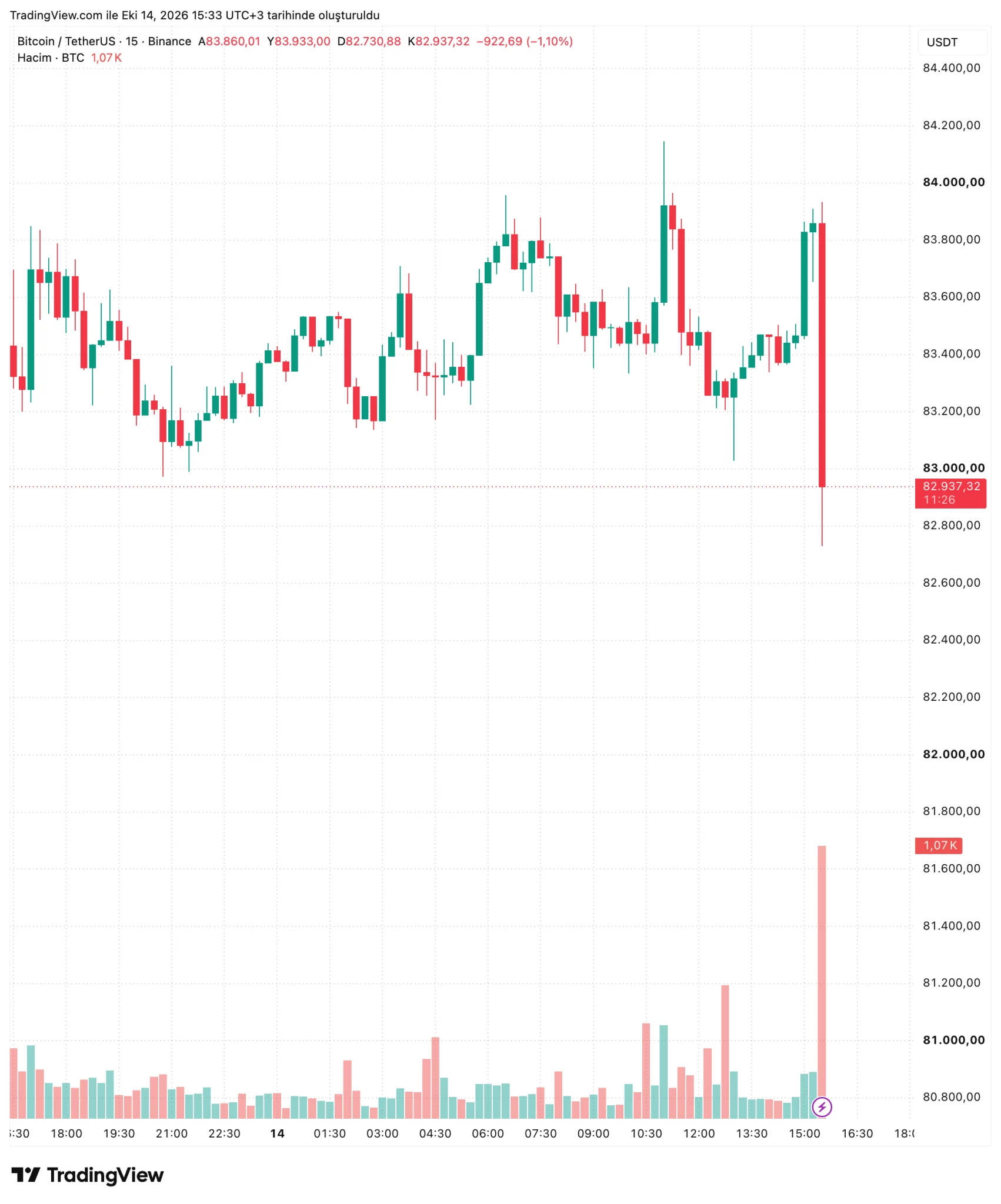
Bitcoin (BTC) surged above $77,000 following news from the US-Iran front. While the price subsequently fell back to around $76,000, one analyst suggests a significant rise in $XRP is possible.
Darkfost, a CryptoQuant analyst, stated that the funding rate for $XRP is negative.
The analyst noted that the funding rate for $XRP perpetual futures on Binance has remained consistently negative this year, indicating an extreme bearish trend.
This indicates that $XRP investors on Binance are gradually shifting towards a general bearish sentiment and are now approaching a market-wide consensus.
The analyst also noted that the $XRP correction is currently around -60%, with investors continuing to position themselves for further declines rather than expecting a recovery.
“Historically, these kinds of extreme emotional dynamics haven’t always been well-timed signals for following consensus.”
He recalled that after a similar situation was last observed, $XRP triggered a strong upward momentum, rising from approximately $1.6 to $3.6, showing an increase of about 127%.
However, the analyst noted that the overall market environment remains challenging, especially for altcoins, and therefore caution should be exercised in position strategies.
A critical development regarding the Strait of Hormuz has occurred within the ongoing negotiations between the US and Iran.
According to reports in the US press, the Iranian government announced that the Strait of Hormuz will remain “fully open” to all commercial vessels during the ceasefire. This step is considered an important signal regarding the security of global energy and trade flows.
US President Donald Trump announced that Iran had pledged not to close the waterway again. However, Trump emphasized that the US naval blockade in the region would continue until a comprehensive agreement is reached. The Washington administration appears inclined to maintain military and strategic pressure while awaiting a final agreement.
Related NewsAnalysis Company Claims “Bullish Signs” May Have Begun to Emerge in an Altcoin That Has Been Stagnant for a Long Time
While progress has been reported in negotiations between the parties, there are hopes that an agreement could be reached by the end of the week. However, disagreements on critical issues are said to persist. It is claimed that the US is considering releasing approximately $20 billion worth of Iranian assets as part of the negotiations, while the Trump administration maintains that they plan to take over Iran’s enriched uranium and that “no money transfers will take place” in this process.
Meanwhile, on the Lebanese front, another aspect of the tension in the region, the 10-day ceasefire is reportedly being largely maintained. Israel has stated it will not withdraw from southern Lebanon, while Iranian-backed Hezbollah has indicated it will only abide by the ceasefire if Israeli attacks cease completely. This delicate balance in Lebanon remains a crucial bargaining chip in the comprehensive peace talks with Iran.
Following these developments, the price of Bitcoin experienced a significant increase.