Tag: CRYPTOS FoxBusiness

  • MemeToro vs Pump.fun: Which Fair-Launch Memecoin Platform Actually Protects Traders? $MT Deep Dive

    MemeToro vs Pump.fun: Which Fair-Launch Memecoin Platform Actually Protects Traders? $MT Deep Dive

    Launching a memecoin has never been easier. Platforms now allow almost anyone to create a token within minutes, helping thousands of new projects appear every week. But easier launches have also created new problems, including bot activity, recycled developer wallets, and pump-and-dump schemes.

    That is why many traders have started looking beyond simple launch tools. MemeToro ($MT) and Pump.fun both target the memecoin market, but they approach fair launches very differently.

    Pump.fun Made Launches Easy, But Risks Still Remain

    Pump.fun changed the memecoin landscape by making token creation accessible to everyone. More recently, it strengthened its infrastructure by integrating the Vyper trading terminal directly into its ecosystem, creating a more complete trading experience for users.

    The platform has also matured considerably since its early days.

    Many experienced traders who survived the initial speculative period have adapted their strategies, leading to stronger profitability among active on-chain participants. Even so, analysts continue pointing out that creating a token quickly does not automatically create a fair launch.

    Automated liquidity locks reduce some risks, but they cannot stop coordinated bot activity or prevent recycled developer wallets from participating in launches.

    As one market analyst recently noted:

    “Platforms like Pump.fun haven’t eliminated risk; they have just democratized token generation. The infrastructure is superior on Solana, but traders must remember that viral narratives are noise until confirmed by sustainable on-chain depth.”

    For many investors, that means looking beyond launch speed and focusing more on how projects attempt to improve launch quality.

    How MemeToro Approaches Fair Launches

    MemeToro ($MT) takes a broader AI-first approach rather than acting as only a token creation website.

    The platform is also being developed alongside the growing $BNB Chain AI ecosystem, where new infrastructure focuses on reducing front-running while supporting autonomous blockchain applications.

    Instead of asking users to manually monitor market trends, MemeToro ($MT) organizes public information into practical insights before launch decisions are made.

    Technical Overview of MemeToro AI Agent: How it Works

    The MemeToro ($MT) AI Agent is an automated asset-creation tool that manages the end-to-end development of trend-based cryptocurrency tokens.

    Core System Functions:

    • Real-Time Data Analysis: Scans continuous feeds of global news and digital communities to identify rising cultural topics.
    • Automated Creative Output: Generates all essential visual and structural assets, including logos, marketing banners, and the core token concept.
    • Pre-Launch Verification: Displays a comprehensive preview of the generated materials and token mechanics for user evaluation prior to the official launch.
    • Fair-Launch Deployment: Deploys the completed token instantly to the public market without pre-allocations or team advantages.

    The infrastructure is powered by the $MT token, which is currently available during the active presale phases.

    Currently in Stage 4, the project has already raised $66,670.37, reaching 82.52% of its $80,785.59 funding target.

    The current token price is $0.00171, while the next stage increases automatically to $0.00190.

    Fair Launches Depend on More Than Speed

    Creating a token in minutes is no longer enough to stand out.

    As AI becomes more involved in blockchain applications, traders are beginning to evaluate how launch platforms handle transparency, automation, and long-term ecosystem participation. MemeToro ($MT) combines launch tools with AI-powered trend analysis, staking, and prediction markets, giving users additional ways to interact after a token goes live rather than focusing only on deployment.

    That broader ecosystem reflects how many newer blockchain projects are trying to build beyond the launch itself.

    Different Platforms for Different Goals

    Pump.fun remains one of the most recognizable names in memecoin creation and continues attracting significant activity across Solana.

    MemeToro ($MT) is targeting a different direction by combining AI-assisted launches with a wider ecosystem built around $BNB Chain. Whether one approach ultimately proves stronger will depend on adoption, continued product development, and user participation.

    As the memecoin market evolves, investors increasingly appear to value platforms that offer more than simply creating another token.

    More Information on MemeToro ($MT) Presale Here:

    Website: https://memetoro.com/

    X: https://x.com/memetoro_mt

    Telegram: https://t.me/memetoro_mt
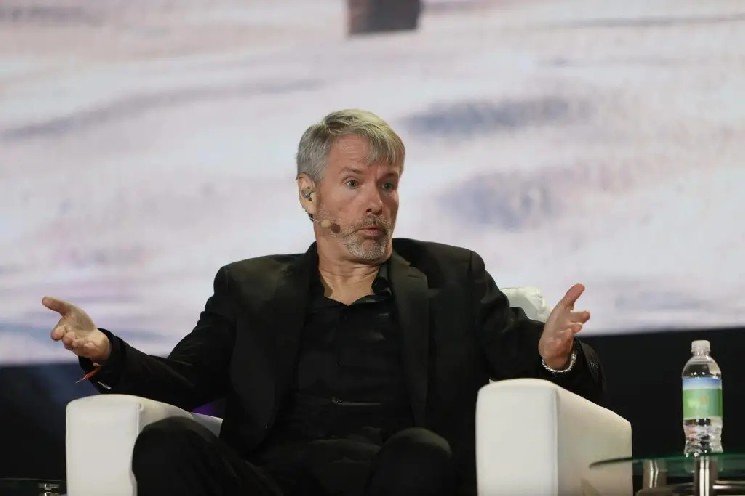
  • Michael Saylor Changes Strategy: Strategy Didn’t Buy Bitcoin This Week! Here’s Where He Invested!

    Michael Saylor Changes Strategy: Strategy Didn’t Buy Bitcoin This Week! Here’s Where He Invested!

    Strategy, the largest institutional Bitcoin investor, has paused its Bitcoin strategy. While the giant company sold a significant amount of $BTC last week, it hasn’t made any sales this week, but it hasn’t made any new $BTC purchases either.

    According to Strategy founder Michael Saylor, Strategy sold $466.7 million worth of MSTR shares but did not purchase any Bitcoin.

    According to a July 13 SEC filing, Strategy sold 4.82 million shares of MSTR between July 6 and July 12 for net proceeds of $466.7 million.

    The company did not make any Bitcoin purchases during the week and kept its holdings stable at 843,775 $BTC as of 12/07/2026.

    At this point, Strategy increased its USD reserves by $450 million, raising its total reserves to $3.0 billion.

    “Strategy has increased its USD reserves by $450 million. As of 7/12/2026, we hold 843,775 $BTC in our $BTC reserves and have $3.0 billion in our USD reserves.”

    Especially in the face of recent Bitcoin declines and risks, Strategy and Saylor, which have been focusing on cash reserves to calm the markets, announced their Digital Credit Capital Plan in June. This plan stipulated that the company would hold reserves sufficient to cover at least 12 months of dividend payments.

    As you may recall, the company also announced that it sold 3588 $BTC to increase its USD reserves.

    *This is not investment advice.

  • Progmat moves ¥452B in tokenized securities to Avalanche

    Progmat moves ¥452B in tokenized securities to Avalanche

    Progmat has completed the migration of its security-token platform from Corda 5 to a dedicated Avalanche Layer 1.

    The company said every active project on the platform moved to the new network. Those projects represent more than ¥452 billion in underlying assets and issued securities. The migration makes the platform’s security tokens compatible with the Ethereum Virtual Machine, or EVM. Progmat describes itself as Japan’s leading security-token platform by domestic market share.

    The company carried out the work under Project Keystone. Progmat redesigned the system so its business functions no longer depend on one blockchain. It added a mediator layer between applications and the ledger. The structure allows the platform to connect with other chains later while keeping its existing issuance, ownership and transfer processes. A dedicated Avalanche L1 can also use rules tailored to regulated financial products.

    Progmat, Japan’s largest STO platform, is now live on @avax

    “All ST projects (over 452 billion yen) are now EVM-compatible, achieving both financial institution-level requirements and the utilization of public chains.

    Rights transfers are accelerated 3-5 times faster than… https://t.co/xeMVc8EM8e

    — Justin Kim (@justinkim415) July 13, 2026

    Rights transfers become faster

    Progmat said the new setup processes rights transfers three to five times faster than the earlier system. Avalanche transactions reach finality in less than two seconds, according to the company.

    “Rights transfers are accelerated three to five times faster,” Progmat said.

    The speed figure comes from Progmat’s internal testing and has not been independently verified. Finality records a completed network transaction, but it does not cover every banking or administrative step around a trade.

    The company also moved its smart contracts from Java-based Corda code to Solidity-based EVM contracts. Progmat said it kept current functions and service requirements during the switch. It also said the migration caused minimal disruption for issuers. Existing users did not need to rebuild their products. EVM support gives developers access to Ethereum-based tools, but it does not make regulated securities freely available to public wallets.

    AvaCloud supports institutional controls

    AvaCloud supplies the dedicated Avalanche network and operating services. Progmat said the setup meets SOC 1 and SOC 2 Type II assurance standards. Progmat and Ava Labs also created a response system for outages during nights and holidays.

    The firms aim to meet the control and availability standards used by regulated financial companies. The network remains application-specific rather than operating as an unrestricted retail trading venue.

    AvaCloud chief executive Nick Mussallem called the transfer of more than ¥452 billion in regulated securities a test for institutional infrastructure. However, that assessment came from a company involved in the migration.

    Progmat has not released public transaction data showing how the new network performs during peak demand or across a large investor base. The company also has not announced new trading volumes tied directly to the change.

    Progmat prepares for cross-chain settlement

    The migration gives Progmat a base for planned links between security tokens, stablecoins and tokenized bank deposits. Datachain said in February that the partners plan cross-chain services for delivery-versus-payment and payment-versus-payment transactions.

    These systems would exchange assets and payments across different networks in one coordinated process. Progmat said its revised design can support more than one chain when asset features or investor needs differ.

    Elsrwhere, BlackRock’s BUIDL fund reached about $900 million on the network, while Avalanche’s distributed real-world assets stood near $2.10 billion.

    As crypto.news reported, Progmat will support a Metaplanet and JPYC study into Bitcoin-backed digital credit. That project remains under review, with no issued product or fixed terms. Securitize also placed its listed shares on Avalanche and Solana in July.

  • Japanese Financial Giant SBI Holdings Accelerates Cryptocurrency Investments! Here Are the Companies They Invested In

    Japanese Financial Giant SBI Holdings Accelerates Cryptocurrency Investments! Here Are the Companies They Invested In

    SBI Holdings, one of Japan’s leading financial groups, has drawn attention in recent months with its multi-billion dollar investments in cryptocurrencies. In just the last few weeks, the company was the sole investor in Gauntlet’s $125 million Series C funding round and also participated in EDX Markets’ $76 million Series C funding.

    In addition to agreeing to acquire Japanese cryptocurrency exchange Bitbank for approximately $289 million, SBI also acquired a controlling stake in Singapore-based Coinhako earlier this year.

    SBI also invested in Digital Asset’s $355 million funding round, Morpho’s $175 million token funding, and Circle’s $222 million token presale for its Arc blockchain. Last month, it launched JPYSC, Japan’s first yen stablecoin backed by a trust bank.

    According to company officials, the common goal of these investments is to build an end-to-end “onchain finance” ecosystem. SBI aims to offer all financial services on the blockchain, from exchanges and asset tokenization to payment infrastructure and digital asset management. The company predicts that the token economy will soon become mainstream and that a large portion of financial transactions will take place on the blockchain in the future.

    Experts believe that SBI is not only investing in crypto assets, but also acquiring the financial infrastructure of the future. Joseph Goh, Areta’s Asia Pacific President, states that SBI aims to be the first Asian financial group to integrate issuance, custody, trading, payments, and asset management under one roof.

    One of the key reasons behind SBI’s aggressive strategy is Japan’s comprehensive reforms in cryptocurrency regulation. The new bill aims to classify crypto assets as financial instruments, pave the way for exchange-traded funds (ETFs), and reduce capital gains tax from 55% to 20%. Analysts believe that a clearer regulatory framework could encourage not only SBI but also other major financial institutions in Asia to accelerate their investments in digital assets.

    *This is not investment advice.

  • Bitmine Chairman Tom Lee Announces Ethereum Price Has Hit Rock Bottom!

    Tom Lee, Chairman of Bitmine (BMNR), argued that Ethereum ($ETH) has bottomed out at its current price levels and is preparing for a strong recovery. Speaking at the WebX 2026 conference in Tokyo, Lee compared Ethereum’s current outlook to the recovery of the US stock market following the 1987 stock market crash.

    According to Lee, there are striking similarities between Ethereum’s price chart and the movement of the S&P 500 index after 1987. The renowned investor noted that the S&P 500 entered a strong uptrend after a sharp decline, suggesting that Ethereum is similarly at a significant low point and has the potential to move upwards in the coming period.

    Tom Lee stated that the recent weak performance of Ethereum’s price has worried many investors, but they are ignoring the long-term fundamental dynamics of the market. He specifically noted the growing institutional adoption, particularly from Wall Street, but argued that the increasing interest of traditional financial institutions in the Ethereum ecosystem has not yet been fully reflected in prices.

    According to him, while the current low prices are influenced by investor psychology, institutional demand is considered to be a significant support factor for $ETH in the long term.

    Lee also touched upon the major macroeconomic factors that could affect Ethereum and the overall cryptocurrency market in 2026. Key issues Lee highlighted as needing close monitoring included the Federal Reserve’s (Fed) monetary policy, the Clarity Act (expected to establish a regulatory framework for the crypto sector in the US), the impact of AI investments on capital flows, and the financial sector’s weaker performance compared to other sectors.

    Market experts say Ethereum’s future performance will depend not only on technical indicators but also on institutional investor interest, regulatory developments, and global macroeconomic conditions. Nevertheless, Lee maintains that current levels present a significant opportunity for long-term investors.

    *This is not investment advice.

  • Why Bitcoin miners are holding 1.19M BTC despite 10% mining stock losses

    Why Bitcoin miners are holding 1.19M BTC despite 10% mining stock losses

    Bitcoin [$BTC] has spent days consolidating at the time of writing and was on the edge of a decisive move. The asset has failed to reclaim the $64K level for a third consecutive time, and the momentum behind each attempt has weakened.

    Bitcoin will need far stronger momentum to force a rally, and several factors will decide whether that happens. Among them, the role of miners cannot be dismissed, since their actions tend to shape market direction.

    Bitcoin mining stocks stay under water

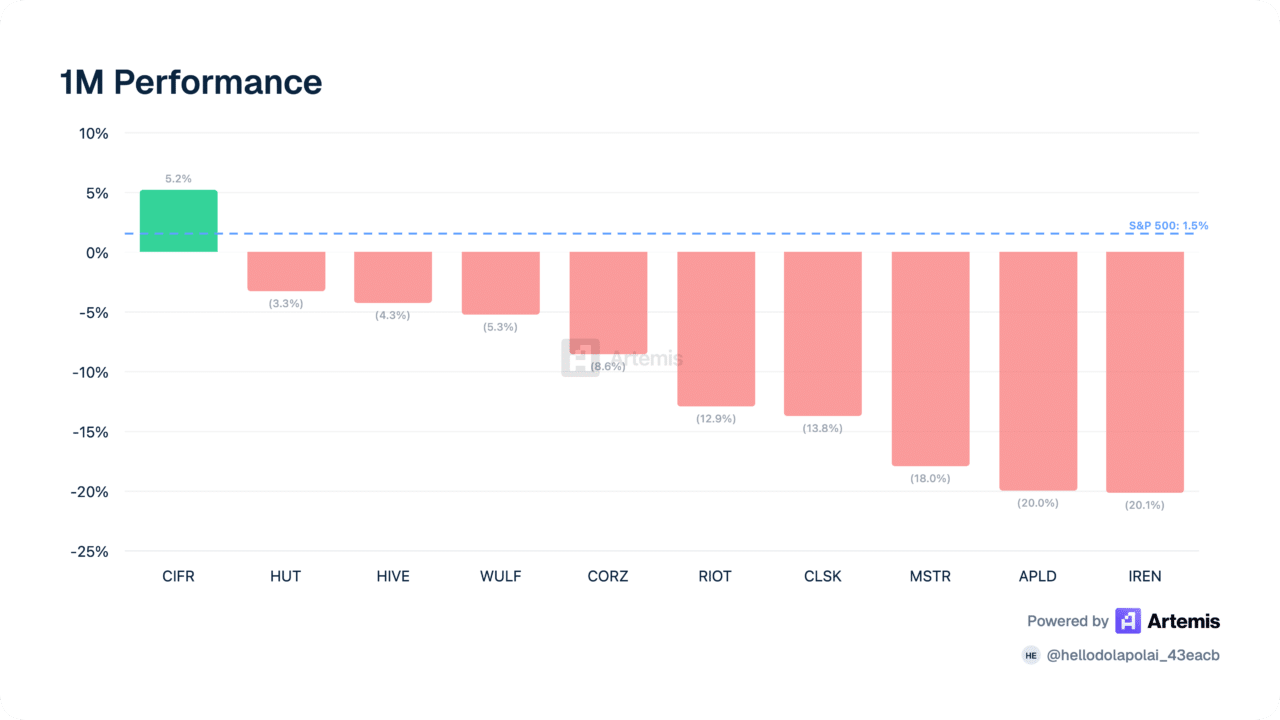
    Bitcoin miners, responsible for securing the network, have traded underwater for weeks. Notably, over the past month alone, the Artemis Theme Tracker recorded a 10% decline across these Bitcoin mining stocks.

    Source: Artemis

    The tracker follows eleven Bitcoin mining stocks currently valued at $102.9 billion. Iris Energy [IREN] and Applied Digital [APLD] have absorbed the steepest losses over the past month, down 20.1% and 20%, respectively, while Hut 8 Mining and Hive Digital Technologies have slipped 3.3% and 4.3%.

    Cipher Mining [CIFR] stood as the only name in the category to hold net positive, rising 5.2% over the same period and outperforming the S&P 500, which gained 1.5% across the month.

    The question is whether miners will offload their $BTC, particularly as mining costs climb; paired with Bitcoin’s underperformance, that pressure could build further.

    What will Bitcoin miners do

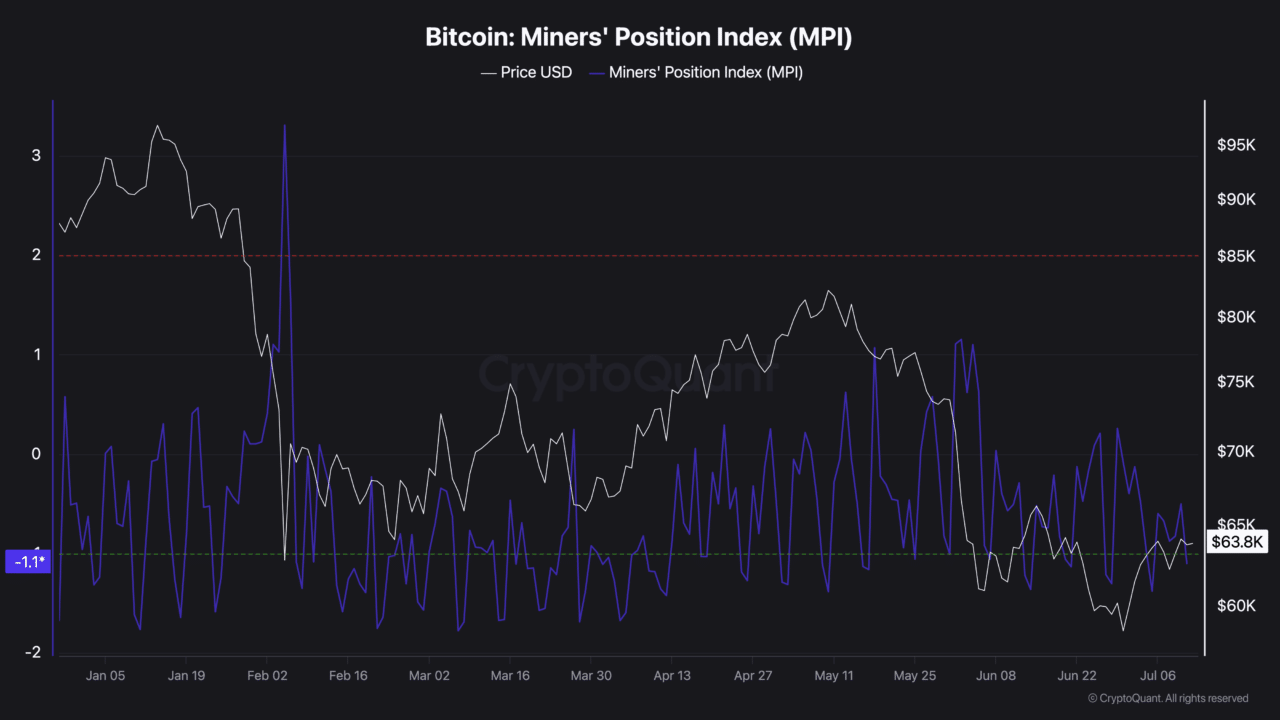
    Miners have kept their Bitcoin positions steady despite the growing threat of selling in the market. At press time, the Bitcoin Miners’ Position Index (MPI) reflected near‑term confidence with a reading of -1.1, with miners continuing to accumulate.

    The metric measures the ratio of total miner outflows in USD to their one-year moving average, and a reading below that average typically signals that miners are holding their assets.

    Source: CryptoQuant

    The Miner Supply Ratio, which tracks how much of Bitcoin’s supply miners hold, has likewise been climbing, an overall sign of accumulation.

    The climb began on the 8th of July and has continued since, with the supply ratio reaching 0.05951 at press time. A sustained rise would reinforce a supportive dynamic for Bitcoin, provided miners keep their assets off the market.

    Miners hold their reserves steady

    Miners remain central to Bitcoin’s price performance, as their decision to sell or hold can steer direction.

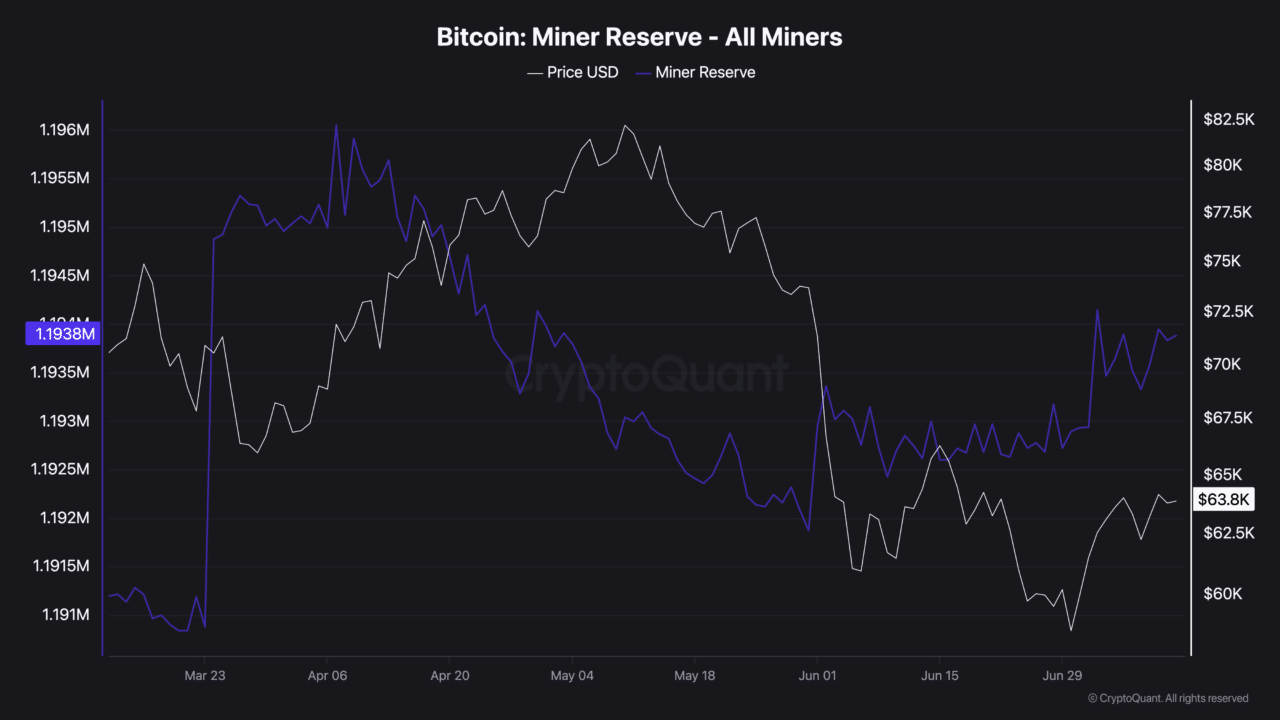
    The group controls roughly 1.1933 million Bitcoin, just over 5% of the total supply in the market, and any move to sell could weigh on the asset and drag it lower.

    Source: CryptoQuant

    Currently, though, this group is doing the opposite despite the decline in Bitcoin’s price over the past weeks. Their holdings have edged up to 1.1938 million, one of the highest levels since early May.


    Final Summary

    • Bitcoin miners are accumulating rather than selling, with holdings edging up to 1.1938 million $BTC, even as mining stocks trade under water.
    • Bitcoin has failed to reclaim $64,000 for a third straight time, and with the Miners’ Position Index at -1.1, miner conviction remains one of the few supports underpinning the asset.
  • 4 Things That Could Impact Crypto Markets This Week

    4 Things That Could Impact Crypto Markets This Week

    Crypto markets have largely held on to gains over the weekend, but were looking a little shaky on Monday morning as traders digested the latest developments between the US and Iran.

    The US has launched several waves of strikes on Iran over an Iranian attack on another container ship in the Strait of Hormuz. Iran has declared the Strait closed, while President Trump said otherwise.

    Meanwhile, some heavy inflation reports could further rattle sentiment and add to the volatility as the bear market drags on.

    “Q2 2026 earnings season has arrived, and Strait of Hormuz tensions are mounting again,” said the Kobeissi Letter.

    Economic Events July 13 to 17

    US Central Command reported on Monday morning that forces began launching more strikes against Iran “to continue degrading their ability to attack civilian mariners and commercial ships freely transiting the Strait of Hormuz.”

    Crude oil prices were up around 4%, with WTI and Brent hitting $74.50 and $79, respectively, while US stock futures opened slightly lower.

    June’s Consumer Price Index (CPI) inflation data is due on Tuesday, which could add to the market volatility. This is followed by the Producer Price Index (PPI) data out on Wednesday, measuring wholesale inflation.

    Year-on-year measures for both headline CPI and PPI are expected to rise by 3.8% and 6.2%, respectively, reported Yahoo Finance. Rising inflation will put more pressure on the Federal Reserve to hike rates, which is bad news for risk-on assets such as crypto. The escalation of military action in the Middle East is also not good for dampening inflation concerns.

    June Retail Sales data and July Philly Fed Manufacturing Index reports are due on Thursday, followed by July’s Michigan Inflation Expectations and Consumer Sentiment reports on Friday.

    Key Events This Week:

    1. Markets React to Strait of Hormuz Closure – Today, 6 PM ET

    2. June CPI Inflation data – Tuesday

    3. June PPI Inflation data – Wednesday

    4. June Retail Sales data – Thursday

    5. July Philly Fed Manufacturing Index – Thursday

    6. July MI Inflation…

    — The Kobeissi Letter (@KobeissiLetter) July 12, 2026

    Several Wall Street banks and finance giants are reporting Q2 earnings this week, including JPMorgan Chase, Goldman Sachs, Bank of America, Wells Fargo, and Citibank on Tuesday, followed by Morgan Stanley and BlackRock on Wednesday.

    Crypto Market Outlook

    Total market capitalization has remained steady over the weekend, hovering around $2.26 trillion with a very minor dip on Monday morning after the latest airstrikes.

    Bitcoin had held ground just above $64,000 for the past 12 hours or so but dipped to $63,400 during early trading, where it remains at the time of writing.

    Ether prices fared a little better, holding above $1,800 for most of the past day following a 15% gain over the past fortnight. Escalation of conflict and higher inflation this week could send both much lower.

  • Bitcoin Price Prediction: Eric Trump Calls $1M Target as American Bitcoin Stock Hits Record Low

    Bitcoin Price Prediction: Eric Trump Calls $1M Target as American Bitcoin Stock Hits Record Low

    Bitcoin ($BTC) is trading around $63,396 on July 13, 2026. It is still nearly 50% below its all-time high of $126,198. While short-term price action remains choppy, Eric Trump says institutional adoption is accelerating faster than ever. He believes Bitcoin still has a long way to go.

    Eric Trump Sticks to $1 Million Bitcoin Call

    Speaking in a recent interview, Eric Trump said Bitcoin is entering a new phase of adoption. This is as traditional financial institutions continue embracing crypto.

    “The floodgates are opening,” Trump said, pointing to major firms like Charles Schwab, Fidelity, and JPMorgan Chase expanding Bitcoin services. He shared that when he recently logged into his Fidelity account, he was prompted to create a digital asset wallet. Therefore, it is now easier than ever for customers to buy Bitcoin.

    According to Trump, the biggest change is accessibility. Investors no longer need to rely on complicated wallets or self-custody. Now Bitcoin is available through spot ETFs and large financial institutions.

    “We are on the one-yard line of cryptocurrency, and we’ve got another whole field to run,” he said.

    Trump also doubled down on his long-term prediction, saying, “I do think it hits a million dollars eventually. I’ve never been more bullish on anything in my life.” He added that stronger crypto legislation in the U.S. has only increased his confidence.

    Perhaps his boldest claim came when discussing institutional demand. “I talk to the biggest companies, the biggest families in the world, and every single one of them is racing to buy Bitcoin,” Trump said.

    American Bitcoin Stock Struggles Despite Bigger $BTC Holdings

    Interestingly, Trump’s bullish comments come even as American Bitcoin, the mining company he co-founded, continues to face pressure in the stock market.

    According to Bloomberg, the company’s shares have dropped more than 95% from their peak, wiping out over $600 million from the value of Eric Trump’s roughly 6% stake over the past 10 months. The company recently carried out a 1-for-15 reverse stock split to maintain its Nasdaq listing. Still, it hit a record low last week.

    Despite the weak stock performance, American Bitcoin continues to build its Bitcoin treasury. The company purchased 500 $BTC this week, taking its total holdings to more than 8,000 $BTC. However, its first-quarter results showed an operating loss of $118.2 million, including a $117.2 million Bitcoin impairment charge.

    U.S. Strategic Bitcoin Reserve Adds Long-Term Confidence

    Supporting the long-term bullish narrative, the U.S. government now holds around 328,372 $BTC, worth roughly $20-$25 billion. These assets are primarily acquired through criminal asset seizures. The holdings are managed as part of the Strategic Bitcoin Reserve (SBR), established under a White House Executive Order.

    While Bitcoin remains well below its record high, growing institutional participation, improving regulation, and continued accumulation by both private investors and governments are keeping long-term expectations firmly intact.

  • Elephant who fell into abandoned well rescued with excavator

    Elephant who fell into abandoned well rescued with excavator

    Video grab as an elephant was rescued after falling into an abandoned well and becoming stuck for over 10 hours. // A 15-year-old elephant was found trapped in an abandoned well in Ernakulam, in southern India's Kerala on July 7.According to reports, the wild tusker accidentally fell into an abandoned unwalled well near the residence of local resident Thattayath Aliyar, away from the forest boundary.Forest officials worked to rescue the animal using an excavator to create a mud ramp for its safe escape after several hours. Photo released 08/07/2026
    The elephant fell into the unmanned well earlier this week (Picture: Newslions / SWNS)

    A 15-year-old elephant was trapped for 10 hours in an abandoned well before it was rescued.

    The animal fell into a well in Ernakulam, in the southern Indian state of Kerala, on Tuesday at around 2.00am. According to the reports, the well didn’t have a wall, and was located near the home of doctor Thattayath Aliyar.

    Forest officials rescued the elephant using an excavator, creating a mud ramp so it could safely escape.

    Witnesses say the elephant struggled at first to climb out from the muddy water, but eventually managed to break free and return to the forest.

    Forest department personnel were initially prepared to begin rescue operations in the early morning, but residents protested, demanding that the elephant be permanently relocated away from human habitation.

    Video grab as an elephant was rescued after falling into an abandoned well and becoming stuck for over 10 hours. // A 15-year-old elephant was found trapped in an abandoned well in Ernakulam, in southern India's Kerala on July 7.According to reports, the wild tusker accidentally fell into an abandoned unwalled well near the residence of local resident Thattayath Aliyar, away from the forest boundary.Forest officials worked to rescue the animal using an excavator to create a mud ramp for its safe escape after several hours. Photo released 08/07/2026
    Villagers had their doubts about the rescue (Picture: Newslions / SWNS)

    Sign up for all of the latest stories

    Start your day informed with Metro’s News Updates newsletter or get Breaking News alerts the moment it happens.

    Video grab as an elephant was rescued after falling into an abandoned well and becoming stuck for over 10 hours. // A 15-year-old elephant was found trapped in an abandoned well in Ernakulam, in southern India's Kerala on July 7.According to reports, the wild tusker accidentally fell into an abandoned unwalled well near the residence of local resident Thattayath Aliyar, away from the forest boundary.Forest officials worked to rescue the animal using an excavator to create a mud ramp for its safe escape after several hours. Photo released 08/07/2026
    The elephant fell at around 2am (Picture: Newslions / SWNS)

    After a meeting, the area’s divisional forest officer, P. Karhik, assured villagers the elephant would be kept under 24-hour surveillance using drones and forest patrol teams upon release and would be captured if it were to stray into human areas again. 

    Authorities also said they would compensate the homeowner for damages and install an electric fence in the region. Only after these demands were met did the rescue operation begin, around noon. 

    Forest officials say that the top of the elephant’s trunk was damaged as part of an old wound. The injury restricts the elephant’s ability to forage for food and water, explaining why it frequently wanders into residential areas to find easily accessible sustenance. 

  • Man who’s spent 28 years walking from Chile to Hull stopped from swimming English Channel home

    Man who’s spent 28 years walking from Chile to Hull stopped from swimming English Channel home

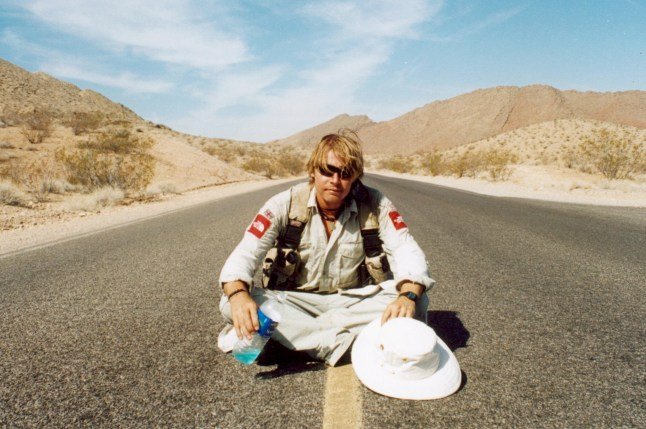
    Karl Bushby has been travelling the world on foot for nearly 30 years (Picture: Karl Bushby / SWNS)

    A former paratrooper who has spent nearly 30 years walking home to Hull from South America may be prevented for a second time after he was prevented from swimming across the English Channel.

    Karl Bushby – who is travelling the world without using cars, trains, buses or planes – may not be able to make the final crossing to the UK from France, as French authorities only allow people to swim in the other direction.

    Karl, 57, said: ‘We are talking with the French coastguard.’

    Bushby set off from Chile in 1998 and has reached Belgium.
    He is now nearing the final stages of his journey back to his hometown.

    But crossing the Channel has proven a challenge more than once after Eurotunnel bosses refused his request to walk through it in June.

    Sign up for all of the latest stories

    Start your day informed with Metro’s News Updates newsletter or get Breaking News alerts the moment it happens.

    Karl in Chile in 1999, shortly after he started his epic journey (Picture: Karl Bushby / SWNS)

    This left him with no option but to swim, in line with the terms of his challenge, which say he cannot use any form of transport to travel.

    Bushby still hopes that authorities might let him use the Eurotunnel. In the meantime, he is hoping he can find a way to swim the 21-mile distance in just a few months.

    We have secured a support boat for October’, he said. ‘That’s a big thing. I would expect it to take two or three days to swim across to the UK.’

    Karl is currently in Mexico, where he takes breaks between stages of his challenge to meet visa regulations and to plan routes. On occasion, he visits the US, where his sponsors are based. 

    ‘I will be back in Belgium in early September,’ he said. ‘Towards the end of that month, I expect to be in France, preparing for the swim.

    ‘I am not angry it has come to this. I am more disappointed. But things could still change. Walking through the service tunnel is still the preferred option.’

    Karl Bushby on his walk while in Alaska, USA, 2005.
    Karl has crossed all terrains and has even been detained along his route (Picture: Karl Bushby / SWNS)

    Karl is no stranger to traversing vast bodies of water. 

    In 2006, he became the first Brit to walk across the Bering Strait, a 58-mile stretch of frozen sea linking North America and Russia. 

    Then, in 2024, he swam more than 170 miles over 31 days across the Caspian Sea from Kazakhstan to Azerbaijan to avoid conflict zones in Russia and Iran.

    Despite this, Karl isn’t a fan of this method of getting around.

    ‘I’m just not into the swim thing,’ he said previously. 

    ‘I’ve had to do a couple of swims here and there. […] [The English Channel] is a different stretch of water; it’s colder, we’ll see. Hopefully, I’ll never have to think about it.’

    Where has Karl been so far?

    Karl Bushby on his walk - Panama, 2001. // A Brit nearing the end of a round-the-world walk faces swimming across the English Channel after he was told he can?t use the Channel Tunnel.Former paratrooper Karl Bushby, 57, has spent the last 27 years trekking across the globe ? after setting off from Chile in 1998, with the aim of returning to Hull.But despite overcoming hurdles ? including the infamous Darien Gap, being arrested in Russia, and having to swim through the Caspian Sea to avoid Iran ? Mr Bushby now faces his final: the English Channel.GetLink, the operators of the tunnel, have denied his formal request to walk through the 31-mile long service tunnel ? saying it would pose a safety risk. Photo released 18/06/2026
    Karl in Panama in 2001 (Picture: Karl Bushby / SWNS)

    Karl began the challenge after sketching a rough path on a map when he was in the army. He showed the plan to fellow soldiers who told him it could not be done.

    This made him all the more determined, and he set himself two rules: to never use transport, and to not return to the UK until he had completed the journey.

    Karl set off on his 36,000-mile journey from Punta Arenas, Chile, in 1998, thinking it would take him 12 years.

    But in the three decades since, he has been met with several setbacks that have lengthened his adventure.

    He has had to evade bandits in the notoriously dangerous Darien Gap and has been detained by Russian officials for illegally entering the country.

    He also spent 18 days in prison in Panama for entering without a visa before continuing his journey through Mexico and the US, where he overstayed his visa and had to fly back to Colombia to wait for a new one.

    In 2003, as he was preparing to cross the border into Canada, his trailer was stolen and he was forced to wait another month for the items in it to be replaced.

    Karl Bushby on his walk - Bering Strait crossing, 2006. // A Brit nearing the end of a round-the-world walk faces swimming across the English Channel after he was told he can???t use the Channel Tunnel.Former paratrooper Karl Bushby, 57, has spent the last 27 years trekking across the globe ??? after setting off from Chile in 1998, with the aim of returning to Hull.But despite overcoming hurdles ??? including the infamous Darien Gap, being arrested in Russia, and having to swim through the Caspian Sea to avoid Iran ??? Mr Bushby now faces his final: the English Channel.GetLink, the operators of the tunnel, have denied his formal request to walk through the 31-mile long service tunnel ??? saying it would pose a safety risk. Photo released 18/06/2026
    Karl crossed the Baring Strait in 2006 (Picture: Karl Bushby / SWNS)

    His trailer was stolen on New Year’s Day 2003, a day before he was due to cross into Canada while visiting a bar. Another month passed while he replaced his lost items.

    Despite this – and many other issues he encountered along the way – he reached Armenia last June, before travelling through Turkey, Bulgaria, Romania, Hungary, Austria, Slovakia and, after stopping off in Mexico to sort his Schengen visa out, traversed Europe where he is now hoping to find a way to cross his final sea.

    Once he is back on UK shores, Karl will walk to Hull, where the journey will end at his childhood home.

    The French Maritime Rescue Coordination Centre referenced a 2018 ‘prefectural order’ confirming the restriction on Karl’s swim.

    It said it has referred Karl’s support team to the Channel and North Sea Maritime Prefecture.