Mexico has asked the United States for evidence of a cross-border shooting that allegedly targeted US security personnel.
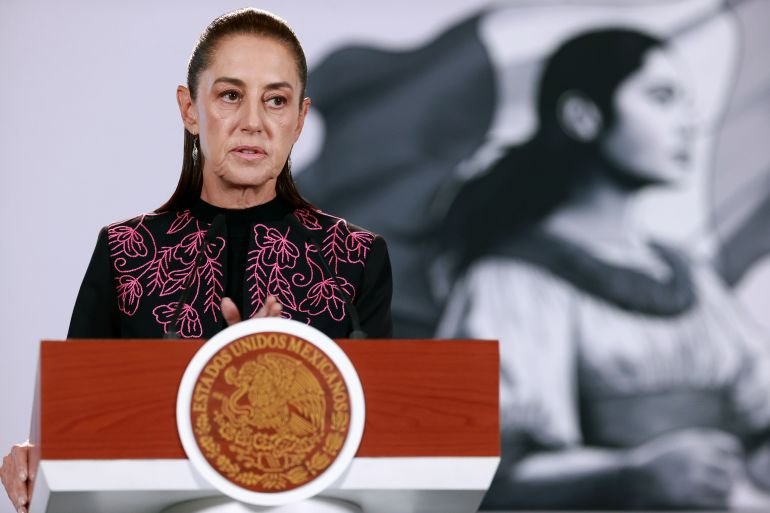
In her daily news conference on Monday, Mexican President Claudia Sheinbaum explained that the US had reported “shots from the Mexican border”.
Recommended Stories
list of 3 itemsend of list
“We asked for all the evidence because we have no evidence,” Sheinbaum said. She added that Mexico’s National Guard, Army and Navy had not detected any shots being fired from Mexican territory towards the US.
Sheinbaum made her remarks a day after the US Ambassador to Mexico Ronald Johnson wrote on the social media platform X about the shooting, which allegedly took place in Texas across from the Mexican state of Tamaulipas in late September.
Johnson said the targets were members of the US Coast Guard, and that the threat would be “swiftly addressed”.
“The U.S. Embassy in Mexico is helping coordinate with Mexican forces deploying to the border area where U.S. Coast Guardsmen were fired upon,” Johnson wrote.
“Together, we intend to patrol both sides of our shared border, protect our communities, and make it more difficult for criminal and terrorist organizations to operate.”
Some 500 US troops, along with helicopters, drones and anti-drone equipment, have been sent to the border since the alleged shooting.
Mexico has sent its own deployment in the border area, as part of a joint operation called Operation Mirror between the two countries to secure the frontier.
In Monday’s news conference, Sheinbaum confirmed that the Mexican deployment was designed “to forestall any issues” that may arise.
During their time working together, Johnson and Sheinbaum have repeatedly been at odds over questions of border security and national sovereignty.
A former US Army Green Beret who later served in the Central Intelligence Agency (CIA), Johnson has served as ambassador to Mexico since May 2025, under US President Donald Trump.
Since returning to office for a second term, Trump has sought to increase US influence over Latin America, as part of a policy informally dubbed the Donroe Doctrine — a twist on the 19th-century Monroe Doctrine.
His administration has also taken a more active role in the region’s security, on the premise of combatting narcotics trafficking and criminal organisations.
Trump has repeatedly said he may carry out military strikes inside Mexico to attack the cartels he said are “running Mexico”, framing their presence as a threat to US security. Sheinbaum, however, has warned that such an operation would violate her country’s sovereignty.
Mexico’s tensions with the Trump administration have strained relations with Johnson. Sheinbaum has accused the ambassador of overstepping diplomatic norms, while Johnson has sought to push the Mexican government to cooperate with Trump’s demands.
In June, Johnson criticised Sheinbaum’s government on social media for turning the “fight against cartels” into a “political dispute”.
Sheinbaum responded the next day with a warning for Johnson, saying, “Ambassadors must respect the internal political affairs of their countries.”
Law enforcement agencies in the US and Mexico have long cooperated in counter-narcotics operations, but Trump’s militaristic approach has created friction with left-wing governments including Mexico.
On Monday, Sheinbaum took issue with Johnson for announcing the opening of an international police academy in the central state of Queretaro without her government’s knowledge.
“How can a groundbreaking ceremony take place with a US ambassador and a Mexican governor, but not with the federal security cabinet?” she said.
Under the Mexican constitution, the federal government must approve the activities of foreign forces on Mexican soil.
But that law was tested earlier this year, when two CIA agents were reportedly killed in an April car accident in the northern Mexican state of Chihuahua, alongside members of the state’s law enforcement.
What the CIA agents were doing in Chihuahua remains unclear. Reports emerged that the CIA agents may have been participating in a state-led raid on a local drug lab without federal authorisation.
One state official publicly denied that report, saying the agents were conducting an unrelated training on drone usage.
Sheinbaum said neither she nor her cabinet were informed of any CIA activities, and her government pledged to investigate the incident.
English Premier League viewership up 20 percent among young Americans following World Cup, Nielsen Sports data shows.
Published On 5 Oct 20265 Oct 2026
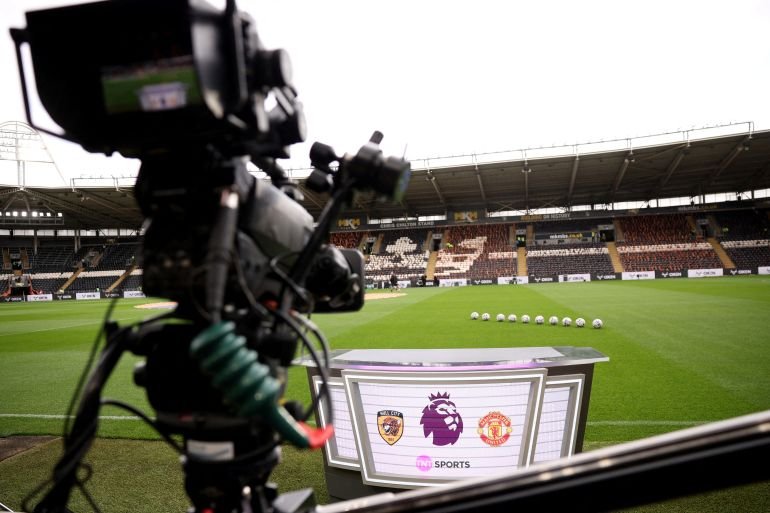
The Premier League has struck a chord with young Americans after the US cohosted this year’s World Cup, with viewership for the English top-flight up 20 percent among 18-34-year-olds so far this season, shows data from Nielsen Sports released on Monday.
US broadcasters NBC and the USA Network have attracted an average of half a million viewers for Premier League games so far this season – a 3 percent increase as the sport’s popularity has grown.
Recommended Stories
list of 4 itemsend of list
“The World Cup served as a powerful catalyst, expanding the Premier League’s footprint across a far broader demographic in the US,” said Jon Stainer, global GM at Nielsen Sports.
“Our data shows that fandom is not only reaching record highs but it is also expanding rapidly among younger, diverse audiences and carrying over into major domestic and international leagues.”
Just over one million Americans watched Tottenham Hotspur’s 2-0 home defeat by Newcastle United on August 29, the Premier League’s most-watched match in the US this season so far.
Spurs have been involved in three of the six most-watched Premier League games in the US this season, as their 3-0 loss at Brentford and 0-0 home draw with Everton also made the list.
Major League Soccer also benefitted from the growing exposure in the lead-up to the World Cup, with interest soaring 23 percent among 16-34 year olds.
Interest in the World Cup peaked at 87 million fans in July, with female supporters accounting for 44 percent of the total fanbase, according to Nielsen Fan Insights, which collects data from half-hour online surveys with a sample size of 3,000 in the US.
Russian authorities quarantine hospital, monitor 200 contacts after suspected pneumonic plague death in Siberia.
Published On 5 Oct 20265 Oct 2026
President Donald Trump says the United States is ready to help Russia with a suspected pneumonic plague outbreak.
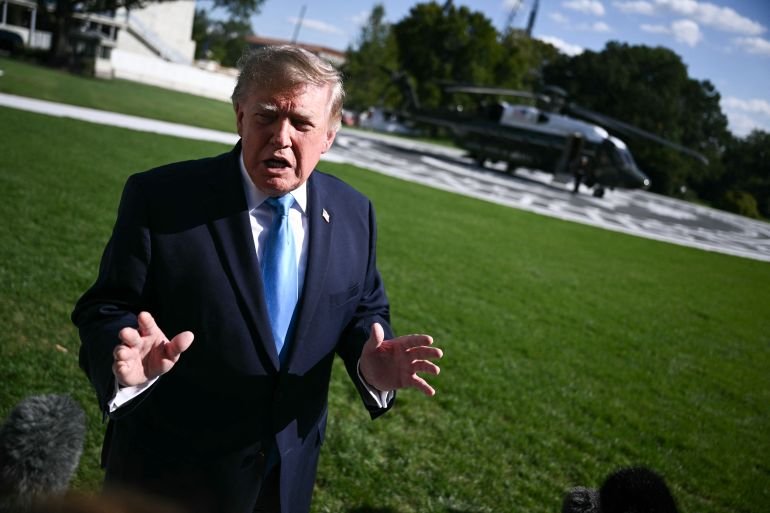
“We are looking at it very strongly. We just heard about it,” Trump said, adding that he had not spoken to Russian President Vladimir Putin about it but is prepared to offer US support.
Recommended Stories
list of 3 itemsend of list
“It’s a disease we used to be able to control,” Trump said. “Even with great advancement, the germs have really become relatively stronger than they were, and things that used to work on pneumonia don’t work anymore … anyone that has that kind of problem, we will help.”
The World Health Organization (WHO) said based on unofficial information it has received, the “public health risk to the general population appears to be low”.
Earlier on Monday, US Secretary of State Marco Rubio downplayed the danger as well. “I don’t think it’s cause for alarm, but it is cause for focus and a cause to just keep an eye on it,” Rubio said.
Russian authorities have quarantined a hospital and are tracing the contacts of an employee at a plague research institute in the remote Siberian region of Irkutsk who died of a suspected pneumonic plague infection. Local media identified the employee as 28-year-old laboratory technician Darya Shipilova.
Official details about the incident have been limited, and Russian media reports say authorities in Irkutsk have placed nearly 200 people under medical observation.
On Sunday, Russia’s official TASS news agency reported that the country’s consumer protection agency, Rospotrebnadzor, said an employee at the Irkutsk Anti-Plague Research Institute of Siberia and the Far East was diagnosed with “pneumonia of unknown aetiology” or origin. The agency also said it had expanded sample testing from the patient and found no microorganisms associated with her work.
On Saturday, the governor of neighbouring Buryatia region said in a post on his Telegram channel that a woman in Irkutsk had “died, maybe of the plague”.
In a statement to Al Jazeera, a US State Department official said: “We encourage Russian authorities to share accurate information quickly and openly.”
Pneumonic plague is caused by the bacterium Yersinia pestis, usually found in small mammals and their fleas. According to the WHO, the plague is highly infectious and can be fatal if not treated early.
The plague comes in three forms affecting different parts of the body. Pneumonic plague, an infection of the lungs, triggers the patient to cough out infectious airborne droplets.
If identified quickly, antibiotics can treat the disease. Left untreated, it can be fatal in one to six days.
The abrupt redeployment to the US comes after several ‘terrorism-related’ arrests were made outside RAF Fairford.
The United States has made the abrupt decision to withdraw its bombers from the Royal Air Force (RAF) base Fairford in the western part of the United Kingdom, citing concerns about a potential attack.
Media reports emerged on Sunday that an urgent redeployment was under way, with B-1 bombers leaving RAF Fairford for the US.
Recommended Stories
list of 3 itemsend of list
Roughly a dozen such aircraft had been based at RAF Fairford prior to the sudden departure.
“While operational security precluded us from confirming the movement of our assets and forces in real-time, we can acknowledge now that all US bombers that were deployed to RAF Fairford have re-deployed to their home stations in the United States,” a Pentagon spokesperson told Al Jazeera.
“The Airmen that operate America’s bomber force, including B-1s, B-2s, and B-52s, remain ready to deliver precision global strike capabilities – including through operations that launch and recover from the continental United States – anywhere, anytime,” the official added.
It is unclear precisely what prompted the withdrawal, which comes as the US and Israel remain embroiled in a war against Iran.
RAF Fairford has served as a stopping point for US bombers participating in the war, which began more than seven months ago, on February 28.
But the base, located roughly 160km (100 miles) west of London, has been rumoured to be the target of a “terror” plot involving Iran.
On September 27, UK authorities arrested five men on suspicion of plotting to plant explosives near the base.
Iran has denied any such scheme, and the men were released without charge a day later. Investigators discovered petrol, but no explosive devices, in their vans. Still, officials in the UK say they remain under investigation.
On Thursday, British police also announced they had arrested a 25-year-old UK-Iranian dual national in London on suspicion of plotting an attack against the airbase.
UK Prime Minister Andy Burnham suggested last week that “Iran played a part” in the alleged plot, though he declined to provide details.
“The investigation into circumstances surrounding events in Gloucestershire is hugely complex, and our specialist teams are interrogating multiple lines of enquiry,” Senior National Coordinator for Counter Terrorism Policing Vicki Evans said in a statement.
“As we’ve made clear, we’re looking at all possible angles – including possible foreign state involvement.”
US President Donald Trump responded to the initial arrests by accusing the men of seeking to do “big damage” to US facilities. He also praised UK authorities for their efforts.
“The arrest in the UK was fantastic. Working with Britain – it was an amazing job. We had them under investigation,” Trump said of the suspects. “We had them under view for a long time, and we got them.”
Iran, meanwhile, summoned the UK ambassador to Tehran over the last week in protest of the arrests.
The US has a long history of stationing forces at RAF Fairford during its wars in the Middle East, stretching back to the Gulf War in the 1990s.
RAF Fairford has been the site of antiwar protests in the past. During one instance, in 2003, five protesters broke into the airbase in an attempt to destroy military equipment slated to be used in the US invasion of Iraq.
The UK has largely declined to participate in the ongoing war on Iran, despite pressure from the Trump administration.
Still, while the UK government was initially hesitant to let the US use its bases for the war, it granted the US “defensive” access to bases, including Fairford and RAF Diego Garcia, in March.
Jesse Marsch alleges Man City’s financial wrongdoing was widely known in the Premier League, and relegation must follow.
Published On 4 Oct 20264 Oct 2026
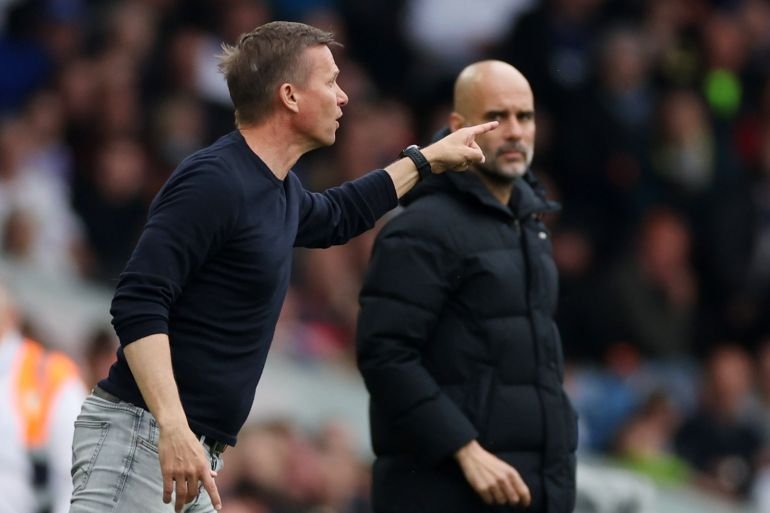
Canada coach Jesse Marsch has called for Manchester City to be punished severely over breaches of Premier League financial rules, saying his experience managing against the club left him convinced there were inconsistencies in the way it operated.
City were found guilty of serious breaches of the Premier League’s financial rules over nine seasons from 2009-10 to 2017-18, with the league alleging the club used “sham” commercial contracts to inflate revenue and understate costs by more than 900 million pounds ($1.19bn).
Recommended Stories
list of 3 itemsend of list
The club has denied wrongdoing, saying the verdict contained material errors of law, principle and fact, and filed an appeal on Thursday against the independent commission’s ruling.
Marsch, who managed Leeds United from 2022 to 2023, said the disparity between the clubs had been apparent to him during his time in England.
“I think Man City should be punished severely. I think they should have to go down, and by the way, everyone knew about it. Everyone knew,” Marsch told The Guardian in an interview published on Sunday.
Marsch also pointed to the 2022 summer transfer window, when Leeds sold Raphinha to Barcelona and Kalvin Phillips to City, while both clubs reported making money.
“That summer [2022], us and Man City were the only teams that said we made money,” he said.
“For us, we did make money, because we sold Raphinha, we sold Kalvin Phillips. We had a lot left over from what we bought.
“At the time, we weren’t in a position financially to not save. Our ownership didn’t have deep pockets. Whereas when Man City says this, I was literally like, ‘Are you kidding me? Is this some kind of joke?’”
The American coach was also sceptical about City’s signing of Erling Haaland from Borussia Dortmund that summer.
“When they said they got Erling Haaland for 52 million pounds ($69m), it’s like, ‘Yeah, OK, sure!’ So, I knew there were inconsistencies in it, but what can you do? You just put your arms in the air and go, ‘This is football’,” Marsch said.
City’s appeal will be heard privately by an independent three-member board, with the club fully denying all charges.
Potential sanctions include fines, points deductions and other sporting penalties, with relegation or the removal of titles also discussed as possible outcomes. It remains unclear whether any sanctions would be imposed before the appeal is decided.
Experts have warned over the past decade of a resurgence in white supremacy in the United States, fuelled in part by the mainstream influence of political figures like President Donald Trump.
Just this year, the Public Religion Research Institute released the results of a 2025 survey that asked more than 20,000 US adults to evaluate the statement, “Immigrants are invading our country and replacing our cultural and ethnic background.”
Recommended Stories
list of 3 itemsend of list
That belief is the cornerstone of the great replacement theory, a conspiracy that falsely claims that immigrants, Jews and nonwhite groups seek to supplant white people in Western countries.
The research institute found that 32 percent of respondents – nearly one in three – nevertheless agreed with the idea.
Critics have accused right-wing leaders like Trump of normalising such views, through rhetoric that paints immigration as an “invasion” and “an assault on Western countries”.
Trump has also been accused of cosying up to white nationalists, even dining in 2022 with Holocaust denier Nick Fuentes, a key figure in the movement. When white nationalists engaged in a deadly clash with protesters in Charlottesville, Virginia, in 2017, Trump said there were “fine people on both sides”.
Al Jazeera correspondent Phil Lavelle travelled to Boone County, Arkansas, to see whether one of the most infamous white supremacist organisations in US history had seen a bump in its influence midway through Trump’s second term.
He spoke to Thomas Robb, the head of what was formerly known as the Knights of the Ku Klux Klan, a white supremacist group founded in the 1970s by David Duke.
What Lavelle found was a group seemingly eager to rebrand. The group had shortened its title to The Knights Party, and members told Lavelle they were trying to re-centre their message around family and faith.
But when Lavelle asked if a Black person would be welcome at the group’s church, Robb’s answer was simple.
“No,” Robb responded. “Because this is a white nationalist church.”
The Ku Klux Klan (KKK) has a long history of racism and violence in the US. The movement began at the end of the civil war in 1865, as a response to government efforts to expand civil rights to Black people and other minority groups.
Through lynchings and other targeted acts of violence, the KKK attempted to block non-white participation in government and maintain racial divides.
Robb, a Christian pastor, took over as the head of the Knights of the Ku Klux Klan – a faction of the KKK – in 1989. He has since attempted to broaden the group’s appeal.
He changed his title from “grand wizard” to “national director”, allowed new members to participate confidentially by mail, and distanced himself from KKK violence in public outreach campaigns.
Still, he has adhered to the racist philosophy his organisation is known for.
“What do you make of politicians like Zohran Mamdani or Abdul El-Sayed?” Lavelle asked Robb in his interview, referencing two high-profile US politicians who identify as Muslim.
“Well, first off, they’re not Americans,” Robb said. When Lavelle pointed out that El-Sayed was born in Michigan, Robb brushed off the contradiction. “I don’t care where he’s born. He’s not American.”
He proceeded to draw a distinction between the children of white and non-white immigrants. Only the children of white foreigners can be American, Robb said, “because they’re white”.
The Knights of the Ku Klux Klan is one of dozens of white supremacy organisations operating in the US.
The Southern Poverty Law Center, an advocacy group, estimates that there are at least 152 such groups active in the US today, part of what it calls a rising trend over the last decade.
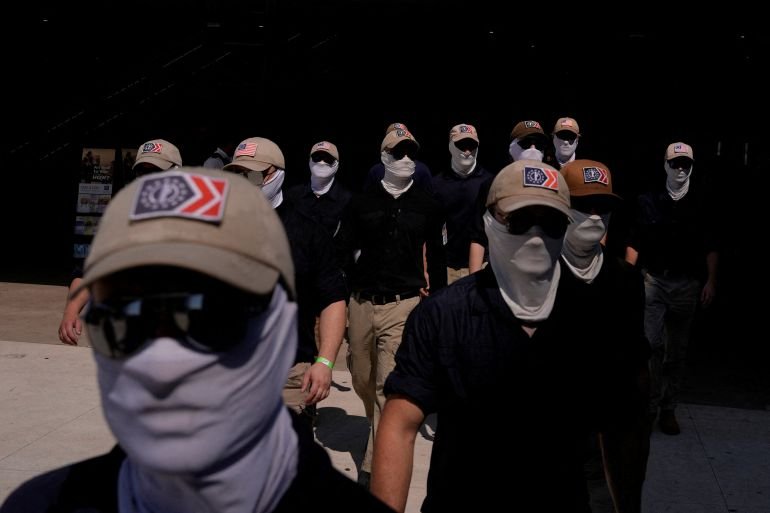
Just this year, another white supremacist organisation, the Patriot Front, marched through Washington, DC, during the Independence Day holiday.
Critics say Trump, at times, has echoed their rhetoric. Trump told The New York Times earlier this year that “white people were very badly treated” in fields like academics.
He also instructed his second administration to dismantle diversity initiatives, and under his leadership, the government has launched probes into whether universities and companies like Nike discriminate against white people.
In addition, Trump has given priority to white South Africans in refugee admissions, falsely claiming they are the subject of a “genocide”.
Robb claimed the current rise in white nationalist sentiment began well before Trump, in 2008, during the election of Barack Obama, the country’s first Black president.
“People are beginning to stir and being angered by what they see happening to the country,” said Robb. “So we’re kind of a voice for that.”
Still, Robb acknowledged public wariness of joining a white supremacist group like his. “As for people actually to become members, that’s kind of a line they [are] a little hesitant to cross sometimes,” he said.
He also declined when asked to provide membership numbers or provide evidence for his assertion that support for his movement “is growing”.
Iran’s Foreign Ministry says reopening the strait has been its main goal, while the US continues to focus on nuclear talks.
Published On 4 Oct 20264 Oct 2026
The Strait of Hormuz is going to remain closed until the United States accepts Tehran’s seven-day plan to reopen the waterway, Iran’s top negotiator and parliament speaker has said.
Iranian state-linked news agency Nournews, quoting Mohammad Bagher Ghalibaf, reported on Sunday that Washington made “some proposals through a mediator” days after the US replied to Iran’s diplomatic proposal.
Recommended Stories
list of 4 itemsend of list
The US should know “that the era of wasting time and dictating unilateral demands is over”, Ghalibaf said, adding Iran’s position remains “clear and definite”.
He emphasised that “the Strait of Hormuz will not open until our seven conditions based on the Islamabad memorandum are met”, and that Iran is “present on the military battlefield and will confront them with new surprises”.
He added that Iran was neither “excited” nor “intimidated” by the latest US proposals and would “both fight and negotiate”.
US President Donald Trump ruled out an Iranian proposal to reopen the Strait of Hormuz last week, hours after Iran put forward a roadmap to reopening the strait, through which one-fifth of global oil and natural gas is shipped during peacetime.
Last month, Trump threatened to “annihilate” Iran in his speech on the floor of the United Nations General Assembly (UNGA).
On Sunday, Iranian Foreign Minister Abbas Araghchi also said Iran is “serious about finding diplomatic solutions just as we are serious about defending ourselves”.
Speaking to foreign ambassadors and diplomats in Tehran, Araghchi said Iran had clearly explained its conditions for reopening the strait and that Tehran hoped Washington would choose diplomacy and accept its proposal.
However, Araghchi warned that if the US takes military action again, Iran is “more prepared than before and will take whatever action is necessary to defend ourselves”.
Iranian Ministry of Foreign Affairs spokesman Esmaeil Baghaei added that Tehran used the UNGA platform last month to provide world leaders with its position on ending the US-Israel war on Iran.
He said the US has continued to focus on nuclear talks, while reopening the strait has been Iran’s main goal.
“We are at this stage mainly focusing on the strait, and our principal concern is to reach a solution and to have peace and stability restored within this waterway,” Baghaei said.
The Strait of Hormuz has been largely blocked and disrupted for more than seven months, since the US and Israel launched strikes on Iran on February 28, driving one of the worst maritime shipping disruptions in decades.
About one-fifth of global oil and natural gas is shipped through the Strait of Hormuz during peacetime, as the US-Israel war on Iran has created several trade chokepoints [File: Al Jazeera]
Sullivan’s goal beat fellow teenager Julian Hall’s record for United States which was only set against Chile on Tuesday.
Published On 4 Oct 20264 Oct 2026
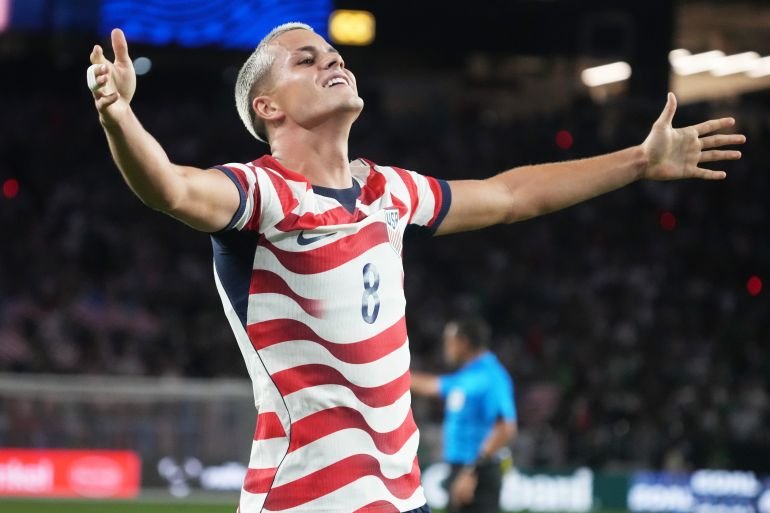
Cavan Sullivan became the youngest US international goalscorer in history as the United States defeated archrivals Mexico 3-0 in a friendly international in Arizona on Saturday.
Sullivan, who is poised to join English Premier League side Manchester City next year, netted a superbly taken goal in the 62nd minute to double the USA lead at the State Farm Stadium in Glendale.
Recommended Stories
list of 4 itemsend of list
At 17 years and five days, Sullivan beat Mathis Albert’s five-day-old record as the youngest US goalscorer.
Albert, aged 17 and 31 days, scored during Tuesday’s 4-2 defeat of Chile.
“These are the moments you dream of when you’re three, four, five or six-years-old,” Sullivan said.
“I manifested this moment, not just these past couple of hours when I found out I was starting, but my whole life,” he added.
Sullivan’s strike came after another teenager — 18-year-old Julian Hall — had given Mauricio Pochettino’s side the lead in the 28th minute.
Hall’s goal was his third in as many games since being handed his international debut by US coach Pochettino in last week’s defeat of Peru. Hall also scored in the victory over Chile.
The loss puts more pressure on Mexico coach Rafael Marquez, who is still seeking his first win since taking over following the World Cup.
Mexico dominated possession and territory early on but were unable to find a way through a well-organised United States defence.
Instead, it was the hosts who took the lead just before the half-hour mark with a superbly worked goal from Hall.
Gio Reyna surged into the penalty area to collect a pass from Alex Freeman and ghosted past Mexico midfielder Erik Lira to reach the byline.
Reyna’s low cross was parried away by Mexico goalkeeper Raul Rangel, but only as far as Hall, who lashed in from close range to make it 1-0.
Mexico’s best chance came early in the second half when Roberto Alvarado’s rasping shot from the edge of the area was tipped over the bar by US goalkeeper Diego Kochen.
Pochettino’s side doubled their lead on 62 minutes when Sullivan’s persistence in chasing down a long ball was rewarded after Rangel mishit a pass to the American outside his area.
Sullivan coolly took his time and chipped home from long range to make it 2-0.
“I just remember chipping the ball, hoping it didn’t hit the crossbar or go over,” Sullivan said of his strike. “I was getting nervous when it was in the air and then everything was a blur.”
A miserable night for Mexico got worse shortly afterwards when substitute Luis Chavez was shown a red card for shoving a hand into the face of Sebastian Berhalter in the 68th minute.
The United States completed the scoring in the 84th minute when Malik Tillman latched onto a poor Mexico backpass and smashed a shot into the top corner for 3-0.
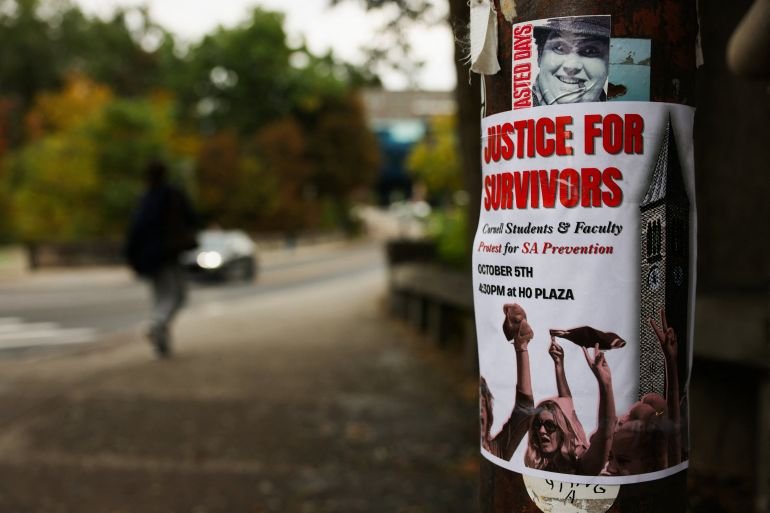
New York – Last month, a woman identified as Jane Doe filed a lawsuit against Cornell University, the fraternity Chi Phi and the seven fraternity members she accused of gang-raping her on the night of October 19, 2024.
Her allegations have triggered a nationwide reckoning in the United States over the prevalence of sexual assault on college campuses.
Recommended Stories
list of 3 itemsend of list
But the case has also reignited efforts to reform New York law.
While the left-leaning state has long presented itself as a leader in women’s rights, advocates say sexual assault survivors still face pervasive legal barriers when they seek justice.
Erica Vladimer, a lawyer and founding director of Harassment-Free New York, a survivor-led nonprofit, told Al Jazeera that much of the legislation currently in the spotlight is the culmination of years, if not decades, of work.
“These are bills that we have been fighting for for years when sexual violence is not in the news,” Vladimer said.
She drew a line between the #MeToo movement, which began in 2017 as an online campaign to denounce sexual misconduct, and the current wave of outrage following Doe’s allegations.
“It speaks to the fact that the #MeToo movement is not dead. It is a movement, not a moment,” Vladimer said.
Already, leaders in Albany, the state capital, have signalled they would take action following the Cornell case.
On Wednesday, the New York Assembly announced it had formed a working group to examine the state’s sexual-assault laws and develop recommendations for the 2027 legislative session.
Still, advocates say more concrete measures are needed to address the crisis.
“I appreciate that this work is happening,” said Lindsey Boylan, a New York City Council candidate. “It doesn’t undo the fact that rape culture is pervasive in the United States and very much so alive and well in New York.”
Boylan was the first woman to publicly accuse former New York Governor Andrew Cuomo of sexual harassment in another high-profile misconduct case, back in 2020. She is among those calling for greater reform.
Here are some of the measures advocates are pushing state lawmakers to adopt or amend:
‘Voluntary intoxication’ statute
The Cornell University case has brought renewed attention to New York’s “voluntary intoxication” statute, a legal loophole that can make it harder to prosecute sexual assault when a person has willingly consumed alcohol or drugs.
New York Governor Kathy Hochul pledged on Friday to work with lawmakers to close the gap.
“It should not matter whether they chose to use drugs or alcohol. Voluntary intoxication is not a license for sexual assault or gang rape. Period,” Hochul said.
Under the current state law, a person who voluntarily drinks or takes drugs is not considered “mentally incapacitated” during an assault, even if they become too intoxicated to consent.
That can make it harder for prosecutors to bring a sex-crime charge. The law primarily recognises incapacitation in the context of sexual assault when a person was involuntarily intoxicated, unconscious or otherwise “physically helpless”.
That distinction has become central to the Cornell case. Doe has acknowledged that she consumed substances before the alleged rape, saying that she was pressured into drinking alcohol and taking the dissociative drug ketamine.
The Tompkins County district attorney initially declined to bring charges, pointing to the law’s stance on “voluntary intoxication”. But the investigation has since been reopened, amid public pressure.
New York is one of 19 states in the US that distinguish between “voluntary” and “involuntary” intoxication when it comes to determining consent in sexual violence cases.
But the Cornell case has spurred a push to remove the distinction from the law books. Critics have argued that sexual assault is no less grievous if a victim is drunk or has chosen to take drugs.
“I mean, to have New York, a supposedly progressive state, penalise people who are sexually abused for drinking is disgusting,” Boylan told Al Jazeera.
Vladimer, for her part, explained that distinguishing between “voluntary” and “involuntary” intoxication as a means for pursuing sexual assault cases shifts the focus onto the actions of victims, rather than perpetrators.
“We essentially have codified victim-blaming by saying if you become voluntarily intoxicated and then are sexually assaulted, you essentially cannot seek justice in our court system,” Vladimer told Al Jazeera.
In June, the New York state Senate unanimously passed a bill to allow sexual assault charges regardless of whether a victim is intoxicated voluntarily or involuntarily.
But the legislation has yet to be taken up in the state Assembly.
Students look on at Cornell University’s campus in Ithaca, New York, on October 1 [Lauren Petracca/Reuters]
The rape-shield gap
New York’s rape-shield protections limit the use of evidence about a complainant’s sexual history and conduct in criminal proceedings. But those protections do not currently extend to civil cases.
This distinction could matter in the Cornell case because Doe filed a civil lawsuit.
Vladimer said questions about a survivor’s behaviour could come up in the discovery process of a civil case, as well as in court.
“There is the potential of her having to face questions about things like her sexual history,” Vladimer said.
Bridie Farrell, the director of victim rights advocacy and legislation at the law firm Weitz and Luxenberg, told Al Jazeera that she has seen major differences in how male and female survivors are questioned in civil cases where this practice is still permitted.
In one case involving a brother and sister who were both sexually assaulted, Farrell said the man was not questioned about his sexual history while the woman was “grilled on it”.
A bill sponsored by State Senator Liz Krueger would extend rape-shield protections to civil proceedings. The measure passed the Senate in June and is currently before the Assembly Judiciary Committee.
A student walks through an archway at Myron Taylor Hall on the Cornell University campus in Ithaca, New York, on October 1 [Lauren Petracca/Reuters]
Retaliatory defamation lawsuits
Advocates are also pushing for legislation to prevent retaliatory defamation lawsuits.
Boylan said she has spent more than $2m defending herself in legal proceedings connected to her accusations against Cuomo, who stepped down as New York governor in 2021.
He has repeatedly denied any allegations of wrongdoing, despite a state attorney general’s report that concluded he “engaged in conduct constituting sexual harassment”.
“Every step of the way, we have a system that penalises people for speaking up about their own harm,” Boylan said.
Boylan and Charlotte Bennett, a former aide who also accused Cuomo of sexual harassment, are proponents of the Speak Your Truth Act, which would provide legal protections for people who publicly report sexual assault, harassment or discrimination.
The bill, sponsored by Assembly member Jessica Gonzalez-Rojas, would make certain communications about sexual assault, harassment or discrimination privileged when they are made without malice.
It would also allow survivors of sexual misconduct who successfully defend themselves against a defamation lawsuit to recover legal fees and costs. The bill remains in an Assembly committee.
Cornell University and local officials in Ithaca, New York, have faced questions about how they handled the Jane Doe case [Lauren Petracca/Reuters]
A recent win, a long way to go
For Bridie Farrell, the victims’ rights advocate, the fight for legal change is personal.
Farrell was a 15-year-old competitive speed skater in 1997 when she said she was sexually abused by her 33-year-old teammate and mentor. She came forward with her story of abuse in 2013.
By then, the statute of limitations in her case had expired. Farrell later became an advocate for changes to New York’s laws, helping to pass the Child Victims Act in 2019 that extended the time available for survivors of childhood sexual abuse to pursue criminal and civil claims.
The law allowed Farrell to file her own case, which she did in 2020. She tells Al Jazeera that a trial has finally been scheduled for June 2027.
“Before we passed the Child Victims Act in 2019, New York was one of the worst in the country,” Farrell said of the situation for sexual assault survivors seeking justice.
Farrell considers the legal impediments to Doe’s case — like the “voluntary intoxication” statute — all too predictable. “I’m not surprised if we haven’t updated a law that is archaic,” she said.
Still, lawmakers have signalled willingness to reform such laws. In announcing the state Assembly’s working group on sexual-assault laws, Speaker Carl Heastie pledged to “thoughtfully” consider how the state can strengthen its laws.
“The allegations being reported out of Cornell University are truly horrifying,” Heastie said on Wednesday. “We want to do everything we can to ensure victims of sexual assault see justice served.”
But survivors and sexual violence advocates say the Cornell case points to problems that go beyond any single law. They hope to see widespread systemic and societal change.
“Changing legislation is incredibly important. But legislation in a lot of cases can only go [as far as] the paper that it’s written on,” Boylan said. “It would be amiss to orient this horrible, tragic, unacceptable, infuriating case in isolation without looking at the broader rape culture of our state and our country.”
Washington, DC – Democrats have the momentum; Republicans are surging in defence and cash.
That narrative has emerged ahead of the United States midterm elections in November, as races across the country enter their final stretch.
Recommended Stories
list of 3 itemsend of list
With control of the US House of Representatives and the US Senate at stake, Democrats begin October with a surprisingly rosy outlook as more congressional seats are seen as in play.
Republicans, meanwhile, appear to be in damage control, pouring millions of dollars into races once seen as secure victories while injecting more funding into a handful of marquee showdowns.
The party’s standard bearer, President Donald Trump, who has embraced the notion of the election being a referendum on his leadership, enters the final month with staggeringly low approval ratings.
The most recent Associated Press-NORC polling, released on Thursday, showed Trump with 31 percent approval, the lowest during either of his two terms. Only 26 percent of respondents approved Trump’s handling of the economy, dipping two points below his predecessor, former President Joe Biden’s lowest rating on the topic.
Surveys continue to show voters rank the economy as their top issue, with topics like gas prices, made higher by the US-Israel war with Iran, dominating their concerns. Immigration and corruption have also regularly ranked high.
“The broad stroke is that Americans are disappointed, bordering on angry that President Trump hasn’t delivered on the core promises he made when he won re-election,” according to Henry Olsen, a senior fellow at the conservative Ethics and Public Policy Center in Washington, DC.
House looking solid for Dems
Political trackers have long projected Democrats will take control of the US House of Representatives in the November 3 vote.
Winning a majority in the 435-member chamber from Republicans would give the party renewed legislative power to assert leverage over Trump, while launching investigations into his administration’s dealings. Top Democrats have already signalled that probes into Trump’s family business dealings would be top priorities.
Two election non-partisan prediction authorities, the Cook Political Report and the University of Virginia’s Sabato’s Crystal Ball, have recently assessed that the likelihood of Democrats taking the House has only increased.
The Cook Political Report recently shifted 15 House races in the direction of Democrats, moving some considered “toss-ups” to “leans Democrat” and some previously considered “lean Republican” to “toss-ups”.
One such shift was for a Texas border district represented by Republican Monica De La Cruz. Her district was emblematic of a wider Latino shift towards Trump in 2024. Once seen as holding the advantage over her challenger, Democrat Bobby Pulido, Cook now rates her race as a “toss-up”.
All told, the political analysis clearinghouse now predicts Democrats are on track to win 5 to 15 House seats.
Senate in play
With 30 days left to go, “there’s much more drama in the Senate than the House races”, according to Kyle Kondik, the managing editor at Sabato’s Crystal Ball.
Once considered a pipe dream for Democrats, who need a net gain of at least four seats to win a slim majority, the 100-member chamber has moved within a more comfortable striking distance.
Unlike in the House, where every seat is up for re-election, only 35 Senate seats are up for grabs in this cycle, creating a far narrower pathway to control.
“The trajectory of the polling since Labor Day (September 7) has generally been that a bad Republican environment is just getting worse,” Kondik said, adding that “the Senate just seems to get more and more competitive as the cycle has gone on”.
To be sure, the quality of polling can vary across the country, with Kondik cautioning that gauging the political temperature of the Midwest has been particularly challenging for pollsters.
Still, in North Carolina, former Democratic Governor Roy Cooper is expected to trounce former Republican National Committee chairman Michael Whatley in the race for a Senate seat currently held by Republicans. Top conservative donors have already begun to divert funds from the contest.
Surveys have consistently shown Democrats leading in three other races for seats currently held by Republicans: Democrat James Talarico against Republican Ken Paxton in Texas; Democratic challenger Sherrod Brown against Republican incumbent Senator John Husted in Ohio; and Democratic Mary Peltola against Republican Dan Sullivan in Alaska.
Races for Republican held seats in Iowa, between Republican Ashley Hinson and Democrat Josh Turek, and in Maine, between Republican incumbent Susan Collins and Democratic challenger Troy Jackson, remain separated by less than one point, according to Real Clear Politics polling averages.
Democrats, meanwhile, have consistently led in polling in Senate races in Georgia, New Hampshire and Michigan for seats the party currently holds.
Big money in the race
For Republicans, salvation could be in the spending, with this year’s race continuing a US phenomenon of small fortunes poured into politics.
All told, at least $4bn had been spent on gubernatorial and congressional midterm advertising buys as of September 17, putting the race on track to become “perhaps the most expensive midterm on record”, according to Michael Franz, co-director of the Wesleyan Media Project.
Republicans entered September with a considerable funding edge. The Republican National Committee had $125.6m on hand, with the Democratic National Committee trailing far behind with $16.9m and $17.6m in debt.
When accounting for the three major committees associated with both groups, the Republican Party had $233.4m in cash, according to a CNBC analysis, while the Democratic Party had $130.4m.
Trip Yang, a Democrat strategist based in New York City, told Al Jazeera such spending can be deployed to help boost a candidate’s name recognition or to tear down a competitor.
According to AdImpact, Republicans and their allies were set to spend $888m on advertising from mid-September to election day, with Democrats and their supporters set to spend $666m.
The firm found pro-Republican ad spending would be particularly pronounced in the key Senate races in Ohio, Texas and Michigan, outpacing Democratic spending by at least $24m in each state.
Trump’s unpopularity, Yang said, means “Republicans spending millions or hundreds of millions of dollars improving their candidates’ images by itself may not be enough”.
“If you’re a little bit handicapped because your president is so toxic, you try to spend your hundreds of millions of dollars attacking the Democrats to make it more of a food fight,” he said.
A New York Times analysis estimated by the end of August at least $1bn in so-called “dark money” had been poured into the midterms. The term refers to spending where the donor’s identity is shielded, typically through nonprofit and shell-company donations to Super PACs.
Industry groups, including those supporting Crypto, AI and online betting firms, are expected to be top spenders in key races, although their support tends to cut across partisan lines.
Trump, meanwhile, has pledged to spend between $400m and $500m from his MAGA Inc Super PAC, though it has so far spent about $15m to support Paxton’s Senate bid in Texas.
Pro-Paxton ad reservations far outpaced Talarico in September, according to AdImpact data analysed by NPR, with $94m spent compared with $30m to support the Democrat.
The Trump factor
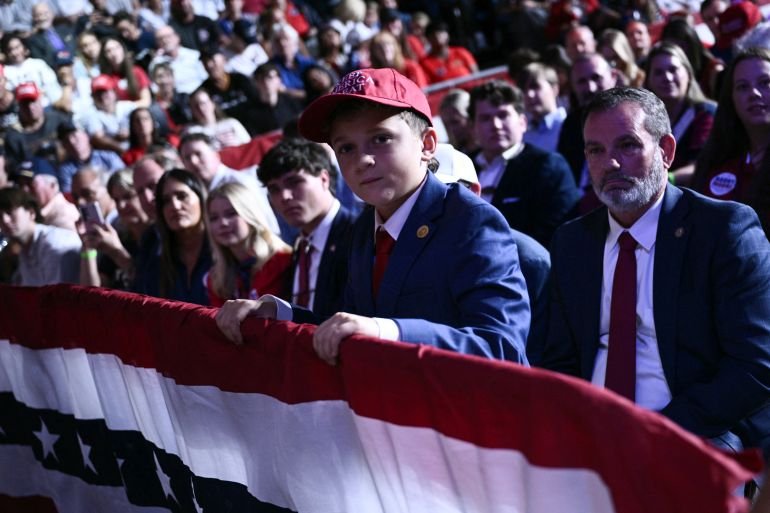
Trump has pledged to spend the final days before the election in non-stop campaign mode, after urging supporters during his Republican Midterm Convention in Dallas, Texas, to “vote like I’m on the ballot”.
His plan to criss-cross the country for rallies underscores a “base turnout” strategy meant to energise voters already loyal to the party, according to conservative analyst Olsen.
“But the Republican problem is a persuasion problem with people in the middle,” Olsen said. “[Trump’s campaigning] might help with some turnout … but their real problem is persuasion, and it’s not something that’s going to help with that in the slightest.”
Polls have spelt trouble for Republicans when it comes to swaying independents, with a PBS News, NPR and Marist poll from September 23 showing unaffiliated voters breaking for Democrats at 57 percent compared with 32 moving towards Republicans.
US President Donald Trump participates in a midterm election rally for Oklahoma Republican gubernatorial candidate Mike Mazzei at the Choctaw Event Center in Durant, Oklahoma, US, October 1, 2026. [Nick Oxford/Reuters]
The scenario has created a dilemma for some top Republican candidates over whether to break from the president on his most controversial actions, according to Lee Miringoff, the director of the Marist University Institute for Public Opinion.
Senate candidates Ashley Hinson in Iowa, Jon Husted in Ohio and Mike Rogers in Michigan all recently put daylight between themselves and Trump on the war with Iran.
One Republican House candidate, Representative Maria Elvira Salazar, has criticised Trump’s aggressive immigration enforcement policies as she seeks to rally Latino voters in South Florida.
Trump, in turn, reposted a social media message calling Salazar a “backstabber”.
“You need to have, you know, something else going for you other than endorsement of Trump,” said Miringoff. “Some Republicans are starting to have self-preservation kick in because they’re concerned.”
What can change?
Achieving a wide-scale shift in public opinion remains a tall order for Republicans in the final stretch of the race.
Many of the defining issues are unlikely to change before November, with Trump signalling a possible escalation with Iran following the vote as he has downplayed the prospect of short-term affordability relief.
At the same time, the US president has also not ruled out actions that rights groups say could upend voter turnout. Most recently, he refused to commit to not invoking the Insurrection Act or declaring a state of emergency surrounding the vote during an interview with Time magazine.
Miringoff said he believed that the “potential for more than just a marginal shift is there”, as he assessed some Democratic candidates have struggled to present clear visions beyond opposition to Trump.
“The result isn’t formed in concrete,” he said, “to the degree that there’s going to be a lot of money still spent.”
Analyst Olsen saw less remaining wiggle room for the party.
“Republicans have the time and the resources to change the outcome with respect to a few close Senate races,” Olsen said. “But to change direction, they would need something that would be apocal.”