Category: Business

  • XRP Bull Flag Breakout After 8-Month Consolidation To Send Price To $11

    XRP Bull Flag Breakout After 8-Month Consolidation To Send Price To $11

    Crypto analyst Luke has drawn attention to an $XRP bull flag breakout, which could send the price to $11, which would mark a new all-time high (ATH) for the altcoin. This comes as the altcoin faces further downside amid the U.S.-Iran war, which threatens to drag on for a long time.

    $XRP Eyes Rally To $11 Amid Bull Flag Breakout

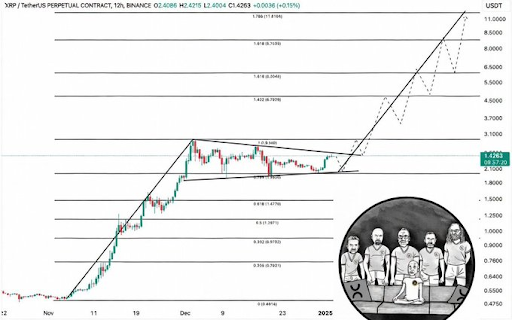
    In an X post, Luke stated that a bull flag breakout is forming on the $XRP weekly chart, with the target being $11. The analyst noted that this is a textbook bull flag after the 8-month consolidation. A pole height measured move points to a rally to exactly $11 while the altcoin could reach $11.20 based on the 1.618 Fib extension.

    An $XRP rally to $11 from the current price represents an upside of almost 700%. Luke indicated that such a rally is possible, with institutions also accumulating, a development that shows a “parabolic leg” is incoming. However, it is worth noting that the $XRP ETFs have seen daily net outflows in the last two days as tensions between the U.S. and Iran intensify.
    SoSoValue data shows that the funds recorded outflows of $6.15 million and $16.62 million on March 5 and 6, respectively. As a result, the net assets of these $XRP ETFs have dropped below $1 billion. The altcoin, alongside the broader crypto market, is currently facing downside pressure, with the U.S.-Iran tensions pushing oil prices to multi-year highs.

    Crypto analyst CasiTrades predicted that $XRP could drop to as low as $0.87, as it remains below the $1.67 resistance level. Crypto analyst Egrag Crypto also stated that $XRP could drop to as low as $0.85 after facing rejection at the $1.55 level.

    Insight Into the Current Price Action

    In an X post, crypto analyst JB stated that all previous wicks, including the one on October 10, have been filled down into the demand zone. The analyst opined that there isn’t much additional downside fuel left if $XRP is still in a higher timeframe (HTF) bullish environment. JB also mentioned that the first attempt to reclaim $1.61 failed, so a retest of the $1.25 and $1 level are now back on the table.

    For an invalidation of this bearish structure, $XRP needs to reclaim $1.61 and break the diagonal resistance. JB noted that this would significantly increase the odds of resuming the broader uptrend after about 15 months of correction. “The current area offers one of the strongest R:R setups for HTF spot longs, with invalidation below the gray demand zone,” the analyst added.

    At the time of writing, the $XRP price is trading at around $1.36, down over 2% in the last 24 hours, according to data from CoinMarketCap.

    Featured image from Freepik, chart from Tradingview.com
  • Latin America’s crypto user growth outpaced U.S. by 3x in 2025, report shows

    Latin America’s crypto market is expanding far faster than that of the United States as users increasingly rely on cryptocurrencies for payments and cross-border transfers rather than speculation. a new report claims.

    The region, according to a report from Argentinian crypto firm Lemon, received more than $730 billion in cryptocurrency transaction volume in 2025, a 60% increase from the previous year, representing roughly 10% of global crypto activity.

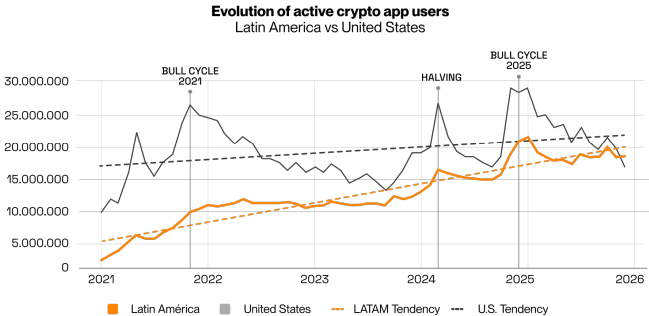
    Growth was not only measured in transaction volume. Monthly active crypto app users in Latin America rose about 18% year over year, roughly three times faster than growth in the United States, the report said.

    Brazil dominates the region by transaction size.

    The country received $318.8 billion in crypto value with growth approaching 250% year over year, driven largely by institutional trading and expanding regulatory clarity for financial institutions.

    Argentina shows a different pattern. Despite inflation falling to about 32% in 2025, crypto adoption continued to rise. Average monthly users were four times higher than during the 2021 bull market, according to the report.

    One driver is cross-border payments. Argentine fintech companies linked crypto rails to Brazil’s PIX instant payment system, allowing users to pay Brazilian merchants using pesos while stablecoins such as USDT settle the transaction behind the scenes.

    The integration led to 5.4 million crypto app downloads in Argentina during 2025, with January downloads hitting a record level.

    Peru, which back in January saw Bybit Pay integrate with digital wallets Yape and Plin, emerged as one of the fastest-growing markets. Crypto app users doubled as interoperability rules allowed banks and digital wallets to connect. Transfers between banks and wallets surpassed 540 million transactions, up 120% year over year.

    Stablecoins are playing a central role in the shift toward practical use cases. Across the region, users rely on digital dollars to send money abroad, receive funds from platforms like PayPal and bypass traditional banking networks, the report points out.

  • Nigel Farage Confidant Linked to $550K Loss On Iran Strike Polymarket Bet: Report

    Nigel Farage Confidant Linked to $550K Loss On Iran Strike Polymarket Bet: Report

    In brief

    • An account bearing George Cottrell’s name appeared to lose $550k on an Iran strike bet.
    • An additional $125k loss was tied to a wager on Keir Starmer leaving office.
    • Polymarket is not licensed to operate in the UK.

    An account on the prediction market Polymarket that appears to bear the name and birth year of British financier and Nigel Farage confidant George Cottrell lost more than $550,000 on bets about whether the U.S. would bomb Iran.

    The “GCottrell93” account wagered roughly $550,000 on the outcome “No” to the question “US strikes Iran by February 28, 2026?” according to Polymarket data first cited by UK newspaper The Daily Telegraph. The position was wiped out after the United States struck Iran on February 28. Prior to this, the account won multiple bets against the strikes before other dates in February.

    The same account also appears to have lost around $125,000 on a bet that Prime Minister Keir Starmer would be out of office by February 28. It has garnered almost $3.5 million in profits, the bulk of that coming from a bet on Trump winning the 2024 election.

    Blockchain investigator ZachXBT has previously expressed “high confidence” that the account belongs to Cottrell, a longtime associate of Reform UK leader Farage who has helped raise millions of pounds for his political movements, including Ukip and the Brexit Party. In 2025 his mother, aristocrat Fiona Cottrell, emerged as one of Reform UK’s largest donors.

    Cottrell has a long history with high‑stakes betting and finance. Court filings in the UK previously named him as part of a professional betting syndicate linked to Brighton and Hove Albion owner Tony Bloom. The syndicate, tied to the analytics firm Starlizard, reportedly generated hundreds of millions of dollars in winnings, with Cottrell said to have earned substantial sums by copying its bets.

    Cottrell was arrested in 2016 while attending the Republican National Convention in Chicago alongside Farage. U.S. prosecutors charged him with conspiracy to commit money laundering, wire fraud, blackmail and extortion after meetings with undercover federal agents in Las Vegas. Following a plea agreement, he pleaded guilty to a single count of wire fraud and served eight months in prison.

    Last month, he published a book entitled “How To Launder Money: A guide for law enforcement, prosecutors and policymakers,” whose launch was attended by Farage and senior Reform UK figures.

    In a statement emailed to Decrypt, a Reform UK spokesperson said that “George Cottrell is not employed by the party so you are best approaching him for comment.” Decrypt has attempted to contact Cottrell via his company, Geostrategy. 

    Reform UK and crypto

    Reform UK has taken an explicitly pro‑cryptocurrency stance and became the first major British political party to accept crypto donations in June 2025. The policy has drawn criticism from lawmakers and transparency campaigners who warn that cryptocurrency donations could enable money laundering or foreign interference in British elections.

    This week former Labour minister Rushanara Ali called for a ban on crypto political donations, describing them as a potential vector for “foreign interference in our democracy.” Seven parliamentary committee chairs also wrote to the prime minister earlier this year urging an explicit prohibition on cryptocurrency donations.

    Campaign groups have raised similar concerns. The UK Anti‑Corruption Coalition and Spotlight on Corruption argue that the Electoral Commission lacks the powers necessary to properly monitor the origin of crypto donations.

    Despite publicly saying it accepts it, donating online to Reform UK using crypto doesn’t seem to work. Decrypt tried to access the party’s crypto donations page online on multiple browsers and was directed to a blank page each time.

    Prediction markets under scrutiny

    Cottrell’s bets also come at a time of increased scrutiny of prediction markets. Polymarket is not licensed to operate in the UK and limits services to UK-based users. The Gambling Commission told Decrypt it “does not comment on individual businesses” but pointed to its register of licensed operators, which does not include Polymarket.

    In guidance published last month, the regulator said prediction market platforms would likely fall under the legal definition of a “betting intermediary” in the UK, similar to a betting exchange, and would require the appropriate gambling licence to operate legally.

    Despite arguments by some platforms that prediction markets are distinct from gambling, regulators around the world have taken an increasingly hard line. Companies in the sector face legal or regulatory challenges in numerous jurisdictions including  France, Germany, Italy, Australia, Singapore, Portugal, Hungary, Thailand and the Netherlands.

    Daily Debrief Newsletter

    Start every day with the top news stories right now, plus original features, a podcast, videos and more.

  • Kazakhstan’s Central Bank Will Invest Up to $350 Million in Crypto Assets: Reuters

    Kazakhstan’s Central Bank Will Invest Up to $350 Million in Crypto Assets: Reuters

    In brief

    • Kazakhstan’s central bank could invest up to $350 million in crypto and related assets.
    • The investments will comprise associated firms and financial products.
    • The allocations could dovetail with Alatau City, a so-called smart city.

    Kazakhstan’s central bank has earmarked $350 million for investments in the crypto, with plans to deploy capital as early as next month, Reuters reported on Friday.

    “This includes not only cryptocurrency itself,” National Bank of Kazakhstan Governor Governor Timur Suleimenov reportedly said, while taking questions on the central bank’s latest interest rate decision. “We are currently developing ​a list of instruments in which we ⁠will invest.”

    Derived from the Central Asian country’s gold and foreign exchange reserves, which totaled nearly $70 billion as of Feb. 1, the initiative marks an effort to diversify away from traditional stores as value using a relatively small amount of capital.

    The investments will span “shares of high-tech ​companies related to cryptocurrencies and digital financial assets, index funds, and other instruments that exhibit similar ​dynamics to crypto assets,” suggesting that the central bank may not hold digital assets in their native form.

    Decrypt has reached out to the National Bank of Kazakhstan for comment.

    Kazakhstan’s national fund, established decades ago to manage oil-sale revenue, was valued at $65.23 billion at the start of last month. And the central bank’s investments in crypto could begin as late as May, per Reuters, which cited Deputy Governor Aliya Moldabekova.

    “We are currently selecting companies that deal with digital ​assets. For ​example, those ⁠involved in cryptocurrency infrastructure,” she said. “We are currently in the process ​of selecting such companies.”

    The measure resembles a relatively distinct approach to capitalizing on digital assets compared to the strategic Bitcoin reserve established by the Trump administration last year, set to be seeded using Bitcoin seized from U.S. criminal or civil proceedings via executive order. The reserve represented a key campaign promise from President Donald Trump in 2024.

    Kazakhstan President Kassym-Jomart Tokayev floated a strategic crypto reserve himself in September, describing such assets as foundational to “the new digital financial system.”

    At the time, he tied the country’s efforts to Alatau City, a so-called smart city featuring massive towers that aims to reach a population of 2 million residents by 2050.

    “Alatau City should become the first fully digitalized city in the region,” Tokayev said, underscoring a desire for “technologies to pay for goods and services with cryptocurrency.”

    Daily Debrief Newsletter

    Start every day with the top news stories right now, plus original features, a podcast, videos and more.

  • Bitcoin Dives Below $69K as US Loses 92K Jobs in February

    Bitcoin Dives Below $69K as US Loses 92K Jobs in February

    In brief

    • The U.S. lost 92,000 jobs in February, pushing unemployment to 4.4% and sending Bitcoin below $69,000.
    • Bitcoin ETFs lost $228 million on Thursday, though one analyst says stability above $70,000 could signal a healthy reset.
    • Investors are watching next week’s CPI, GDP, and jobs data for clues on inflation and the labor market.

    Bitcoin plunged below $70,000 on Friday, falling more than 5% over the last day as the U.S. lost 92,000 jobs in February and the unemployment rate inched up to 4.4%, according to the Bureau of Labor Statistics.

    U.S. Representative Darren Soto (D-FL) was quick to blame President Donald Trump for the weakening labor market.

    Job losses mount as Trump’s dismal economy continues to take its toll on American families,” he wrote on X. “U.S. lost another 92,000 jobs in February after dismal job numbers for 2025. His tariffs, corruption and incompetence are to blame.”

    The president hasn’t yet commented on the the jobs report. On Truth Social, he said of the U.S. war with Iran that: “There will be no deal with Iran except UNCONDITIONAL SURRENDER!”

    Bitcoin peaked above $72,000 yesterday, but was trading for $68,282 at the time of writing after having lost 5.6% in the past day, according to crypto price aggregator CoinGecko.

    Liquidations have been modest over the past 24 hours. A total of $370 million worth of crypto derivatives have been forced to sell in the past day, the majority of that coming from long positions. Nearly half of that tally came from Bitcoin positions, according to derivatives analytics platform CoinGlass.

    Earlier this week, Bitcoin climbed above $74,000 for the first time in four weeks. But the retrace isn’t cause for alarm, according to Nexo analyst Iliya Kalchev.

    “Markets do not need acceleration here; they need acceptance above reclaimed levels,” he said in a note shared with Decrypt. “Stability above $70,000 would reinforce the idea that positioning has reset and that incremental supply is thinning.”

    There’s also signs that institutional BTC investors are still feeling skittish, as Bitcoin ETFs shed $228 million on Thursday.

    Looking ahead, next week will bring a full slate of marcoeconomic indicators, Kalchev added.

    “Monday brings Japan’s gross domestic product data. Wednesday features Germany consumer price index, United States consumer price index, and a United States 10-year note auction that will test demand for duration at current yield levels,” he wrote. “Thursday’s initial jobless claims and Friday’s core personal consumption expenditures data alongside JOLTs job openings will further shape the inflation and labor narrative.”

    Daily Debrief Newsletter

    Start every day with the top news stories right now, plus original features, a podcast, videos and more.

  • Dubai Orders Crypto Exchange KuCoin to Stop Offering Services to Residents

    Dubai Orders Crypto Exchange KuCoin to Stop Offering Services to Residents

    In brief

    • Dubai’s virtual asset regulator, VARA, issued a cease and desist order to KuCoin saying that it is not licensed in the emirate.
    • The regulator urged consumers and investors not to utilize the exchange as a result.
    • Another crypto exchange, MEXC, also received a similar warning, though it didn’t contain the cease and desist language.

    Dubai’s digital asset regulatory body has ordered Kucoin Exchange EU Gmbh—operating as Kucoin—to cease and desist its operations in the emirate, according to a Friday announcement. 

    The Virtual Assets Regulatory Authority (VARA) said that the cryptocurrency exchange does not hold a license to provide digital asset services within Dubai, and is therefore not authorized to operate there. 

    “It has come to VARA’s attention that the company [KuCoin] may be providing Virtual Asset activities to Dubai residents without the necessary regulatory approvals and misrepresenting its licensing status,” the notice reads. “As a result, the company has been instructed to cease and desist all unlicensed VA activities.”

    The regulator’s announcement warns investors that engaging with unlicensed companies can pose “significant financial risks” and advises them not to utilize KuCoin. 

    In response to the news, KuCoin indicated that it operates via various entities in different geographic jurisdictions, saying KuCoin Exchange EU GmbH “operates as a MiCAR-regulated entity focused on the European Union (EU) market” and does not accept non-EU users or conduct marketing activity outside the area. 

    “Regulatory frameworks for digital assets are developing rapidly across many jurisdictions, and regulators are increasingly clarifying their expectations for the industry,” a spokesperson for the firm told Decrypt. “KuCoin respects applicable laws and regulatory processes globally and maintains a cooperative approach with regulators while supporting the development of a responsible digital asset ecosystem.”

    It is not immediately clear whether or not the exchange will seek the appropriate regulatory licenses to operate in the emirate, and a representative did not immediately respond to Decrypt’s inquiry. 

    In addition to KuCoin, crypto exchange MEXC was issued a similar warning notice by the regulator on March 4. However, the regulator did not formally request that the firm cease and desist services, despite indicating that MEXC is “not allowed to offer or promote” virtual asset services in the emirate.

    A representative for MEXC did not immediately respond to Decrypt’s request for comment.

    Daily Debrief Newsletter

    Start every day with the top news stories right now, plus original features, a podcast, videos and more.

  • Trump’s National Cyber Strategy pledges to support crypto and blockchain

    Crypto industry executives are combing through US President Donald Trump’s National Cyber Strategy after it was released on Friday, searching for hints about what it could signal for government support of the crypto industry.

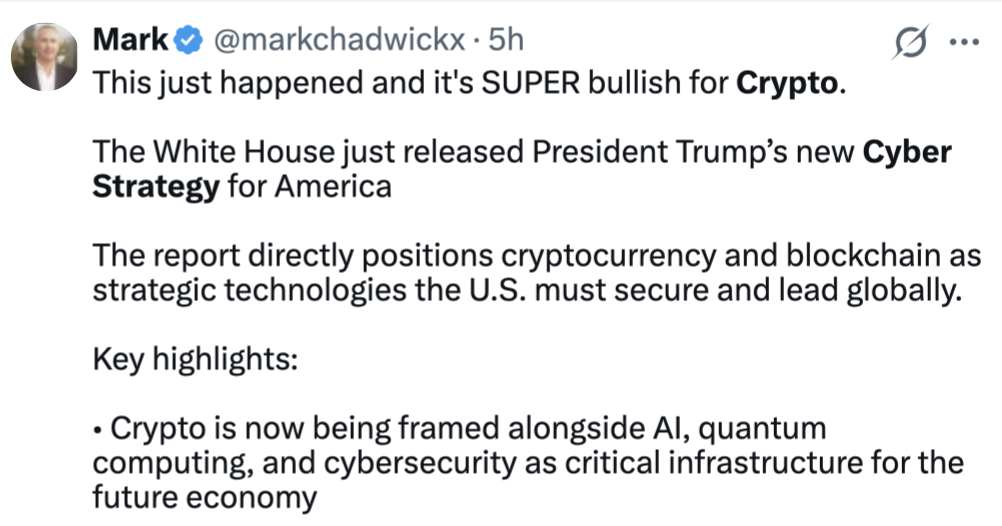
    “Crypto and blockchain are explicitly named as technologies to be ‘protected and secured.’ This is a first for any US cybersecurity strategy,” Galaxy Digital’s head of firmwide research Alex Thorn said in an X post on Friday.

    Crypto and blockchain were mentioned once in the six-page report:

    “We will build secure technologies and supply chains that protect user privacy from design to deployment, including supporting the security of cryptocurrencies and blockchain technologies.”

    However, industry executives have also been interpreting other parts of the document to see how they relate to crypto.

    Cryptocurrencies, United States, AI, Donald Trump, Quantum Computing

    Source: Mark Chadwick

    Thorn pointed to a section pledging to “uproot criminal infrastructure and deny financial exit and safe haven.” “This language could easily justify crackdowns on mixers, privacy coins, and unregulated off-ramps,” he said.

    Bitcoin VC points out that quantum has been taken “seriously”

    Castle Island Ventures founder Nic Carter, who has been vocal about the threat of quantum computing to Bitcoin (BTC) in recent times, pointed to the section saying the government “will accelerate the modernization, defensibility, and resilience of federal information systems by implementing cybersecurity best practices, post-quantum cryptography, zero-trust architecture, and cloud transition.”

    “Sure seems like they’re taking quantum seriously. Nothing to worry about, I’m sure,” Carter said in an X post.

    It comes as the crypto industry continues to debate about how close quantum computing is to being a serious threat to Bitcoin. On Feb. 15, Carter said that major Bitcoin-holding institutions may eventually lose patience with Bitcoin developers for not addressing quantum computing concerns quickly enough.

    Trump points to the next generation as a priority

    Trump said that the National Cyber Security outlines his priorities for “ensuring that America remains unrivaled in cyberspace.” Artificial intelligence was a key focus of the report.

    “We will secure the AI technology stack—including our data centers—and promote innovation in AI security,” it said.

    Trump also emphasized the importance of recruiting the next generation of workers in the cyber workforce to “design and deploy exquisite cyber technologies and solutions.”

    The US typically releases a national cybersecurity strategy every administration, outlining the government’s priorities for emerging technologies.

  • Vancouver Moves to Close Bitcoin Reserve Proposal After Legal Review

    Vancouver Moves to Close Bitcoin Reserve Proposal After Legal Review

    In brief

    • City staff have concluded the Vancouver Charter does not allow Bitcoin in city reserves.
    • The motion followed a late 2024 decree by Mayor Ken Sim to study crypto use.
    • Municipal finance rules keep assets like Bitcoin outside treasuries, Decrypt was told.

    Vancouver staff have recommended closing a council motion that explored whether the city could become “Bitcoin-friendly,” after determining that its rules don’t allow the crypto to be held as a municipal reserve asset.

    The recommendation appears in a report to the council reviewing outstanding member motions, where staff said they had “conclusively determined” that Bitcoin is not “an allowable investment asset,” recommending the motion be closed as part of a broader reprioritization of staff resources and efforts.

    Staff cited the Vancouver Charter, the provincial law that governs how the city operates, including how municipal funds can be invested, which does not permit the city to hold Bitcoin as a reserve asset, limiting Vancouver’s ability to pursue the proposal.

    The motion’s sole opponent on council, Pete Fry, told local media he assumed the proposal had already been shelved and was surprised to see it referenced in the report.

    “I already thought it was dead in the water,” he said. “It was probably good closure to have it mentioned in here, but I don’t even know that it was entirely necessary.”

    The recommendation comes more than a year after Vancouver council initially backed a motion from Mayor Ken Sim directing staff to study whether the city could become a “Bitcoin-friendly city.”

    At the time, the proposal asked officials to examine accepting taxes and fees in crypto, and the possibility of converting part of the city’s financial reserves into Bitcoin.

    But the proposal had faced legal limits right off the start.

    The British Columbia Ministry of Municipal Affairs said at the time that municipalities cannot hold financial reserves in crypto under provincial rules, adding in a statement that the intent of the legislation “is that local government funds are not exposed to undue risk.”

    “The legal and treasury-related barriers were reportedly already understood from the outset, so the decision to end the process does not come as a real surprise” Kevin Lee, chief business officer at crypto exchange Gate, told Decrypt.

    In Vancouver’s case, the initial prospects “appeared to reflect Mayor Ken Sim’s personal pro-Bitcoin vision as much as a practical municipal finance initiative,” Lee added.

    Back then, Mayor Ken Sim defended the proposal, saying Bitcoin had been the top-performing asset “over the past 16 years,” arguing it should at least be considered as part of a diversified portfolio.

    Decrypt has reached out to the mayor’s office for comment.

    Constraints and upsides

    The outcome also reflects limitations in how municipalities operate financially.

    “Demand for Bitcoin isn’t the constraint, public balance sheet mandates are,” Dominick John, analyst at quantitative research firm Zeus Research, told Decrypt.

    Municipal treasuries are “structured for capital preservation, which keeps assets like Bitcoin outside the reserve toolkit,” he said. “Until legislation, accounting treatment, and custody frameworks evolve, cities like Vancouver will remain stuck at the study.”

    When asked whether this could set a precedent for other cities, John said it’s likely the same idea would be explored elsewhere, though most proposals “will die at feasibility.”

    This could happen “only if local leaders believe there is political, branding, or ideological value in being seen as pro-crypto or pro-innovation,” Gate’s Lee said.

    That value, as in Vancouver’s case, is not guaranteed, he said. “Once the political upside is weak, most of these initiatives are likely to stall at the feasibility stage.”

    Still, crypto remains used far more as an investment than for payments, Gate’s Lee explained.

    “Government payment options usually follow private sector behavior rather than lead it,” he noted. “If crypto becomes widely used for everyday payments across retail, e-commerce, and services, then accepting it for taxes or municipal fees will be the natural extension.”

    Daily Debrief Newsletter

    Start every day with the top news stories right now, plus original features, a podcast, videos and more.

  • BlackRock private credit fund is latest to crack, hitting crypto prices and DeFi markets

    BlackRock private credit fund is latest to crack, hitting crypto prices and DeFi markets

    Cracks in the global private credit market are rattling investors, raising concerns the stress could spill into crypto markets.

    Bloomberg reported Friday that BlackRock’s $26 billion private credit fund has begun limiting withdrawals amid rising redemption requests. The move follows similar stress at Blue Owl, which sold $1.4 billion in loans last month to meet withdrawals and reportedly has exposure to a collapsed U.K. property lender.

    Shares of major asset managers including BlackRock (BLK), Apollo Global Management (APO), Ares Management (ARES) and KKR slid 4%-6% Friday, extending their 2026 rout.

    Read more: Blue Owl liquidity crisis has investors bracing for 2008-style fallout

    If redemption pressure forces private credit funds to unwind positions, it could trigger broader deleveraging across asset classes that could ripple through digital assets including bitcoin BTC$67,962.60, Andreja Cobeljic, head of derivatives trading at Swiss crypto bank AMINA Bank warned in an emailed note.

    Credit stress meets energy shock

    U.S. banks extended nearly $300 billion in loans to private credit providers as of mid-2025 and another $285 billion to private equity funds, Cobeljic wrote, carrying risks that credit woes could extend to the banking sector

    “In isolation this would be manageable,” he said. “But emerging in the middle of a broader global deleveraging event, alongside an energy shock and collapsing rate-cut expectations, it is a different conversation.”

    “For risk assets, including crypto, a disorderly unwind here would represent a significant second-order shock that current pricing does not reflect,” he said.

    Contagion to tokenized asset markets

    A second channel of credit risk could surface directly on blockchain rails.

    Tokenized private credit products — loans and funds packaged and issued on public blockchains as tokens — have grown quickly as part of the broader real-world asset (RWA) trend. According to data from rwa.xyz, the on-chain private credit market now stands at just under $5 billion. That remains tiny compared with the roughly $3.5 trillion global private credit market in 2025, estimated by the Alternative Credit Council.

    But the growing presence of these assets inside decentralized finance (DeFi) means stress in the underlying loans could ripple directly to crypto markets.

    “Institutions are entering crypto, but often with products that even degens and DeFi natives don’t fully grasp,” said Teddy Pornprinya, co-founder of real-world asset protocol Plume.

    Real-world credit products can carry complex risks that are not always obvious to crypto investors, he said, including volatile net asset value swings and headline yields that don’t fully reflect fees or credit risk.

    A recent episode shows how off-chain credit stress can spill into DeFi.

    According to a report by risk advisory firm Chaos Labs, the 2025 bankruptcy of auto-parts supplier First Brands Group affected a private credit strategy run by Fasanara Capital. A tokenized version of the strategy, mF-ONE, had been issued on the Midas RWA platform and used as collateral for borrowing on the Morpho protocol.

    When the underlying fund marked down exposure tied to the bankruptcy, the token’s net asset value slipped about 2%, pushing highly leveraged borrowers close to liquidation and tightening liquidity on the platform. Lenders ultimately avoided losses, but the episode highlighted how tokenized private credit used as DeFi collateral can transmit traditional credit stress into on-chain markets.