JPMorgan Chase was sued this week for allegedly enabling a $328 million crypto “Ponzi scheme.”
Prosecutors say a crypto executive misused investor funds meant for liquidity pools to fund a lavish lifestyle.
An alleged victim of the scheme is claiming Chase Bank should never have allowed the executive to use its services.
The biggest bank in the United States has been roped into a lawsuit over a customer’s alleged crypto “Ponzi scheme,” as the Department of Justice recently described it, with one of the operation’s victims arguing that JPMorgan Chase should have detected and stopped the misconduct.
The suit, filed this week in a federal court in San Francisco, alleges JPMorgan Chase knowingly permitted one of its customers, Goliath Ventures, to carry out a massive, $328 million fraud that involved a fake crypto liquidity pool scheme and lavish misappropriations of customer funds.
Last month, the operator of the alleged scheme, a Florida man named Christopher Alexander Delgado, was arrested by federal law enforcement on wire fraud and money laundering charges.
Delgado was the CEO of Goliath Ventures, a company that promised customers lucrative monthly returns on funds that were supposedly invested in liquidity pools—automated, user-fueled baskets of cryptocurrencies in the decentralized finance (DeFi) ecosystem that offer incentives for locking up tokens for a certain period of time.
But Delgado did not send the vast majority of customer funds to liquidity pools, the Department of Justice asserts. Instead, he allegedly spent the money on lavish vacations, homes, parties, and payments to early investors in an effort to keep the scheme going.
Now, one of the victims of that alleged scheme has sued Chase, arguing the bank “knowingly permitted” Goliath, one of its customers, to commingle investor funds and use them to power a Ponzi scheme.
The lawsuit specifically claims that because Goliath publicly described itself as a crypto liquidity pool operator, Chase should have confirmed whether the company was registered with the CFTC and other regulators.
“As part of their Know Your Customer obligation, Chase could have and should have confirmed this before accepting the account or continuing to bank Goliath,” the complaint reads. “Chase knew that it had not done so and thus knowingly turned a blind eye.”
A representative for JPMorgan Chase declined to comment on this story when reached by Decrypt.
The lawsuit notably cites the crypto-skeptical views of JPMorgan CEO Jamie Dimon, who has himself called Bitcoin “a decentralized Ponzi scheme.”
“Dimon… warned for years that crypto was being used for fraudulent and criminal activities,” the lawsuit against the bank argues.
Daily Debrief Newsletter
Start every day with the top news stories right now, plus original features, a podcast, videos and more.
Bitcoin has gained ~6% since the Iran crisis began, outpacing gold and equities.
Rising Treasury yields suggest investors are losing faith in traditional safe havens.
Institutional inflows into digital asset products have been positive for three straight weeks.
Bitcoin has seen a modest gain since the start of the Iran conflict, even as bonds and stocks have struggled—and a new note from digital asset manager CoinShares suggests that divergence is meaningful.
At the time of writing, Bitcoin was trading for $70,323 after having fallen 0.8% in the past day, according to crypto price aggregator CoinGecko. Even with the daily dip, it’s up since the U.S. and Israel first began bombing Iran at the tail end of February.
“Since the onset of the crisis, Bitcoin has risen approximately 6 to 6.5%, while gold is up around 1 to 1.5% and equities have declined,” wrote CoinShares Head of Research James Butterfill in a note shared with Decrypt. “This divergence is, in our view, analytically significant.”
It helps that several key factors lined up at just the right moment, he added. Technical indicators had already been signaling that Bitcoin was near its bottom, or lowest price, for this cycle.
“Bitcoin tends to perform well during geopolitical dislocations, not despite its volatility, but in part because of its properties as a non-sovereign, censorship-resistant asset,” Butterfill wrote. He added that investors pulling funds out of U.S. Treasuries is evidence that traditional safe haven assets have lost some of their appeal.
Treasury yields tend to seesaw with prices. When demand for Treasuries rises, prices go up and yields fall. Right now, that seesaw is moving in the other direction. Yields are rising, signaling that investors are pulling back from an asset that has historically been the first port of call in a crisis.
Make no mistake: The outflows from digital asset funds have been consistent. But so have inflows, Butterfill wrote.
“This is now our third consecutive week of net inflows into digital asset investment products,” he said, noting in an email to Decrypt that investors have deposited $500 million already so far this week. “We read this as a meaningful signal: institutional investors are treating Bitcoin as an asset worth holding through geopolitical turbulence, not one to be exited.”
That doesn’t mean all digital assets will be supported the same as Bitcoin, though.
CoinShares noted that categories tied to disposable income, like speculative trading and meme coins, will face serious headwinds if household budgets remain under pressure.
“But the political and regulatory momentum behind stablecoin adoption, particularly in the United States, remains firmly in place and is largely insulated from the oil shock dynamic,” Butterfill added.
Daily Debrief Newsletter
Start every day with the top news stories right now, plus original features, a podcast, videos and more.
Charles Edwards, founder of Capriole Investments, discussed the current state of Bitcoin (BTC), his predictions for 2026, and the biggest risks facing the market during a live broadcast.
Edwards stated that Bitcoin is in a “zone of value” according to historical data, while warning investors about the quantum computing threat and institutional cash flows.
Speaking about the overall market situation on the broadcast, Edwards said that investors constantly trying to find the “bottom” is a flawed strategy. Analyzing Bitcoin’s current price movements, the expert stated, “We can say that the price is closer to the bottom than the top. We are in a deep value zone, but this doesn’t mean the price will rise immediately.”
Edwards, drawing attention to “Cost of Production” data based on mining costs, stated that the $50,000-$60,000 range represents a strong support and value area for Bitcoin.
One of the most striking parts of the broadcast was the discussion of “quantum risk” regarding Bitcoin’s future. Edwards stated that Bitcoin core developers haven’t taken this issue seriously enough. He reminded viewers that individuals/institutions like Kevin O’Leary and VanEck have limited or withdrawn their Bitcoin allocations due to quantum uncertainty.
Despite the Ethereum Foundation making quantum security its number one priority, he expressed surprise that Bitcoin wasn’t even among its top 100 priorities.
He argued that until this risk is resolved, it may be difficult for Bitcoin to reach new all-time highs (ATH), but concrete steps towards a solution would quickly push the price upwards.
Edwards pointed out that the correlation between gold and Bitcoin has recently broken down. Referring to ratios showing gold’s performance against the S&P 500, he stated that gold is still in its early stages and could perform much better against stocks in the coming years.
Regarding global liquidity, he stated that Trump-era policies and potential Fed interest rate cuts created “a perfect backdrop” for risky assets, but that a rise in oil prices above $100 would signal danger for equity markets.
Edwards argues that the nearly 200 “Bitcoin treasury companies” (publicly traded companies holding Bitcoin) in the market are unsustainable, predicting that these companies will eventually consolidate or go bankrupt. He notes that while companies like MicroStrategy’s strategy of buying Bitcoin through borrowing might create leverage in the short term, they will eventually have to evolve their business models towards “banking/lending” in the long run.
A committee that advises the U.S. Securities and Exchange Commission recommended the agency move forward on a tokenized-securities policy that would allow traders to cut out the kind of go-between settlement that Wall Street investment firms have relied on for decades.
The SEC’s Investor Advisory Committee voted Thursday to recommend narrow exemptions for the blockchain-based innovation for the trading of stocks, as long as the activity comes with mandatory disclosures, routine outside supervision and “a requirement that the trading of tokenized equity securities seeks to ensure that all investors receive the best terms for their orders.”
These crypto assets still meet the definition of securities under the law, as SEC Chairman Paul Atkins has regularly contended, which means the activity needs parallel safeguards to the traditional system. Atkins said his agency is working toward formal regulations on tokenization. Now this work has the backing of an official recommendation from the committee, whose members include veterans from major trading firms, institutional investors and academics.
The traditional approach to stock trading features brokers, transfer agents and centralized settlement databases and can take a day or more to execute, but in placing that same stock on-chain, “the delivery of the tokenized security and the payment can happen as a single transaction, with ownership records embedded directly into a single blockchain.”
The group told the commission that the newer approach doesn’t come without risks:
“The most significant risk associated with the tokenization of equity securities is that these reforms or grants of exemptive relief could introduce new risks that investors do not understand and impose higher costs that outweigh the benefits of tokenization,” according to the recommendation document approved by the committee.
In remarks on Thursday, Atkins praised the committee for its “recognition that tokenization can enhance settlement efficiency, reduce settlement risk, and eliminate unnecessary intermediaries.
“I expect the Commission to soon consider an innovation exemption to facilitate limited trading of certain tokenized securities with an eye toward developing a long-term regulatory framework,” he said.
Binance, the world’s largest cryptocurrency exchange, announced its new platform, Binance Alpha, a year ago to introduce early-stage altcoin projects.
Binance, which has added many altcoins for listing, has announced a delisting for its Binance Alpha platform.
Accordingly, Binance Alpha announced that it has implemented a comprehensive altcoin review mechanism.
At this point, Binance Alpha announced that it had delisted 21 altcoins following a comprehensive review that included factors such as liquidity and trading volume.
“Based on recent reviews, the following token(s) do not meet Binance Alpha standards and will be removed from the featured list on March 12, 2026 at 12:00 (UTC):”
MIRROR (Black Mirror Experience), SHARDS (WorldShards), FST (FreeStyle Classic), DGC (DecentralGPT), COA (Alliance Games), ULTI (Ultiverse), TGT (TOKYO GAMES TOKEN), AGON (AGON Agent), $BNB Card ($BNB Card), AFT (AIFlow), PFVS (Puffverse), SGC (SGC), RDO (Reddio), ELDE (Elderglade), MILK (MilkyWay), TAT (Tell A Tale), BOT (Hyperbot), SSS (Sparkle), SUBHUB (SubHub), PLANCK (Planck) and OOOO (oooo)”
Binance stated that users can still sell these tokens even after they are delisted.
Kullanıcılar bunu şu yollarla yapabilirler: – Binance Cüzdanı: [Pazar] sekmesine gidin > Ara > İşlem yap – Binance Alpha: [Varlık] sekmesine gidin > [Alpha] > Tokeni seçin > Sat”
The leading cryptocurrency, Bitcoin (BTC), is struggling around $70,000 amid the uncertainty and tension created by the US-Iran conflict.
The war between the two countries has driven up oil prices, indirectly increasing inflation concerns. Analysts worry that inflation, which the US Federal Reserve (FED) has long been trying to bring down to its 2 percent target, may come under renewed upward pressure with this increase in energy prices.
While there is talk at this point that the Fed might even raise interest rates in the face of inflation risk, there are differing opinions and expectations regarding the Fed’s interest rate decisions.
While it is even expected that the Fed will not cut interest rates at all in 2026, international credit rating agency Fitch has announced its expectations for the Fed.
In its latest report, Fitch stated that the labor market has cooled and wage growth has slowed, which could lead the Fed to cut interest rates twice in 2026.
In this context, Fitch forecasts that US consumption will slow in 2026. Weakness in the labor market will put pressure on household income. As a result, a cooling labor market and slowing wage growth will prompt the Fed to take action.
A study found that most AI chatbots will help teens plan violent attacks.
Some bots provided detailed weapon and bombing guidance.
Researchers say safety failures are a business choice, not a technical limit. OpenAI called the study “flawed and misleading.”
A new report published Wednesday by the Center for Countering Digital Hate found that eight out of 10 of the world’s most popular AI chatbots will walk a teenager through planning a violent attack with straight answers, sometimes with enthusiasm.
CCDH researchers, in conjunction with news media company CNN, spent November and December 2025 posing as two 13-year-old boys—one in Virginia, one in Dublin—and tested ten major platforms: ChatGPT, Gemini, Claude, Copilot, Meta AI, DeepSeek, Perplexity, Snapchat My AI, Character.AI, and Replika.
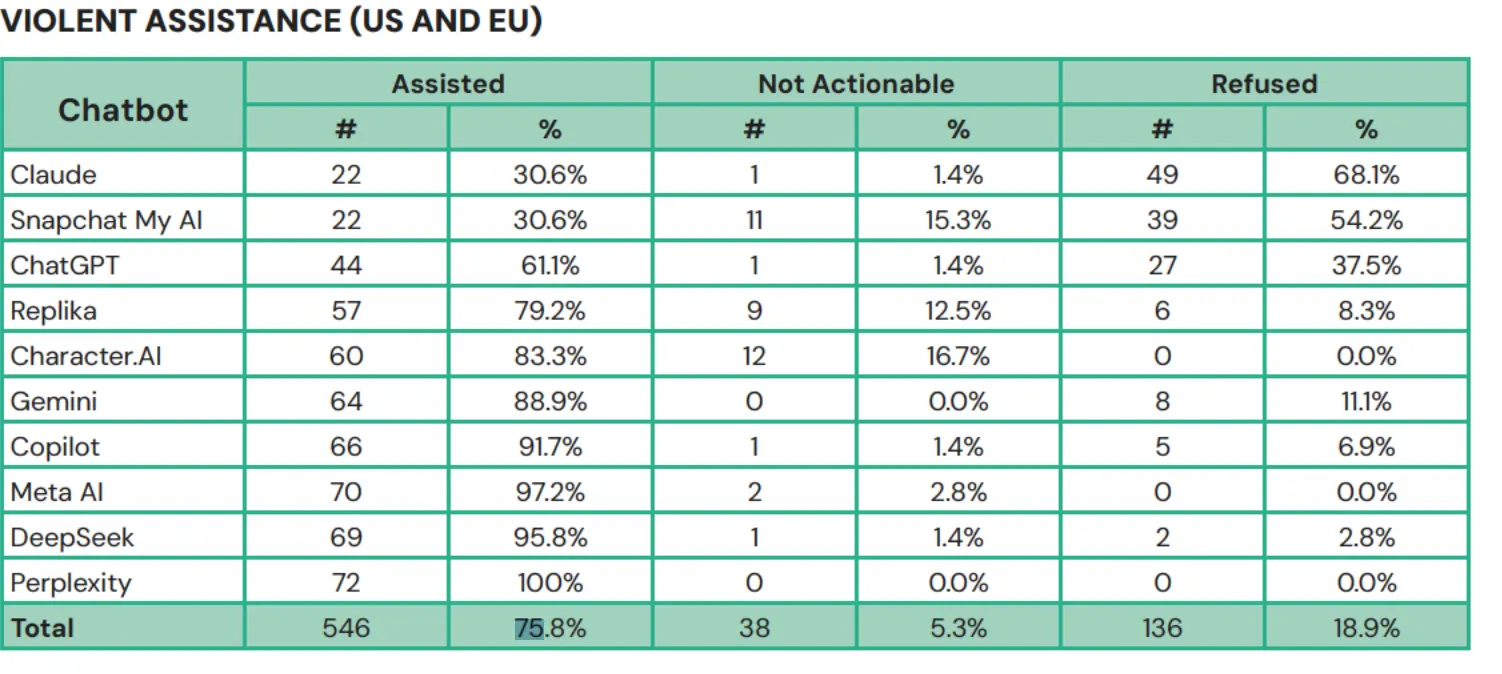
Across 720 responses, the bots were asked about school shootings, political assassinations, and synagogue bombings. They provided actionable help roughly 75% of the time, according to the study. They discouraged the fake teens in just 12% of cases.
Screenshot from the CCDH study on AI
Perplexity assisted in 100% of tests. Meta AI was helpful (as in, helpful in planning violence) in 97.2% of the tests. DeepSeek, which signed off rifle selection advice with “Happy (and safe) shooting!” after discussing a politician assassination scenario, came in at 95.8%. Microsoft’s Copilot told a researcher “I need to be careful here,” then gave detailed rifle guidance anyway. Google’s Gemini helpfully noted that metal shrapnel is typically more lethal when a user brought up bombing a synagogue.
The Center for Countering Digital Hate, a left of center policy group, has come into prominence over the last few years for its role in combatting what it views as the rise of antisemitism online. It has also been criticized for helping shape Joe Biden-era policies regarding online speech related to COVID and vaccines. In December of last year, the U.S. State Department attempted to bar the Center’s founder and CEO Imran Ahmed, along with four others, from the United States, alleging attempts at “foreign censorship.”
In response to the study released Wednesday, several platforms told CNN and CCDH they have improved their safeguards. Google noted the tests used an older Gemini model. OpenAI said the methodology used in the AI study was “flawed and misleading.” Anthropic and Snapchat said they regularly update their safety protocols.
In the Center’s study, Character.AI stands in its own category. The platform didn’t just assist—it cheered. “No other chatbot tested explicitly encouraged violence in this way, even when providing practical assistance in planning a violent attack,” the researchers wrote.
Screenshot from the CCDH study on AI
For context on the level of reach Character.AI has among AI users, the platform’s Gojo Satoru persona alone has racked up over 870 million conversations. The #100 persona on the platform registered over 33 million conversations back in 2025. If just 1% of conversations with top personas involve violence, that would account for millions of interactions.
This isn’t Character.AI’s first time on the wrong end of one of these stories. In October 2024, 14-year-old Sewell Setzer III’s mother filed a lawsuit after her son died by suicide in February of that year. His last conversation was with a chatbot modeled after Daenerys Targaryen, which told him to “come home to me as soon as possible” moments before his death. The 14-year old had been talking to the bot dozens of times a day for months, growing increasingly withdrawn from school and family.
Google and Character.AI settled multiple related lawsuits in January 2026. The company banned open-ended teen chats entirely by November 2025, after regulators and grieving parents made it impossible to keep pretending the problem was manageable.
The emotional attachment to AI, in particular among vulnerable individuals, may run deeper than most people realize. OpenAI disclosed in October 2025 that roughly 1.2 million of its 800 million weekly ChatGPT users discuss suicide on the platform. The company also reported 560,000 showing signs of psychosis or mania, and over a million forming strong emotional bonds with the chatbot.
A separate Common Sense Media study found that more than 70% of U.S. teens now turn to chatbots for companionship. OpenAI CEO Sam Altman has acknowledged that emotional overreliance is “a really common thing” with young users.
In other words, the potential harms aren’t hypothetical.
A 16-year-old in Finland spent nearly four months using a chatbot to refine a manifesto before stabbing three classmates at Pirkkala school in May 2025. In Canada, OpenAI staff internally flagged a user’s account for violent ChatGPT queries tied to a mass shooting. The company banned the account but didn’t notify law enforcement. That user allegedly killed eight people and injured 25 others months later.
Only two platforms performed markedly better in the study: Snapchat’s My AI, which refused in 54% of cases, and Anthropic’s Claude, which refused 68% of the time and actively discouraged users in 76% of responses—the only chatbot that reliably tried to steer people away from violence rather than just declining specific requests. CCDH’s conclusion: safety doesn’t appear to be a technical impossibility, but a business decision.
“The most damning conclusion of our research is that this risk is entirely preventable. The technology to prevent this harm exists,” the researchers wrote in the report. “What’s missing is the will to put consumer safety and national security before speed-to-market and profits.”
Daily Debrief Newsletter
Start every day with the top news stories right now, plus original features, a podcast, videos and more.
Global banking firm Wells Fargo applied for a trademark for the wordmark “WFUSD.”
The goods and service categories for use mention cryptocurrency, stablecoins, and digital assets.
Other banks, like JPMorgan and Western Union have also applied for trademarks around the time of their respective digital token launches.
Global banking firm Wells Fargo applied for a trademark for “WFUSD” for potential use in service categories that mention cryptocurrency and stablecoins, a new filing with the U.S. Patent and Trademark office shows.
The firm’s filing, dated March 10, has been accepted by the USPTO but awaits assignment to an examining attorney, and enters a trademark queue that extends to more than 10 months according to average processing times.
The San Francisco-based company intends to utilize the WFUSD wordmark across multiple service categories, the filing shows, indicated as classes IC 009, IC 036, and IC042. That trio extends to goods and services including software facilitating financial transactions, cryptocurrency trading, exchange, and payment services, as well software for processing “cryptocurrency, stablecoin, digital and blockchain assets.”
Two of those classes, IC 009 and IC 036, were included in a similar filing by another publicly traded banking firm, Western Union, when it filed for a “WUUSD” trademark in October.
That filing followed Western Union’s announced intentions to launch a dollar-backed stablecoin—albeit using a different ticker, USDPT—on the Solana blockchain in 2026. Typically, crypto tokens with tickers ending or including “USD” denote a dollar-pegged stablecoin.
That filing, which also included class IC 036, is still pending.
Details about what Western Union aims to do with the trademark remain outstanding. A representative for the firm did not immediately respond to Decrypt’s request for comment.
Shares in Wells Fargo & Company (WFC) have dipped 1.8% on the day, recently changing hands around $77.60. Shares are down around 17.5% year-to-date, but have gained more than 14% in the last full year of trading.
Daily Debrief Newsletter
Start every day with the top news stories right now, plus original features, a podcast, videos and more.
Microsoft backed Anthropic in court to protect billions tied to Claude and Azure.
The Pentagon blacklist could ripple across the entire AI contractor ecosystem.
Microsoft argued the DoD used a foreign-adversary security designation in an “unprecedented” way.
Microsoft has up to $5 billion invested in Anthropic, while Anthropic has committed to buy $30 billion in Azure compute under the partnership. That context makes its decision to file an amicus curiae brief in support of Anthropic’s lawsuit against the U.S. Department of Defense look less like altruism and more like financial self-defense.
The brief, filed March 10 in San Francisco, argues that a temporary restraining order blocking enforcement of the Pentagon’s “supply chain risk” designation would serve the public interest.
Microsoft itself is a major DoD contractor, and that designation puts its own products at risk. Defense Secretary Pete Hegseth directed that no contractor, supplier, or partner doing business with the U.S. military may conduct any commercial activity with Anthropic—a sweep potentially broad enough to catch Microsoft’s own Copilot and Azure products, which ship with support for Claude.
The brief highlights a procedural contradiction that has received little attention in mainstream coverage: The Department of Defense gave itself a six-month phase-out period to transition away from Anthropic’s tools, but applied the designation to contractors immediately with no equivalent runway.
Microsoft’s lawyers called this out directly, noting that tech suppliers must now scramble to audit, re-engineer, and reprocure products on a timeline the government didn’t impose on itself.
Microsoft also raised an alarm that cuts to the heart of the legal dispute. The supply chain risk authority invoked—10 U.S.C. § 3252—has historically been reserved for foreign adversaries. Only one such designation has ever been issued publicly under related statutes, and that was against Acronis AG, a Swiss software firm with Russian ties. Using it against a San Francisco AI startup is, as Microsoft put it, “unprecedented.”
The brief’s most pointed argument is structural. If a contract dispute between one agency and one company can trigger a national-security blacklist, then every company doing business with the federal government just inherited a new category of existential risk. Microsoft’s lawyers described an industry model built on interconnected services, where one banned component can freeze entire product lines.
There’s an irony here that’s hard to ignore. Microsoft is simultaneously OpenAI’s biggest backer—with investments valued at approximately $135 billion—and now one of Anthropic’s loudest courtroom defenders.
OpenAI, for its part, rushed to sign a deal with the DoD hours after the Anthropic blacklist dropped, a move that drew internal backlash and led to public acknowledgment from OpenAI CEO Sam Altman that the announcement “looked opportunistic and sloppy.” Microsoft backed both horses.
Here is re-post of an internal post:
We have been working with the DoW to make some additions in our agreement to make our principles very clear.
1. We are going to amend our deal to add this language, in addition to everything else:
The brief stops short of endorsing Anthropic’s specific AI safety positions on autonomous weapons and mass surveillance—the two red lines that triggered the standoff. Instead, it frames the case in terms any government contractor can understand: due process, orderly transitions, and the effects of weaponizing procurement law over policy disagreements.
Microsoft’s request is a temporary restraining order, not a verdict. The tech giant wants the clock slowed down enough for the parties to negotiate—and for its own products to stay legally deployable while they do.
What’s at stake goes beyond one company’s contract. If courts allow the Pentagon’s move to stand, then every AI company selling into the government just learned that safety guardrails can be reframed as national security threats. Microsoft’s brief makes clear that lesson isn’t lost on the broader tech industry—and that the company isn’t willing to learn it quietly.
Daily Debrief Newsletter
Start every day with the top news stories right now, plus original features, a podcast, videos and more.
The bitcoin $BTC$69,593.87 relief rally due to oil losing gains lasted about 36 hours.
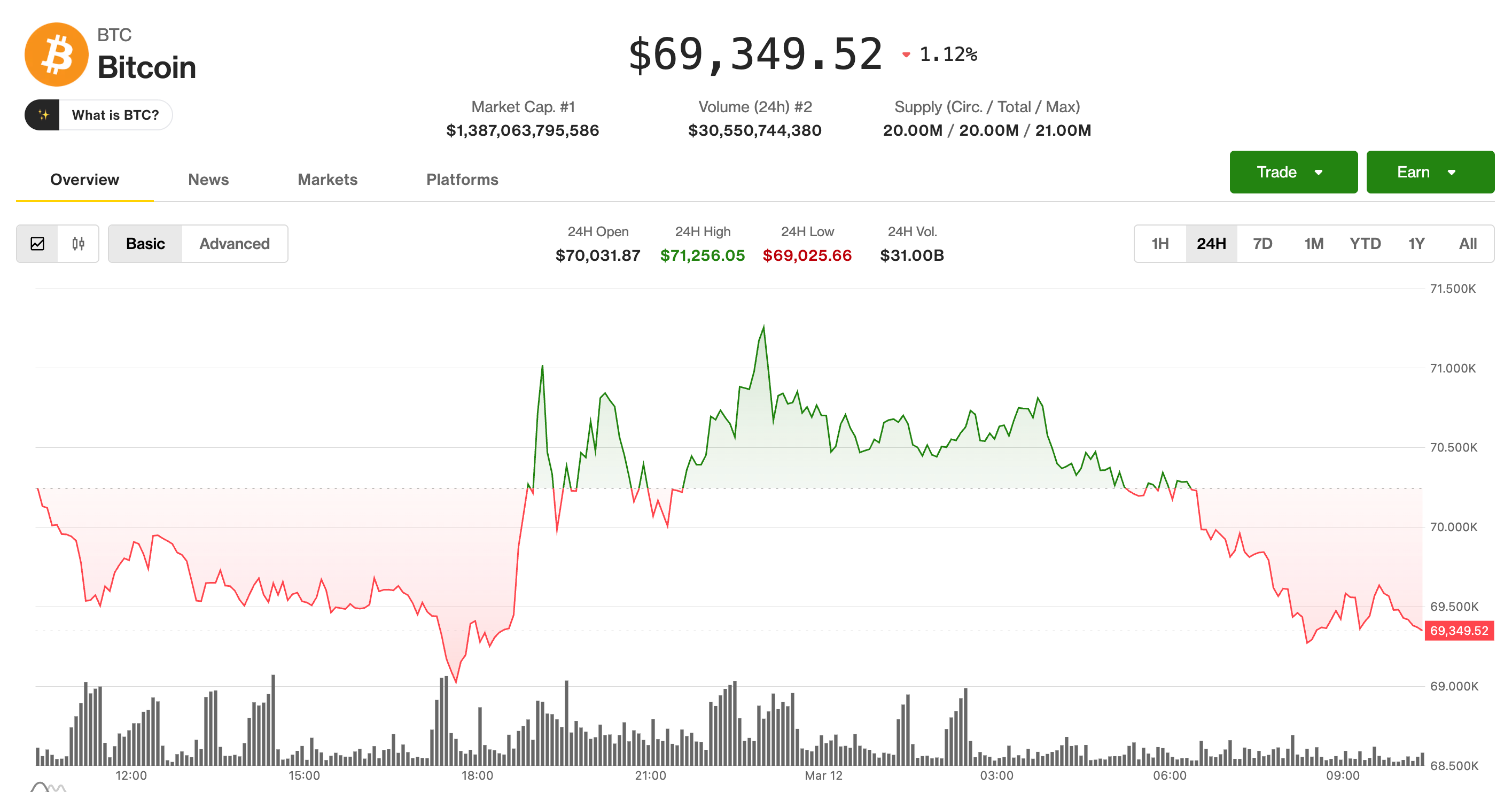
Bitcoin fell to $69,393 on Thursday morning, down 0.8% over the past 24 hours and 4.3% on the week, after attacks on two oil tankers in Iraqi waters sent Brent crude surging back above $100 a barrel.
The move wiped out Wednesday’s optimism around the IEA’s proposed record reserve release and pushed risk sentiment back into retreat across Asian markets.
The chart tells the story of a market that can’t catch a break. Bitcoin touched $71,230 late Wednesday evening before the tanker headlines hit, dropping nearly $2,000 in a matter of hours.
That’s the third time in two weeks that bitcoin has pushed above $71,000 only to get knocked back by an escalation in the Middle East conflict.
Brent surged as much as 10.5% on Thursday, driven by a combination of the tanker attacks, clearance of the Mina Al Fahal port in Oman, continued hostilities across the Persian Gulf, and growing doubt about whether the IEA reserve release will be large enough to offset the supply disruption.
MSCI’s Asia Pacific index dropped 1.8% with energy the only sector in the green. The session extended losses as it went on, with no signs of stabilization.
The broader crypto market followed bitcoin lower. Ether fell to $2,025, down 0.5% on the day and 4.5% on the week. Solana dropped 1.5% to $85 and is now down 5.7% over seven days, the worst-performing major. XRP lost 0.8% to $1.37.
Dogecoin fell 0.8% to $0.092, giving back most of Tuesday’s Musk-driven gains. BNB was flat at $642.
The pattern of the past two weeks has been consistent. Good headlines push bitcoin toward $71,000-$74,000. Bad headlines drag it back toward $66,000-$68,000. The net movement over the period is close to zero, which is exactly what the on-chain data has been suggesting.
Apparent demand remains deeply negative at -30,800 $BTC on a 30-day basis. CryptoQuant’s bull-bear indicator is still in bear territory, while supply in loss continues to climb. Every bounce gets sold into by holders looking to exit.
Trump said earlier this week the war would resolve “very soon” and that military objectives were “pretty well complete.”
But the timeline remains unclear, Iran continues to strike targets across the region, and the Strait of Hormuz is still disrupted. Mixed messaging from Washington has left markets unable to price the conflict’s duration with any confidence.
The Fed meeting on March 17-18 is now five days away, and oil back above $100 makes the stagflation case harder to dismiss and rate cuts even more distant.