Category: Business

  • Ethereum Founder Vitalik Buterin Wants Running a Node to Feel Less Like Rocket Science

    Ethereum Founder Vitalik Buterin Wants Running a Node to Feel Less Like Rocket Science

    In brief

    • Buterin says running two separate Ethereum clients adds unnecessary complexity for independent validators.
    • The Nimbus team recently merged both clients into a single, easier-to-run program.
    • Ethereum’s multi-client design is intentional—the network penalizes validators more heavily for failures that affect many nodes at once.

    Ethereum co-founder Vitalik Buterin wants there to be fewer moving parts for aspiring network validators to juggle.

    He recently commented on a Nimbus “Unified Node” pull request from the Status-im team, which would combine two separate Ethereum software components into a single, easy-to-run program.

    “Running two daemons and getting them to talk to each other is far more difficult than running one daemon,” Buterin wrote on X. “Our goal is to make the self-sovereign way of using Ethereum have good UX. In many cases, that means running your own node. The current approach to running your own node adds needless complexity.”

    The separate Beacon and execution clients were introduced during the Ethereum “merge” in 2022, when the network switched from using the energy-intensive proof-of-work consensus to proof-of-stake.

    Running an Ethereum node requires users to keep two separate background programs, called daemons, running on their computer simultaneously. The validators need to make sure they’re properly configured to talk to each other. What the Nimbus team built, and what Buterin is praising, collapses those two programs into one.

    “Longer-term, we should be open to revisiting the whole architecture,” Buterin added.

    On a proof-of-stake network like Ethereum, validators need to use hardware and software clients to verify transactions on the blockchain. Those blocks of transactions get added to the ledger and become the source of truth about how much ETH is held in wallets, and whether coins have been spent.

    Buterin has advocated for making the node operator process more accessible for years, equating better UX with validator diversity. It came up in 2024 after Elon Musk, who had recently bought Twitter for $44 billion and renamed it X, asked the Ethereum co-founder why he hadn’t been using the platform much.

    He responded by using the platform to share a blog post advocating for validator decentralization, citing concerns about large-scale Ethereum staking pools running nodes on the same hardware and experiencing the same downtime. For that reason, he argued, they should face steeper financial penalties.

    Daily Debrief Newsletter

    Start every day with the top news stories right now, plus original features, a podcast, videos and more.

  • Argentina blocks access to Polymarket after early bets on February inflation

    Argentina blocks access to Polymarket after early bets on February inflation

    Authorities in Argentina have ordered a nationwide block on the prediction market platform Polymarket following a ruling by Buenos Aires Judge Susana Parada on March 16, reporting from Clarín indicates.

    Argentina’s ENACOM, which oversees telecoms, broadcasting, internet, radio, and postal services, is tasked with implementing the national measure through ISPs and app stores, preventing access to the platform on both Android and iOS.

    The decision follows Polymarket’s accurate prediction of February inflation data ahead of INDEC’s publication, which has drawn scrutiny from authorities and journalists.

    Data analysis highlighted small but unusually timed wagers from accounts that normally trade minimal amounts, raising suspicions of insider activity.

    According to Clarín, complaints from LOTBA (Buenos Aires City’s lottery authority) and CASCBA (the national gambling industry association), supported by investigations by FEJA (the city’s gambling prosecutor) and CIJ (the technical investigative branch of the Public Prosecutor’s Office), found that the platform operated as an unauthorized online betting system.

    The court highlighted that Polymarket allowed easy account creation, accepted crypto assets and credit cards, and lacked age verification, increasing risks for minors.

    While some praise the move as protecting users, critics warn it may limit access to global prediction tools, making Argentina the second Latin American country to impose a full ban.

    Colombia became the first country in Latin America to ban Polymarket after its gambling regulator, Coljuegos, declared the platform illegal to operate without a license in September 2025 and instructed ISPs to block access.

    Disclosure: This article was edited by Vivian Nguyen. For more information on how we create and review content, see our Editorial Policy.

  • According to Some Economists, the Fed May Raise Interest Rates This Year: What Are the Expectations?

    According to Some Economists, the Fed May Raise Interest Rates This Year: What Are the Expectations?

    The volatility created in global energy markets by the war with Iran in the Middle East could complicate the Fed’s interest rate cut plans. Rising oil and natural gas prices, creating new pressure on inflation, have significantly weakened expectations for an interest rate cut.

    Economists expect the Fed to keep its policy interest rate unchanged at its March 18 meeting. However, many analysts had previously predicted a first rate cut in June. The war with Iran, however, has rapidly increased energy prices, leading to a reassessment of these predictions. According to Wall Street analysts, the increase in energy costs could lead to price increases in many areas, including transportation, food, and utilities.

    This situation presents a difficult balance for the Fed. On the one hand, the central bank is trying to bring inflation down to its target level of 2% annually, while on the other hand, it has to support a labor market that is showing signs of slowing. The Personal Consumption Expenditures (PCE) index, one of the inflation indicators most closely watched by the Fed, which was released on March 13, showed that prices continued to rise in January. It is noteworthy that this increase occurred before the full impact of the Iran war was felt in energy markets.

    According to CME FedWatch data, which is based on futures markets, there is a 99% probability that the Fed will keep interest rates unchanged at 3.5%–3.75% at its March 18 meeting. The same tool calculates a 95% probability that the Fed will not change rates at its April 30 meeting, and a 77% probability at its June meeting. A month ago, these probabilities were 70% and 31%, respectively.

    Due to rising energy prices, some economists believe the Fed may not cut interest rates at all this year. EY-Parthenon Chief Economist Gregory Daco stated that they have revised their baseline scenario due to rising inflation expectations, now forecasting only a single 25 basis point rate cut in 2026, likely in December. According to Daco, the possibility of the Fed not cutting rates at all in 2026 cannot be entirely ruled out.

    Some analysts go even further, suggesting that the Fed might even raise interest rates in 2026 to control inflation. Sonu Varghese, Chief Macro Strategist at Carson Group, stated that current conditions are already challenging for the Fed, and that if inflationary pressures increase, the central bank might begin discussing rate hikes later in the year instead of cutting them.

    Another problem facing the Fed is the weakening labor market. In February, employers in the U.S. laid off 92,000 people, a development considered unexpected by economists. PNC economist Gus Faucher noted that the labor market has been gradually weakening in recent years and that inflation continues to run higher than the Fed would like.

    According to Faucher, the fundamental dilemma for the Fed is this: cutting interest rates to support the labor market could accelerate inflation again, while keeping interest rates stable could lead to further weakness in the labor market.

    On the other hand, the future leadership of the Fed is also a subject of debate. Gregory Daco stated that if Kevin Warsh is confirmed as Fed chairman, he will need to demonstrate that his monetary policy views are based on economic rather than political grounds.

    *This is not investment advice.

  • ‘Operation Atlantic’: US Secret Service Teams With UK, Canada to Stop Crypto Fraud

    ‘Operation Atlantic’: US Secret Service Teams With UK, Canada to Stop Crypto Fraud

    In brief

    • The U.S. Secret Service is working with authorities in the United Kingdom and Canada to stop crypto fraud.
    • Dubbed “Operation Atlantic,” the agencies will work together to try and stop “approval phishing” or “pig butchering” scams that are often tied to crypto.
    • More than $17 billion was stolen in crypto crimes last year alone, per a Chainalysis report.

    Law enforcement agencies across three countries are teaming up to try and stop crypto fraud schemes in their tracks. 

    Authorities in the United States, United Kingdom, and Canada will collaborate on “Operation Atlantic,” a joint international initiative to identify and squash “approval phishing” scams, which are sometimes referred to as “pig butchering.”

    In these scams, individuals are often tricked into a romantic relationship online before the victim gives access to their funds to a malicious actor. 

    “Approval phishing and investment scams cost victims millions in financial loss each year,” said Deputy Assistant Director for the U.S. Secret Service’s Office of Field Operations Brent Daniels, in a statement. 

    “During Operation Atlantic, the U.S. Secret Service, alongside our international law enforcement partners, will identify and disrupt these scams in near real-time denying criminals the ability to further profit from their crimes,” he added.

    The Secret Service will work in tandem with the U.K. National Crime Agency and the Ontario Provincial Police, Ontario Securities Commission, among others in public and private services.

    “Approval phishing scams are becoming increasingly sophisticated. Operation Atlantic is designed to protect the public by warning people early and helping them secure their assets,” said Deputy Director of Cyber at the UK’s National Crime Agency Paul Foster in a statement. “This joint international operation further enhances our strong partnerships. Criminals operate across borders, so our response must do the same.”

    The trio’s collaboration follows the launch of “Operation Atlas,” a similar operation led by Canadian authorities beginning in 2024. 

    “Project Atlas demonstrated the power of coordinated disruption,” said Detective Superintendent Jennifer Spurrell, director of the Financial Crimes Services Bureau at the Ontario Provincial Police, in a statement. “We’re proud to be part of Operation Atlantic, which builds on that approach by uniting international partners to take action in real time.” 

    Pig butchering scams have been on the rise since 2020, and more than $17 billion was estimated to be stolen in crypto crimes in 2025 alone, according to analytics firm Chainalysis.

    The new task force is just the latest law enforcement attempt to curb those massive losses. In November, the U.S. Department of Justice launched an interagency Scam Center Strike Force designed to “dismantle international pig butchering crypto scams tied to Chinese crime networks.”

    Daily Debrief Newsletter

    Start every day with the top news stories right now, plus original features, a podcast, videos and more.

  • Trump-Backed World Liberty Puts $5.3 Million Price Tag on ‘Guaranteed Access’ to Team

    Trump-Backed World Liberty Puts $5.3 Million Price Tag on ‘Guaranteed Access’ to Team

    In brief

    • Investors that stake $5 million worth of WLFI will earn “guaranteed access” to members of the World Liberty Financial Team.
    • Moving forward, investors will need to lock up their tokens for at least 180 days to participate in the project’s governance project.
    • Last week, the team behind the president’s meme coin teased an exclusive dinner at Mar-a-Lago with President Donald Trump for top holders.

    World Liberty Financial, the decentralized finance project backed by U.S. President Donald Trump and his sons, approved a measure on Friday that allows big-time investors to access members of its team based on their financial alignment.

    The shift stems from a governance vote that concluded last week, in which 99% of participants voted in favor of changes centered around World Liberty Financial’s native token and USD1, a $4.5 billion stablecoin unveiled by the project nearly a year ago.  (Disclosure: Myriad, a prediction market operated by Decrypt’s parent company Dastan, recently adopted USD1 as its “exclusive settlement asset.”)

    Under a three-tiered framework, the measure establishes so-called super nodes, which gain “guaranteed access to the WLFI team for partnership discussions.” In order to attain that status, investors need to lock up 50 million WLFI tokens for a minimum of 180 days.

    The access entails facetime with WLFI’s business development team and executives, “not to specific founders,” WLFI spokesperson David Wachman told Reuters. Eric Trump, Donald Trump Jr., and Barron Trump are listed as co-founders in the project’s “gold paper,” as well as two sons for Steve Witkoff, Trump’s special envoy to the Middle East.

    With WLFI recently changing hands around $0.106 on Monday, securing super node status would cost roughly $5.3 million, according to data from CoinGecko. When the token was valued at a peak of 33 cents in September, becoming a super node would cost more than $15 million. WLFI is up about 3% over the last day, close to the broader rise in the crypto market during that span.

    In the governance forum, WLFI described the threshold as a “filter to prioritize projects and platforms that are actively supporting and participating in the WLFI ecosystem, rather than those seeking partnership on a purely opportunistic basis,” while citing heightened interest.

    Investors need 10 million WLFI—about $1.06 million worth—to be eligible for the next lowest tier, which gives “nodes” the ability to exchange USD1 for other stablecoins at par via over-the-counter trades. The project said that shift is aimed at redirecting value “from a small number of intermediaries to long-term ecosystem participants,” while potentially pressuring demand for alternatives.

    When World Liberty Financial debuted in 2024, the project was billed as a way to democratize digital finance. However, the framework approved on Friday requires that “stakers” lock up their tokens for at least 180 days to participate in WLFI’s governance process.

    What’s more, the project is moving forward with restrictions for rewards for stakers. In order to be able to earn 2% annually on tokens that are locked up, investors need to participate in at least two governance votes during a specific period.

    WLFI is opening up access to its team after Rep. Ro Khanna (D-CA) launched an investigation into the Trump family’s crypto dealings. His calls in February specifically centered on a $500 million investment by a United Arab Emirates royal family member in WLFI. 

    Khanna expressed concern that the investment may have impacted the Trump administration’s decision to reverse restrictions and approved export licenses that once prevented the UAE from accessing tens of thousands of advanced AI chips.

    The Trump family’s involvement in digital assets has drawn criticism from other influential Democrats, including Sen. Elizabeth Warren, who has also expressed alarm regarding WLFI’s efforts to gain a banking charter under the supervision of federal regulators.

    “President Trump’s crypto company is now at the center of perhaps the most disgraceful presidential corruption scandal in U.S. history,” Warren said. “An American president who sells out our national security to make money for himself.”

    Last week, the team behind the president’s Solana-based meme coin—a separate project from World Liberty Financial—offered exclusive access in its own way. The team teased an event featuring the president for top TRUMP holders, which is set to take place next month at the president’s Mar-a-Lago estate in Florida.

    Daily Debrief Newsletter

    Start every day with the top news stories right now, plus original features, a podcast, videos and more.

  • IBM Opens Quantum Hardware to Researchers as Bitcoin Security Threat Looms

    IBM Opens Quantum Hardware to Researchers as Bitcoin Security Threat Looms

    IBM is expanding free access to its quantum computers, giving researchers more time with powerful hardware to run experiments as the threat of future quantum advancements hangs over the crypto industry.

    The company said Monday it is updating the IBM Quantum Open Plan, a free cloud platform that lets anyone run experiments on real quantum machines. The changes increase runtime limits, add new training resources, and allow access to one of IBM’s more advanced processors.

    “Starting today, researchers on the Open Plan who use 20 minutes of runtime within any 12-month period can opt in to a special one-time promotion and get 180 minutes of runtime for the next 12 months,” IBM said in a statement.

    IBM’s Open Plan usually gives users 10 minutes of time on a quantum computer every 28 days, which lets researchers run small experiments, test algorithms, and try simple quantum programs.

    The update comes as Bitcoin developers debate how soon quantum computing could eventually challenge the cryptography that secures the network.

    IBM is also opening access to its Heron R2 processor, called ibm_kingston—a more advanced quantum system capable of running large numbers of quantum operations quickly while keeping error rates relatively low.

    With the expanded runtime and hardware access, IBM said, researchers can run more advanced workloads, including hybrid optimization algorithms, error-mitigation experiments, and other research tied to quantum computing. IBM is also introducing a course focused on planning research programs, identifying use cases, and securing research funding.

    Over the past year, IBM has reported a series of advances aimed at scaling up its quantum systems.

    In October, IBM researchers entangled 120 qubits into a single GHZ “cat state,” demonstrating large-scale quantum entanglement. A month later, the company introduced its 120-qubit Nighthawk processor along with a roadmap targeting verified quantum advantage, when a quantum computer can outperform traditional computers, before the end of 2026.

    These advances are part of IBM’s broader roadmap, aimed at building quantum computers stable enough to correct their own errors and run complex algorithms without the noise that currently limits quantum systems. The goal is to accomplish those tasks by the end of the decade.

    “Open-access quantum computing shouldn’t just be for beginners running small circuits,” IBM said. “We want to ensure that even serious researchers can extract real value from the IBM Quantum Open Plan for serious experiments and proof of concept work. With 180 minutes of compute on our quantum hardware, you’ll be able to do that.”

    As tech giants like IBM invest more and more heavily in quantum computing, blockchain researchers are sounding the alarm about the risk involved. Bitcoin developers recently advanced a proposed framework called BIP 360 for dealing with the quantum threat, though it still must undergo a formal review.

    “The argument about whether quantum is real or whether we should take it seriously is something I tend not to engage with much, because I think long-term reality will make that argument,” cryptographer and BIP 360 co-author Ethan Heilman told Decrypt.

    “What we’re trying to do is marshal the people who do believe it’s important to get everything set up—to think through all the issues and get the software ready—because by the time it becomes real, we’ll have won the argument and we’ll also be ready to implement,” he said.

    Even so, the timeline for a real threat remains uncertain. A recent report from Ark Invest and Bitcoin financial services firm Unchained said quantum computing poses a long-term risk to Bitcoin, not an immediate one, noting that today’s quantum machines remain far below the capability needed to break the network’s cryptography.

    IBM did not immediately respond to a request for comment by Decrypt.

  • Lido’s community staking module sharpens its edge with DVT clusters

    Lido’s community staking module sharpens its edge with DVT clusters

    Lido’s new IDVTC design lets verified solo stakers form DVT clusters, slashing collateral needs while hardening Ethereum validator risk and sustaining staking yields.

    Summary

    • IDVTC groups four verified community stakers into one DVT-backed validator cluster, reducing single-operator failure risk.​
    • Lower collateral becomes viable as DVT makes slashing and downtime tail events instead of structural threats.
    • Launch with CSM v3 in Q2–Q3 2026 positions Lido against rival restaking and LST platforms on resilience instead of raw TVL.

    Lido’s community staking module is about to stop pretending this is still a game for whales only. A new proposal to introduce an “Identified DVT Cluster” (IDVTC) operator type would let verified independent stakers pool into distributed validator clusters, cutting collateral requirements while hardening the protocol’s weakest link: operational risk.

    You might also like: BTC traders brace for $2B liquidation risk as market hovers near key levels

    Under the plan, each IDVTC cluster consists of four independent community stakers, all running validators via Obol or SSV with keys created through distributed key generation (DKG). In practice, that means no single operator can take a validator down, mis‑configure a client, or disappear without the rest of the cluster absorbing the shock. Distributed validator technology (DVT) spreads duties and key shares across multiple nodes, so slashing and downtime events become outliers instead of structural risk.​

    Because the risk profile improves, Lido can justify lowering collateral requirements for these operators. That is the capital-efficiency play: you move from over‑collateralized, quasi‑professional setups to leaner independent operators whose main constraint is competence, not balance sheet size. For Lido, this broadens the operator base without opening the door to pure anon fly‑by‑night nodes, since IDVTC membership is restricted to verified Independent Community Stakers (ICS) who pass onboarding checks.​

    Timing matters. The IDVTC feature is targeted for launch with CSM v3 in Q2–Q3 2026, squarely into the next phase of Ethereum’s staking cycle and a more competitive liquid staking market. Restaking, AVSs and competing LSTs are already bidding for the same underlying validator set. Bring down collateral, keep slashing risk contained, and you have a better story for decentralization and yield sustainability than “more TVL, same handful of operators.”​

    If executed, IDVTC pushes Lido closer to a model where independent stakers look more like a distributed credit book: risk‑tiered, clustered, and modular. For investors, the signal is simple: Lido is trying to buy resilience and decentralization with better engineering instead of higher issuance. In a market where basis trades and ETF flows are already compressing staking spreads, that is the only credible way to keep the yield machine running without blowing up the tail risk.

    Read more: Ethereum price prediction $2.8K as bulls defend key levels and $1.8B in long liquidations

  • Etherfuse Launches Low-Cost Dollar-Peso FX

    Etherfuse Launches Low-Cost Dollar-Peso FX

    Etherfuse, a blockchain infrastructure company focused on tokenized bonds, has launched Etherfuse FX, a new platform for fast currency conversion between US dollars and Mexican pesos. The company says the system can reduce conversion costs by up to 90% for businesses that regularly move money between the United States and Mexico.

    For Mexican peso exposure, the system uses tokenized CETES, short-term government treasury bonds issued by Mexico. According to the company, this structure is designed to provide the type of asset backing familiar to institutional finance while improving transaction speed and efficiency.

    The solution is aimed at companies that frequently work with multiple currencies. This includes remittance services, payment processors, B2B software providers, and import-export businesses operating between the US and Mexico.

    Businesses can connect to Etherfuse FX through standard APIs that integrate with existing payment and accounting systems. The company says most integrations can be completed within two to three weeks.

    Image: Freepik

  • You Can Control an AI Agent’s Crypto Spending With Ledger Hardware Wallets and MoonPay

    You Can Control an AI Agent’s Crypto Spending With Ledger Hardware Wallets and MoonPay

    In brief

    • Ledger now supports hardware wallet signing for MoonPay Agents transactions.
    • Users must approve each transaction while AI agents execute trades and transfers.
    • MoonPay launched its AI agent infrastructure in February.

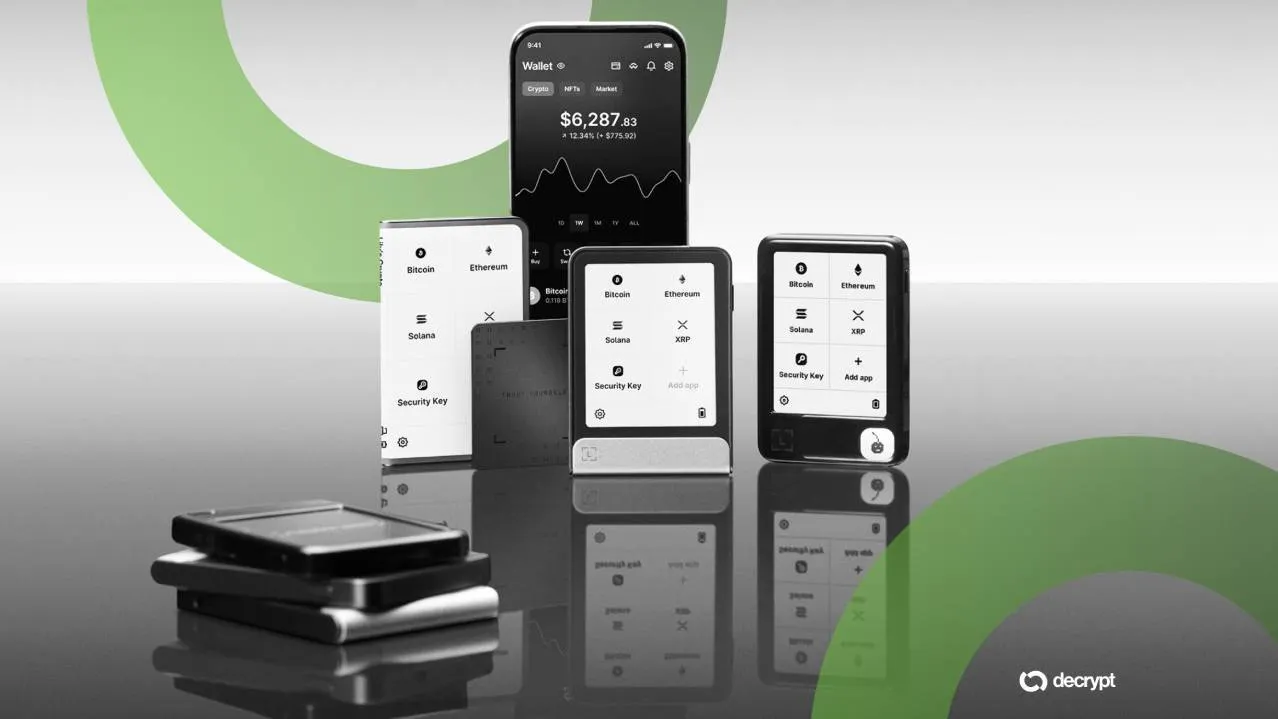
    Ledger has added hardware wallet support for MoonPay Agents, allowing human users to verify and sign transactions initiated by their deployed AI agents, MoonPay announced on Friday.

    The announcement comes as the crypto industry has embraced artificial intelligence in the form of autonomous AI agents. The Ledger integration routes agent-generated trades, swaps, and transfers through a secure signer that requires manual approval on the hardware wallet.

    “The Ledger integration is just the beginning. We plan to support additional hardware wallets and look forward to collaborating with more partners across the ecosystem,” MoonPay CEO Ivan Soto-Wright told Decrypt. “Any developer building an agent that needs to move value can plug MoonPay in as the financial rail across trading, gaming, commerce, treasury, and beyond.”

    MoonPay Agents support Ledger Nano S Plus, Nano X, Nano Gen5, Stax, and Flex devices. According to MoonPay, agents can detect and interact with wallets on blockchains including Ethereum, Solana, Optimism, Avalanche, and Base.

    Automatic Ledger app switching lets an agent move across blockchain networks, MoonPay explained. Swaps, bridges, and transfers all routes through the Ledger signer for on-device approval.

    “There is a new wave of CLI and agent-centric wallets emerging, and these will need Ledger security as a feature, too,” Ledger Chief Experience Officer Ian Rogers said in a statement.

    AI agents are gaining traction in crypto trading, as developers including Eliza Labs, Fetch AI, and Coinbase build systems that can send, receive, and manage digital assets autonomously. MoonPay launched its Agents software in February to give AI systems access to crypto wallets and the ability to execute transactions.

    However, giving your cryptocurrency to an AI comes with risk, and security has been an ongoing concern as agents remain susceptible to cyber attacks like prompt injection attacks.

    “Today, most agents with wallets just have a private key sitting on disk somewhere, and you’re already seeing those wallets get exploited, or people lose access when agents make mistakes,” Erik Reppel, head of engineering for Coinbase Developer Platform, previously told Decrypt.

    Daily Debrief Newsletter

    Start every day with the top news stories right now, plus original features, a podcast, videos and more.

  • ShapeShift founder Erik Voorhees doubles down on Ethereum with $49M investment: Onchain data

    ShapeShift founder Erik Voorhees doubles down on Ethereum with $49M investment: Onchain data

    ShapeShift founder and Bitcoin pioneer Erik Voorhees is continuing his Ethereum buying spree after restarting purchases following a year-long break.

    According to on-chain data tracked by Lookonchain, Voorhees on Sunday spent around $49 million acquiring 23,393 $ETH. He still holds over 35 million $USDT and is expected to buy more $ETH.

    Erik Voorhees(@ErikVoorhees), an early #Bitcoin supporter and founder of ShapeShift, is buying $ETH like crazy after a one-year break!

    He spent 49.08M $USDT to buy 23,393 $ETH at $2,098 through 2 wallets.

    He still holds 35.25M $USDT and may buy more $ETH.… pic.twitter.com/18ifLc8Ghe

    — Lookonchain (@lookonchain) March 16, 2026

    The prominent entrepreneur, who also founded Venice AI, reportedly resumed his $ETH purchases earlier this year after selling 12,886 $ETH at over $3,300 each.

    Erik Voorhees(@ErikVoorhees), an early #Bitcoin supporter and founder of ShapeShift, is buying back $ETH after a one-year break.

    One year ago, he sold 12,886 $ETH($42.83M) at $3,324.

    In the past 5 days, he has spent 17.75M $USDT to buy back 8,576 $ETH at $2,069.

    He still holds… pic.twitter.com/zTD1DdU6WU

    — Lookonchain (@lookonchain) March 15, 2026

    The activity was linked to wallets believed to be controlled by Erik Voorhees and labeled as such by Arkham Intelligence. He has not confirmed that he controls them.

    The latest transfers came as $ETH surpassed $2,200, representing a 7% increase in the last 24 hours, CoinMarketCap data shows.

    The crypto market rallied over the weekend, pushing total market capitalization up about 3% to $2.5 trillion. Bitcoin advanced 2.5% to retake $73,500.

    Disclosure: This article was edited by Vivian Nguyen. For more information on how we create and review content, see our Editorial Policy.