Category: Business

  • Gemini Faces Class-Action Suit Over Prediction Market Pivot, Plummeting Stock Price

    Gemini Faces Class-Action Suit Over Prediction Market Pivot, Plummeting Stock Price

    In brief

    • Gemini is being sued by shareholders for allegedly misleading investors and hiding its pivot to prediction markets.
    • Founders Tyler and Cameron Winklevoss are accused of overstating the viability of Gemini’s crypto business.
    • The lawsuit links these claims to the company’s sharp stock decline.

    Crypto exchange Gemini is facing a class action lawsuit from shareholders who claim the company illegally failed to disclose its pivot into prediction markets—and overstated the viability of its struggling core business.

    The federal suit, filed this week in the Southern District of New York, alleges Gemini and its founders, Tyler and Cameron Winklevoss, materially misled investors in the build-up to taking the company public last fall.

    Gemini “overstated the viability of its core business as a crypto platform” and “overstated its commitment to and/or the viability of growing its business through expanding its international operations,” the lawsuit claims.

    The shareholders further argue that Gemini withheld information that would have shown the company was poised for “an expensive and disruptive restructuring.” Indeed, in February, the exchange laid off over a quarter of its staff and fully exited Europe and Australia, saying that it planned to lean on AI to boost company efficiency.

    That same day, the Winklevoss twins announced the company planned to make its new prediction market platform “front-and-center” for users. Plans for this significant pivot were also improperly concealed when Gemini went public months prior in September, the shareholders allege.

    Gemini did not immediately respond to Decrypt’s request for comment on the case.

    Since Gemini went public six months ago, the company’s stock (Nasdaq: GEMI) has lost nearly 85% of its value. In the same period, Bitcoin has shed some 40% of its price. Gemini shareholders insist the damage to Gemini’s stock has much to do with the company’s alleged failure to disclose the state of its businesses and its future plans.

    “As a result of defendants’ wrongful acts and omissions, and the precipitous decline in the market value of the company’s securities, Plaintiff and other class members have suffered significant losses and damages,” the complaint reads.

    On Thursday, Gemini shares rose nearly 7% in after-hours trading after the company reported more stable revenue streams in 2025, and signaled success from its cost-cutting efforts—though it also reported a $582.8 million net loss for 2025.

    Gemini’s stock is down 5.8% on the day Friday, as of this writing, to $5.66.

    Daily Debrief Newsletter

    Start every day with the top news stories right now, plus original features, a podcast, videos and more.

  • Can stablecoin payments reshape Visa and Mastercard strategies through 2026?

    Can stablecoin payments reshape Visa and Mastercard strategies through 2026?

    Markets weigh how stablecoin payments reshape Visa Mastercard strategies as AI rails and fintech links emerge through 2026.

    Card networks are racing to defend profits as stablecoin payments, AI agents, and new fintech rails challenge the economics of traditional credit and debit transactions.

    Card networks under pressure from markets and regulators

    The big payment groups have pulled back sharply from record highs. Visa has fallen 19%, Mastercard 18%, and American Express 23% from prior peaks, reflecting mounting disruption risks.

    The selloff is driven by two key concerns. First, President Donald Trump has floated a proposal to cap credit card interest rates at 10%, which could compress yields. Second, investors increasingly fear that stablecoin rails may erode the card industry business model.

    Stablecoin technology allows merchants to settle transactions faster and at lower cost than on legacy card systems. This potential shift has unsettled markets. However, the incumbents are not simply defending their turf; they are retooling their strategies to plug into the new infrastructure.

    Mastercard’s record crypto move and Visa’s AI-enabled rails

    Mastercard is leaning in with its largest crypto acquisition to date. The company agreed to purchase BVNK, a specialist in stablecoin infrastructure, in a deal worth up to $1.8 billion, marking the biggest stablecoin-focused transaction on record.

    Keefe, Bruyette & Woods analyst Sanjay Sakhrani called the acquisition “a critical, long-term strategic move” that positions Mastercard as a conduit between traditional card rails and emerging blockchain-based settlement systems.

    Visa is also executing an aggressive pivot. Its contactless payment stack, which can integrate on-chain settlement, now accounts for 80% of all in-person transaction volume worldwide. Moreover, Visa launched Visa CLI, a command-line interface that lets artificial intelligence agents trigger card payments directly through terminal environments.

    AI agents and the Machine Payments Protocol

    The competitive landscape is expanding beyond card issuers. This week, Stripe and blockchain startup Tempo unveiled the Machine Payments Protocol, an open standard designed so AI systems can autonomously buy services such as APIs, data streams, and compute capacity.

    The protocol batches numerous micro-transactions into consolidated settlements on a blockchain. That said, its launch underscores how programmable money could bypass legacy billing flows if adoption scales among developers and enterprises.

    Tempo raised $500 million at a $5 billion valuation in October 2025. Chief executive Matt Huang, a Paradigm co-founder who also sits on Stripe’s board, is positioning the company as a core infrastructure provider for autonomous commerce.

    Early supporters of the protocol include Anthropic, OpenAI, DoorDash, Shopify, Revolut, plus both Visa and Mastercard. In this context, the card rivals are acting as collaborators, seeking relevance inside the next generation of machine-driven payments.

    Scale of agentic commerce and stablecoin volumes

    Morgan Stanley forecasts that agent-driven online buying could represent $385 billion of U.S. e-commerce by 2030, highlighting the potential size of autonomous transaction flows. Moreover, on-chain settlement is already large today.

    Stablecoin transfer volume hit $33 trillion in 2025, expanding 72% year over year. This explosive growth reinforces why traditional issuers view stablecoin payments as both a strategic threat and an integration opportunity.

    Interchange fees and the risk of AI-driven disintermediation

    A February 2026 note from Citrini Research warned that AI agents, optimized to minimize transaction costs, could systematically avoid card rails. They may target the 2–3% interchange fees charged by Visa and Mastercard and instead route flows over networks where costs are fractions of a cent.

    Visa processed $17 trillion in annual volume, underscoring how even small share losses could be material. However, the valuation backdrop already reflects some of this risk, with earnings multiples compressing from historical peaks.

    At present, Mastercard and Visa trade at around 24x and 22x forward earnings respectively, both below their long-run averages. American Express sits near 16x forward earnings, further illustrating the sector’s de-rating as digital alternatives gain traction.

    Profit outlook and revenue trajectory for 2026

    Despite macro headwinds, analysts have nudged their 2026 earnings expectations higher. Wall Street now projects low-teen percentage growth in sector-wide earnings per share, supported by close to 10% revenue expansion.

    Combined revenue for the group is projected to climb toward $163 billion in 2026. Moreover, investors expect the big processors to lean on pricing power, cross-border volume, and technology partnerships to sustain that growth even as new rails emerge.

    Stripe’s expanding role in payment infrastructure

    Stripe itself is becoming a direct competitor to the card networks in infrastructure control. The company processed $1.9 trillion in payment volume during 2025, underscoring its scale as an internet-native processor.

    To deepen its blockchain capabilities, Stripe acquired stablecoin specialist Bridge for $1.1 billion. This crypto acquisitions deal reflects a strategy to embed programmable settlement directly into its platform rather than paying card networks for access to their systems.

    As chief executive Matt Huang noted, “agentic payments is very early, and we still are figuring out the best way to structure these.” However, as frameworks like the Machine Payments Protocol mature, they may push more transaction logic off traditional card stacks.

    Strategic crossroads for card networks and stablecoins

    The rise of stablecoin payments is forcing Visa, Mastercard, American Express, and Stripe to rethink how value is captured across settlement layers. Card groups are betting that partnerships, crypto integrations, and AI tooling will keep them central to digital commerce rather than sidelined by cheaper rails.

    For now, the sector still generates strong earnings and rising revenue, but pricing power and interchange economics face mounting tests. The next few years will show whether legacy networks successfully absorb blockchain innovation or whether autonomous agents and open protocols redirect a meaningful share of global transaction flows.


  • Allegations of Major Manipulation in an Altcoin Airdrop: One Person Received the Largest Share of the Tokens

    Blockchain analytics platform Bubblemaps has announced the detection of significant manipulation in the $ROBO token airdrop conducted by Fabric Protocol.

    According to the company’s findings, a single entity gained control of approximately 40% of the total tokens distributed using a method called a “syllabic attack.”

    According to Bubblemaps data, over 7,000 new wallets were created in the two months prior to the token’s launch. These wallets were found to have purchased similar amounts of Ethereum (ETH) from seven different cryptocurrency exchanges, exhibiting highly consistent on-chain behavior. It was then suggested that these funds were routed through three-tiered new wallets in an attempt to conceal the trail.

    These wallets participated in the airdrop following the $ROBO token launch on February 27th, claiming a total of approximately 199 million $ROBO tokens. This amount reportedly represents 40% of the distribution and was worth approximately $8 million at the time of launch.

    The analysis reveals that high similarities in the funding method, timing, and transfer movements of the wallets indicate that the entire operation was organized by a single entity. However, Bubblemaps added that, based on the available data, there is no evidence linking these activities to the Fabric Protocol or OpenMind teams.

    Fabric Protocol aims to develop a robotics-focused network layer powered by the OpenMind infrastructure. The project raised a total of $20 million in funding from leading investors such as Coinbase and Pantera. The $ROBO token was distributed via an airdrop at launch, representing 5% of the total supply.

    *This is not investment advice.

  • Bitcoin jumps to $70,800 as oil retreats; ether and XRP lag

    Bitcoin jumps to $70,800 as oil retreats; ether and XRP lag

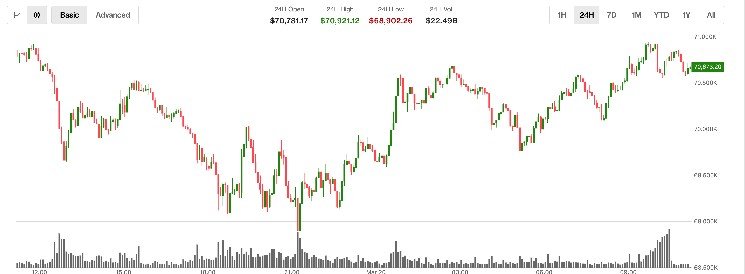
    Bitcoin $BTC$70,584.30 and the wider crypto market saw a notable price bounce on Friday after major economies announced joint efforts to boost oil supplies through the now-disrupted Strait of Hormuz.

    $BTC, the largest cryptocurrency, jumped to $70,800, up more than 1% on the day, extending its recovery from overnight lows under $68,900, according to CoinDesk data. Other major coins, including ether (ETH), $XRP ($XRP), and solana (SOL), saw smaller gains of less than 1%, lagging behind bitcoin.

    West Texas Intermediate (WTI) crude fell nearly 2% to $93.80, alongside similar losses in Brent, after Britain, France, Germany, Italy, the Netherlands, and Japan said they would take steps to stabilize energy markets and join collaborative efforts to ensure safe passage through the Strait of Hormuz. In a joint statement issued by the U.K. Prime Minister Keir Starmer’s office, leaders of these nations condemned the attacks by Iran and urged it to halt its actions immediately.

    On Thursday, U.S. Treasury Secretary Scott Bessent said the U.S. may soon remove sanctions from Iranian oil tankers and could release crude from its Strategic Petroleum Reserve.

    With the Federal Reserve expressing heightened uncertainty on growth and inflation outlooks earlier this week, traders have scaled back expectations for Fed rate cuts. That has left crypto and traditional risk assets largely at the mercy of oil price swings.

    The latest drop in oil, though positive, doesn’t end the uncertainty, as military conflict in the Middle East continues. WTI remains near recent support at $92.00, still significantly above pre-war valuations.

    “For now, WTI crude continues to hold what appears to be an increasingly important area of support. That level aligns well with prior highs and the short-term trend. As long as oil holds that support and the trend continues higher, it will likely maintain an upward bias,” Mott Capital Management said in an email to its subscribers.

    The firm added that positioning in the oil options market suggests higher levels are possible.

    Another market that bitcoin traders might want to watch is the S&P 500, Wall Street’s benchmark equity index.

    The index closed below its pivotal 200-day simple moving average (SMA) on Thursday – the first such instance since May last year – signaling a bearish shift in momentum. A potential strengthening of risk aversion in stocks could spill over into crypto and the wider financial markets.

  • Argentine Lawmakers Seek to Oust Federal Prosecutor From Leading Libra’s Probe

    Argentine lawmakers who probed the Libra incident have vowed to act against Eduardo Taiano, the prosecutor in charge of the case, after information revealed hints at a deeper relationship between President Javier Milei and Mauricio Novelli, an associate behind the token launch.

    Argentine Deputies Prepare Legal Actions To Accelerate Libra’s Case

    A group of Argentine lawmakers is preparing to take action to accelerate the Libra probe after new data linking President Milei to some individuals behind the token launch was recently made public.

    The congressional commission that investigated the Libra event is reportedly launching two complaints against Eduardo Taiano, the prosecutor in charge of the case, for not acting expeditiously, even though he had several key elements to advance the investigation.

    The first complaint accuses Taiano of hindering the Congress’s work, as he rejected a request seeking to force government officials to clarify their links to the token and did not allow the commission to access the case files that had recently been made public.

    Another complaint alleges that Taiano was covering up evidence to protect President Milei, his sister Karian Milei, and other individuals linked to the presidential group.

    Maximiliano Ferraro, former president of this commission, directly referred to Milei as a part of the Libra launch, highlighting that the Argentine president was the “protagonist and necessary participant” of a “multi-million-dollar act of corruption and of the misappropriation of the presidential office”.

    On social media, he stated that:

    “There was direct coordination between fringe operators within the crypto world and the President of the Nation’s inner circle, who leveraged his office and power to promote the cryptocurrency in exchange for payments amounting to millions.”

    Ferraro also called to request that Milei, his sister Karina, former Chief of Staff of Advisors to the President of the Nation Demian Reidel, and Milei’s advisor Santiago Caputo, disclose their communications with Mauricio Novelli on Libra’s launch day.

    In addition, they will also promote a possible interpellation of Manuel Adorni, Chief of the Cabinet of Ministers, and Secretary Karina Milei.

    All indicates that the case is facing a breaking point, and that Taiano is at the center of it.

    FAQ 🧭

    • Why are Argentine lawmakers accelerating the Libra cryptocurrency probe? They are taking action after new data linked President Milei and his inner circle to the token’s launch.
    • Why is prosecutor Eduardo Taiano facing congressional complaints? Lawmakers accuse Taiano of obstructing the investigation and covering up evidence to protect the presidential entourage.
    • What are the specific allegations against President Milei? Former commission president Maximiliano Ferraro claims Milei leveraged his office to promote the cryptocurrency in exchange for millions.
    • What are the next steps in the congressional investigation? Lawmakers are demanding the disclosure of the administration’s communications on launch day and seeking to interrogate top cabinet officials.
  • Morgan Stanley Prepares Bitcoin ETF for NYSE Arca Launch, Picking MSBT Ticker

    Morgan Stanley Prepares Bitcoin ETF for NYSE Arca Launch, Picking MSBT Ticker

    In brief

    • Morgan Stanley amended its Bitcoin ETF S-1, adding Fidelity as custodian and the NYSE Arca ticker MSBT.
    • The fund will offer a fee waiver on the first $5 billion invested for six months.
    • The Solana ETF filing remains unchanged since January, suggesting the Bitcoin fund could list first.

    Investment banking giant Morgan Stanley has updated its Bitcoin ETF application, adding Fidelity as a custodian and disclosing that the fund will be listed on the NYSE Arca under the MSBT ticker when it launches.

    The Morgan Stanley Bitcoin Trust will offer investors a fee waiver on the first $5 billion invested for six months, the firm said Wednesday in an amendment to its S-1 SEC form.

    The firm first registered its Bitcoin fund alongside a Morgan Stanley Solana Trust in January. Based on SEC filings, it appears that the BTC fund could get listed before its SOL counterpart. The Solana filing hasn’t been updated since its initial S-1 was filed.

    At the time, the bank described both as passive investment vehicles that would seek to track the performance of the relevant cryptocurrency’s price. The initial filings did not yet name custodians, crypto counterparties, or specify fee structures—which is typical for S-1 filings, which are usually amended leading up to a fund’s listing.

    Earlier this month, Morgan Stanley said that The Bank of New York Mellon and Coinbase Custody Trust Company would custody the fund’s assets, with Fidelity now joining the list of custodians.

    The updated application comes as Morgan Stanley has been signaling a broader crypto push.

    In February, the bank’s newly appointed digital assets strategy head, Amy Oldenburg, said the firm plans to build proprietary Bitcoin custody and trading services in-house, with yield and lending services also under exploration.

    “We really need to build this out internally. We can’t just primarily rent the technology to do this,” she said at a Bitcoin conference in Las Vegas.

    Morgan Stanley, which oversees nearly $9 trillion in client assets, confirmed last September that it would offer Bitcoin, Ethereum, and Solana trading via its E*Trade app.

    The bank also filed to add an Ethereum ETF to its planned crypto lineup in January, one day after the Bitcoin and Solana registrations. That filing has also yet to be updated since it was first filed.

    Daily Debrief Newsletter

    Start every day with the top news stories right now, plus original features, a podcast, videos and more.

  • First Working Quantum Battery Proves Bigger Really Does Mean Faster

    First Working Quantum Battery Proves Bigger Really Does Mean Faster

    In brief

    • Australian scientists built the first working quantum battery prototype.
    • Quantum batteries charge faster as they scale, defying classical limits.
    • The breakthrough could power future quantum computers, but not yet consumer devices.

    Your phone takes an hour to charge. Your EV takes all night. That trade-off—more capacity means more waiting—is so embedded in how batteries work that nobody really questions it anymore. A team of Australian scientists just built something that breaks that rule entirely.

    Researchers at CSIRO, Australia’s national science agency, together with teams from RMIT University and the University of Melbourne, have unveiled the world’s first working quantum battery prototype.

    This is an actual physical device that charges, stores energy, and discharges it—using the rules of quantum physics instead of chemistry. Their findings were published Wednesday in Nature Light: Science & Applications.

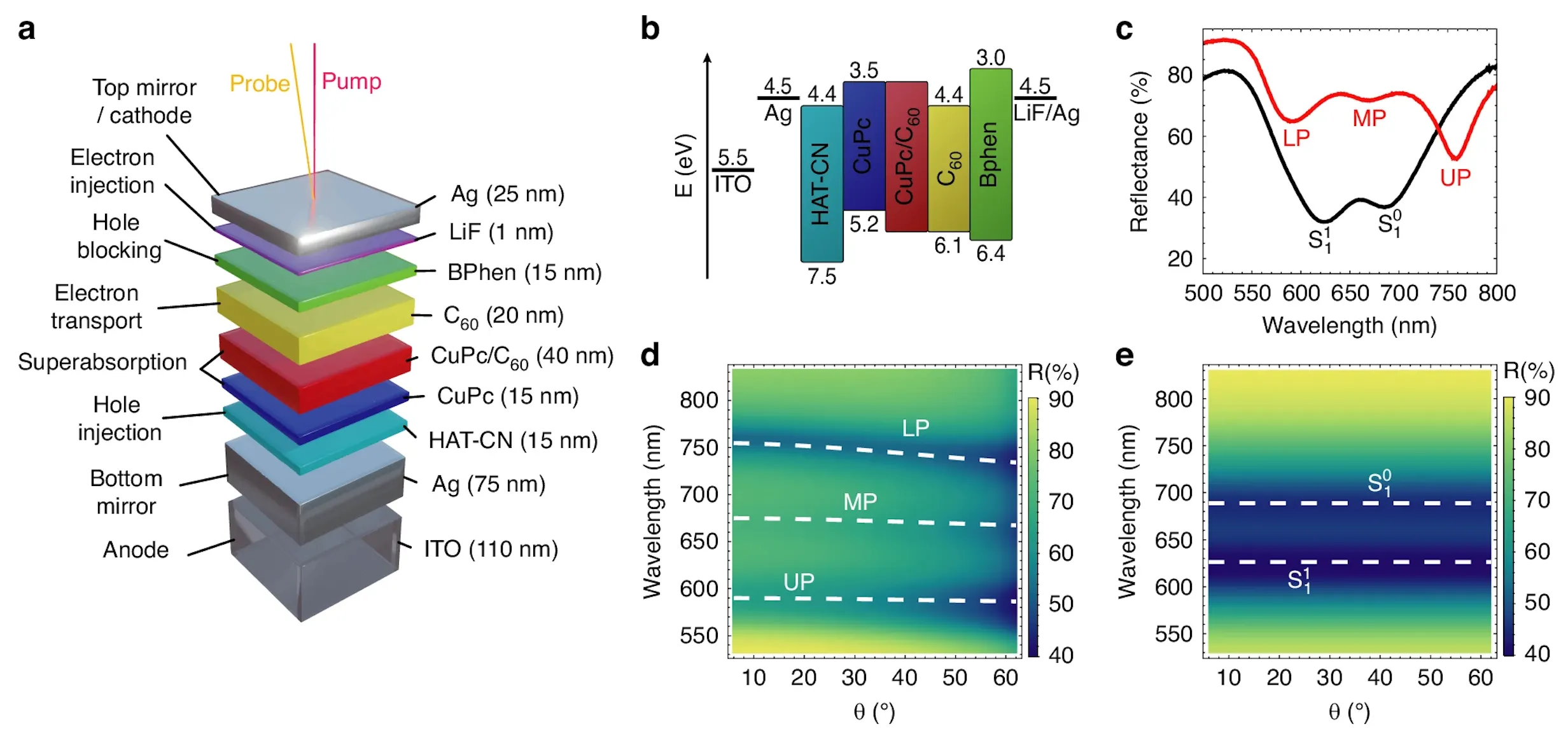
    The prototype is a tiny, layered wafer of organic materials like a nanoscopic sandwich that gets charged wirelessly by a laser pulse. That pulse lasts femtoseconds. One femtosecond is a quadrillionth of a second. The device charges in that window, then holds its energy for nanoseconds—about six orders of magnitude longer than it took to fill up.

    That gap sounds unimpressive until you scale it. “If we can charge a battery in one minute, it would stay charged for a couple of years,” lead researcher James Quach explained. The physics already work. The challenge now is extending how long the stored energy can last in a real-world device.

    The genuinely strange part isn’t the speed but the scaling behavior.

    Conventional batteries get slower to charge as they grow. More capacity means more time, but quantum batteries do the opposite. The more molecules packed into the device, the faster each one charges—because at the quantum level, they don’t act individually. They behave collectively, sharing the incoming energy in a single coordinated burst the researchers call “superabsorption.”

    Technically speaking researchers say that the charging time drops as 1/√N, where N is the number of molecules. Double the battery, cut the charging time by nearly half, and so on.

    “Our findings confirm a fundamental quantum effect that’s completely counterintuitive: quantum batteries charge faster as they get larger,” Quach told Melbourne University. “Today’s batteries don’t function like that.”

    This property had been predicted mathematically since 2013, and a partial version was demonstrated in 2022. What’s new here is the complete cycle: The team figured out how to pull the stored energy back out as an electrical current, which no previous quantum battery experiment had managed. The device also runs at room temperature—a practical advantage over competing superconducting approaches from China and Spain that require cryogenic cooling.

    The immediate application isn’t your EV or something like that. The prototype’s total capacity is measured in billionths of electron-volts—enough to power nothing in the real world yet. But quantum computers are a different story. Those systems are already advancing faster than most expected, and they have a specific energy problem: Their delicate quantum states demand power delivered coherently, without the noise that conventional electronics introduce. A quantum battery charges and discharges using the same quantum language those processors speak.

    “Quantum batteries could provide energy coherently, with the minimum energy cost to the quantum computers,” Professor Andrew White, who leads the quantum technology lab at the University of Queensland and was not involved in the research, told The News Digital.

    CSIRO is already seeking development partners, including EV manufacturers and deep-tech investors, to push the research forward. The theory had a decade head start on the hardware. The hardware just caught up.

    Daily Debrief Newsletter

    Start every day with the top news stories right now, plus original features, a podcast, videos and more.

  • XRP Treasury Firm Evernorth Inches Closer to Public Listing With $685 Million Stash

    XRP Treasury Firm Evernorth Inches Closer to Public Listing With $685 Million Stash

    In brief

    • Evernorth Holdings filed a new S-4 registration statement with the SEC about its intentions to go public.
    • The firm aims to become the biggest XRP treasury firm, and is expected to launch with $685 million in XRP tokens.
    • It originally raised more than $1 billion to build its XRP treasury.

    Evernorth Holdings, a firm with intentions of becoming the largest publicly traded XRP treasury, expects to launch with at least 473 million XRP valued around $685 million, according to its S-4 registration statement filed with the SEC on Wednesday. 

    The firm, which got a sizable XRP contribution from Ripple—the payments firm that’s built around the crypto asset—raised more than $1 billion to accumulate the token. 

    “We believe global finance is entering a new era with digital assets playing a larger role in how capital is held, managed, and deployed,” said Evernorth founder and CEO Asheesh Birla, in a statement. Our focus is on combining public-market discipline with XRP blockchain-based financial infrastructure to help shape a more transparent, efficient, and connected global financial system.” 

    Initially announced in October, the firm’s planned public listing will come via a business combination between Evernorth and Armada Acquisition Corp. II, a special purpose acquisition company (SPAC) that is sponsored by Arrington Capital and trades on the Nasdaq as XRPN. 

    Its XRP holdings, worth around $324 million less than the $1 billion it raised, were acquired via a variety of agreements, the S-4 filing notes.

    The biggest chunk, around 211 million XRP, is being contributed by the sponsor, Arrington Capital, pursuant to an advanced funding subscription agreement. Nearly 127 million XRP is expected to be contributed by Ripple upon the completion of the business combination, while around 84 million further XRP tokens were purchased at an average price of $2.53 using $214 million in advanced funding. 

    The value from its purchased lot has now almost been cut in half, and is valued around $122 million as XRP recently changed hands at $1.45. 

    Nevertheless, the firm notes that it believes the public company will provide “an attractive entry valuation” to investors seeking exposure to XRP. 

    “The SPAC Board believes that [Evernorth] provides an attractive entry valuation (calculated as a multiple to NAV) to XRP,” the filing reads.

    While its filing is still subject to SEC review, and the business completion subject to shareholder approval, the firm intends to actively manage its eventual XRP treasury. 

    Its four key business pillars include accumulating XRP, actively managing the asset, earning yield by using it in decentralized finance (DeFi), and exploring international expansion opportunities with a beginning focus on Japan and South Korea.

    “Our core strategy begins with our efforts to acquire, hold, and actively manage a treasury focused on XRP,” it wrote in the S-4. 

    XRP is down around 0.4% in the last 24 hours, recently sitting 60% off its July all-time high of $3.65. Earlier this week, the token leapfrogged BNB to become the fourth most valuable crypto asset by market cap. 

    A representative for Evernorth did not immediately respond to Decrypt’s request for comment.

    Daily Debrief Newsletter

    Start every day with the top news stories right now, plus original features, a podcast, videos and more.

  • Ancient Bitcoin Whales Spring to Life, Flood Market with BTC After Years of Silence

    Ancient Bitcoin Whales Spring to Life, Flood Market with BTC After Years of Silence

    TL;DR

    • A 2013-era holder sold 1,000 $BTC worth about $71.6 million, while Owen Gunden sold another 650 $BTC worth roughly $46.3 million to market.
    • The 2013 wallet has now sold 3,500 of 5,000 $BTC for about $337 million, suggesting a measured unwind instead of a sudden full exit over time.
    • The report casts the moves as generational profit-taking that may pressure upside, while also showing Bitcoin can absorb repeated OG distribution.

    Dormant Bitcoin supply is moving again, and the timing is stirring anxiety across the market. What is resurfacing now is not ordinary selling pressure, but aged supply from Bitcoin’s earliest era. According to the report, a 2013-era holder who accumulated 5,000 $BTC at an average cost near $332 sold another 1,000 $BTC worth about $71.6 million, while Owen Gunden sold an additional 650 $BTC worth around $46.3 million. Together, the transactions suggest that some of the market’s oldest wallets are converting paper wealth into realized profits rather than holding through this stage of the cycle.

    A #BitcoinOG with 5K $BTC($356M) sold another 1,000 $BTC($71.57M) 8 hours ago.

    This OG received 5K $BTC(cost $1.66M) at $332 12 years ago, and started selling $BTC on Nov 26, 2024, selling a total of 3,500 $BTC($337M) at ~$96,262.

    Total profit: $442M — a 266x return.… pic.twitter.com/oErv0KccjN

    — Lookonchain (@lookonchain) March 19, 2026

    Why the Market Watches These Old Wallets So Closely

    The first wallet tells a revealing story. This is not a sudden capitulation, but a disciplined unwind from one of Bitcoin’s cheapest positions. The source says the holder began selling on Nov. 26, 2024 and has now transferred 3,500 $BTC for about $337 million at an average sale price near $96,262. Even after the latest move, the wallet still reportedly holds 1,500 $BTC worth $106.8 million. That matters because steady legacy distribution can weigh on upside over time, even without the shock effect that would normally come from a single forced liquidation event for traders.

    Gunden’s sale adds another layer of unease because the market had treated his earlier exit as finished. The fresh 650 $BTC move suggests that high-profile whale distribution stories may end less cleanly than traders assume. Lookonchain reportedly tied the sale to roughly $46.3 million in value, after previously summarizing a much larger 11,000 $BTC liquidation worth about $1.12 billion. The report notes that Gunden’s transactions carry symbolic weight because he is seen as an important Bitcoin figure whose wallet activity is read as a signal about how some of crypto’s earliest capital is being repositioned.

    The broader takeaway is more nuanced than a bearish headline. These transfers look like generational profit-taking, but they also show how modern liquidity is absorbing old supply. The report argues that coins accumulated before institutional ETFs, treasury strategies and current exchange infrastructure are now being redistributed into a very different market structure. That does not make the selling irrelevant. On the contrary, the reactivation of dormant, low-cost $BTC remains one of the clearest windows into cycle behavior. But it also suggests Bitcoin is operating with enough depth to take repeated OG distribution without structural breakdown.

  • Arthur Hayes Loads Up on ETHFI Hours Before Upbit Listing—Signal or Coincidence?

    Arthur Hayes Loads Up on ETHFI Hours Before Upbit Listing—Signal or Coincidence?

    TL;DR

    • Arthur Hayes acquired around 132,730 $ETHFI, worth close to $72,800, roughly 5 hours before Upbit confirmed the listing.
    • The timing has triggered debate over possible insider awareness vs strategic positioning.
    • South Korea remains a dominant altcoin market, with sustained KRW-based demand since 2023, which may provide stronger liquidity and price support for $ETHFI after its debut.


    EthereumFi ($ETHFI) has returned to the spotlight after a well-timed purchase by Arthur Hayes aligned with its listing on South Korea’s largest crypto exchange, Upbit. The overlap between capital inflow and exchange exposure quickly caught market attention, as such combinations often influence short-term price action.

    Arthur Hayes $ETHFI Trade Raises Questions

    On-chain data indicates that Arthur Hayes, co-founder of BitMEX and CIO of Maelstrom, received 132,730 $ETHFI from Anchorage Digital about 5 hours before Upbit enabled trading. The transaction was valued near $72,800, with the token priced around $0.55 at the time.

    The close timing between the acquisition and the listing announcement fueled speculation about potential informational advantages. Still, there is no direct evidence of wrongdoing. Hayes has remained active in decentralized finance throughout 2026, allocating more than $3.4 million across multiple protocols.

    Earlier activity also shows that roughly one month prior, wallets linked to Hayes moved about 2.15 million $ETHFI at lower price levels, pointing to a broader accumulation strategy rather than a single trade.

    As part of its standard listing procedures, Upbit introduced temporary restrictions, including a brief pause on buy orders and limit-only trading during the initial phase. These measures aim to reduce volatility and stabilize price discovery.

    Korean Market Liquidity Strengthens $ETHFI Outlook

    An Upbit listing carries weight due to South Korea’s strong participation in altcoins. KRW-denominated trading remains elevated, even when excluding major assets such as Bitcoin, Ethereum, XRP, BNB, and Solana.

    Data from recent cycles shows a consistent buy-side presence from 2023 through 2026, with larger participants absorbing sell pressure. This dynamic contributes to deeper liquidity and stronger support levels across altcoin pairs.

    For $ETHFI, entering this environment means immediate exposure to one of the most active trading regions globally. Listings in Korea have historically driven higher volumes and faster price discovery, especially for DeFi tokens.

    EthereumFi is part of a growing segment focused on restaking and on-chain yield strategies built on Ethereum. As demand for these mechanisms expands, $ETHFI continues gaining traction among both retail and institutional traders.

    In conclusion, while the timing of Hayes’ purchase continues to draw attention, market structure and liquidity trends provide a broader explanation. With strong Korean demand and rising interest in DeFi infrastructure, $ETHFI may extend beyond its initial listing momentum and integrate into longer-term capital flows.