Category: Business

  • Bitcoin slips below $69,500 as tanker attacks send oil back above $100

    Bitcoin slips below $69,500 as tanker attacks send oil back above $100

    The bitcoin $BTC$69,593.87 relief rally due to oil losing gains lasted about 36 hours.

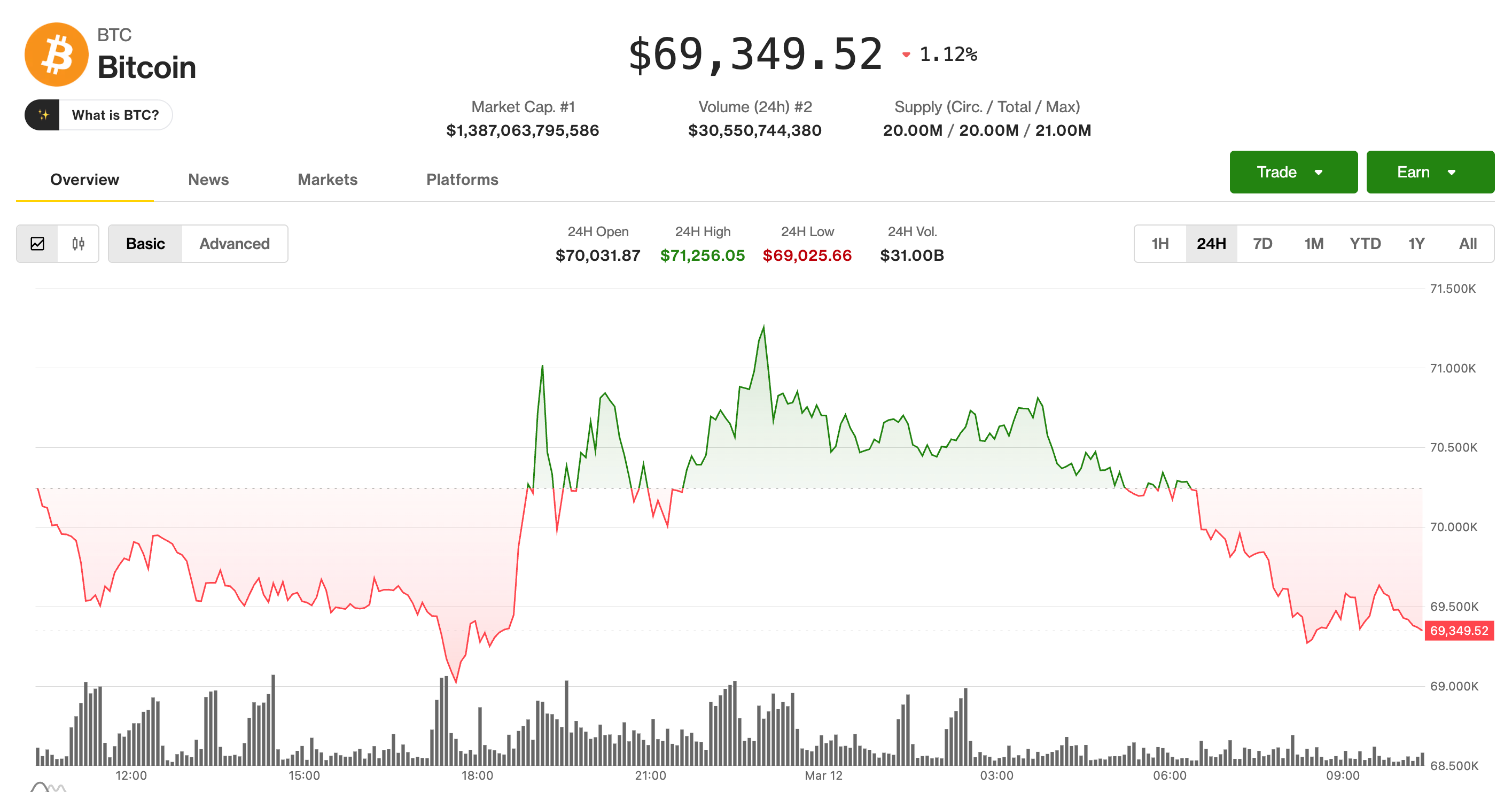
    Bitcoin fell to $69,393 on Thursday morning, down 0.8% over the past 24 hours and 4.3% on the week, after attacks on two oil tankers in Iraqi waters sent Brent crude surging back above $100 a barrel.

    The move wiped out Wednesday’s optimism around the IEA’s proposed record reserve release and pushed risk sentiment back into retreat across Asian markets.

    The chart tells the story of a market that can’t catch a break. Bitcoin touched $71,230 late Wednesday evening before the tanker headlines hit, dropping nearly $2,000 in a matter of hours.

    That’s the third time in two weeks that bitcoin has pushed above $71,000 only to get knocked back by an escalation in the Middle East conflict.

    Brent surged as much as 10.5% on Thursday, driven by a combination of the tanker attacks, clearance of the Mina Al Fahal port in Oman, continued hostilities across the Persian Gulf, and growing doubt about whether the IEA reserve release will be large enough to offset the supply disruption.

    MSCI’s Asia Pacific index dropped 1.8% with energy the only sector in the green. The session extended losses as it went on, with no signs of stabilization.

    The broader crypto market followed bitcoin lower. Ether fell to $2,025, down 0.5% on the day and 4.5% on the week. Solana dropped 1.5% to $85 and is now down 5.7% over seven days, the worst-performing major. XRP lost 0.8% to $1.37.

    Dogecoin fell 0.8% to $0.092, giving back most of Tuesday’s Musk-driven gains. BNB was flat at $642.

    The pattern of the past two weeks has been consistent. Good headlines push bitcoin toward $71,000-$74,000. Bad headlines drag it back toward $66,000-$68,000. The net movement over the period is close to zero, which is exactly what the on-chain data has been suggesting.

    Apparent demand remains deeply negative at -30,800 $BTC on a 30-day basis. CryptoQuant’s bull-bear indicator is still in bear territory, while supply in loss continues to climb. Every bounce gets sold into by holders looking to exit.

    Trump said earlier this week the war would resolve “very soon” and that military objectives were “pretty well complete.”

    But the timeline remains unclear, Iran continues to strike targets across the region, and the Strait of Hormuz is still disrupted. Mixed messaging from Washington has left markets unable to price the conflict’s duration with any confidence.

    The Fed meeting on March 17-18 is now five days away, and oil back above $100 makes the stagflation case harder to dismiss and rate cuts even more distant.

  • Ripple Moves to Secure Australian Financial Services License for APAC Payments

    Ripple moves to secure an Australian financial services license, positioning its blockchain payments network for deeper expansion across Asia-Pacific while tightening regulatory footing in one of the region’s most active digital asset markets.

    Ripple Strengthens Global Compliance Network With Australian License Plan

    Ripple plans to secure an Australian Financial Services License (AFSL) to expand its regulated payments offering in Australia and across the Asia Pacific (APAC) region, the blockchain-based enterprise solutions provider stated on March 11. The initiative aims to support financial institutions, fintechs, and enterprises seeking faster cross-border value transfers within established regulatory frameworks.

    Fiona Murray, Managing Director for Asia Pacific at Ripple, stated the licensing effort supports the company’s global compliance strategy and regional growth plans. Murray explained:

    “Licensing is fundamental to Ripple’s strategy, ensuring we can deliver secure, compliant solutions to customers worldwide.”

    “Australia is a key market for Ripple, and an AFSL strengthens our ability to scale Ripple Payments across the region,” the executive continued. “By leveraging blockchain technology and digital assets, we enable customers to move value globally with greater speed, transparency, and reliability. We remain focused on working closely with regulators to support the next phase of growth for digital asset infrastructure.”

    The company outlined that it intends to obtain the license through the proposed acquisition of BC Payments Australia Pty Ltd. The announcement states:

    “Ripple will obtain its AFSL through the proposed acquisition of BC Payments Australia Pty Ltd, which is subject to finalizing the standard completion process. This will strengthen Ripple’s ability to offer a licensed, end-to-end platform for moving funds globally.”

    With the AFSL in place, the payments platform would manage the full lifecycle of transactions including onboarding, compliance, funding, foreign exchange, liquidity management, and final payout. The acquisition of BC Payments Australia is expected to provide Ripple with an existing AFSL rather than requiring a new license application, allowing faster entry into the regulated market once the transaction closes.

    Meanwhile, APAC payments volume nearly doubled year over year in 2025, reflecting increased regional demand for blockchain-based settlement infrastructure, Ripple noted. The network works with institutions including Hai Ha Money Transfer, Novatti Group, Stables, Caleb & Brown, Flash Payments, and Independent Reserve. The company holds more than 75 regulatory licenses globally and participates in initiatives such as Project Acacia led by the Reserve Bank of Australia and the Digital Finance Cooperative Research Centre.

    FAQ 🧭

    • Why is Ripple seeking an Australian Financial Services License?
      Ripple aims to expand regulated cross-border payment services across Australia and the broader Asia Pacific region.
    • How could the AFSL impact Ripple’s payments network?
      The license would allow Ripple to operate a fully regulated end-to-end payments platform in Australia.
    • What does Ripple’s acquisition of BC Payments Australia mean?
      The acquisition is expected to provide the regulatory pathway for Ripple to secure the AFSL.
    • Why is the Asia Pacific region important for Ripple?
      Rapid growth in APAC cross-border payments demand makes the region a major expansion opportunity for Ripple’s blockchain infrastructure.
  • Justin Sun Deal Complicates SEC’s Crypto Stance, Legal Experts Say

    Justin Sun Deal Complicates SEC’s Crypto Stance, Legal Experts Say

    In brief

    • The SEC moved to settle its case against Justin Sun for $10 million over alleged violations tied to tokens TRX and BTT.
    • To impose the fine, the SEC effectively asserted that TRX had been offered as a security at some point.
    • Experts say this position could complicate the regulator’s narrative that most crypto tokens fall outside securities law.

    Last week, the SEC did something rather unusual for the Trump era—it announced a plan to fine a crypto company for violating America’s securities laws.

    Since President Donald Trump’s return to power, the Wall Street regulator has dropped virtually all crypto-related cases it inherited from prior administrations. The agency’s new leadership has argued it should have no part in regulating most crypto activity.

    But on Thursday, the SEC moved to settle its longstanding case against Justin Sun, a controversial crypto entrepreneur with business ties to the Trump family. Legal experts say the unique dynamics of the settlement may have unforeseen implications—and, potentially, undermine some of the logic propping up the Trump SEC’s aggressively pro-crypto posture.

    In 2023, the SEC under President Joe Biden accused Sun not only of offering unregistered securities in the form of two crypto tokens—TRX and BTT—but also of manipulating the secondary markets for those tokens with wash trading.

    Within weeks of Trump’s return to the White House, however, the SEC paused the case. The move prompted an uproar among Democrats, who highlighted Sun’s payments of tens of millions of dollars to Trump family crypto projects. Sun quickly became the face of political attacks regarding the president’s alleged “crypto corruption.”

    Last week, the SEC finally announced a plan to settle its case against Sun for $10 million and dismiss all outstanding charges against the entrepreneur. Sen. Elizabeth Warren (D-MA) swiftly blasted the deal, which still needs to be approved by a federal judge, as a “free pass” handed to a “crypto billionaire with ties to Donald Trump.”

    But there may be more to the proposed settlement than meets the eye. While the agreement between Sun and the SEC did not require the crypto entrepreneur to admit any wrongdoing, it did expressly state Sun needed to pay the $10 million for violating the Securities Act of 1933.

    If the SEC wanted to fine Sun, it had to claim jurisdiction over his case. But does that mean the Trump SEC still contends TRX or BTT were, in fact, securities? Such an admission could constitute a huge shift in the SEC’s approach to crypto, given the regulator has dismissed nearly every other ongoing case involving similar tokens.

    A source familiar with the SEC’s thinking confirmed the agency did, in fact, take such a view when deciding it had jurisdiction to settle its case against Sun.

    “The SEC has jurisdiction because it alleged in the amended complaint that, at the time of the wash trading, TRX was offered and sold subject to an investment contract,” the source told Decrypt.

    Amanda Fischer, a former SEC official who worked at the regulator when Sun was initially charged, told Decrypt she found the explanation strange. If the SEC believes TRX was offered as a security, then U.S.-based crypto platforms that listed the token should therefore also be considered unregistered securities exchanges, she said.

    What’s more, TRX is not unlike numerous other crypto tokens listed by crypto exchanges previously sued by the SEC, including Coinbase and Kraken. SEC lawsuits against Coinbase, Kraken, and other major crypto exchanges were dismissed when Trump returned to office last year.

    The SEC declined to comment for this story. Representatives for Sun did not respond to Decrypt’s requests for comment.

    Fischer argues the SEC is only asserting jurisdiction over TRX because agency leadership found itself stuck between a rock and a hard place. Drop all charges against someone like Justin Sun and face immense public blowback; pursue the case against him, and the SEC would have to explain in court why this crypto offering is a security but most aren’t.

    A relatively small fine may have emerged as the best compromise, Fischer said. But now, the move has potentially put the SEC in an awkward position.

    “The agency is desperate to save face and create the appearance that they’re enforcing the law against the president’s benefactors by imposing a sweetheart settlement,” Fischer said. “After scolding the Gensler SEC for creating ‘uncertainty,’ the Commission now asserts jurisdiction when it’s politically convenient.”

    Gary Gensler, the previous chair of the SEC, was endlessly criticized by crypto leaders for taking a case-by-case view of digital assets. In contrast, the Trump SEC has pledged to create simple, uniform rules that will allow most crypto projects to breathe easy.

    But if the Trump SEC now contends TRX was a security offering—at least at some point—legal experts say that view could throw a wrench in the regulator’s laissez faire crypto logic.

    “The whole message has been we want clear rules of the road,” Drew Rolle, a partner at Alston & Bird specializing in securities law and crypto, told Decrypt. “That’s what makes this interesting.”

    Rolle said that, in light of the Justin Sun settlement, crypto projects may have to continue deducing for themselves what types of crypto tokens and sales potentially trigger securities laws—even if the Trump SEC has promised most crypto tokens shouldn’t be considered securities.

    Andrew Hinkes, a crypto-focused partner at Winston & Strawn, agreed. He said the SEC’s settlement with Justin Sun suggests the agency is now taking the view that crypto tokens can be sold in ways that trigger the securities laws, even if the tokens are not themselves securities.

    “The fact that the SEC is settling this action suggests that the SEC seems to believe that the instruments at issue were offered in investment contracts at the relevant time,” Hinkes told Decrypt

    It remains to be seen whether the SEC will actually enforce that view broadly, or if it was unique to Justin Sun’s case. But the move could immediately impact other litigation—such as private lawsuits filed by TRX holders against Sun.

    “I wouldn’t be surprised if potential claimants point to this and try to leverage it,” Rolle said.

    Editor’s note: Updated name of law firm from Alliston & Bird to Alston & Bird

    Daily Debrief Newsletter

    Start every day with the top news stories right now, plus original features, a podcast, videos and more.

  • Myriad to Use USD1 on BNB Chain as Exclusive Settlement Asset

    Myriad to Use USD1 on BNB Chain as Exclusive Settlement Asset

    Prediction market Myriad is transitioning to World Liberty Financial’s USD1 stablecoin as its exclusive settlement asset.

    As part of the move, Myriad, owned by Decrypt’s parent company Dastan, is migrating its entire prediction market catalog to BNB Chain.

    The move will result in a “faster, simpler, and more consistent prediction environment,” according to Myriad, replacing the current fragmented multi-chain experience with a single, unified standard.

    Myriad’s migration to BNB is “long overdue,” said Myriad Markets co-founder and President Farokh Sarmad, adding that, “With over $5 billion in TVL and millions of active users, we needed a home that can sustain the incoming growth of our platform.”

    Earlier this year, Myriad became the first prediction market to integrate USD1, a stablecoin launched by the Trump-backed DeFi platform World Liberty Financial, on its 5-minute markets.

    Partnering with USD1 was a no-brainer, said Farokh, calling it a “top stablecoin” that will enable deeper integration with the BNB Chain ecosystem.

    Myriad’s tie-up with USD1 underpins the prediction market’s incoming transition from an automated market maker liquidity model to a Central Limit Order Book (CLOB), enabling an array of new features including slippage controls, limit orders, dynamic fees, and broader market information for users.

    A CLOB, which matches buy and sell orders based on price and time priority, enables users to trade directly with each other rather than through an intermediary. “The CLOB is by far the most important update to Myriad,” said Farokh, adding that it will “unlock billions of dollars being able to be traded on our platform and 100x our user base.”

    Myriad Season 3

    Simultaneously, Myriad is launching Season 3 with “game-changing updates across the platform.”

    Season 3 launches alongside the full rollout of Myriad Wallet across the platform. Built from the ground up for speed, the Myriad Wallet is optimised for fewer approvals and lower gas costs. Integrated with MoonPay as Myriad’s official payments partner, the Myriad Wallet enables users to deposit in seconds from over 12 currencies, with a simple user flow.

    In response to user feedback, Season 3 introduces an overhauled leaderboard and points structure, with points now distributed every 7 days and taking into account an array of metrics rather than a single signal.

    That lays the groundwork for Myriad’s journey into the MYR ecosystem, with participants who contribute liquidity, information, and infrastructure to the network able to claim rewards when the system goes live. “Season 3 will play the biggest role in what comes next,” said Farokh. “So even if you missed earlier seasons, there’s still plenty of time to catch up!”

    Daily Debrief Newsletter

    Start every day with the top news stories right now, plus original features, a podcast, videos and more.

  • Crypto Market Review: Shiba Inu (SHIB) Took Worst Hit in 2026, Ethereum (ETH) Will Be Brutally Tested, Is Solana (SOL) on the Edge of a Volatility Implosion?

    Crypto Market Review: Shiba Inu (SHIB) Took Worst Hit in 2026, Ethereum (ETH) Will Be Brutally Tested, Is Solana (SOL) on the Edge of a Volatility Implosion?

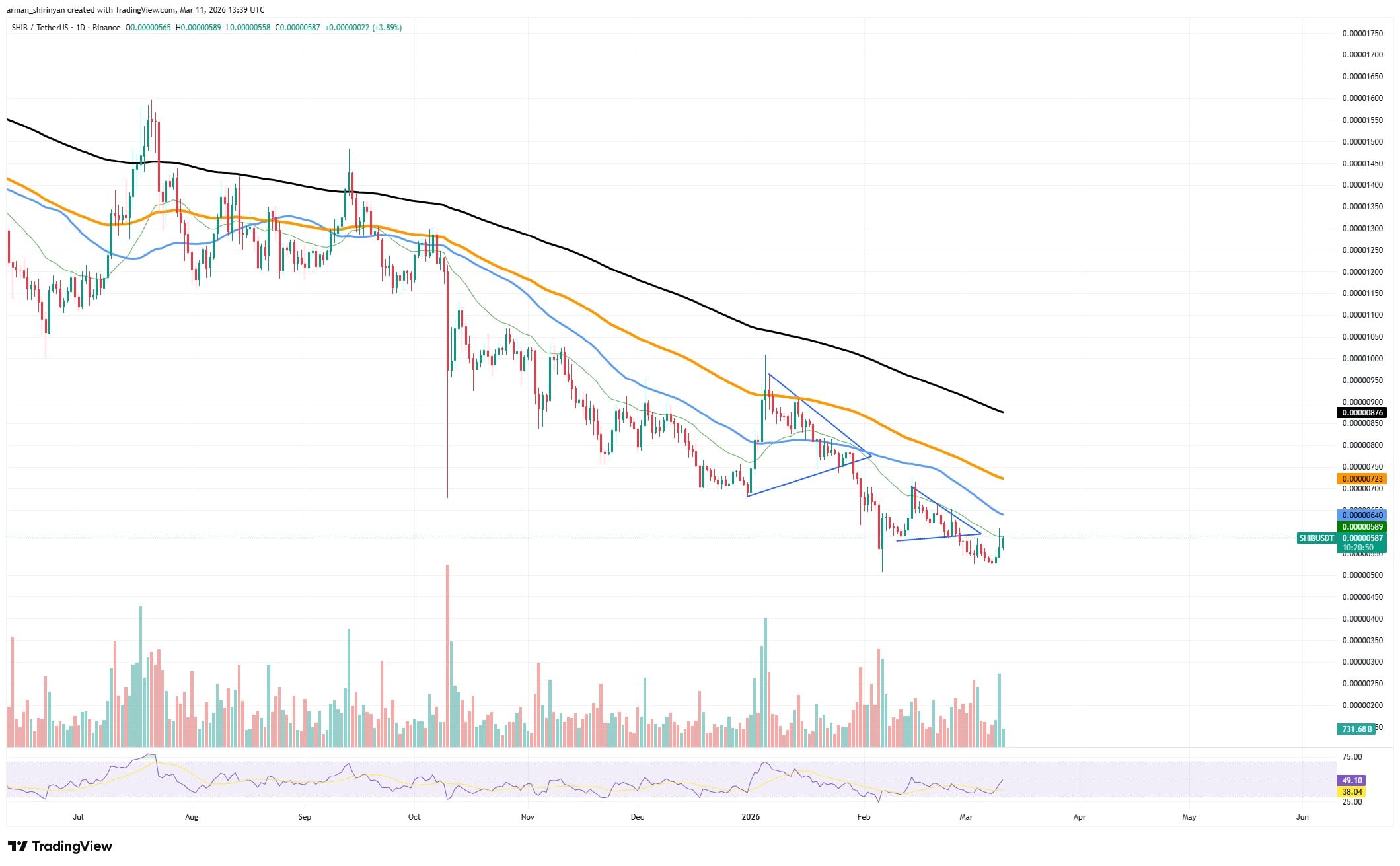
    Throughout 2026, Shiba Inu has become one of the most stressed assets on the cryptocurrency market. The token’s price structure is severely weakened as a result of its inability to regain any significant momentum following months of continuous decline.

    Trend flipping

    The asset has been dominated by a broader bearish trend this year, which has been reinforced by the failure of even brief recovery attempts to produce long-term upside.

    $SHIB is currently trading close to the $0.0000056 range, which shows how far the token has dropped from its prior highs. The chart unequivocally demonstrates a recurring pattern of lower highs and lower lows, indicating that sellers are still in complete control of the market. The asset has not been able to establish a steady upward trend because every attempt at recovery has been met with fresh selling pressure.

    Article image

    The recent fakeout rally, which briefly hinted that $SHIB might be getting ready for a comeback, was one of the most telling moments. After rising above local lows, the price got close to the 26-day exponential moving average, which was its first significant technical barrier. For a brief while, it seemed like buyers were at last making progress.

    Shiba Inu gets rejected

    But that optimism was short-lived. The entire move was a classic fakeout since $SHIB was firmly rejected rather than overcoming the resistance. Even the earliest stage of a possible trend reversal is currently unattainable, as demonstrated by the failure at the 26 EMA.

    Fakeouts of this kind can be especially detrimental to market confidence. When a move fails, traders who entered positions anticipating a breakout are frequently compelled to exit, which can increase selling pressure. The rejection, in $SHIB‘s case, supported the notion that the larger downward trend is still present.

    The future appears uncertain. The market will probably continue to be under pressure as long as the price stays below major moving averages. Although short-term rallies are still possible, particularly if the overall cryptocurrency market stabilizes, they might not be able to turn into long-term recoveries.

    Ethereum’s stabilization chances

    As the asset tries to stabilize following months of intense selling pressure, Ethereum is nearing another crucial point. The $2,000 mark is no longer the primary psychological or technical barrier for Ethereum, despite the market’s recent temporary stability in that area.

    The 26-day exponential moving average, which presently serves as the most important resistance zone, is where the actual battlefield is located higher on the chart.

    Article image

    Ethereum has been stuck in a distinct downward structure for a number of months. The price chart consistently displays lower highs and lower lows, indicating that the general trend is still bearish. The asset has not been able to develop sustained upward momentum because every attempt at recovery has been stopped by declining resistance.

    For traders earlier in the cycle, the $2,000 mark held great psychological significance. Because they represent important sentiment thresholds, round numbers have historically drawn attention.

    Recent price trends, however, indicate that the market has already reached this level. Earlier this year, Ethereum briefly broke below it. Since then, it has traded around that level without producing the strong reactions that typically accompany a significant psychological barrier.

    The 26 EMA, where selling activity seems to be concentrated, is now Ethereum’s true challenge. Sellers swiftly surface and drive the market back down each time the price gets close to this moving average. This pattern suggests that a lot of traders use the 26 EMA as a crucial decision point, either to open new short trades or to close long positions.

    A break above the 26 EMA would indicate a change in short-term momentum and possibly pave the way for a more significant recovery move. But for the time being, Ethereum is still constrained by a number of barriers.

    Solana’s tighter market range

    Solana is about to enter a technical phase that might cause volatility to spike. The asset is starting to stabilize close to local lows after months of decline and frequent rejection by major moving averages. Even though the price is still relatively stable, a number of indicators point to the possibility that the market is getting ready for a much bigger move.

    Article image

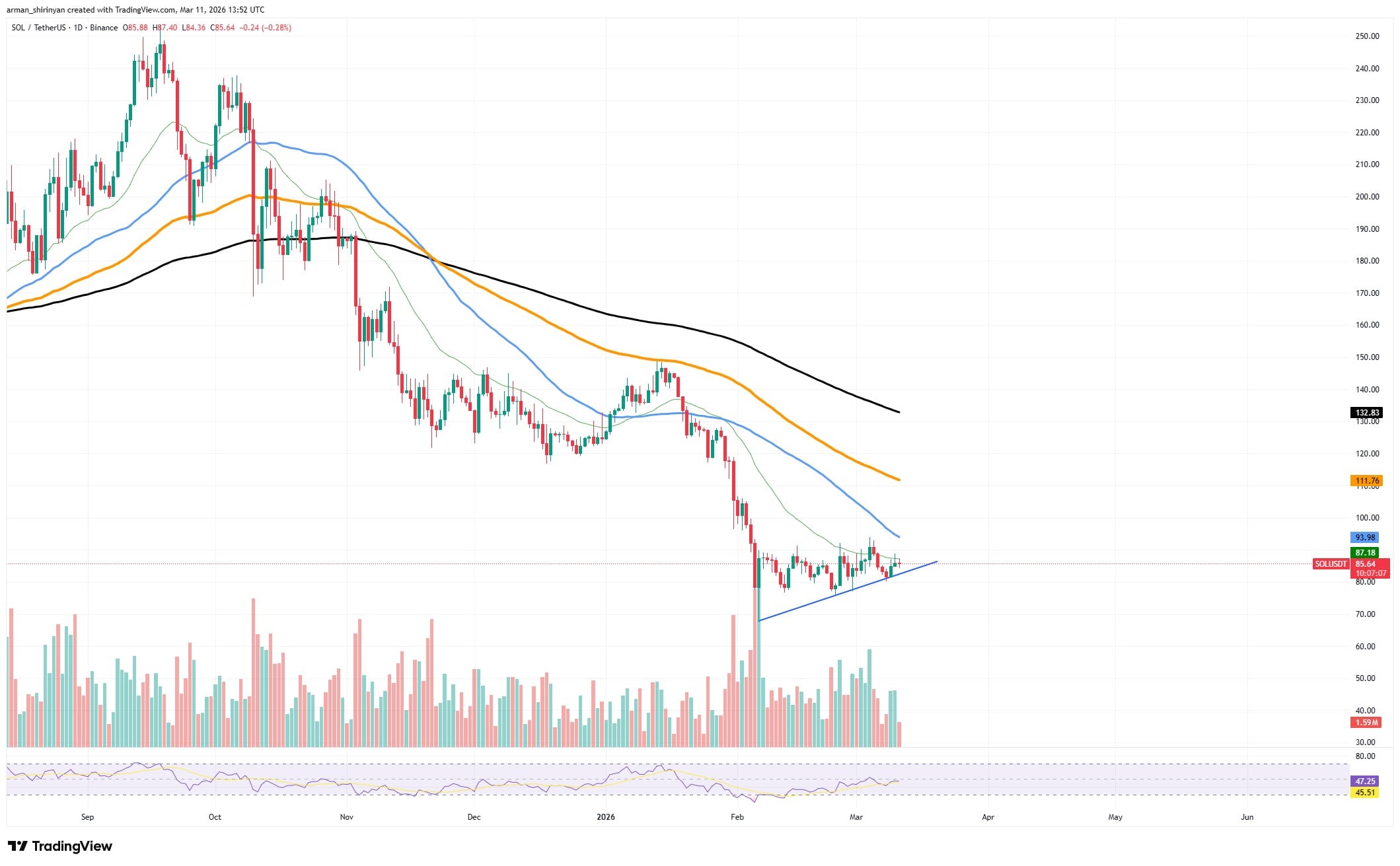
    Solana is currently trading between $85 and $87, consolidating following a sharp decline that began earlier in the year. The 50-day, 100-day and 200-day moving averages are all above the price, indicating that the overall trend is still obviously negative. These levels support the longer-term downward trend and continue to serve as significant resistance zones.

    Solana is forming higher lows along a rising support line, forming a tightening range, according to recent price action. This kind of compression frequently heralds an impending expansion in volatility, particularly following extended downward pressure.

    Solana derivates staying up

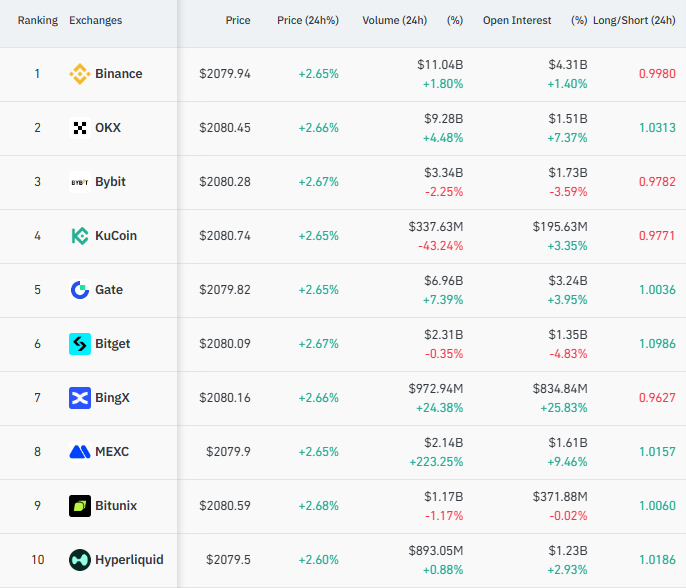
    This possibility is supported by CoinGlass derivative data. There has been a noticeable increase in futures activity around Solana, as traders position themselves for a more significant directional move. Despite the comparatively muted price movement, market participants are becoming more active, according to metrics pertaining to open interest and trading flows.

    Solana has not yet confirmed a breakout in spite of these signals. The fact that the price is still stuck in a small range indicates that the market is still applying pressure rather than releasing it. The duration of this stabilization phase may vary, but the final breakout is typically stronger the longer the compression lasts.

  • Crypto Traders Turn to Hyperliquid for Oil Bets Amid Iran Volatility

    Crypto Traders Turn to Hyperliquid for Oil Bets Amid Iran Volatility

    Crypto traders are increasingly using the DeFi derivatives platform Hyperliquid to speculate on oil prices, in the latest sign that always-on crypto markets are beginning to absorb trading tied to global macro shocks.

    Oil-linked perpetual futures on Hyperliquid processed roughly $991 million in trading volume over the past 24 hours, according to data shared Wednesday on X by James Wang, director of product marketing at Cerebras Systems. Comparable contracts recorded about $75,000 in volume on Coinbase over the same period.

    The disparity underscores how liquidity for synthetic commodity exposure is clustering on crypto-native derivatives venues rather than traditional exchanges or U.S.-based crypto platforms.

    Order-book data in the oil market shows large resting orders and relatively tight spreads, suggesting participation from professional liquidity providers alongside retail traders.

    Crude prices surged on Monday amid fears the conflict could further disrupt shipments through the Strait of Hormuz, briefly pushing Brent crude to about $119.50 a barrel before retreating to roughly $91–$100 after President Donald Trump suggested the war involving Iran might soon de-escalate.

    By Wednesday evening in New York trading, Brent crude was hovering around $90–$92 a barrel as markets continued to digest developments and the prospect of emergency oil stockpile releases.

    The activity follows this month’s first weekend surge in trading on the exchange as tensions tied to Iran rattled global markets, helping to push the price of its native token, $HYPE, above $32. It is up a further 6% on the day to $36.33, according to CoinGecko data.

    As previously reported by Decrypt, traders have turned to the platform amid headlines surrounding tensions in the Middle East while conventional markets, at times, remain closed.

    Hyperliquid lets traders take leveraged positions through perpetual futures contracts collateralized by stablecoins, primarily USDC, allowing them to speculate without opening brokerage accounts or accessing regulated commodity futures venues such as the CME Group.

    The exchange’s system is divided between HyperCore and HyperEVM. HyperCore runs the platform fully on-chain, with spot and perpetual futures order books recording every order, trade, and liquidation with near-instant finality and supporting up to about 200,000 orders per second, according to its white paper. HyperEVM, meanwhile, provides an Ethereum-compatible environment where developers can deploy smart contracts and build applications that interact with the exchange’s liquidity.

    It’s a feature that has attracted participants since its mainnet launch in 2023, helping to ferment growth on the exchange while doubling the token’s total market cap to over $8.8 billion in one year.

    For Hyperliquid’s native token, $HYPE, trading tied to macro volatility can have direct financial implications. The protocol directs a portion of trading fees toward token buybacks, linking spikes in derivatives activity to potential demand for the asset.

    Analysts say geopolitical shocks may continue to drive episodic bursts of trading on always-on crypto venues as traders seek to position ahead of global events.

    If sustained, that dynamic could position platforms like Hyperliquid as an early outlet for traders seeking to price global risk ahead of conventional markets, they say.

  • Brera Stock Plunges Amid Growing Solana Pivot as ‘Solmate’ Firm Dumps Soccer Teams

    Brera Stock Plunges Amid Growing Solana Pivot as ‘Solmate’ Firm Dumps Soccer Teams

    In brief

    • Shares of Brera Holdings (SLMT) have dumped more than 19% on Wednesday.
    • The firm announced its intentions to shift focus to a UAE-centered Solana infrastructure firm late Tuesday.
    • One of its largest institutional shareholders, Ark Invest, began offloading small portions of its holdings on Monday.

    Shares of publicly traded Solana treasury firm Brera Holdings (SLMT), also known as Solmate, have plunged more than 19% so far Wednesday following a late Tuesday announcement that the company is shifting its strategic focus to being an Abu Dhabi-centered Solana infrastructure company. 

    The proposed shift, approved by the firm’s board of directors, will center its interests on “digital infrastructure” like institutional-grade staking and validating, while “aligning its legal structure with a core blockchain mission,” according to the announcement. 

    “This transformation is the culmination of Brera’s strategic shift toward infrastructure opportunities we see in Abu Dhabi,” said Solmate CEO Marco Santori in a statement. “By focusing our capital and corporate identity on Solana, we are positioning ourselves to be a central player in the region’s rapidly expanding digital economy.”

    As part of its repositioning, the firm will be dumping legacy business assets Brera Tchumene and Brera IIch, two soccer clubs participating in leagues in Mozambique and Mongolia, respectively.

    Capital “liberated” from those clubs, which it identified as “underperforming soccer teams,” will be utilized to implement its Solana strategy in the UAE. However, the firm will maintain its flagship soccer team, Juve Stabi, which plays in the second tier of professional soccer leagues in Italy. 

    Brera also intends to conduct a reverse 10-for-1 stock split with an effective date expected sometime after April 7, the day of a scheduled shareholder meeting seeking approval for its new initiative. 

    Shares in the firm were recently changing hands around $0.89, down over 19% on the day after dipping as low as $0.84. SLMT shares have dropped almost 35% in the last week of trading. During that time, one of its most notable shareholders—Cathie Wood’s investment firm, Ark Invest—began offloading shares of Brera for the first time. 

    Wood’s firm had been accumulating shares in the Solana company since December, creating a multi-million-dollar position in Brera, including a purchase as recent as last week. It also participated in the firm’s private investment in a public equity (PIPE), netting around 11.5% of the firm’s shares, according to a Brera announcement from the time

    However, Ark started trimming its position on Monday, selling around $76,000 worth of SLMT shares. On Tuesday, it trimmed nearly $54,000 worth of the stock as well, but it still maintains a nearly $10 million position in the firm, according to data from Cathie’s Ark

    Brera announced its intentions to shift to a Solana treasury strategy in September, raising $300 million via its PIPE. The firm also purchased $50 million in discounted Solana tokens directly from the Solana Foundation.

    Daily Debrief Newsletter

    Start every day with the top news stories right now, plus original features, a podcast, videos and more.

  • Mastercard Recruits Binance, Ripple and PayPal for Crypto Partner Program

    Mastercard Recruits Binance, Ripple and PayPal for Crypto Partner Program

    In brief

    • Mastercard launched a Crypto Partner Program with 85+ companies including Binance, Ripple, Circle, and PayPal to advance practical digital asset use cases.
    • Partners will collaborate with Mastercard on products merging digital asset capabilities with traditional card rails.
    • The initiative builds on existing blockchain efforts to integrate on-chain innovation into everyday commerce.

    Mastercard said Wednesday that it has launched the Crypto Partner Program, a global initiative uniting over 85 crypto-native companies, payment providers, and financial institutions.

    The program reflects a growing recognition that digital assets are moving beyond speculation and into practical applications, it said—such as cross-border remittances, business-to-business transfers, and settlement—often integrated quietly into existing financial infrastructure.

    The payments giant has tapped many of the largest companies in the crypto world, with an announcement video showcasing industry giants like crypto exchanges Binance, Crypto.com, Bybit, and Gemini, as well as XRP-linked payments firm Ripple, USDC stablecoin issuer Circle, and payments companies MoonPay and PayPal.

    Other partners include the teams linked to the blockchain networks Solana, Avalanche, Aptos, and Polygon, along with firms like Anchorage Digital, Nexo, Paxos, and SoFi. Crypto analytics and intelligence firms like Elliptic and TRM Labs are also on the list.

    “Through the program, participants will engage with Mastercard teams on the design and direction of future products and services, including solutions that aim to bring the speed and programmability that digital assets offer together with established card rails and global commerce flows,” an official blog post reads.

    This initiative builds on Mastercard’s existing digital asset efforts, including its Start Path blockchain track, Engage platform, and Crypto Card program. Going forward, Mastercard said it aims to bridge on-chain innovation with its established global payments infrastructure, to ensure that emerging technologies integrate smoothly into everyday commerce.

    Daily Debrief Newsletter

    Start every day with the top news stories right now, plus original features, a podcast, videos and more.

  • Japan to tap oil reserves in historic move amid Middle East crisis

    Japan to tap oil reserves in historic move amid Middle East crisis

    Japan will begin releasing crude oil from its strategic reserves as early as next Monday to curb potential spikes in gasoline and petroleum prices caused by Middle East conflicts and disruptions to Persian Gulf oil shipments, Prime Minister Sanae Takaichi said Wednesday.

    The intervention will mark the first time the nation has tapped its government oil reserves without waiting for a coordinated response from the International Energy Agency (IEA) since stockpiling began in 1978.

    The release will cover 15 days’ worth of reserves held by private-sector entities, followed by one month’s supply from government stockpiles.

    “We will flexibly review the support measures to ensure continuous relief for the public even if the situation is prolonged,” Takaichi told reporters in Tokyo.

    Japan’s decision reflects its acute exposure to energy flows through the Strait of Hormuz, which has been effectively closed to commercial traffic following US and Israeli military strikes on Iran late last month.

    More than 90% of Japan’s crude imports originate from Persian Gulf producers, a dependency Takaichi characterized as “prominently high” relative to other industrialized economies.

    The prime minister warned that shipments are expected to drop dramatically by late March, creating the potential for severe shortages of gasoline and other refined products.

    Retail gasoline prices have already begun climbing. Industry ministry data show the national average approached 162 yen ($1.02) per liter as of Monday, up from a mid-January low of approximately 155 yen.

    Takaichi cited projections that prices could breach 200 yen ($1.26) per liter and pledged to deploy government funds to cap costs at roughly 170 yen, providing a buffer equivalent to approximately 15% below the anticipated peak.

    At the end of December, Japan held 470 million barrels of petroleum reserves, sufficient to cover 254 days of domestic consumption.

    Disclosure: This article was edited by Vivian Nguyen. For more information on how we create and review content, see our Editorial Policy.