Latvia could allow residents to pay personal taxes with cryptocurrency as early as next year, as part of a push to attract crypto firms and investors.
The country’s Finance Ministry has agreed to the plan, though technical work with a payment provider remains, said Didzis Dejus, an adviser to the prime minister on strategic planning and the new economy.
Asked whether Latvians would be able to pay taxes in crypto during the prime minister’s term, Dejus told CoinDesk at the UN:BLOCK Fintech conference in Riga that “I believe that will take place next year.”
CoinDesk has reached out to Latvia’s Finance Ministry for comment but hasn’t heard back at the time of writing.
The move would give crypto holders a way to use their assets to meet tax bills. It also builds on plans announced in May 2025 to enable crypto tax payments and the tokenization of other assets like real estate.
“We are not afraid to be the fastest country,” Dejus said, describing efforts to attract crypto business beyond licensing.
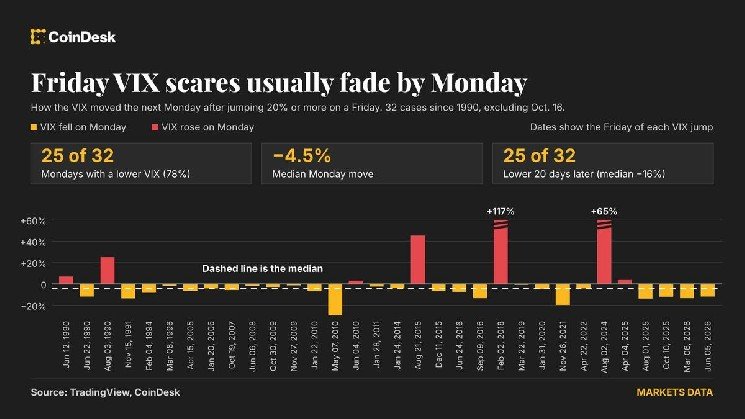
Wall Street’s fear gauge, the VIX index, ripped higher on Friday as stocks tanked on AI and geopolitical worries. Bitcoin $BTC$81,030.77 traded choppy.
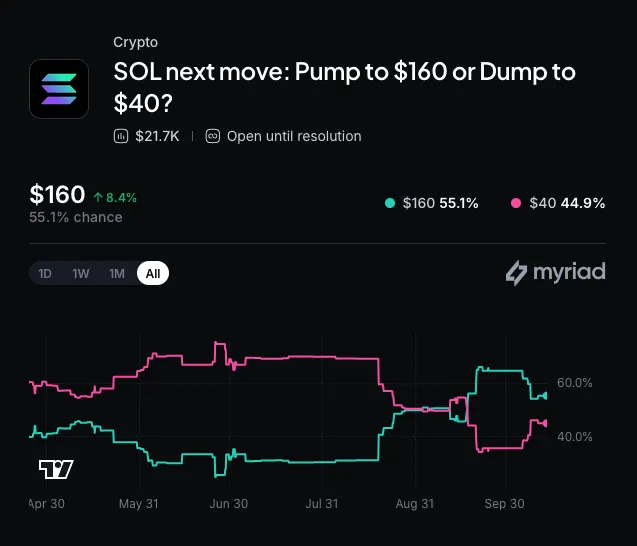
Traders are betting the fear gauge keeps climbing.
However, if VIX history and bitcoin’s steady weekend price action are any guide, the panic could subside just as quickly on Monday.
First, a quick primer. Cboe’s VIX measures how much traders expect the S&P 500, the blue-chip stock index, to swing over the next four weeks. It’s derived from options prices. When people get nervous, they buy options, which are contracts used to hedge against price swings. That pushes the VIX up.
Bitcoin $BTC$81,030.77, meanwhile, is the only macro asset thats trades over the weekend. As such, swings in bitcoin over the weekend are often seen as lead indicators of how traditional markets may open on Monday.
Friday’s VIX surge
On Friday, the VIX jumped 21.5% to 19.99 as the S&P 500 fell by 1.09%.
That’s VIX’s biggest one-day rise since June 5, when the S&P 500 suffered its worst day in months, according to data source TradingView.
Related NewsBloomberg Analyst Makes Alarming Prediction for Bitcoin: $10,000—He Explained the Condition
Therefore, this development is not a new network feature that was rolled out on Cardano today, but rather a development project that its founder announced he was working on.
It’s noteworthy that Hoskinson also mentioned an ambitious idea for the privacy-focused Midnight earlier in the week. However, it has not been confirmed that the two statements relate to the same project.
Cardano already has development tools like Plutus and Aiken. How the new language will be integrated into this framework and what it will provide to existing applications will become clear with the release of the technical details.
A rule in the Your First Home scheme could block couples from using it who may otherwise find the scheme very helpful.
Among the rules is an income cap which bars couples with a household income of £90,000 from the scheme, which rises to £110,000 in London.
However, this rule could exclude couples who work in the public sector from the scheme despite them still struggling to be able to afford a house.
For example, The Times reported how two paramedics working in London could both be earning the reported median salary for the profession, which is £60,797.
This would take the household income up to £121,594 – well above the suggested maximum of £110,000 for the UK capital, according to analysis by Newspage.
Outside of London this could also see people like teachers and nurses excluded from the scheme as well.
The median salary for a teacher is £51,048, while for nurses it is £44,053, though these will also vary depending on someone’s experience and seniority.
The scheme is designed to help people buy their first home, but there are already concerns (Getty Stock)
However, if there was a couple made up of a nurse and a teacher on their respective professions’ median salary then they as a couple would be excluded from the scheme if they lived outside London.
Matt Coulson is the Founder at Rickmansworth-based Heron Financial, and said: “The problem is that income is the wrong thing to cap on, because it doesn’t tell you whether someone can buy.”
He added that one big problem with the previous Help to Buy scheme is that it was ‘helping people who’d have bought anyway, so some targeting is sensible’.
The scheme has not yet been fully confirmed, and it is expected to be confirmed when the budget is announced later this month in a last minute decision to postpone the announcement, with the government insisting that the concerns about the caps are ‘speculation as full details are yet to be set out’
The cap is also what distinguishes the Your First Home scheme from the previous Help to Buy scheme announced by chancellor at the time George Osbourne in 2013, and which ran until 2022.
Under the scheme people only need a deposit of 2.5 percent (Getty Stock)
Housing secretary Angela Rayner has said that the scheme will be open to first-time buyers who have a deposit of 2.5 percent on their home, with the state then providing a loan of up to 20 percent of the new build property’s value, along with an interest free period.
There will also be rules about the maximum value of the homes that people will be able to buy as well.
In the original scheme which ran between 2013 and 2021 there was a maximum property value of £600,000, which was applies across the country.
That was altered in the last two years of the scheme to be 1.5 times the value of the average first time buyer property price, varying from £186,100 in the North East to £600,000 in London.
A spokesman for the housing department said in a statement: “By reducing the size of deposits and boosting the number of high-quality new homes, Your First Home will help support more hardworking people onto the housing ladder.”
The woman who gained online notoriety for frolicking in a red bikini at a foam party has come under fire for her latest scantily-clad post.
Océane, who is better known as the ‘red bikini girl’ or Aora DJ on social media, has been dining out on the viral fame that the clip of her dancing in Lloret de Mar, Spain, has brought since July.
However, her latest Instagram post has prompted a bit of backlash for a variety of reasons – and the 20-year-old has now snapped back at her critics.
Océane has racked up a whopping 200,000 followers on the photo sharing platform after footage of her summertime antics spread like wildfire online.
Océane’s latest video has raised some eyebrows (Instagram/@aora.d)
She said that the ‘simple’ video of her dancing had ‘changed her life completely’ in a post shared after she was identified, while revealing what she believes made the video resonate with people.
“I think if it touched so many people, it’s because I was just being myself: spontaneous, natural, and with a desire to enjoy every moment,” Océane wrote.
“I’m truly moved by all your messages – more and more of them- coming in from all over the world. I still can’t quite believe everything that’s happening to me.
“One thing is certain: I’ll stay true to myself. No pretense, no fakery – just natural, with a smile, and living my life the way I want to. This adventure is just beginning.”
Despite Océane saying she is only just getting started, a lot of people now seem to think her five minutes of fame might nearly be up.
‘The iconic red bikini is back’
In a video shared to Instagram on Thursday (15 October), she sported a red bikini once again – but this time, she was strutting around a metro station in Paris.
After flaunting her physique for a few seconds, she then filmed herself strapping an iPhone onto the window of the train that was packed with commuters with some seriously strong tape.
It began moving mere moments later – and she then chased after it for a few seconds, before the train continued to travel right past the iconic Eiffel Tower and the River Seine.
Océane was taking part in a bizarre TikTok trend that is growing in popularity, much to the dismay of transport bosses.
She captioned the clip: “Wait for the view…The iconic red bikini is back.”
As you can imagine, for starts, tons of social media users were stunned to see her donning swimwear in the metro station – which led a lot of people to suspect that Océane had used artificial intelligence to create the video.
One person wrote: “Definitely AI.”
“Lol it’s just AI,” another claimed. “She took the same video someone else did but just in a little outfit, that’s all lol.”
A third wrote: “Is this your whole personality? That you danced in a red bikini in some club once?”
While a fourth commented: “People who really believe it’s real…When it’s actually a video of a guy that was re-shot and generated using AI! It’s becoming more and more realistic.”
Amid the mounting allegations that she used AI, Océane responded to this comment saying: “It’s so well done that you think it’s AI?”
She sprinted through the station wearing nothing but a red bikini (Instagram/@aora.d)
She also hit back at critics who slammed her for wearing a red bikini in a public space in a similar sarcastic fashion, saying that she believes it’s ‘more practical’ than wearing clothing.
Others lurking in her brimming comment section said it was ‘sad how quickly five minute of fame falls’ and questioned ‘how she was not embarrassed’ – but others described the clip as ‘iconic’.
One wrote: “Absolute cinema, the timing, the risk, the view!!!”
Another said they thought the video was ‘actually pretty neat’ – while another urged her to reveal what tape she had used to stick the phone to the train, given it held on ‘amazingly’ well.
Océane previously explained that some of the unsavoury responses she has received to her online content ‘hurt her a lot’ at first, but said it’s like water off a ducks back for her now.
Airlines will not be able to charge for bags amid a whole set of rules being brought in to protect flyers.
A whole raft of new rules are set to come into force for airlines, including not charging parents more to sit with their children, and are aimed at protecting passengers from hidden costs when booking their flights.
The rules are set to come into force in the UK and Europe in October 2027at the earliest point, and also include one rule that can be a major sticking point for passengers – luggage.
Many of us have been there, getting lured in by a deal for a cheap flight only to find ourselves being bogged down by a series of hidden subsequent charges, suddenly turning a cheap deal into a expensive trip.
But under the new rules passengers are now allowed to have up to two items of hand luggage on a flight at no extra cost, The Sun reports.
These are made up of one item of luggage which can fit under the seat in front of you, like a handbag, rucksack, or satchel, as well as larger cabin bag which can weigh up to 7kg.
One bag can fit under the seat in front (Getty Stock)
Unfortunately, while these rules sound great unfortunately at present Brits will only be able to use them on certain flights.
While flights coming from inside the EU to the UK will be subject to these rules, the outbound flights will not be subject to them, landing Brits in a weight situation where they have to follow strict rules when flying out, but not flying back.
For example if you wanted to fly from Manchester to Barcelona, then this flight would not be covered by the new luggage rules, but the flight from Barcelona to Manchester would be covered.
While it’s not as good as having the rules apply for both trips, at least it leaves space for passengers to do some shopping while abroad and bring back some souvenirs.
However this is just how it is at present, and the UK government could also make rules to match the EU ones which would mean that this rule is in force both ways.
Happily though, other new rules which are coming into force which are also applying fully in the UK.
You can also have one piece of luggage that can go in the overhead compartments (Getty Stock)
Another rule includes families not having to pay any extra to be able to sit together on flights
Transport Secretary Heidi Alexander said: “Parents should not have to feel the pinch just to sit next to their child on a flight, or for amending a simple booking error.
“That’s why we’re scrapping these unnecessary charges for all airlines.
“Another everyday fix to help put money back in people’s pockets and give households more breathing room.”
The government has claimed that a parent and child could be charged as much as £104 to sit together for a return journey, something the new rules are aimed at putting a stop to.
“Charging parents just to sit with their children is a rip-off, plain and simple,” said Prime Minister Andy Burnham.
Circle plans to expand into roughly 40 emerging and developing countries, CEO Jeremy Allaire told Reuters, saying blockchain is entering its “mainstream scaling phase.”
USDC holds about 25% of the stablecoin market versus roughly 60% for Tether’s USDT, and its circulation rose 19% year over year to $73.3 billion in the second quarter.
Allaire called the GENIUS Act, set to take effect in January, “a watershed moment,” but warned that AI is heightening security risks.
Circle wants USDC in a lot more wallets around the world.
The stablecoin issuer is preparing to enter roughly 40 emerging and developing countries, CEO Jeremy Allaire told Reuters on the sidelines of the IMF and World Bank meetings in Bangkok.
Allaire pointed to rising organic demand for stablecoins across Southeast Asia, Latin America, Africa, and the Middle East from people and businesses looking to tap into an internet-based economy.
The technology, he said, is moving “from the early adopter phase of blockchain technology into the mainstream scaling phase.”
Stablecoins are cryptocurrencies pegged to a traditional asset, usually the U.S. dollar. Circle’s USDC holds about 25% of the stablecoin market, compared with roughly 60% for Tether’s USDT. USDC’s circulation rose 19% year over year to $73.3 billion in the second quarter.
Circle has resources for the push, including its $400 million acquisition of payments firm Tazapay and a $100 million strategic investment from Binance, Reuters reported.
BitcoinBTC · USD
$81,118−3.33%
Oct 11Oct 13Oct 15Oct 16Oct 18
$84.2k$82.9k$81.5k$80.2k
24h HighHigh$82,178
24h LowLow$80,823
VolVol$723.8M
→
The company is also leaning on regulatory tailwinds. Circle secured a federal banking charter in July, sending its stock higher, and has pursued a New York trust charter. The GENIUS Act, the U.S. stablecoin law, is slated to take effect in January. Allaire said the law would give the world “legal digital dollars,” calling it “a watershed moment.”
Banks are building their own stablecoins, which Allaire framed as healthy competition. After a long stretch in which incumbents kept outsiders out, he said, “they are no longer in charge, and the innovators are having their day.”
Allaire also credited AI agents making tiny machine-to-machine payments with boosting USDC usage. Circle’s Arc network has been adopted by BlackRock, Visa and Standard Chartered, according to Reuters. Circle has been pushing to make USDC the currency of AI agents.
But Allaire warned that AI also raises security risks for financial infrastructure. “If you’re not concerned about it, then your head is in the sand, right?” he said.
Daily Debrief Newsletter
Start every day with the top news stories right now, plus original features, a podcast, videos and more.
And Bitcoin? A new 4-year cycle bull market could be underway, based on its power law patterns. There doesn’t seem to be a narrative, but then again, bull markets rarely start with one. pic.twitter.com/trJJ2giWdh
— Jurrien Timmer (@TimmerFidelity) October 16, 2026
Bitcoin’s own price history backs him on one point, because the early-July low of $57,757 printed only about 2% above that power-law floor, almost exactly where the model placed long-term support. Timmer’s longer-range version of the same model points toward $300,000 by 2029, which he presents as a projection and which remains far from a confirmed outcome.
A model that ignores earnings and rates
The power-law model describes Bitcoin’s history as a mathematical relationship between price and time. Plotted on logarithmic scales, where each step on the axis represents a multiple of the previous one, Bitcoin’s growth has followed a fairly consistent curve for more than a decade. Valuation methods built on earnings, cash flows or interest rates play no part in it.
That makes the model a tool for judging whether a crash has broken the long-term trend or simply pulled price back toward it. Timmer’s argument is that this year’s downturn stayed inside the structure. He has also acknowledged in Fidelity’s own educational material that relationships like this can stop working, even after holding for years.
A 54% drop against 80% norms
Fidelity’s March research on the four-year cycle shows that previous bear markets erased close to 80% or more of Bitcoin’s value from peak to trough. The current cycle’s decline from above $126,200 to the July low cut about 54%, a far milder drawdown by those standards.
Peaks and earlier bottoms from Fidelity research.
Fidelity’s researchers noted that a strict repeat of past cycles would place the next bottom around November 2026, several months after the July low, and that date is the hardest part of Timmer’s case to explain away. Timmer’s interpretation implies the market finished its correction ahead of that timetable, which only holds if July’s low survives the coming weeks.
$81,400 holds the trend together
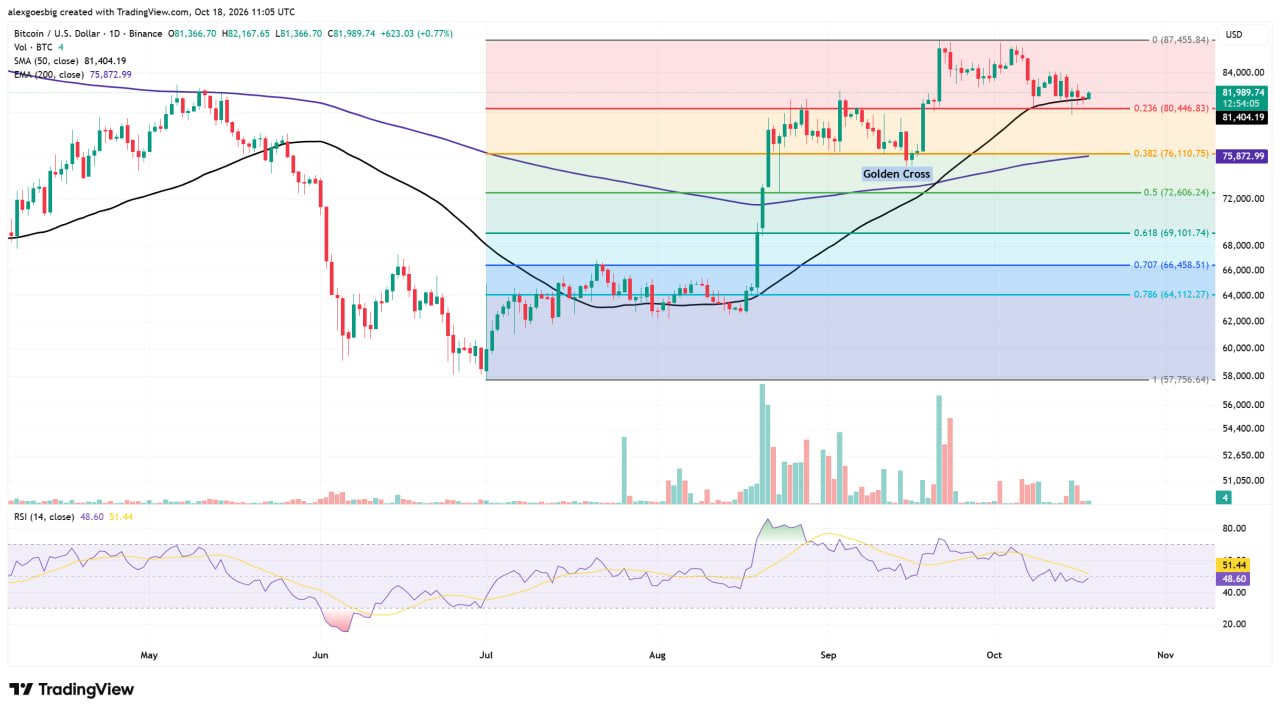
$BTC/USD daily chart. Source: Alexander Stefanov / TradingView
The run from the July low to the late-September high of $87,456 added about $29,700, or 51%, in 86 days, and the trend on the daily chart still points up. The 50-day moving average sits at $81,406, well above the 200-day at $75,874, and the 200-day itself has turned higher after falling through most of the summer. Momentum tells a weaker story. October produced two highs near $87,000-$87,400, every rebound since then has topped out lower, and the last one stalled near $85,000.
The Relative Strength Index (RSI) has slipped to 49, back to the neutral midpoint after topping above 80 during the August breakout. The September price high came with a clearly lower RSI reading, a mismatch that usually warns buyers are losing force, and the choppy October trading followed from it. Volume has also thinned out, so sellers lack conviction, but so do the bounces. One recent candle dipped to about $79,500 and closed back above $80,447, which shows buyers have already defended this zone once.
Levels based on the daily $BTC/USD chart.
A daily close below $80,400 would break the trend for the first time since the golden cross and make the $76,000 area the likely next stop, since that is where the strongest overlap of support on the chart sits. Further down, $72,600 marks the base of the big August breakout candles.
McGlone still sees $10,000
Mike McGlone, senior commodity strategist at Bloomberg Intelligence, still sees a possible slide toward $10,000 if US stocks go through a major correction. Ki Young Ju, chief executive of on-chain analytics firm CryptoQuant, rejected that scenario and argued that spot ETF demand and the Bitcoin held on corporate balance sheets support a substantially higher floor. Fidelity’s Q4 outlook sits between the two camps. It highlighted the late-August rally, which included a weekly gain of more than 25%, and suggested the quiet stretch before it may have reflected exhausted selling, while warning that the rebound did not guarantee the bear market was over.
A Bitcoin $10,000 Reversion Path Could Trigger Tumbling Dominoes
The first-born crypto led the way up for risk assets since 2009, but Bitcoin’s peak above $100,000 in 2025, gold’s rise above $5,000 in 1Q and most central banks shifting to restraint alongside surging government… pic.twitter.com/91NGRU2Kj6
— Mike McGlone (@mikemcglone11) October 16, 2026
Fidelity’s November date looms
For now, Bitcoin looks most likely to trade between $80,000 and $85,000 while the RSI resets, with the rising 50-day average narrowing the room underneath. A hold of that average followed by a move above $85,000 on stronger volume would set up another run at $87,456. The more telling test may come from the calendar, since November is the month Fidelity’s own cycle research flags for a possible bottom. If Bitcoin stays above the July low and its power-law floor through that window, Timmer’s view that the bear market ended early would have survived the period most likely to disprove it.
Global M2 combines cash, checking accounts and savings deposits across the largest economies, including the US, the eurozone, China and Japan, converted into US dollars.
Fast Money Growth Has Not Meant Big Gains
When global money grew more than 5% a year, Bitcoin was a median 6% higher one year later and rose in only half of those weeks.
When growth was slower, the median one-year gain was about 85%.
Money growth peaked above 20% in spring 2021, and Bitcoin topped later that year.
The Signal That Worked
Comparing money growth with its pace three months earlier produced a clearer pattern. When growth was accelerating, Bitcoin was higher three months later in about 70% of cases, with a median gain near 20%. When growth was slowing, $BTC rose only four times in ten, with a small median loss. The pattern held from 2014 to 2019 and again from 2020 onward.
This year’s results are mixed. The signal was positive from November to March, yet Bitcoin fell from about $106,000 to $71,000. It turned negative in late March, ahead of the early-July low near $59,000, and flipped positive in mid-August with $BTC near $63,000. The price has gained almost 30% since.
Why The Current Reading Looks Fragile
Annual money growth has eased from about 8% to 7% since late August.
Global M2 has slipped almost 1% since its early-September peak.
A 2.5% jump in the first week of August, one of the two largest weekly moves since 2014, is the only reason the signal is still positive.
The dollar index has risen about 3% since early September, which shrinks the dollar value of euro and yuan balances.
The research ties part of the dollar’s strength to a September Federal Reserve rate hike to 3.75% to 4%, described as the first since 2023. The Fed’s balance sheet has grown by about $220 billion since December. If money growth holds near 7%, the signal is projected to turn negative around mid-November.
Bitcoin Price Levels To Watch
Micro support: $80,371 to $81,638, which held through the weekend
Resistance: $82,400, then $84,134
Deeper support: the 50-week simple moving average near $76,800
The near-term outlook points to lower or sideways trading, with room for a brief bounce. A bullish long-term scenario projects a $165,000 to $300,000 zone. The leading scenario, however, treats the July rally as a counter-trend bounce within a broader correction.
Some major perpetuals, most linked to AI stocks and semiconductor businesses, dropped hard on Saturday evening/Sunday morning, including SOXL (-5.45%), SNDK (-3.6%), MU (-3.42%), and others. Most losses were quickly erased, with markets rebounding from this flash crash, but millions of dollars worth of leveraged positions were already liquidated.
Something similar transpired in the crypto markets, with BTC dropping by a grand before rebounding by $1,200, and ETH tanking from $2,420 to $2,360, and back to $2,410. Many analysts caught these moves and questioned whether this was just a weekend shakeout or a warning before “Black Monday.”
BREAKING: Something very WEIRD just happened.
Bitcoin and Ethereum suddenly dumped, while major AI stock perpetuals plunged 5% within SECONDS, then quickly bounced.
No obvious news. U.S. stock markets closed.
With onchain trading running 24/7, there’s no rest anymore.
A weekend shakeout… or a warning before BLACK MONDAY?
— Crypto Rover (@cryptorover) October 18, 2026
Calls for such a “Black Monday” development have skyrocketed over the weekend after the painful end to the previous business week. However, the Kobeissi Letter believes such expectations typically lead to the opposite move and predicted the S&P 500 could soon hit a new all-time high of 8,000 if “history is any guide.”
You may also like:
The S&P 500 Is Near Record Highs: But Most Stocks Are Already in a Bear Market
Bitcoin Under Pressure as Trump Reportedly Prepares to Strike Iran Within 24 Hours
This Bitcoin Cycle Theory Puts $350K in Focus Before the Next Crash
Ukraine Hits Russia
Although they might not be directly related, these price moves coincided with the latest escalation in the war between Russia and Ukraine. This time, the latter struck the St. Petersburg oil port and “set it ablaze,” according to reports on circulating videos online.
The two sides had reached an agreement earlier this week to refrain from hitting each other’s energy centers, which was reportedly violated by Russia. Ukraine’s President Zelenskyy said his country will restart attacking Russian energy sites.